

While it is perhaps less true than it used to be, for decades many Westerners took it as if the Arab-Israeli, or Arab-Palestinian, conflict was THE matter of war and peace in the Middle East. That was never really true.
Israel got (and gets) a lot of attention because it is a Western-style democracy, with the openness and sense of familiarity that involves. It is the only such Western-style democracy stuck in a region of continental anarchy, which has led to all sorts of jarring with the sensibilities of the mercantile maritime order most Western democracies are deeply embedded in. Sensibilities that are epitomised by the fable of international “law”.
The best single lecture to understand the evolution and nature of the current world order.
Many Arab regimes were only too happy to encourage a focus on Israel and its sins (real and imagined). Such regimes for decades ran a sort of geopolitical shell game with their people—we won’t provide freedom, political participation or much in the way of economic development, but we will confront the Zionist Entity. The Islamic Republic of Iran epitomises this in extravagant style.
The Palestinians have entirely lived off confronting the Zionist Entity. That of all the C20th population movements, they were the only ones not taken in (with the partial exception of Jordan) as citizens by their ethno-religious confreres—being kept as stateless sticks to beat the Zionist Entity with—was not something it served the Palestinian leadership to draw attention to. That they had their very own UN body—UNRWA—which maintains their status as the world’s only hereditary refugees, and pays them hundreds of millions of dollars a year to never make peace with Israel, just reinforces the point. They literally live off confronting the Zionist Entity.
If they make peace with Israel, they stop being hereditary refugees, and the money stops. Hence they insist on the right of return—the basis of them being hereditary refugees—which Israel will never agree to. The late Charlie Munger’s point of show me the incentives and I will show you the outcome strikes again.
If one looks at the numbers of fatalities, the Arab-Israeli/Israeli-Palestinian conflict is not even close to the deadliest conflict in the postwar Middle East.
The Iran-Iraq War of 1980-8—with its death toll in the vicinity of 500,000 dead—remains by far the deadliest inter-state conflict in the Middle East since 1945.
The Lebanese Civil War of 1975-1990—with a death toll of 120,000-150,000—was largely triggered by the political and social dynamics generated by Palestinians being hereditary refugees.
The Algerian Civil War of 1992-2002—with its death toll in the vicinity of 150,000—killed more people than all the conflicts with Israel up to the Gaza War.
The Yemeni Civil War of 2014 to present—with its death toll of at least 150,000 from violence, though famine and other indirect deaths may push the death toll to around 380,000—is the latest, and worst, bout of Yemeni internal violence. (Yes, that the same number keeps recurring does suggest that casualty estimates are very much estimates.)
The anti-Taliban War in Afghanistan of 2001-2021—with a death toll of around 180-212,000—was a remarkably restrained insurgency conflict, given civilian deaths are estimated around 46,000.
The Iraq War of 2003-2011 has highly disputed casualty counts, but ranges of 105-150,000 deaths would put it in a similar level as other Middle Eastern conflicts.
The Iraq War of 2013-2017 against The Islamic State may have killed around 218,000 including 67,000 civilians. Taking the Costs of War Project estimates up to 2018 of up 295,000 deaths would make the two wars combined one of the deadlier conflicts in the region since 1945.
The Syrian Civil War of 2011-2024—with its death toll of around 670,000—managed to be the deadliest conflict in the region since 1945.
The casualties from the various interstate wars with Israel have been relatively light, as the wars have mostly been brief and not fought in urban areas. The estimated total casualties from the Israel-Palestinian conflicts before the Gaza War that began on October 7 2023 (so, 1920-2023), was around 10,000 Jews/Israelis and around 30,000 Palestinians. The casualties from the interstate wars with Israel since 1947 push the numbers up to around 80,000 deaths.
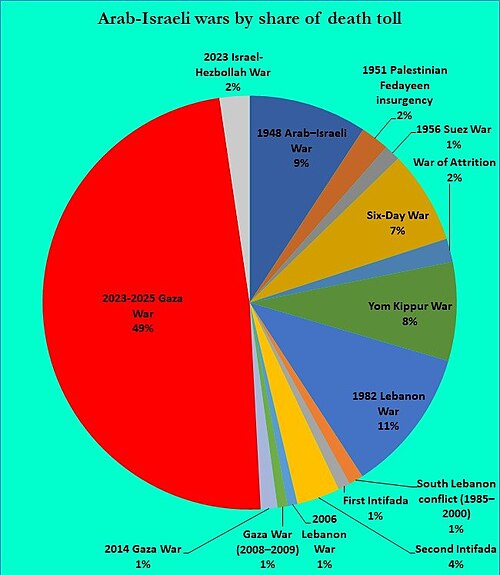
Nevertheless, in terms of death toll, Israel’s conflicts prior to the Gazan War have been a lesser conflict by the standards of the region, despite extending across decades and consuming huge amounts of media attention. The Islamic Regime of Iran may have managed to kill about the same number of its own people in a few days in putting down the recent nationwide protests as had the specifically Israel-Palestinian conflicts prior to October 7 2023.
Gazan Trap
The Gaza War has around doubled the numbers of violent deaths from the conflicts with Israel. Months of urban warfare where the civilian population could not escape will do that. For comparison, the 2016-2017 Battle of Mosul had much lower civilians deaths, because civilians could escape.
The civilian population was blocked from leaving Gaza by Egypt. Like other Arab countries (other than Jordan), Egypt refuses to accept Palestinian refugees. Indeed, like other Arab countries (other than Jordan and Lebanon), Egypt refuses to accept Arab refugees, period.
If the civilian population cannot escape, then urban warfare will kill civilians. The entire point of the Hamas strategy of taking all those hostages and hiding them and its military forces—but not Palestinian civilians—in the tunnel network it spent huge sums creating was to use Palestinian civilians as human shields. The more Palestinian civilians who are killed, the better for Hamas’s strategy—both to delegitimise the Zionist Entity and to sabotage Israel’s diplomatic normalisation within the region.
Hezbollah uses the same strategy of civilians as human shields in Southern Lebanon. The Islamic Regime in Iran also uses a version of this human shield strategy.
Anarchistic Regime
The Islamic Regime shoots thousands of missiles and drones at Israel and kills barely any Israelis, not only because of the Israeli air defences—including, famously, the Iron Dome—but also because Israel provides its civilians with very extensive bomb shelters. The Islamic Regime does not provide such shelters for its civilians because Iranian civilians killed by Israeli (or US) strikes are a propaganda win for the Islamic Regime. The Islamic Regime has repeatedly shown it will sacrifice any aspect of the interests of the Iranian people for its ideology, and for the corrupt benefit of the institutions (primarily the Islamic Revolutionary Guard Corps, IRGC) that exist to prosecute its ideology.
It is actually telling that it is the Islamic Revolutionary Guard Corps, not the Iranian Revolutionary Guard Corps.
On the subject of that ideology, the Islamic Regime has created/supported a series of proxies that have violently destabilised the region in the interests of prosecuting its ideology. Since 1979, the Islamic Regime has been the prime factor making the Middle East a realm of continental anarchy, where degrading and vassalising neighbours is the path to geopolitical “success”.
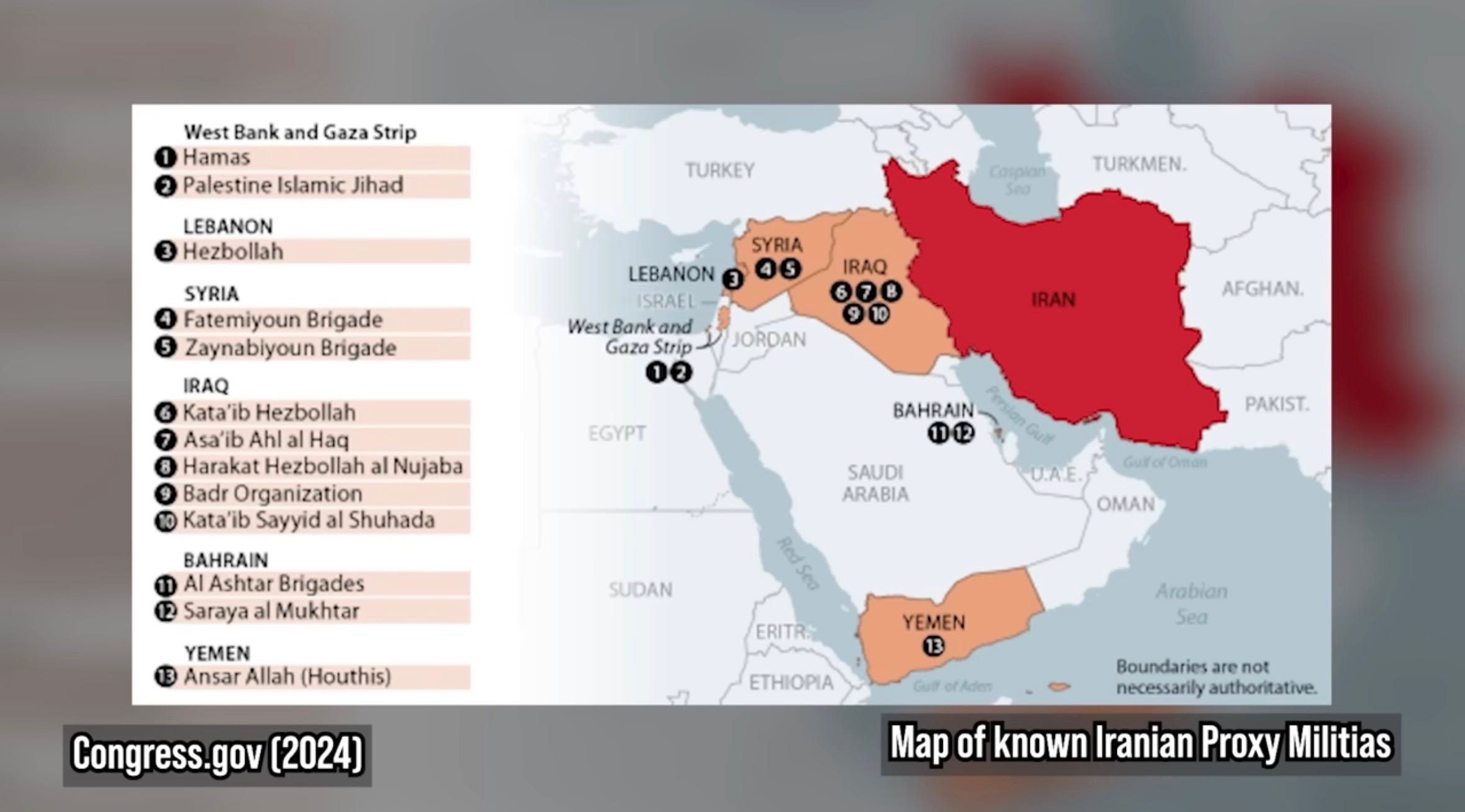
Consider that series of conflicts listed above: again and again, the Islamic Regime and its proxies are deeply involved in the violence. You add up all the Muslims killed in the Islamic Regime’s wars—either by its own forces, or its funded and armed proxies and allies—and it is quite clear that the Islamic Regime plus proxies plus allies have been the champions at killing Muslims since 1979.
The Islamic Regime is not a “normal” regime. It is not such either ideologically or structurally. We have decades of the performance of that regime, and its proxies and allies, to see that. If the Middle East is to shift from being a region of continental anarchy to being much more thoroughly part of the mercantile maritime order of “win-win” interactions, then the Islamic Regime in Iran—it is less and less of Iran—has to be overthrown or thoroughly neutered.
Maritime order
The waterways of the world—about 80 per cent of world trade flows by water—are dominated by oceans and seas. They in turn have been dominated by an Atlanticist maritime order that began with the Iberian conquests in the Americas, Portuguese domination of the Indian Ocean and the Spanish conquest of the Philippines.
That Atlanticist order, which is thoroughly global, is now half a millennium old. Its most recent manifestation is the US Maritime Hegemony, that is sustained by the greatest alliance network in history.
There are regimes which resist that US-led maritime order. Those regimes have nothing in common apart from the way they oppress their own people for their own—typically deeply kleptocratic—benefit. They have that in common, as that maritime order is the basis of the unprecedented mass prosperity of our age.
If those regimes were genuinely focused on the well-being of their own people, they would be broadly supporting that maritime order, even if they might seek to renegotiate parts of it. Iran is the most grotesque example of sacrificing the well-being of their own people to the interests and obsessions of the ruling regime. It is also the most actively and violently disruptive of the continental anarchy regimes. Unfortunately for it, it is also the militarily weakest of these regimes.
The regime with the most ambivalent attitude to the maritime order is CCP China. Post-1978 China has become by far the biggest beneficiary of the maritime order. Yet the CCP’s ambitions to re-unite with Taiwan represent the most dangerous point of potential conflict for that order, while the CCP very much seeks to control its citizens interactions with that order. As a Xi Jinping-led CCP seeks to emphasise CCP control over economic and other considerations, its relationship with the mercantile-maritime order is likely to become more ambivalent rather than less.
The Atlanticist maritime order began to be built around 1500. It is still with us. It has become an overwhelmingly positive thing for the prosperity—past, present and future—of the peoples of the world.
[From 1500 to the Napoleonic Wars, there were major wars between maritime Powers. From the Napoleonic Wars to the present, major wars involving maritime Powers have typically been against continental anarchy Powers. The Iran War of 2026 is very much a case of this.]
Most of the Middle Eastern states want to integrate into that maritime order more, not less. Hence proposals such as IMEC—the India-Middle East-Europe Economic Corridor.
The Iran war—which is the first war that Israel has fought with the US, as well as the first war Israel has fought alongside Arab countries—is not a “distraction” war. It is not about Epstein, or Israel, or Bibi’s legal problems. It is the Atlanticist maritime order asserting itself against a disruptive regime almost everyone else in its region is completely over and which is now attacking all its Arab neighbours, hoping to raise the cost of the war beyond what the US will endure.
Ignore all those who analyse it through their (ultimately childish) political obsessions. Look at it through the prism of history.
All those who wished for a multi-polar world order that was less US-dominated? Congratulations, you have the results of a more contested world order—more violence, not less.
It is fascinating how rich in symbolism the Palestinians and Free Palestine! have become. Palestine is not only the cause du jour but what almost every angry, deracinated Western child screeches when performing any act of rage or rebellion—whether the pretext is anti-ICE, pro-Trans, something to do w Trump or climate change etc, the Palestinians are always there, always praised and chanted, their flag always waving. (I guess the Palestinians have replaced and consolidated everything from Che posters and shirts to Mao's Little Red Book and the Hammer & Sickle—they are the must-have item for the radical poser.)
But post-10/7 it seems that not only have the actual Palestinian people been completely severed from the Palestinian Cause, but they work in inverse now: the more the people suffer and die, the more futile their devotion to violence, the more their territory is reduced to rubble, the stronger the Cause grows, the richer the symbol becomes.
The Free Palestine! cult has crafted a mythical creature called "The Palestinians", who's become a proxy Christ, our sacred victim (killed again by Jews) who dies constantly for our sins and becomes the center of the Western liberal moral universe, as the mythical "Palestinian" bears all the weight of Christian guilt (the most abject is the most sacred) with his struggle reframed in Marxist dynamics (also post-Christian) where Oppressed/Oppressor supplant Saved/Damned and where, in order to be considered Good and Saved, one must devote their life to the worship and adoration of the mythical "Palestinian", who will be reborn in triumph if we can free him from the evil Jews, who worship an ancient vengeful deity that has no place in any modern dispensation, whether Marxist, liberal or Christian.
Free Palestine! seems to have combined religious eschatology with Marxist eschatology and political martyrdom with religious martyrdom and now has become entirely vampiric—it needs and craves Arab and Jewish blood for its survival. (It also helps greatly that most Westerners 1) know very little about this complicated conflict and its long history; and 2) that they live far away in safe, prosperous countries while other people do the bleeding and dying.)
But at root, I think, we're just living through another upsurge of Jew hate based on the fact of their stubborn particularism, which always leads to them being slated for destruction by whatever new universalism rears its head: Christianity, Marxism/Communism, Social Justice, the global corporate state, the Ummah—all their utopias demand the eradication of the ultimate undigestable lump, the Jews.
This is one of the many reasons why Jews drive people crazy. They insist upon existing when so many others need them to be erased.
Extraordinarily insightful. I can find this level of insight nowhere else.