

This is a response to this blog post, which I was not able to provide a comment on directly. It is one of a series of blog posts arguing that racism explains the (much) higher levels of African-American violent crime compared to other groups in the US.
Much of the commentary on crime—especially in the US—fails to grapple with the dynamics of violent crime having two conspicuous features:
It varies hugely by locality.
It is very much a tail/power law effect.
That is, a tiny minority (overwhelmingly male) generates the majority of violent crime and a small minority—also, but not quite as much, overwhelmingly male—generates all the violent crime.
The variation by locality is very well explored in Jens Ludwig’s excellent study Unforgiving Places: The Unexpected Origins of American Gun Violence, which I review here.
The most complete paper I am aware of how much violent crime is a tail effect is: O¨rjan Falk, Ma¨rta Wallinius, Sebastian Lundstro¨m, Thomas Frisell, Henrik Anckarsa¨ter, No´ra Kerekes, ‘The 1% of the population accountable for 63% of all violent crime convictions,’ Social Psychiatry & Psychiatric Epidemiology, 2014, 49, 559–571. https://pmc.ncbi.nlm.nih.gov/articles/PMC3969807/
Males dominate violent crime because they are physically stronger and the “Bell” curves of male traits are flatter—in particular, the reactively (physically) aggressive “tail” is much larger among males than females. Reactive aggression is aggression “in the moment” rather than proactive aggression, which is intended aggression: including aggression coordinated in advance.
On the difference between reactive and proactive aggression see: Richard W. Wrangham, ‘Two types of aggression in human evolution,’ PNAS January 9, 2018, Vol.115, No.2, 245–253. https://www.pnas.org/doi/10.1073/pnas.1713611115
Reactive aggression dominates violent crime. This includes homicide. Around 75-80% of homicides in the US are not premeditated—i.e., are not proactive aggression—but the result of reactive aggression. This is why the dynamics of locality are so important, because different localities present very different threat profiles. Effective policing can greatly reduce the level of violence by interrupting the spiral of violence and reducing the threat profile of a locality.
As for the nature v. nurture, genes v. environment question for explaining the dynamics of violent crime, the answer is the same as for all social dynamics: yes—i.e., both.
In every jurisdiction (e.g. Scandinavia) where there is an East Asian diaspora and a Sub-Saharan African diaspora, the former have a lower—generally much lower—rate of violent crime than the latter. This cannot be explained by the dynamics of American race relations.
For why East Asians have lower rates of reactive aggression, see David Sun, ‘Arctic instincts? The Late Pleistocene Arctic origins of East Asian psychology,’ Evolutionary Behavioral Sciences, Online First Publication, March 3, 2025. https://psycnet.apa.org/fulltext/2025-88410-001.html
(Note, this is only reactive aggression: East Asian—especially Chinese—history includes periods of horrifying levels of proactive aggression.)

Even so, precisely because causation is both genetic and social, jurisdictions can have wildly different homicide rates because they have different dynamics of locality and different levels of effective policing. For instance, there was surge in urban homicides in the US particularly among African-Americans after 2014 Ferguson and 2020 George Floyd riots: not because racism increased, but because police retreated in the face of anti-police activism.
As fewer spirals of violence were interrupted by police, and as the threat profile of localities therefore worsened, the number of homicides increased—dramatically in the aftermath of the George Floyd riots and BLM anti-police activism. It turned out that black lives mattered a lot less than performative politics, congenial Theory and activist grifting.
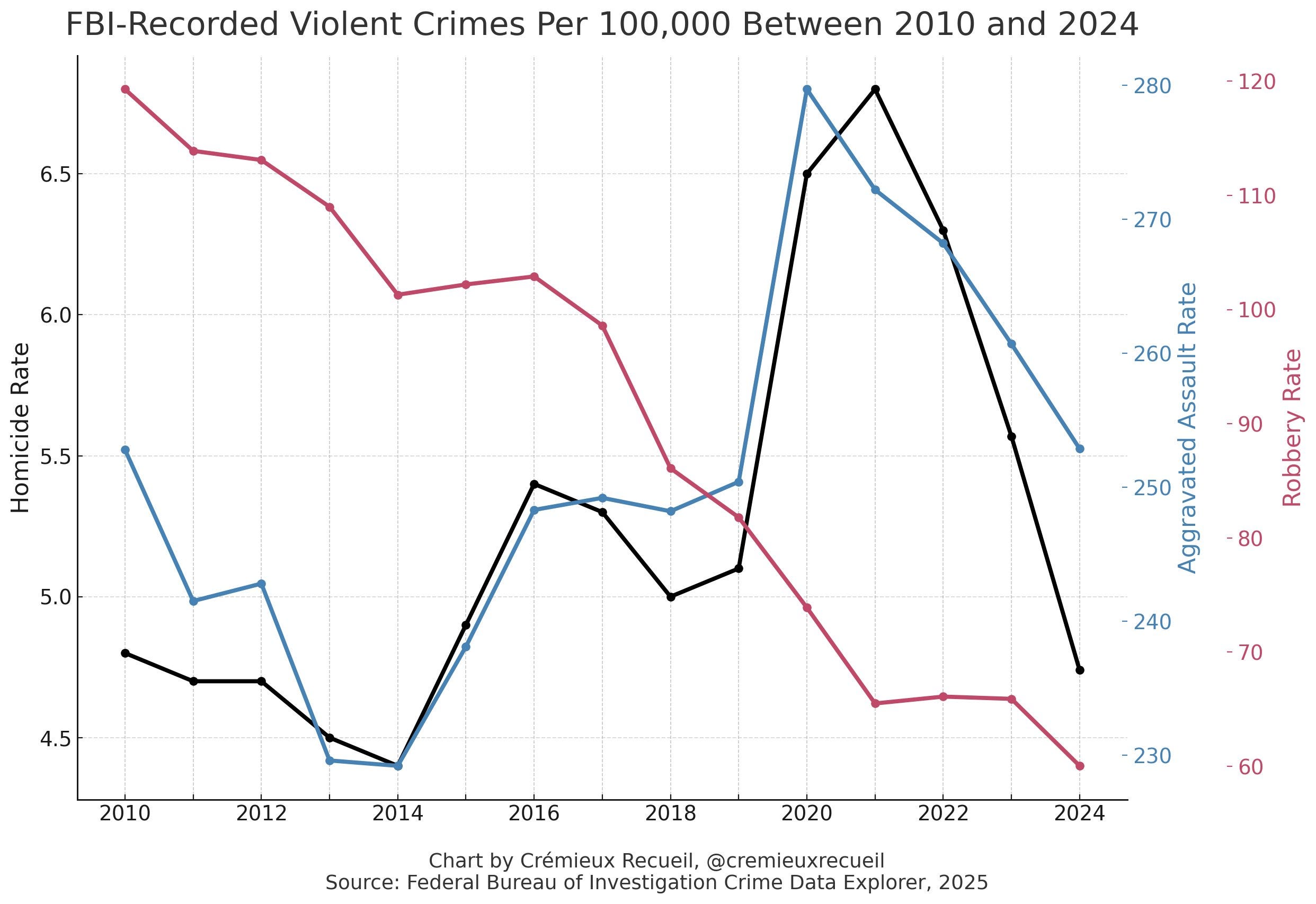
Sub-Saharan African ancestry populations have larger highly reactively-aggressive tails due to ancestral selection dynamics. Is this a soluble problem? Yes. It requires much more attention to the social dynamics of locality and effective policing, but it can be mostly dealt with.
A large part of the problem in the US is that the US is dramatically under-policed, as measured by police per homicide.


Unfortunately, the (accurate) stereotype of higher African-American violence is used to excuse the under-provision of policing services—including detectives and forensic services but also just not having enough police on the beat and having appallingly low homicide clearance rates in various localities.
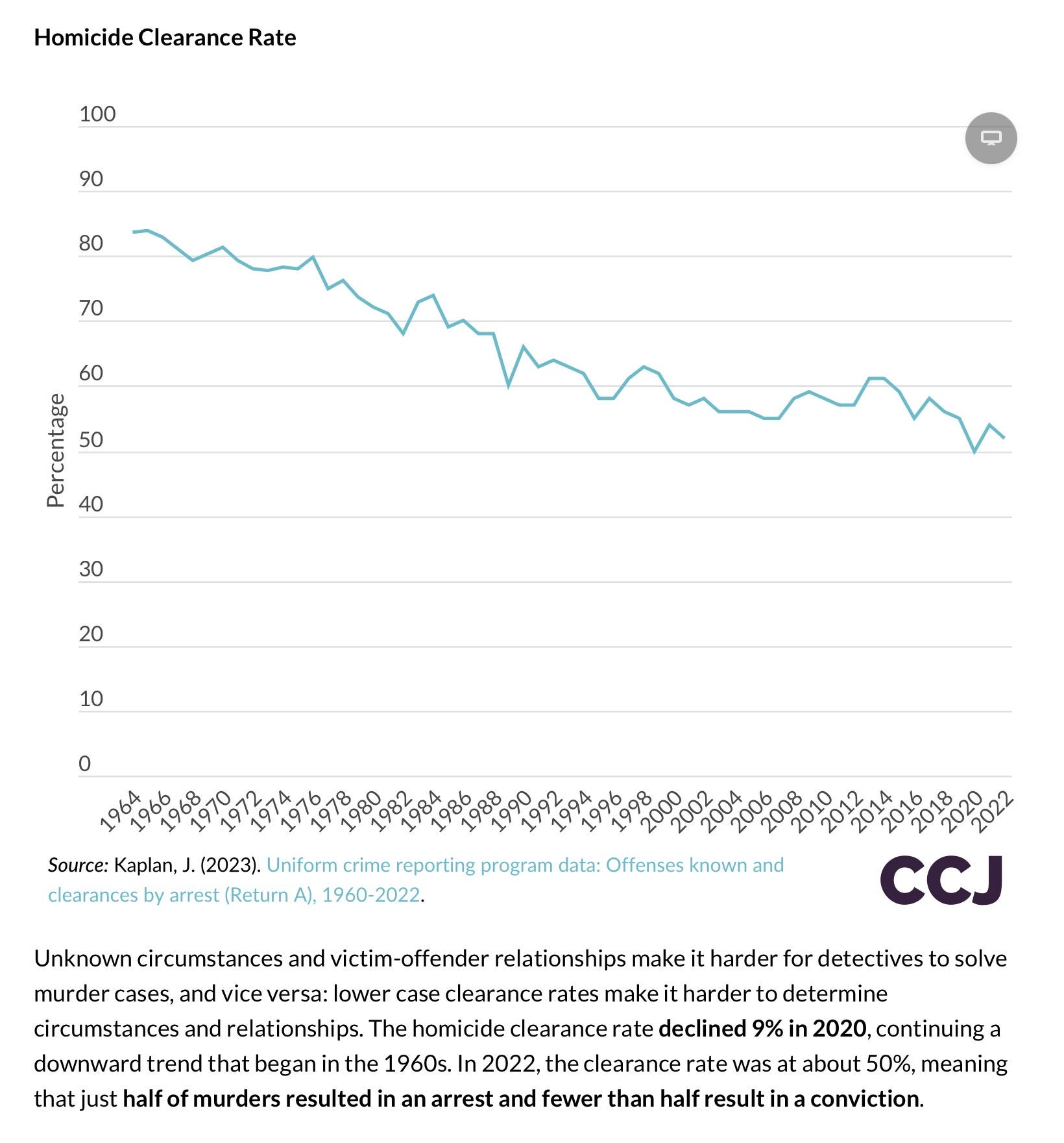
This systematic under-provision of effective policing in African-American communities has been a pattern in the US since the Civil War, though how much so has waxed and waned and varied by State. This is the kernel of truth in “structural racism” analyses, even though—as is typical of so much contemporary academic Theory—mountains of bullshit have been constructed on top of that kernel of truth.
The argument that genetic causes are in play does not rely on identifying specific genetic mechanisms, merely differences in distribution of traits. As violent crime is such a power-law phenomenon (a tiny minority dominates effects), the only causes that can be operative are those that (1) generate a larger—overwhelmingly male—highly physically reactively aggressive “tail” in a population (i.e., genetics) and/or (2) either lead to, or interrupt, spirals of violence (i.e., socio-physical dynamics and level of effective policing). A general phenomenon, such as “racism”, does not explain much unless it feeds into those causal patterns—for example, by an (accurate) stereotype of higher levels of violence providing “cover” for the under-provision of effective policing services.
Any analysis of crime has to grapple with how much it varies by locality and how much it is a tail/power law effect.
Everything social is emergent from the biological. Our genes both constrain and enable us.
So much of the so-called “social sciences” are social pseudo-sciences, for they fail to grapple with our evolved nature; with our genetic variety, including different distributions of traits in various human populations. They are not consilient with what we know from evolutionary biology and evolutionary anthropology.
For a useful discussion of such failures see: Herbert Gintis, Carel van Schaik, and Christopher Boehm, ‘Zoon Politikon: The Evolutionary Origins of Human Political Systems’, Current Anthropology, Volume 56, Number 3, June 2015, 327-353. https://pubmed.ncbi.nlm.nih.gov/29581024/
A much more hopeful implication of both genetic and social causes operating is that even disproportionate tendencies to reactive aggression is largely a soluble problem. Public policy is not helpless in the face of there being genetic causes, as they are also social ones. Effective policy does, however, need to be based on an accurate understanding of the causes, not fantasy stories about “racism” explaining all.
It also means that any presumption that all groups will have identical social outcomes is ludicrous, anti-scientific, nonsense. Since it is nonsense, any attempt to judge public policy on the basis of whether groups have identical social outcomes will be dysfunctional.
Alas, this can be a social selection advantage. That guaranteed lack of success can justify claims to moral authority and to resources indefinitely, as the deemed “proper” outcome will never be achieved. Considerable social dysfunction is, however, highly likely to be generated on the way through, with the post-Ferguson and post-George Floyd surges in homicides being particularly grotesque examples of such.
Too often, even the increased social dysfunction can then just be “doubled down” on by social actors insulated from such dysfunction but committed to the animating “adhering to this makes you a Good Person” social narratives. The combination of insulation from consequences with the returns—both personal and institutional—to selling such social narratives is why, for example, public broadcasting has become increasingly dysfunctional and much of academe even more so.
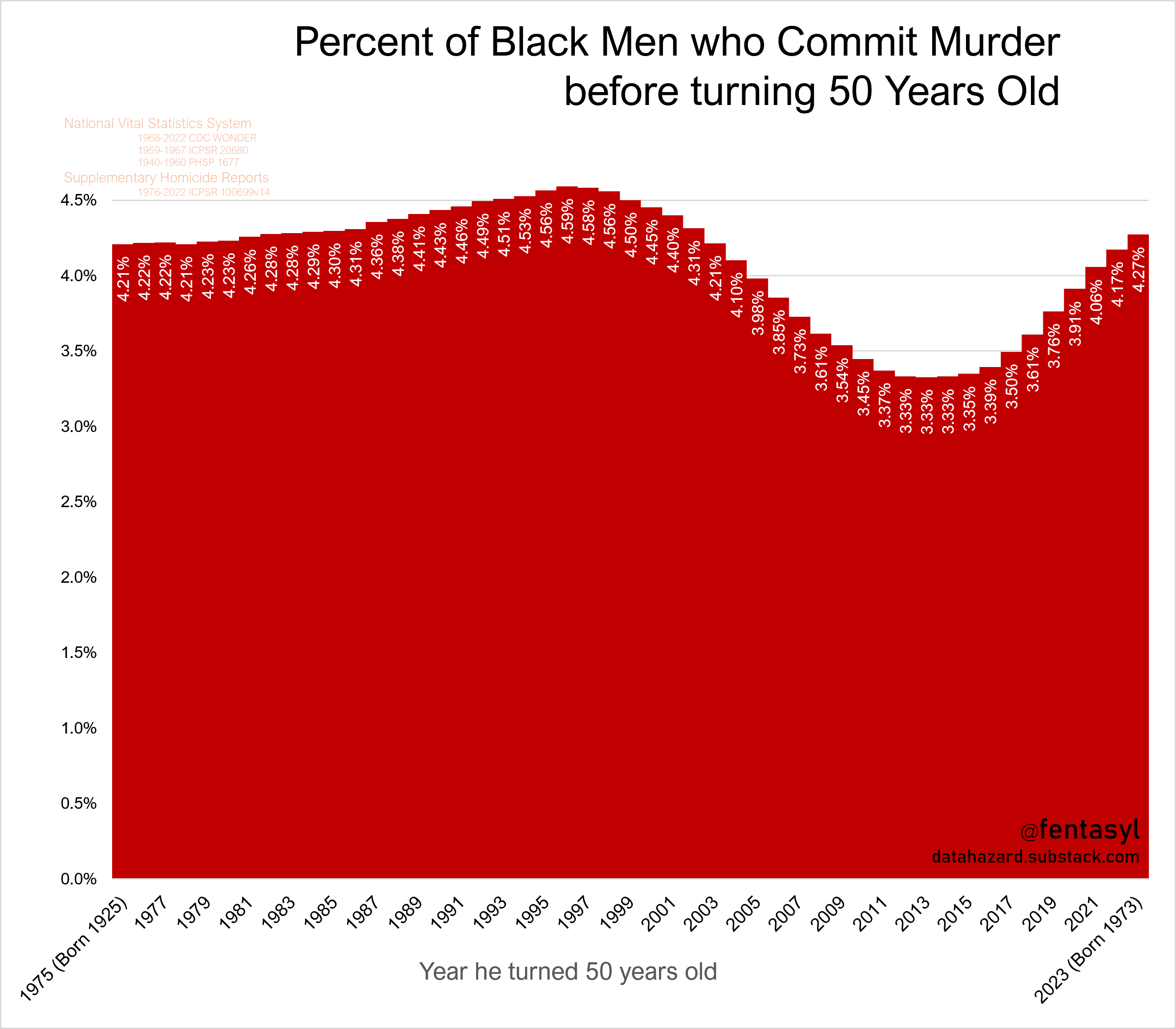
So, yes, there are genetic reasons why African-Americans have higher rates of violent crime, but these still only pertain to a tiny minority of African-Americans: a tiny minority which, for both genetic and social reasons, is much larger than among other groups. Thus, public policy is far from helpless in the face of this reality. Though, of course, policy makers can implicitly or explicitly pretend to be so, providing cover for their own failures.
It also means that any presumption that all groups will have identical social outcomes is ludicrous, anti-scientific, nonsense. Since it is nonsense, any attempt to judge public policy on the basis of whether groups have identical social outcomes will be dysfunctional.--LW.
For generations, auto insurance companies in the US have charged higher rates for men, especially young men. No one blinks an eye.
I don’t think any serious thinkers are buying the “systemic racism” causal explanation anymore. It’s been too long. Too much has happened. We have too much data.
At some point you just need to admit that your socially desirable, institutionally convenient account is wrong. And then you need to start asking real questions…
https://jmpolemic.substack.com/p/white-supremacy