

Winston Churchill was Chancellor of the Exchequer from 1924-1929. As Chancellor, he put the UK pound back on the gold-standard at the 1914 gold-pound exchange rate. He announced this on 28 April 1925.
This was a disastrously bad decision. The argument for going back at the 1914 rate was to preserve the UK pound’s value as a medium of account: meaning that, prices and debts were expressed in pounds and were paid in pounds.
Going back on the gold standard turned gold into the medium of account for what was still the world’s premier reserve currency, mediated by (and denominated in) pound notes. UK bonds would thus have the same value as they did in 1914, when the UK left the gold standard so it could finance its war expenditure.
The bonds would have the same value provided the UK Government could continue to service the interest owed. There are some complications here regarding bond yields, but the intent and reasoning was clear. Government bonds were a promise, and the UK Government was keeping its promise.
The lower the risk on bonds, the lower the interest rate, the cheaper (in pounds) bonds were to service and the easier to sell new bonds as “risk-free assets”. As UK bonds were denominated in UK pounds, the value of the pound made a difference to the value of the bonds. Hence, the decision to go back on the gold standard at the 1914 rate was focused on the UK pound as the medium of account for UK bonds.
So, if the logic is clear, why was going back on gold on the 1914 rate such a bad decision? Because a lot more pounds had been printed since 1914 than the UK had gold to support at the 1914 exchange rate. (This increased printing of pounds was the point of going off the gold standard in the first place.)
In terms of output, of goods and services, a pound in 1925 bought considerably less than it did in 1914. This meant that, at the 1914 exchange-rate with gold, the pound was significantly overvalued. Gold bought more outside the UK. The consequence was obvious: gold tended to flow out of the UK, putting the pound under more stress.
The solution to the pound being overvalued—it did not buy enough goods and services, enough output, to support its exchange-rate with gold—was to have the pound increase in value in goods and services, in output-value. [For prices in pounds to express the value of gold as the medium of account.]
Money increasing in output-value has a name: we call it deflation, or falling prices, as each pound or dollar or whatever buys more and more goods and services. (Just as money decreasing in output-value is inflation, or rising prices, as each pound or dollar or whatever buys less and less goods and services.)
So, putting the pound back on the gold standard at the 1914 rate imposed serious deflation on the UK economy. Prices fell, so incomes fell, while debts increased in output-value. This all put downward pressure on wages. The 1926 General Strike was a direct consequence of putting the UK pound back on the gold standard at the 1914 rate.
All this made the UK economy smaller than it otherwise would have been, increasing the burden of the public debt. It also tended to bleed confidence out of British society, prolonging the effects of the trauma of the 1914-1918 Great War. (You may not be interested in Economics, but Economics is interested in you.)
The roles of money
The classic analysis of money is that it is a unit of account (what prices and obligations are set in), a medium of exchange and a store of value. The store-of-value role is the least important role of money. We can tell that, because people still use money during hyperinflation episodes when money is, by orders of magnitude, the worst asset, the worst store-of-value, in the economy.
People’s expectations about the future value of money do, however, matter a lot. Precisely because a hyper-inflating currency is such an awful store-of-value, people unload it as quickly as possible. This creates a hyperinflation spiral, where the speed at which money travels between transactors heads towards infinity and the output-value of the currency heads towards zero.
Conversely, if people have strong expectations that money will increase in output-value, they will tend to hold onto it, so transact less, so incomes fall, so production falls, so prices fall, so money increases in output-value, increasing the incentive to hold onto it. Debts increase in output-value while incomes fall, so bankruptcies multiply. All this creates a debt-deflation spiral where transactions fall dramatically, so output heads downwards as the output-value of money heads upwards.
The fact that there is a certain level of consumption people are going to do regardless puts something of a limit on the deflation spiral. Also, money constantly increasing in value creates an increasing incentive to inject money into the system. In the case of the gold standard, to either find new sources of gold (what cured the 1890s Depression) or to take the currency off the gold standard (what cured the 1930s Depression).1
The less store-of-value risk there is in money, the more money becomes a potential safe haven for wealth if there is some increase in risk.2 Hence, if a central bank credibly protects the output-value of money—for instance, by generating expectations of low and stable rates of inflation—but does not credibly generate expectations of stable levels of total spending (so incomes) in the economy, then a sudden increase in risk can lead to a flight to cash (and other “safe”) assets, so a crash in transactions.

Why did the US and other developed economies experience the Great Recession after the Global Financial Crisis (GFC), but Australia experienced neither? Because Australian prudential regulation protected from it from the GFC and the Reserve Bank’s monetary policy generated strong expectations of stable levels of total spending in the Australian economy, which almost none of the other Western central banks did for their economies. In those economies, there was a flight to cash (particularly US dollars) and other “safe” assets and so a crash in transactions aka the Great Recession.
Transaction good
But money is a store of value because it can be used in future transactions. This is why expectations about its future value matters so much.
Holding money is using it as an asset. Using money in transactions is using it as a medium of exchange. The term medium of exchange is a usage I particularly dislike, because it helps mystify money.
I much prefer to call money a transaction good, because that focuses on what money primarily does: it reduces transaction costs (particularly search and information costs). It does so massively. That is why people continue to use money even during hyperinflation episodes when money is, by orders of magnitude, the worst store-of-value asset in the economy.
Calling money a transaction good also helps think about money in terms of supply and demand. Any analysis in terms of supply and demand has to define the scope of the commodity—i.e. supply of what, demand for what. If money is being held as an asset, it is not being used as a transaction good. Therefore, money held as an asset is not included in the supply of money being used as a transaction good.
Expectations about the future value of money hugely affect people’s willingness to use money in transactions, so its supply as a transaction good. But no analysis of money that conflates its use as an asset with its use as a transaction good is going to be a good analysis of money.
Thus, any quantity theory of money that aggregates together money being used in transactions—so, as a transaction good—with money being held as an asset is going to be wrong. Calling money a transaction good makes the importance of avoiding such conflation of the uses of money clearer.
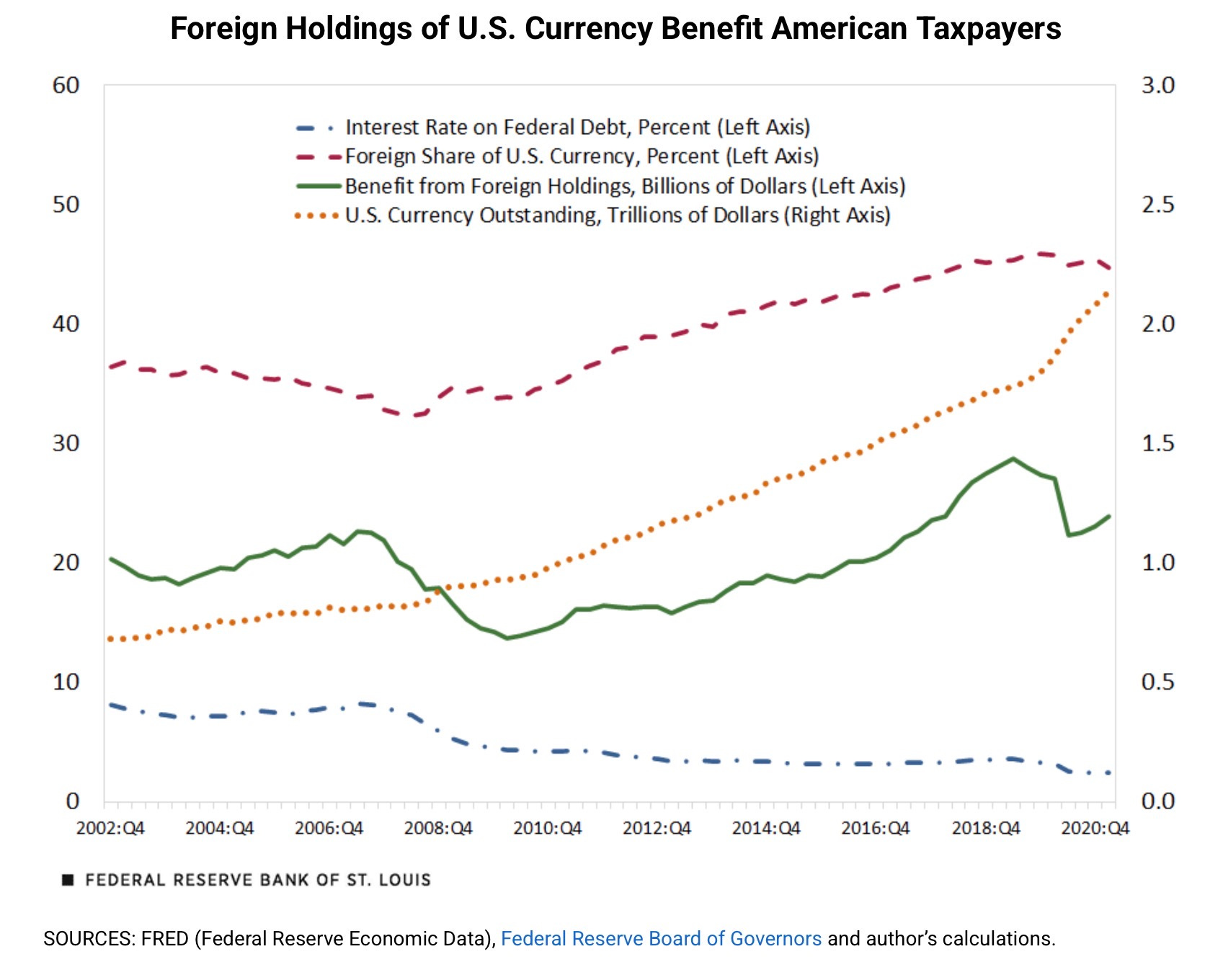
Even with supply and demand for money as asset or as transaction good there are some scope complexities. The number of US dollars that circulate outside the US is remarkable. Demand for US dollar notes is by no means limited to their use within the American economy. The excellent Conflicted podcast recently provided a very informative discussion of the dynamics of money laundering and why US cash remains king.
I also dislike the usage the real economy or in real terms, preferring output or goods-and-services as the role of money—and, indeed, credit—in facilitating transactions is very real. Both money and credit can be means of payment, but the latter is even more driven by information and risk than money.
Money is a physical—so physically possess-able and storable—thing. Credit is a promise, paid for (i.e., made worthwhile to do) by interest. (If someone is paying interest on it, it is credit, not cash.) Cryptoassets, such as Bitcoin, are … odd.3
Banks generate credit, based on their assessments of risk. Such credit can, and usually does, generate claims on cash; but it does not multiply money—it does not increase cash in the economy, unless the bank can issue its own banknotes. It does multiply means of payment denominated in monetary units. Hence, it is perfectly possible to analyse monetary policy without worrying specifically about credit, as these are another set of transactions affected by expectations of the future value of the money they are denominated in and the expectations about future income that they have to be paid back in.
Monetising
The term transaction good also helps thinking about the process of monetising an economy. The more an economy is monetised, the lower transaction costs are going to be, so the more transactions and so the larger the economy can be expected to be. Governments have a particular incentive to encourage the monetising of an economy, not only because a larger economy generates more taxes and other revenue, but because monetisation reduces the transaction costs for government itself in acquiring revenue and expending funds.
A short note on “mercantilism”

Posting here paused for a bit because I did two posts (here and here) at Helen Dale’s substack on the social democratic policy of regime of 1945-1973 and the neoliberal policy regime of 1979-? and their decay. I have also been working on a Submission to the
The alternative to monetised transactions are in-kind transactions. I much prefer to talk about in-kind rather than “barter” because you can have in-kind taxes, in-kind debts as well as in-kind exchange. A medieval manor was not a “barter” system, it was a series of in-kind arrangements.
The processes of monetisation took centuries. As late as the 1940s, the Chinese economy was far from fully monetised, as villages tended to avoid using money in their internal arrangements—to the extent that villagers would travel to the local market town to engage in monetary transactions with a fellow villager.
From the Soil (I): Understanding China

From the Soil: the Foundations of Chinese Society (Xiangtu Zhongguo) is a classic of Chinese sociology, written by pioneer Chinese sociologist, Fei Xiaotong (1910-2005). He had been taught by an American (Robert Ezra Park, 1864-1944), Russian (Sergei Mikhailovich Shirokogoroff
Chinese society was based around kin-groups, and other connections, far more than were the very individualist Western societies. Law also penetrated Western societies—including rural communities—far more than it did Chinese villages. All this made in-kind arrangements more viable within Chinese villages and monetisation more viable in Western rural communities.
Historical aside: the long history of Chinese villages keeping the state at arms-length helps explain how Chinese villages could spontaneously de-collectivise agriculture after the 1966-76 Cultural Revolution had disrupted Party (CCP) control in the villages. The “clever” thing that the CCP did was to work out how to cope with the de-collectivisation that was already happening.
Robust expectations of a stable path for total transactions
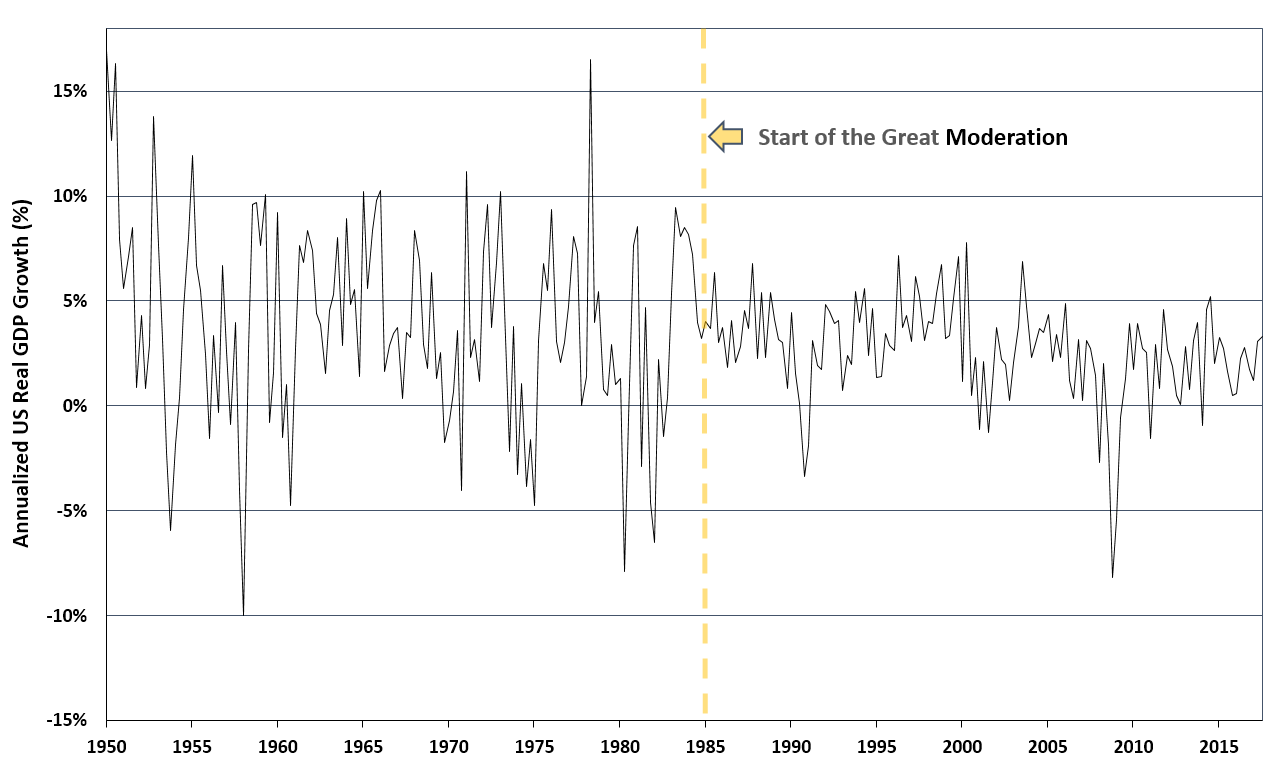
In summary, Winston Churchill, as Chancellor of the Exchequer, focused on money as the medium of account for assets (specifically, UK public bonds) rather than the central role of money—as a transaction good. Eight decades later, the Great Moderation was interrupted by the Great Recession because the US Federal Reserve, and other central banks, focused on expectations about the future value of their currency (i.e., inflationary expectations) and not on generating expectations of a stable path for total transactions when financial risks dramatically increased.4
The medium of exchange usage gets in the way of thinking clearly about money.
Money is first and foremost a transaction good. Its use reduces transaction costs, so makes the economy larger than it otherwise would be. [Its greatest benefit is enabling transactions that otherwise would not happen.]
Monetary policy does best, when it generates strong expectations of a stable positive path for total transactions in an economy. What is the most useful measure of total transactions in an economy? NGDP: GDP at current money (nominal) value.
Sure, there is an asset economy as well as an output—a goods and services—economy. But new assets require goods and services in their creation. (Cryptoassets, for instance, require computers, computer code and electrical power.) Assets are mainly of value either from producing goods and services or providing more reliable access to the same. This includes prestige/status assets.
Moreover, as money can be used as a transaction good, or held as an asset—and is the medium of account for output, assets and obligations—money operates as the “hinge” between current and future transactions and between output and assets.
So, monetary policy does best when it generates robust expectations of a stable positive path for NGDP.
References
Katy Barnett, ‘The Australian Approach To Cryptoassets: Another Block In The Chain,’ forthcoming Journal of Banking and Finance Law and Practice JBFLP (2026). https://papers.ssrn.com/sol3/papers.cfm?abstract_id=6477598
Ronald Coase & Ning Wang, How China Became Capitalist, Palgrave Macmillan, 2013.
Scott Sumner, The Midas Paradox: Financial Markets, Government Policy Shocks, and the Great Depression, Independent Institute, 2015.
Scott Sumner, The Money Illusion: Market Monetarism, the Great Recession, and the Future of Money, University of Chicago Press, 2021.
James Tobin, ‘Commercial Banks as Creators of ‘Money’,’ Banking and Monetary Studies, (ed. Dean Carson) 1963, 408-419, cowles.econ.yale.edu/P/cm/m21/m21-01.pdf.
Fei Xiaotong, From the Soil: the Foundations of Chinese Society, trans, with an introduction and epilogue by Gary G. Hamilton and Wang Zheng, University of California Press, 1992.
Chenggang Xu, ‘The Fundamental Institutions of China’s Reforms and Development,’ Journal of Economic Literature, 2011, 49:4, 1076–1151. https://hub.hku.hk/bitstream/10722/153452/2/Content.pdf
True of almost all gold-standard economies. The US was a slightly different case, as the exchange rate of the US$ was constantly adjusted, but the resultant devaluations of the US$ also exited the economic death spiral the Bank of France’s systematic removing of gold from the monetary system (so driving up the output-value of the gold still in the monetary system) had created in the gold-standard economies. As I have previously noted, a small number of central banks overwhelmingly dominating gold reserves meant that the gold standard had become a form of technocratic money—and the monetary technocrats screwed up spectacularly: not for the last time, but definitely for the worst time.
This may include an increase in Knightian uncertainty (future possibilities without calculable probabilities). Uncertainty can be read negatively or positively. Uncertainty being read positively is what happens in tech booms. In that case, reduction in uncertainty brings the boom to an end. Uncertainty that is read negatively encourages a flight to “safe” assets. When there is increased uncertainty, people move from what they cannot calculate—the realm of uncertainty—to what they can. Thus, in the case of both positive and negatively read uncertainty you get increased herd/flocking behaviour. The point of herd/flocking behaviour is to not to be an outlier and so not do worse than anyone else—given that you have no basis upon which to calculate to do better—and to take speedy advantage of a member of the flock/herd getting information before you. Some of what Keynes called animal spirits is such response to uncertainty. There is always some uncertainty. In “bull” markets, the uncertainty is read positively, in “bear” markets, it is read negatively.
Cryptoassets (such as Bitcoin) are odd in they have locality not physicality, as they are lines of code in a “wallet” possession of which constitutes proof of ownership. So, they have physicality in much the same sense that records of money deposited in a bank have physicality, except that the owner holds the record as proof of ownership. Cryptoassets are so odd that there has been legal argument about whether they should be regarded as property at all. Courts have generally ruled that they are, but that then raises the question of—as they are not physical things—whether they are a third type of property or are chose in action (a personal property right to an intangible object), as debt is.
Not just risk, for (negatively read) Knightian uncertainty (i.e. what could not be calculated) had dramatically increased, further encouraging people shift to “safe” assets.
Offtop, do you recommend any book on Chinese history in 20C?
This is the second piece you have done on money.
I think you could also address debt with a similar view, and I’m not talking about credit.
When the King granted an English town “Market status”, what was he granting? We think it’s similar to permission to hold a party, but it’s not. In these market towns there is a covered area big enough for at least a dozen people. What the market license was, was permission to hold debts amongst one another. So the farmer could loan wheat to the miller and the miller could loan flour to the baker. Now you are the medievalist, and I am just a poorly educated bogan, but that covered area was to make sure that on “market day” everyone was present to square off their books and the English habit that arose in this time was genuinely an expression of concern for someone who owed you money.
“Hi, how are you?”
“Excellent thank you. How are you?”
“Very good”.
That and the covered areas are all the evidence I have and some might say it was just an artefact of plague - but we would have copied this behaviour from the local elites without really understanding why they did it.
Debt was far more important than money here for the market towns to “take off”, and the reason the charters were sought in the first place.
I expect you’ll be able to pour some cold reality on that, but I haven’t seen a better explanation for “hi how are you?”.