

In domestic (“municipal”) law, questions of illegality arise. They arise because states have laws. They have laws because their laws come with remedies—consequences for breaking the law.
So, it is a genuine question whether President Trump is exceeding his constitutional authority in his attack on Iran. But that is a genuine question because the US has a Constitution that matters. The US is a rule-of-law state, no matter how much other common law jurisdictions may point and laugh at how politicised US law is.
In terms of the international order, however, there is no such thing as an illegal war, because (public) international law is not law. It is a set of rules and claims that pretends to be law. It only pretends to be law as it has no remedies—apart from declarative statements, which are not enough to make it law. (Private international law does have enforceable and enforced remedies, so is law.)
One of the consequences of this is that (public) international law, as an academic discipline, has no substantive reality-tests. There are no decisions by judges that are enforceable and enforced. This has led to academic international law being the vector by which the toxic ideas of the Critical Theory magisterium, that increasingly dominates Anglo-American universities, have infected Law Schools.
(Public) International law should not be taught at Law Schools, because it is not law. It should be taught in International Relations or Political Science Departments. A PhD in International Law should not qualify you to teach in Law Schools. Indeed, if you cannot tell the difference between actual law—with genuine remedies—and a simulacrum of law, you should not be teaching students at all.
Rules-based international order
When folk refer to the rules-based international order, they are not referring to nothing. There are various rules and conventions it is convenient for states, and other agents, to follow.
There is also a difference between the mercantile maritime order and continental anarchy. It is not an accident that the original international conventions pertained to sea travel and trade.
Maritime order versus continental anarchy

Law and order is a very redolent phrase. Each element works off the other. Law is ordering. A certain amount of order is necessary to have law.
Within continental anarchy, it is relative power that matters. A war that depletes your resources and capacities, but depletes those of your neighbours more, is a winning proposition, within the state-geopolitics of continental anarchy. The geopolitics of continental anarchy leads states to seek weak or subordinate neighbours. The mercantile maritime order, on the other hand, is all about creating win-win interactions.
Russia, India and China are all continental Powers that live, at least to some extent, in a situation of continental anarchy. But they are also trading States that benefit from the mercantile maritime order maintained by the US-and-allies maritime hegemony. The tension between China as a trading nation becoming the biggest single beneficiary of the mercantile maritime order maintained by the US-and-allies maritime hegemony, and the interests of the CCP (the Chinese Communist Party), is the central strategic difficulty that CCP China faces.
Israel faces the strategic dilemma of operating in a region of continental anarchy but seeking support from states deeply embedded in the mercantile maritime order. Whether the Middle East has to be a region of continental anarchy, or can it become far more embedded in the mercantile maritime order, is precisely what is at stake in the latest conflict.
Any social order has to be enforced. This is even more true of international orders. As there is no such thing as international (public) law, enforcing an international order is not a matter of rules, it is a matter of those who actively support and enforce that order and those who seek to subvert it.
A vivid example of how central enforceability is to any international order is given by comparing the treatment of Germany after the two World Wars. Germany was treated far more harshly after the Second World War than after the First World War. The crucial difference was that the Versailles order was not enforceable by the victors and the Potsdam order was.
An order-disrupting regime
By far the most disruptive force in the Middle East since 1979 has been the ruling regime of the Islamic Republic of Iran. Its sponsorship of jihadis and terror organisations; its own terrorist activities; its arming of non-state actors; its active killing via it and its proxies on behalf of oppressive regimes; has generated violent conflicts, massacres of civilians and disrupted entire societies.
The Islamic Regime did not start the Lebanese Civil War, which predates it. Its armed proxy—the state-within-a-state Hezbollah—has been profoundly disruptive of Lebanon and undermined Lebanon’s ability to recover from its civil war. Similar dynamics can be seen in Yemen, via the Iranian proxy state-within-a-state the Houthis. The Houthis have engaged in direct attacks on maritime trade, and so the maritime order, in the Red Sea.
The Islamic regime’s proxy Hamas has done everything it can to disrupt Arab states making peace with Israel; carried out the worst anti-Jewish pogrom since 1945; and turned the people of Gaza into human shields, taking Israeli hostages en masse precisely so Gazan civilians were placed between its fighters, the hostages they took, and the IDF (Israeli Defense Force). The Iranian regime provided the military muscle that kept the Assad regime in place in Syria—it is no accident that the Israelis gutting of Hezbollah, and forcing its withdrawal from Syria, was immediately followed by the overthrow of the Assad regime.
The ruling regime of the Islamic Republic of Iran has been murderously disruptive of order within the Middle East for decades. Particularly now, given Israel’s gutting of Hezbollah and Hamas, and its demonstration during the 12 Day War of the lack of military capacity of the Iranian regime, governments across the Middle East are just over the Islamic regime’s endless, murderous, disruptions. They want to move more completely into the mercantile maritime order—hence, for example, the India-Middle East-Europe Economic Corridor (IMEC).
The IRGC (Islamic Revolutionary Guard Corps), the state-within-a-state that controls around 40 per cent of the Iranian economy, is committed to the continuation of this murderous disruption. As it became clear that no negotiations with the regime—negotiations clearly subject to the IRGC’s veto—would result in an outcome that the US, and the other states in the region, could live with, the frustration with the regime of the Islamic Republic has become terminal: see Aimen Dean’s comments on Triggernometry and elsewhere.
If there is to be a stable order in the Middle East, the regime of the Islamic Republic has to be either overthrown, or its capacities so gutted that all its energies are re-directed to staying in power. A sufficiently degraded regime would be in a position to accept a deal other states could live with.
Yes, it is entirely possible that a collapse of the regime would lead to a civil war in Iran. Yes, that would be disruptive. But none of the civil wars, or quasi civil wars, in the Middle East since 1979 have been as disruptive to the order of the Middle East as has the regime of the Islamic Republic, whose Constitution commits it to spreading its ideology.
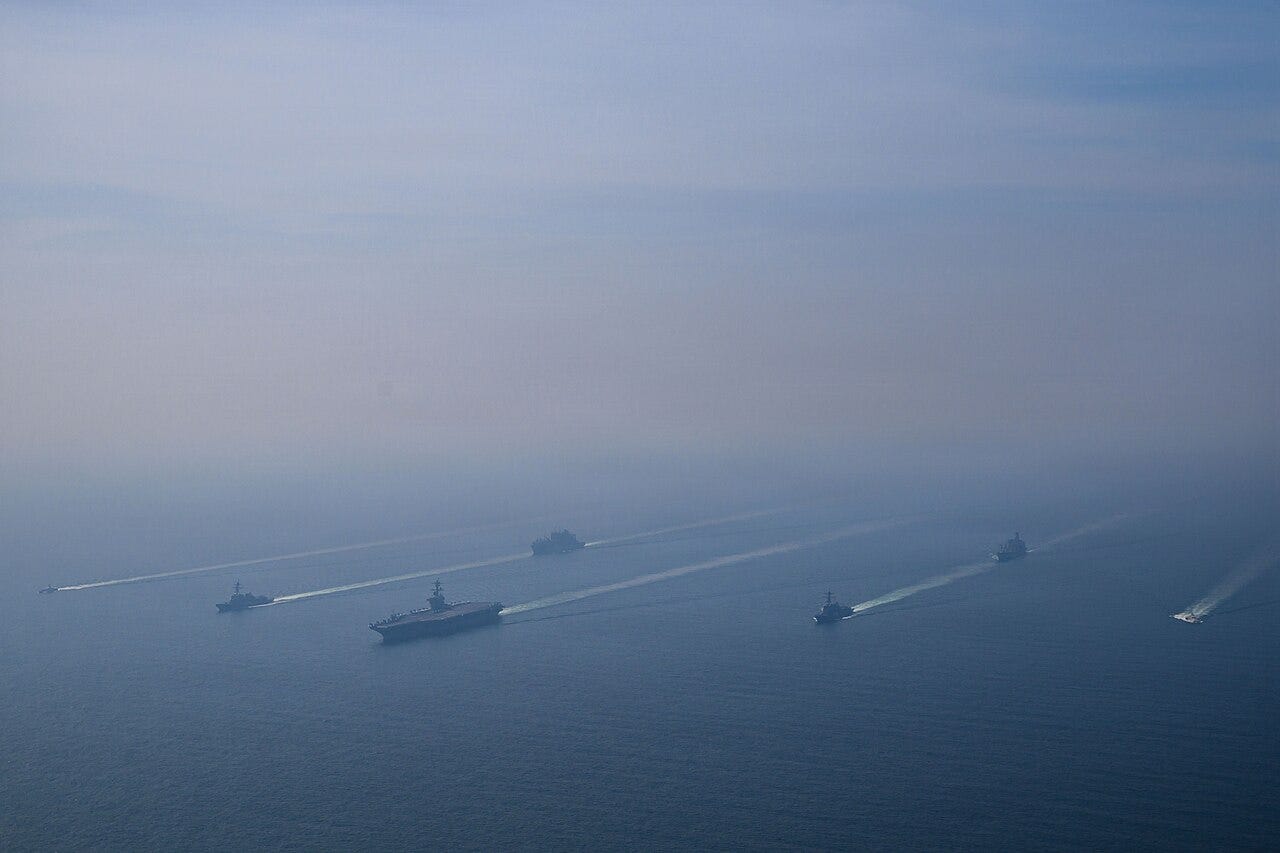
This war is the hegemon of the mercantile maritime order (the US) seeking to move the Middle East from the continental anarchy the ruling regime of the Islamic Republic of Iran imposes on the area to becoming far more a region within the mercantile maritime order.
The Israeli-US attack on Iran is about seeking to create a stable order in the Middle East. It is an order-enforcing effort. This is very clear if you look at things in their Middle Eastern context, with a clear-eyed understanding of the history of the past decades.
Commentary destructive of context
Many people, however, do no such thing. Their commentary is entirely driven by what they think of Trump, of Israel, of the West. Such commentary actively undermines understanding.
We saw the same pattern with the Russian attack on Ukraine and the attempt to blame the expansion of NATO for that attack. NATO is a profoundly stabilising force. Joining NATO is about committing to the mercantile maritime order and protecting oneself against continental anarchy.
It is precisely because of their experience of Russian autocracy across centuries that Russia’s neighbours have sought to join NATO. If you do not look at, or understand, the centuries-long patterns of Russian autocracy, you do not understand what is going on and your commentary will actively undermine such understanding.
No war is illegal. It may be an unconstitutional act. It may be an immoral act. It may be a strategic failure. But it is not illegal because (public) international law is not law.
A much more useful question is: does the war disrupt an existing order or does it seek to enforce (even extend) it?
The likelihood of success of any war is an open question. But the US-Israeli attack on Iran is about enforcing an international order against a regime that has proved itself, for decades, to be murderously disruptive of any such order.
ADDENDUM: The UK Attorney-General declaring the war illegal has been part of what has led to the astonishingly incoherent British response. Part of the backstory is that—since the Blairite debauching of the UK Constitution—such legal determinations from within the Civil Service have been used to hobble Ministers and hamstring the British military.
Concise and brilliant analysis.
Yes, Critical theory folks love this utopia as well. They can build huge mountains of bullshit on this molehill of utopia, and do so.
Unrelated. When I typed "critical" the guess-next-word typing help on Substack offered "thinking". I am so tired of this nonsense term "critical thinking", particularly when it applies to schools. Critical of what? Oh, yes, if kids are taught to think critically, they sure will be equipped for adult life.
Will they? Apparently half can barely read and add numbers, but sure "critical" will do the trick... They have so little basis to be critical about anything, as being critical of the basic stuff they are taught in whichever kindergarten does not lead to any insights (aside, perhaps that a teacher is an idiot).
So, what is the origin of this cargo cult "critical thinking" obsession?
Without necessarily being able to articulate the argument as well as you, the targeted killing of heads of state makes me extremely uneasy. That feels like a red line that has stood for a very long time.