

Universities across Anglo-America, and across the West more broadly, have become increasingly dominated by a Critical Theory magisterium: a teaching authority that claims ultimate or trumping moral authority. This magisterium is based on Critical Theory and its derivatives—Critical Race Theory, Critical Pedagogy, Queer Theory, Post-Colonial Theory, Settler-Colonial Theory, and so on: which constitutes the Critical Social Justice matrix.
This magisterium has come to increasingly dominate academe for a range of reasons. It generates intolerant zealots, so benefits from the dynamics of an intolerant minority.
It offers a powerful shared status game—affirm beliefs X, Y, Z and that makes you A Good Person. This status game spreads a supporting censorious intolerance, for if affirming beliefs X, Y, Z and makes you A Good Person, then denying X, Y, or Z makes you A Bad Person.
This justifies shaming and shunning anyone who denies X, Y, Z, because they are Bad People and its shows your commitment to what makes someone A Good Person. It shows commitment to the shared status game. This status game generates moralised cognitive assets, and you protect the value of those assets by participating in—or at least going along with—the shaming and the shunning.
The status game generates moral projects that the central administrations of universities can use to expand their authority, range of action, and so resources. An opportunity they have enthusiastically embraced. An opportunity that corporate, non-profit and government bureaucracies have also enthusiastically embraced.
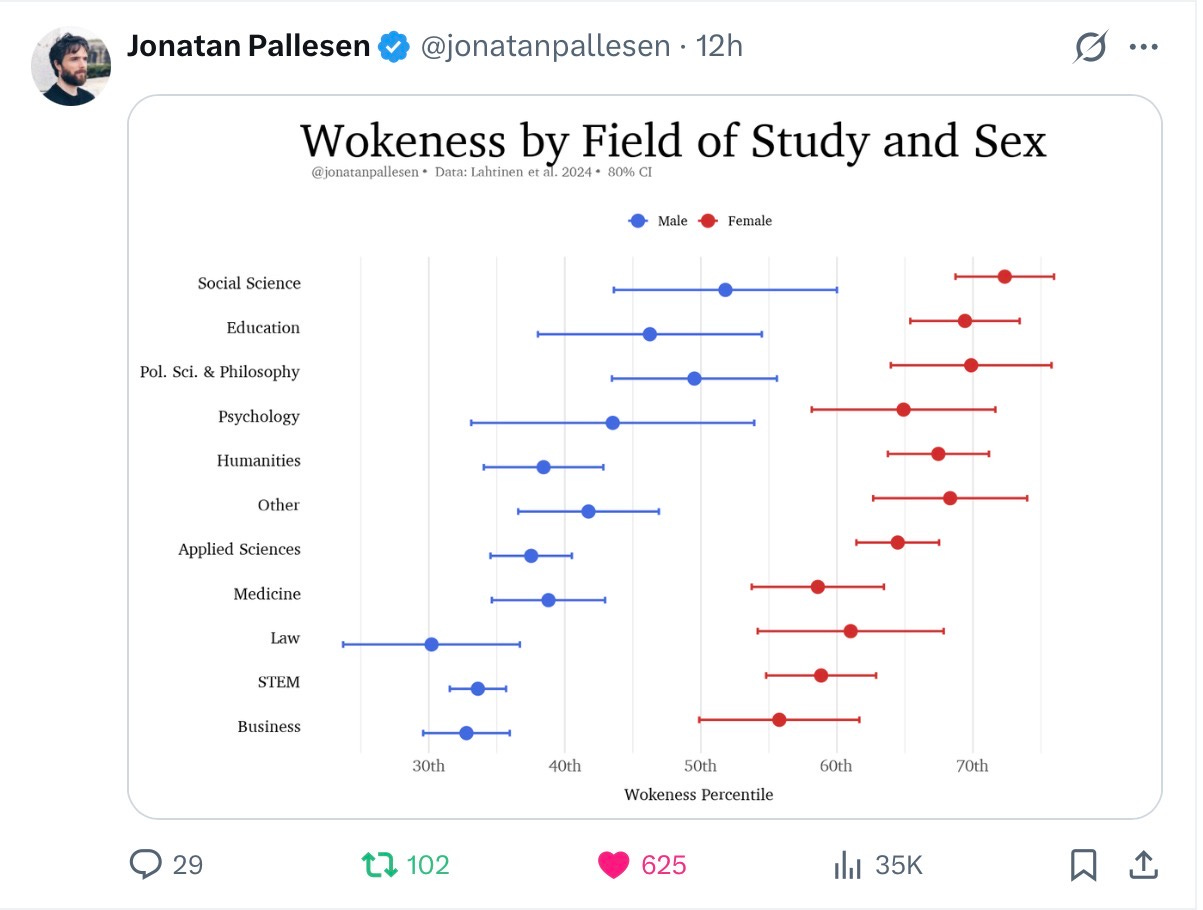
The emotions this status game attaches to those moralised cognitive assets—care, compassion, concern for the marginalised, if you affirm those beliefs, the opposite if you deny them—also plays into fears about threatening emotions (and safety through norm conformity) which are much stronger among women than men. Women are thus systematically more hostile to freedom of speech than men.
It is an exaggeration to claim that “wokery” is just the consequence of feminisation of institutions and occupations. It is, however, true that what works for—what is emotionally resonant in—increasingly feminised institutions and occupations has been selected for.
But the Critical Theory magisterium has expanded across academe—and beyond—due to the nature of its three foundational claims:
A blank slate view of human nature.
A view of social dynamics as dominated by conflict.
An activist relationship with information: that the trumping purpose is not to describe the world, but to change it.
The blank slate view of human nature—not merely that we are born without inborn ideas, but that everything that forms us is social—means that any level of social transformation that can be conceived is attainable. Provided enough social power can be assembled—to move human action, speech and thought in the correct direction—the socially-transformative society free of oppression and alienation can be created.
The grander the conceived purpose, the more energising and motivating it is. But also the more it rhetorically trumps anyone who is willing to “settle” for less than complete human liberation. This then feeds back into energising and motivating, as it provides an endless sense of being moral trumps.
A recurring version of such blank slate claims is that our “true” nature has been obscured or repressed by oppressive forces. This might be the alienation via private property (Marx) or by patriarchy, or white supremacy, or heteronormativity or whatever.
The most dramatic statement of the “repressed true nature” claim is also the earliest, in the first sentence of Jean-Jacques Rousseau’s The Social Contract (1762):
Man is born free and everywhere he is in chains. (l’homme est né libre, et partout il est dans les fers.)
The view that oppressive forces are blocking our true nature goes naturally with the claim that social dynamics are dominated by conflict. This dominated-by-conflict claim was classically stated by Marx and Engels as the first sentence of the first chapter of The Communist Manifesto:
The history of all hitherto existing society is the history of class struggles.
If conflict dominates social dynamics, then the prosecution of such conflict so as to achieve human liberation becomes the ultimate moral good. Coordinating the fighters for human liberation becomes a moral urgency. To prosecute that struggle becomes the most important thing one can do.
Both of these claims naturally lead to, and gain strength from the claim, that the morally trumping thing to do with information is to prosecute the struggle for human liberation. Marx famously said:
The philosophers have only interpreted the world, in various ways; the point is to change it. Theses on Feuerbach, Thesis Eleven, 1845.
Max Horkheimer, in his seminal essay Traditional and Critical Theory (1937) tells us that:
Critical thinking, on the contrary, is motivated today by the effort really to transcend the tension and to abolish the opposition between the individual’s purposefulness, spontaneity, and rationality, and those work-process relationships on which society is built. Critical thought has a concept of man as in conflict with himself until this opposition is removed. If activity governed by reason is proper to man, then existent social practice, which forms the individual’s life down to its least details, is inhuman, and this inhumanity affects everything that goes on in the society.
Critical Theory is activist Theory, aimed at human liberation from the unwanted constraints of existing society and epitomises the activist relationship with information. All scholarship is trumped by this aim and so the most authoritative scholarship is that which is most committed to this aim.
Since such motivated and coordinated commitments are aimed at human liberation, all institutions must either be bent to that purpose, or destroyed, so that said human liberation can be achieved. This combination of motivation, coordination and all-trumping purpose that de-legitimises all dissent is thus structured towards taking over institutions.
What has come to make it particularly effective is that it has evolved to generate a supporting status game that people can adhere to without having any idea of where the underlying ideas come from or what their purpose is. People who have never heard of, or read, Marcuse can nevertheless prosecute his repressive tolerance strategy because they are committed to a status game of believing X makes you a Good Person, so believing not-X makes you a Bad One.
This status strategy thereby turns affirmed beliefs and modes of speech into moralised cognitive assets that folk in elite networks—or aspiring to join or create elite networks—can (and do) add to their other assets. There then develops an entire media/education/IT/advocacy non-profit/corporate/government bureaucracy infrastructure that prosecutes this strategy. They do this both on their own behalf as individuals—albeit in networks—and as a service they are selling: these are the narratives that affirming make you a good person, let us help you curate your information flows to build, maintain and protect your moralised cognitive assets.
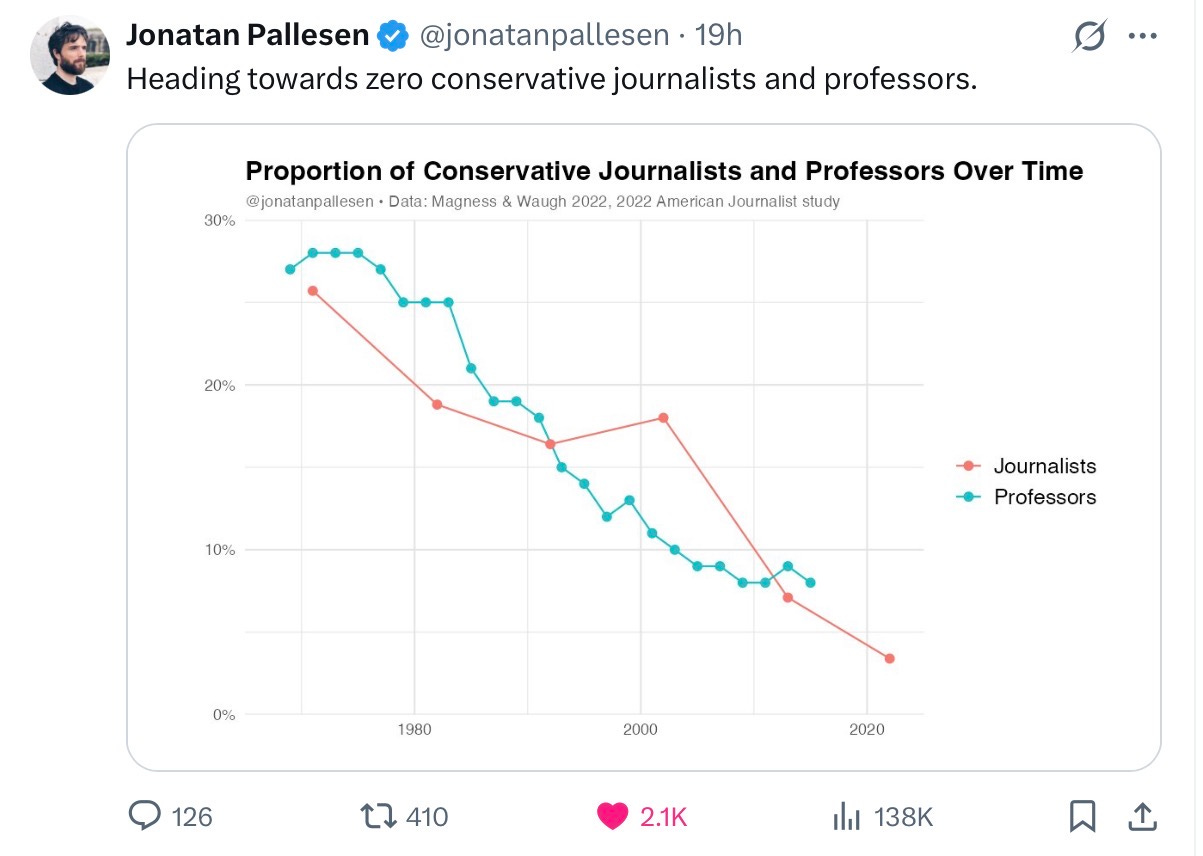
It is creating a situation where academics and journalists are becoming less and less representative of the wider society.
One of the more contemptible patterns of our time is elite folk—who live by their networks, their connections, their social capital—sneering at working-class folk who arc up at having having their locality-based social capital swamped by newcomers flooding into their communities.
The surface doctrines of left-progressivism—adherence to which provide the basis for coordination in various times and places—can, and do, evolve over time. What is selected for is what works better to coordinate and motivate in various cultural and institutional circumstances. Hence the current selection is for what works best in feminised institutions and occupations.
The underlying foundational claims, however do not go away. As we have seen, they date back at least to Jean-Jacques Rousseau (1712-1778).
The evolutionary mechanism that this most builds on is human status-seeking. More particularly, status-through-moral-propriety.
Humans have always been willing to shame-and-shun fellow humans who violate accepted norms. This is very clear from the work of Christopher Boehm and others on the dynamics of foraging societies. The women’s movement became semi-notorious for it. Left-progressivism has evolved on the basis of basic, foundational claims that allow the very effective mobilisation of the shame-and-shun mechanisms.
Levelling downwards
It has also mobilised the levelling strategy that humans—particularly but not only women—mobilise to improve their social position. The levelling strategy is directed against those with more status and resources, to transfer both downwards.
Humans do not typically direct the levelling strategy downwards—so against themselves—thereby transferring resources and status from themselves to those who have less of both. That makes one’s situation worse, which is not a winning evolutionary strategy. Humans using the levelling strategy regularly seek to level downwards towards them, rarely upwards away from them.
What makes Christianity, Buddhism and Jainism so historically odd is precisely that they exult such downward transfers (so levelling up). They do, however, sharply distinguish material transfers from spiritual status. One gets improved spiritual status from the downward material transfer: provided, of course, that what you are giving up is yours; that you are actually making a material sacrifice.
Left-progressivists makes a rhetorical fuss about such downward transfers: but not from themselves. It is very conspicuous that their moral invective is directed upwards, as one would expect in evolutionary terms and particularly as a status game. The most obvious emotion in Communist propaganda—and left-progressivism writing generally—is anger: anger at those materially and socially above them.
Philosopher Bertrand Russell is quite correct: Marx is way more animated by animus toward the bourgeois than any putative love of the proletariat. Indeed, in The Communist Manifesto, it is made quite clear that that proletariat need their cognitive superiors—the Communists—to lead them to liberation.
Moreover, the demanded transfers are not personal sacrifices. On the contrary, they are to be compelled on others, to be taken from those who have materially more.
It is those who commit themselves to the grand project who oversee this grand process—with all the authority, status and resources that accrue to doing so. Left-progressivism has never created a dictatorship of the proletariat: every one of its Party-States has been a dictatorship of (activist) bureaucracy.
A further great advantage that the Critical Theory magisterium has is that it generates moral projects—from speech codes to DEI (Diversity Equity Inclusion)—that justify expanded bureaucratic authority and resources. This continuity in foundational doctrines and evolutionary strategy is why the first DEI program was the Soviet Union’s Korenizatsiya program; the next was Mao’s Black and Red identities; and the third was the Kim Family Regime’s Songbun system.
Left-progressivism generates commissars whenever it can.Nowadays, they are called DEI officers, bias response teams, intimacy consultants, sensitivity readers …
In Marx’s theory, all the social classes above the Communists—as the vanguard of the proletariat—are to be abolished. Given the required transfer of social power to the Correctly Motivated, this is absolutely a classic levelling downwards strategy, with any levelling upwards being in support of the dominant levelling downwards strategy and not coming from the Communists. As all Revolutionary Marxist societies demonstrate—and, for that matter, every welfare state demonstrates—there is a huge gulf between those who are to be equalised and those doing the equalising.
These three foundational claims—the blank slate; dominance of social conflict; activist approach to information—generate various doctrinal ways of making the following claims:
All unwanted constraint is oppression.
What is in my head is better than decades, centuries, millennia of human experience and achievement.
The first claim is obviously highly motivating: who does not have unwanted constraints they wish to get rid of? It is also endlessly motivating, as there are always unwanted constraints, so there is always oppression, so-defined. It allows any blue-haired graduate of an elite university to claim to be oppressed.
The notion that any part of her life experience is somehow in the same continuum as, say, a zek in a Soviet gulag; or a slave being worked to death in a Caribbean or Brazilian plantation; or a Neolithic farmer woman forced to live and breed with the rapist who killed all her male relatives; is utterly, utterly offensive. But playing to people’s narcissism—indeed, enabling them to moralise their narcissism—is a social selection advantage. (This is so, provided that no reality-tests or character tests get in the way.)
The second claim—what is in my head trumps decades, centuries, millennia of human experience and achievement—is also a rampantly narcissistic claim. (It does not become less narcissistic if one hides it behind grand Theory.) But this cognitive narcissism flows quite directly from making human liberation the all-encompassing social goal that trumps all other human achievement.
Such human liberation has never been achieved. It is entirely an imagined and imaginary goal. It is also terribly useful—including rhetorically—as it turns the imagined future into the trumping benchmark of judgement, the trumping moral and epistemic authority. Anyone defending anything with a past—so with flaws—is rhetorically trumped by the imagined vision of the perfected future.
All human history becomes condemned for failing to achieve that imagined liberation. The past becomes a litany of human oppression, while the present is structures of the same. None of such pervasive moral failure provides any basis for learning, beyond what does not work; what has morally failed. Yet past and present constitutes all the information we have, as there is no information from the future. This is a pathological relationship with information.
So, the three foundational claims are highly motivating; they readily enable a great deal of coordination; they naturally combine both towards taking over institutions. Thus is the enduring power of left-progressivism for over two centuries explained.
These three foundational claims also have something else in common. They are not true. They are all false. Nor are they a little bit false: they are comprehensively false.
Systematic falsity
Humans are not blank slates. We are evolved beings with genetic variations between individuals and variations in the distribution of genetically-transmitted traits in different human populations. The longer a human population has been separate from other populations, the more differences in the distribution of such traits there will be.
The more intense the genetic-selection bottlenecks, the more differences in the distribution of such traits there will be. The male expression of human genes is systematically much better at forming and maintaining effective teams than the female expression of human genes. This is in part because of different evolutionary roles across human history but those differences became much more intense due to the y-chromosome Neolithic bottleneck that arose once farming and animal herding had developed enough to create increasingly intense social conflict over farm and grass lands.
Only about 1-in-17 male lineages made it through the bottleneck. Female lineages were unaffected. Effective male teams killed less effective male teams, took their women as the spoils of victory and bred with them.
Generations of women bred with their rapists who had killed all their male relatives. It is horrible to contemplate. (That romantic novel trope of the male brute tamed by a love of a good woman, well …)
The continuing consequence has been that boys and men are much better at teams than girls and women. Hence teenage boy sporting teams regularly crush adult female national teams. Hence—given that institutions and organisation are formalised teams—there are issues with the feminisation of institutions, organisations, occupations.
The left-progressive program of human liberation requires a concentration of social power that no set of Homo sapiens can be trusted with. The very things that makes left-progressivism work so well to motivate and coordinate themselves operate off a combination of evolutionary mechanisms, plus human variation, operating in various social contexts. Homo sapiens will continue to be Homo sapiens.
The grand social and human transformation will not—indeed cannot—happen. This is so even if we engage in some grand genetic manipulation. For enormous levels of knowledge would be required; genes probably do not work as required; selection processes would still happen; it would require abolishing genetic variation; and it would almost certainly require suppression of traits that are necessary to be a socially competent, resilient, reproducing species. (See the problem with The Pax in the film Serenity.)
It is also not true that human social dynamics are dominated by conflict. Indeed, the opposite is true: every human society is dominated by cooperative mechanisms. The more complex and larger the society, the more that is true.
We are the biosphere champions at non-kin cooperation because we are so able to develop cooperative mechanisms. Western states came to dominate the planet because Medieval Christendom—riffing of how Rome did it—put non-kin cooperation on social steroids.
If you see human societies as dominated by conflict, not only are you basing your program on false claims; you will systematically undervalue, and under-consider, such cooperative mechanisms. You will therefore degrade or break such mechanisms.
We can see this process in progressive-governed cities in the US, where the mad program of redistributing status breaks giving prestige to pro-social actions and stigmatising anti-social actions.
An even more dramatic example of under-valuing—indeed failing to notice or understand—key mechanisms of social cooperation is the disastrous consequences of Marx’s (false) labour theory of value.
By (falsely) characterising all value as generated by labour, Marx systematically under-valued the discovery, coordination and risk-management roles that commerce is structured to do. The attempt to replace commerce with central command—to bureaucratically replace commerce—proved to be a serial disaster that no Marxist regime has been able to fix, except by allowing commerce to once again do its thing.
Marx’s economics were developed to serve his social vision. Hence it has proved relatively easy to unplug that economics, and class analysis, from the foundational claims and put other social groupings into the underlying vision—race, sex, sexuality, gender identity, indigenousness, disability … This is the basis of the Critical Theory magisterium.
The Critical Theory magisterium both systematically ignores and/or undervalues the cooperative social mechanisms whose good operation is required for a well-functioning society while also systematically undermining them as “oppressive” structures whose elimination will allow social transformation to take place. As every single attempt to do so shows, no it will not.
What is “de-colonisation” but seeking to replicate in high-functioning societies that passed the stress-tests of history with flying colours the patterns of lower-functioning societies that failed them? But, of course, one of the deep taboos from the normative dominance of blank-slate claims via elite status games is to not notice inconvenient successes or inconvenient failures.
So much of this is built on the disastrous activist relationship to information. Activism corrupts and degrades every realm of human action whenever it imposes on that realm pre-set requirements from outside. We can very much observe this in the degrading of area after area of popular entertainment by the imposing of the “Diversity Message” on behalf of the (almost entirely mythical) “Modern Audience”.

The only source of information we have is past and present. The future provides us with no guide at all. Certainly not our imaginings of the future, which so easily become directed to very self-serving ends, as the entire history of left-progressivism demonstrates.
So much knowledge is dispersed and embedded. It is not centrally articulated and often can’t be. There is a huge amount of such embedded learning in the institutions and practices we inherit from the past. Yes, they have to be allowed to evolve to adapt to changing conditions, but we humans are very bad at creating Theories to so adapt.
Especially when those Theories are not subject to adequate—or any serious—reality-tests. A huge problem with academe is so much of it treats approval by other academics as an authentication procedure when such approval is very much not a reality-test. Structures of raging falsity can be—as they way too often are—“authenticated” by academic approval, if they play correctly to academic status games.
Useful falsities
Alas, even the falsity of the foundational claims is a motivating and coordinating advantage. For their very falsity becomes a mechanism for displaying commitment to shared purpose, to the shared status-game. The not-noticings and rationalisations one has to do to signal one’s adherence to the correct doctrines and affirmations of the moment display one’s commitment to the same.
The Trans madness is an excellent example of this. Claiming that a person with a penis is a woman—and that the hormonal and surgical mutilation and sterilisation of a gender non-conforming child is care and compassion—requires monumental levels of not-noticing and rationalisations to support a bunch of evil lies that destroy lives. Something that hundreds of thousands of people have demonstrated their ability and willingness to do. But their earlier confreres did the same with Castro, Mao, Stalin …
The current cohort display by their not-noticings and rationalisations their commitment to the socially dominant left-progressive status claims generated by the Critical Theory magisterium of the universities especially strongly with Trans. Such status claims have been spread via gay and lesbian non-profits—who shifted to Trans to keep the donation flows going—and by mainstream media whose business model has become selling the narratives the affirming of which made one A Good Person.
This status game is one that so many mainstream journalists became committed to. Indeed, it is part of a matrix of status games that more and more journalists in the mainstream media have become committed to.
But the Trans madness—however horrible for specific individuals and families—is a relatively minor example of the disasters for human flourishing that are the consequences of operating from the three foundational false claims of left-progressivism.
The first—even obvious—point to make is that left-progressivism never achieves what it says on the tin. Ever. The past and present which has failed to achieved the morally-trumping human liberation that justifies all this includes every left-progressive regime ever.
But that failure is not just a failure to achieve human liberation. It is worse than that. Left-progressive governance is regularly a disaster for human flourishing. Mass murder, terror-famines, tyranny, poverty, economic stagnation, intensely exploitive Party-elites: these are the wages of left-progressive governance when it achieves the social dominance it seeks.
Even when it just achieves local control, we see failure. Left-progressive urban government in the US is a litany of failure, from street non-cleaning through entrenched homelessness to crime surges. The current “woke” version of left-progressivism—which seeks to redistribute status—breaks a basic social mechanism, as it separates prestige and propriety from pro-social behaviour and strips stigmatisation from anti-social behaviour. Elevated crime, economic stagnation, fiscal stress, problems with providing basic services: this is what we can observe in such cities.
So, the question arises, how can something based on such false claims, and which has a litany of failures of governance, get so far, and does so in democratic societies? This is due to two factors:
The expansion of the unaccountable classes.
The accelerating effect of the coordinating unreality of social media.
The unaccountable classes are all those who are paid to turn up, so their incomes do not directly rely on their performance generating ongoing consent for their income. They include a large proportion of paid employees. They include most people in any bureaucracy, corporate, non-profit or government. They include academics, teachers, public broadcasting journalists.
If one is not subject to the reality-test of performance, then status games that do not require reality-tests become very, very attractive. Such status games the Critical Theory magisterium generates in abundance.
Consider the package it generates: that its adherents own morality; that those who disagree are morally illegitimate and epistemically incompetent; that the past is irretrievably sinful, the present oppressive; that the imagined future—from which we have no information—provides a reliable, indeed superior, benchmark of judgement; that nothing is ever their fault. It is a package made for those who lack systematic reality-tests or character-tests, or where shaming-and-shunning status games can override the same. The larger the unaccountable classes become, the more such politics can be selected for.
The networking unreality of social media has, demonstrably, generated an accelerating effect. That on social media we interact with narrow avatars of humans that lack the full-feedback effects of a living person means that the self-deceiving mechanisms of relational aggression—where you hide your aggression from yourself, and others, behind moral or social concern—can get full flight. Linguistic taboos become king, while online mobbing is so much quicker and easier than the real thing.
These are social displays of performative “goodness” and of casting out “devils”. But a performance of goodness structured to impose costs—including cruel costs—on others is just the ticket for the socially-impoverished feedback-narrowness of social media.
Social media provides a remarkably low personal cost, but potentially very large effect on others, vehicles for moralised social cruelty.
As both Rousseau and Marx were pretty vile human beings, we should be deeply sceptical of any notion of human good emanating from such people, because it will be a conception compatible with being a vile human being. Which is exactly what we find: a whole series of monsters, both great and small, have been attracted to, and empowered by, such politics precisely because it not only hides, it actively mobilises, psychopathy behind grand purposes.
The politics of appropriation of the property of others, and the elimination of entire classes of people, is a politics of violent aggression. It attracts violent aggressors.
It is not only the tyrannical murderous of Revolutionary Marxist regimes that is remarkable, it is their sheer systematic cruelty. A very physical cruelty in the case of the Soviet regime, a more emotional and psychological cruelty on the part of the CCP regime. (Though both regimes exhibited plenty of both.) This difference in patterns of cruelty manifests differences between Russian and Chinese culture. The contemporary politics of left-progressivism is full of emotional cruelty.
The feminist embrace of the blank slate—seeing any argument based on biology as an oppressive constraint on women—has had a disastrous effect for many women, as it lies about biological constraints. A women’s eggs age as she ages, so women’s reproductive capacity peaks in their late teens and early twenties and declines thereafter. So does the quality of men in their dating pool, while observing bad divorce outcomes discourage men from marriage. For lots of reasons, for so many women, “build your career first” has turned out to mean not having the family they wanted.
Mass urbanisation, particularly into apartments, has largely eliminated the large-family tail that positive fertility rates rest on. No-children-outside-marriage cultural patterns—as in East Asia and Southern Europe—then imprisons the fertility rate inside the marriage rate. Nevertheless, blank slatism treating biology as if it was some manipulatable social construct has misled women dreadfully.
A disastrous science of meaning
When we consider the toxic falsities that the Critical Theory magisterium generates and mobilises, Cardinal Newman’s claim, in his The Idea of a University (1852), that a university without an explicit Theology will generate one eventually—just a bad one—is very much not contradicted by the evolution of modern universities. By Theology Cardinal Newman meant the study of God, but we can broaden his definition from his statement that:
All that is good, all that is true, all that is beautiful, all that is beneficent, be it great or small, be it perfect or fragmentary, natural as well as supernatural, moral as well as material, comes from Him.
A Theology is a coherent conception of ultimate aims, of ultimate purpose. To put it another way, a Theology is a science of meaning. This is absolutely what Marxism, and its various derivatives, provide. This is particularly true of Critical Theory and its derivatives.
They provide a social ontology—a theory of what exists. They provide a social epistemology—a theory of what we do (or do not) know. They provide an eschatology—a theory of the proper purpose and direction of history. They provide a theory of proper social action—realisation of a society free of oppression and alienation.
They have a realm of divine authority—the imagined future, achievement of which becomes the benchmark of judgement. There being no information from the future, it is a realm from which there is no feedback, so generates no inconvenient feedback. Since the aim of social transformation is moral trumps, no citing of information from the oppressive past or present counts against its authority.
They have a structure of sacralisation—the sacred marginalised groups, whose claims are not to be traded-off against. It generates a structure of demonisation—oppressor groups and whoever speaks on their behalf. It generates a series of linguistic and other taboos. It has a moralised caste system, rating groups on their oppressor/oppressed marginaliser/marginalised scale. Hence entire disciplines and areas of employment stopped employing straight white males.
When French economist Thomas Piketty referred to the Brahmin Left he was so spot on.
Our religiosity is, very likely, an adaptation to being cooperative self-conscious beings. Critical Theory—like the Marxism it evolved from—mobilises our religiosity. It allows people to turn their politics into their religion, their identity.
This is, of course, a very bad thing to do. The modern conflicts of political religions have been as very bit as polarising and destructive as the previous Wars of Religion.
Using politics as religion-substitute—creating salvationist politics—has also enabled a painful unlearning of the lessons of those Wars. Hence the attempts to ban blasphemy, the heresy-hunting, the reputational witch-burnings.
The Critical Theory magisterium is absolutely pushing a Theology, a science of meaning, just a very toxic one. James Lindsay provides a useful definition:
Postmodernism is really a Marxist analysis of who gets to say what things mean.
How much that may or may not be true of the original French Theorists, it is absolutely true of what their New World adapters did with postmodernism.
In the case of Paulo Friere, he went straight into a Marxist Theory of Knowledge—hence his The Pedagogy of the Oppressed is full of citations of Marxists. What pedagogy there is in the book is entirely subordinated to the Marxist analysis and activist aims. Feminism and Critical Pedagogy have been two key vectors through which postmodern analyses of who gets to say what things mean was melded with the Marxian template and adapted to contemporary conditions.
Critical Pedagogy enables any form of Critical Theory to be adapted for use in schools. This has been particularly true of Queer Theory, whose penetration of schooling has been truly remarkable.
Trans became the epitome of all this. The idea that the unwanted biological constraints of the body can be overcome; that your “true” identity was what you willed yourself to be; that such “true” identity was hidden under oppressive social constraints (“sex assigned at birth”); all in the name of the “ultimate” marginalised group; requiring heroic amounts of rationalising and not-noticing; generating a whole new set of linguistic taboos marking one as a member of the cognitive and moral elite: Trans is a perfect storm of left-progressivism foundational falsities in an online age.
Trans generates claims of divine authority from the imagined future on behalf of the ultimate sacred—because against their claims no trade-offs are permitted—minority. It also epitomises left-progressivist politics in another way: it is a pack of evil lies who cost is registered in devastated families and the hormonally and surgically mutilated and sterilised bodies of children. A cost that goes with the mass murders, the tyrannies, the terror-families, …
Mass immigration as cultural disaster
These foundational falsehoods and elite status games have interacted badly with mass immigration. What has become increasingly obvious is that, without a strong and coherent civic culture, your institutions start decaying—as the norms and rules of your institutions will not be enforced—if and when they come under pressure. Such pressure can absolutely come from large influxes of people with very different cultures, so very different maps of meaning, very different patterns of cognitive significance and so patterns of behaviour.
The combination of the elite status games generated by the Critical Theory magisterium—whose original ideas are aimed at breaking down Western civilisation and institutions—with influxes of large social “lumps” of people with cultures, with maps of meaning, with patterns of cognitive significance, that are very much in tension with—or incompatible with—the norms and rules of Western institutions, and civic culture, is demonstrably corrosive of having any coherent civic culture, and so of basic institutions. This pattern has a great deal to do with the decline in trust of basic institutions.
For the elite status games generated by the Critical Theory magisterium make blank slate claims normatively dominant. It becomes verboten, taboo, to consider differences between human groups that contradict (the utterly false) blank slate dogmas. It becomes verboten, taboo, to consider any possibility that immigrants might make things worse.
But there are differences between human groups that matter. Immigrants can make things worse. In certain respects, various immigrant groups are demonstrably making things worse within their receiving societies. The ironically named “diversity bollards” are merely a physically conspicuous form of this. Turning formerly high-trust societies into lower-trust societies is not a social improvement.
When you get as sensible a person as Noah Smith citing well-run cities in notoriously culturally homogeneous societies as a reason to import further cultural diversity into Western societies, you know immigration has become a realm of thought-terminating cliches. Yes, Noah Smith is doing so to promote East Asians as being good immigrants, but he is still citing achievements of culturally homogeneous societies to promote cultural diversity. Besides he never asks who might be bad immigrants? (Somalis, obviously; with the bigger their immigrant “lump” the worse—Sweden is now paying them to go away.)
Thanks to the Critical Theory magisterium, the blank slate is too normatively dominant, so immigrants become the only Homo sapiens in history who cannot make things worse. They become another sacred group (“no person is illegal”) against whose claims no trade-offs are permitted.
Disastrous in any context
But the foundational ideas of left-progressivism do not need culturally-corrosive immigrants to be a disaster for human flourishing. They can manage that in any and all circumstances where they take over institutions.
Left-progressivism represents the worst possible combination of ideas: ideas that are false, yet highly motivating; that readily coordinate people; and thereby easily take over institutions. So, not only are they are a disaster for human flourishing, they are structured to gain power and so be—again and again—lived and experienced disasters for human flourishing.
What stops them? A serious commitment to a vigorous pro-social civic culture. A vigorous commitment to truth. The minimisation of the size of the unaccountable classes. The maximisation of pervasive reality-tests. The operation of genuine and systematic character tests. Institutional barriers to looting the treasury: perhaps going as far as those paid by the state cannot vote.
It means reforming and gutting the universities, that have become such grotesque institutional failures. Ban taxpayer funding of activist scholarship. Replace bureaucratic research grants which are way too easily captured by Critical Theory magisterium status games with block grants for STEM. Move the training of journalists, nurses and teachers out of universities.
(In response to that stunningly stupid meme Weimar problems require Weimar solutions, yes, it is demonstrably true that just shooting enough left-progressives also stops them. That was proved in Spain in the late 1930s, in Indonesia in the mid 1960s, in Chile in the 1970s, in Argentina in the late 1970s and early 1980s, in Iran in the early 1980s, in… Apart from the obvious murder-is-wrong, unless your civic culture and institutional structures erect effective, continuing systematic barriers against its revival, left-progressivism just get re-selected for, as Spain is currently experiencing.)
Such program of systematic barriers is not an impossible program to assemble and implement. But it is a program that needs to be actively and seriously assembled and implemented. This means refusing to give any ground to these destructive falsities and their toxic moral grandiosities.
The conventional centre-right has—again and again—failed to do even that much. At various times, they have done the opposite. Hence, in country after country, they have been pushed aside by national populists. (In large part, because they listened to economists on immigration and entirely failed to realise how much immigration is a cultural issue.) Whether the national populists can do better, we shall see.
ADDENDUM. This is how people behave in Communist regimes. It is what the Critical Theory magisterium that dominates our universities produces.

Under the Critical Theory magisterium, academe has become the most corrupt industry in the Western world.

References
Robert P. Abelson, ‘Beliefs Are Like Possessions,’ Journal for the Theory of Social Behaviour, 16, 3 October 1986, 223-250. https://onlinelibrary.wiley.com/doi/10.1111/j.1468-5914.1986.tb00078.x
Plamen Akaliyski, Vivian L. Vignoles, Christian Welzel, & Michael Minkov, ‘Individualism–collectivism: Reconstructing Hofstede’s dimension of cultural differences,’ Journal of Personality and Social Psychology, (2025). Advance online publication. https://www.researchgate.net/publication/398587882_Individualism-Collectivism_Reconstructing_Hofstede’s_Dimension_of_Cultural_Differences
Alberto Alesina and Paola Giuliano, ‘Culture and Institutions,’ Journal of Economic Literature, 2015, 53(4), 898–944. https://www.aeaweb.org/articles?id=10.1257/jel.53.4.898
Scott Atran, ‘“Devoted Actor” versus “Rational Actor” Models for Understanding World Conflict,’ Briefing to the National Security Council, White House, Washington, DC, September 14, 2006. https://core.ac.uk/download/pdf/6801978.pdf
Scott Atran, Robert Axelrod, Richard Davis, ‘Sacred Barriers to Conflict Resolution,’ Science, Vol. 317, 24 August 2007, 1039-1040. https://www.researchgate.net/publication/6123217_Sacred_Barriers_to_Conflict_Resolution
Ayaan Hirsi Ali, Prey: Immigration, Islam, and the Erosion of Women’s Rights, HarperCollins, 2021.
Joyce F. Benenson, Henry Markovits, ‘Levelling as a Female-Biased Competitive Tactic,’ Evolutionary Psychological Science, 9, 270–282 (2023). https://www.researchgate.net/publication/368717155_Levelling_as_a_Female-Biased_Competitive_Tactic
Joyce F. Benenson with Henry Markovits, Warriors and Worriers: the Survival of the Sexes, Oxford University Press, 2014.
Christopher Boehm, ‘Egalitarian Behavior and Reverse Dominance Hierarchy,’ Current Anthropology, Vol. 34, No.3. (Jun., 1993), 227-254 (with Comments by Harold B. Barclay; Robert Knox Dentan; Marie-Claude Dupre; Jonathan D. Hill; Susan Kent; Bruce M. Knauft; Keith F. Otterbein; Steve Rayner and Reply by Christopher Boehm). https://lust-for-life.org/Lust-For-Life/_Textual/ChristopherBoehm_EgalitarianBehaviorAndReverseDominanceHierarchy_1993_29pp/ChristopherBoehm_EgalitarianBehaviorAndReverseDominanceHierarchy_1993_29pp.pdf
Maarten Boudry, ‘A Spiral of Silence: How Academia Enforces Orthodoxy,’ Maarten Boudry’s Substack, Jan. 31, 2026.

Ben Cobley, The Tribe: The Liberal-Left and the System of Diversity, Societas essays in political & cultural criticism, Imprint Academic, 2018.
Roger Eatwell and Matthew Goodwin, National Populism: The Revolt Against Liberal Democracy, Pelican, 2018.
Jo Freeman, ‘Trashing: The Dark Side of Sisterhood,’ Ms magazine, April 1976, pp. 49-51, 92-98. https://www.jofreeman.com/joreen/trashing.htm
Paulo Freire, Pedagogy of the Oppressed, (trans. Myra Bergman Ramos), Penguin, [1970] 1993.
Amory Gethin, Clara Mart´inez-Toledana, Thomas Piketty, ‘Brahmin Left Versus Merchant Right: Changing Political Cleavages In 21 Western Democracies, 1948–2020,’ The Quarterly Journal Of Economics, Vol. 137, 2022, Issue 1, 1-48. https://academic.oup.com/qje/article/137/1/1/6383014
Musa al-Gharbi, We Have Never Been Woke: The Cultural Contradictions of a New Elite, Princeton University Press, 2024.
Herbert Gintis, Carel van Schaik, and Christopher Boehm, ‘Zoon Politikon: The Evolutionary Origins of Human Political Systems’, Current Anthropology, Volume 56, Number 3, June 2015, 327-353. https://pubmed.ncbi.nlm.nih.gov/29581024/
Ryan James Girdusky and Harlan Hill, They’re Not Listening: How the Elites Created the National Populist Revolution, Bombardier Books, 2020.
Zach Goldberg, ‘How the Media Led the Great Racial Awakening,’ Tablet, August 05, 2020. https://www.tabletmag.com/sections/news/articles/media-great-racial-awakening
David Goodhart, The Road to Somewhere: The New Tribes Shaping British Politics, Penguin, 2017.
Mark Granovetter, ‘The Strength of Weak Ties: A Network Theory Revisited,’ Sociological Theory, Vol.1, 1983, 201-233. https://www.csc2.ncsu.edu/faculty/mpsingh/local/Social/f15/wrap/readings/Granovetter-revisited.pdf
Max Horkheimer, ‘Traditional and Critical Theory,’ in Critical Theory: Selected Essays, (trans. Matthew O’Connell and others), Continuum Publishing, [1937] 1982, 188-243. https://blogs.law.columbia.edu/critique1313/files/2019/09/Horkheimer-Traditional-and-Critical-Theory-2.pdf
Garett Jones, The Culture Transplant: How Migrants Make the Economies They Move To a Lot Like the Ones They Left, Stanford University Press, 2023.
Monika Karmin, et al., ‘A recent bottleneck of Y chromosome diversity coincides with a global change in culture,’ Genome Resources, 2015 Apr;25(4):459-66. https://pmc.ncbi.nlm.nih.gov/articles/PMC4381518/
Eric Kaufmann, Whiteshift: Populism, Immigration and the Future of White Majorities, Penguin, 2018.
Joe L. Kincheloe, Critical Constructivism, Peter Lang, [2005] 2008.
Adam Kirsch, On Settler Colonialism: Ideology, Violence, and Justice, W. W. Norton & Company, 2024.
Meir Kohn, ‘An Alternative Theoretical Framework for Economics,’ Cato Journal, Vol. 41, No. 3 (Fall 2021). https://www.cato.org/cato-journal/fall-2021/alternative-theoretical-framework-economics
Ann Krispenz, Alex Bertrams, ‘Understanding left-wing authoritarianism: Relations to the dark personality traits, altruism, and social justice commitment,’ Current Psychology, 20 March 2023. https://link.springer.com/article/10.1007/s12144-023-04463-x
Robert Jay Lipton, Thought Reform and the Psychology of Totalism: A Study of “Brainwashing” in China, Norton, [1961] 2022.
Robert Jay Lipton, Losing Reality: On Cults, Cultism and the Mindset of Political and Religious Zealotry, The New Press, 2019.
Andrew M. Lobaczewski, Political Ponerology: A Science on the Nature of Evil Adjusted for Political Purposes, Red Pill Press, [2006] 2012.
Peter McLoughlin, Easy Meat: Inside Britain’s Grooming Gang Scandal, New English Review Press, 2016.
Herbert Marcuse, ‘Repressive Tolerance,’ in A Critique of Pure Tolerance, Robert Paul Wolff, Barringon Moore Jr., and Herbert Marcuse, Beacon Press, 1965. https://www.marcuse.org/herbert/publications/1960s/1965-repressive-tolerance-fulltext.html
Stephanie Muravchik, Jon A. Shields, Trump’s Democrats, Brookings Institution Press, 2020.
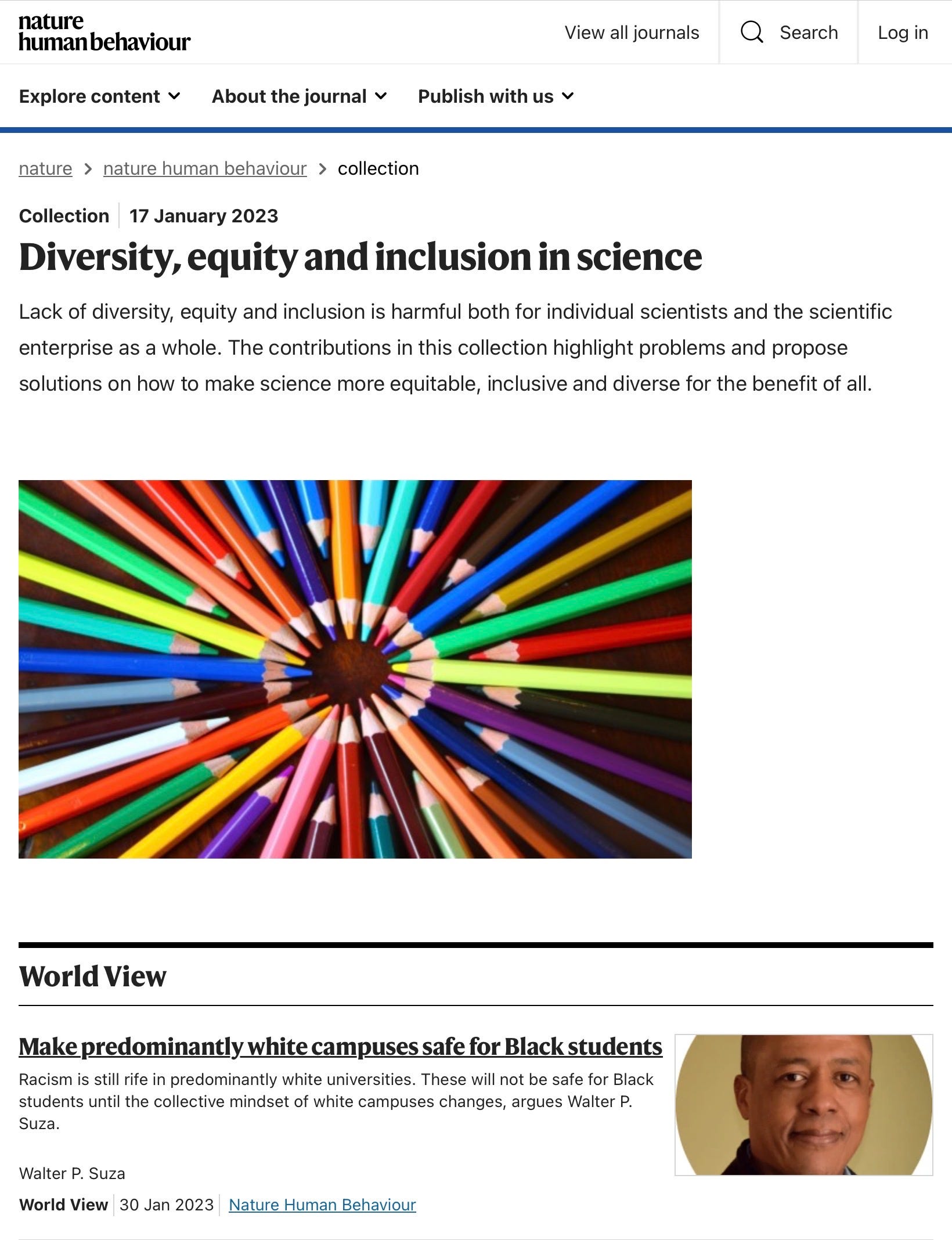
‘Diversity, equity and inclusion in science,’ Nature Human Behaviour, collection, 17 January 2023. https://www.nature.com/collections/daficfhiff
Tommaso Nannicini, Andrea Stella, Guido Tabellini, and Ugo Troiano, ‘Social Capital and Political Accountability,’ American Economic Journal: Economic Policy, 2013, 5 (2): 222–50. https://www.aeaweb.org/articles?id=10.1257/pol.5.2.222
Nathan Nunn, ‘Culture And The Historical Process,’ NBER Working Paper 17869, February 2012. http://www.nber.org/papers/w17869
Daphne Patai & Noretta Koertge, Professing feminism: Cautionary tales from the strange world of women’s studies, Basic Books/Hachette Book Group, 1994.
Jordan Peterson, Maps of Meaning: The Architecture of Belief, Routledge, 1999.
Kenneth M. Pollack, Armies of Sand: The Past, Present, and Future of Arab Military Effectiveness, Oxford University Press, 2019.
Charles Pincourt with James Lindsay, Counter Wokecraft: A Field Manual for Combatting the Woke in the University and Beyond, Imprint: Independently published, 2021.
Vivek Ramaswamy, Woke Inc,: Inside the Social Justice Scam. Swift, 2021.
Jonathan Rauch, Kindly Inquisitors: The New Attacks on Free Thought, University of Chicago Press, 1993.
Max Rollwage, Raymond J. Dolan, and Stephen M. Fleming, ‘Metacognitive Failure as a Feature of Those Holding Radical Beliefs,’ Current Biology, 28, 4014–4021, December 17, 2018. https://www.researchgate.net/publication/329724960_Metacognitive_Failure_as_a_Feature_of_Those_Holding_Radical_Beliefs
David Rozado, ‘Themes in Academic Literature: Prejudice and Social Justice,’ Academic Questions, (2022) 35.2. https://files.eric.ed.gov/fulltext/EJ1359140.pdf
Nicholas Shackel, ‘The Vacuity of Postmodernist Methodology,’ Metaphilosophy, Vol. 36, April 2005, 295-320. https://philpapers.org/archive/SHATVO-2.pdf
Thomas Sowell, Knowledge and Decisions, Basic Books, [1980] 1996.
Kathleen Stock, Material Girls: Why Reality Matters for Feminism, Fleet, 2021.
Will Storr, The Status Game: On Social Position And How We Use It, HarperCollins, 2022.
Cass R. Sunstein, Why Societies Need Dissent, Harvard University Press, 2003.
Robert Trivers, The Folly of Fools: The Logic of Deceit and Self-Deception in Human Life, Basic Books, [2011] 2013.
And we shouldn't underestimate how much of the progressive worldview is, essentially, a set of class prejudices and biases...
https://jmpolemic.substack.com/p/the-progressive-agenda-as-pure-class
Brilliant! Your systematic exploration of three foundational falsehoods of left progressivism covered everything, and covered it so well!
Thus, just for completeness: a while back I ran into this classification of four socialisms (class socialism - like the Soviets, etc.; fascism as civic duty socialism; National Socialism - enough said; and intersectional socialism). With progressives propagating intersectional socialism, I worry about the current and - I am afraid to think - what future disasters it may bring to human flourishing.
While looking into it again a few days ago, I found this: "Intersectional Socialism: A Utopia for Radical Interdependence" (https://academic.oup.com/policy-press-scholarship-online/book/56501). The abstract in the link is worth reading - it is a deadly serious academic trash - and reflects a lot of what Lorenzo criticizes.
I think Kipling's poem summarizes what Lorenzo stated in a way that has been and will be true for ages:
The Gods of the Copybook Headings
1
As I pass through my incarnations in every age and race,
I make my proper prostrations to the Gods of the Market Place.
Peering through reverent fingers I watch them flourish and fall,
And the Gods of the Copybook Headings, I notice, outlast them all.
2
We were living in trees when they met us. They showed us each in turn
That Water would certainly wet us, as Fire would certainly burn:
But we found them lacking in Uplift, Vision and Breadth of Mind,
So we left them to teach the Gorillas while we followed the March of Mankind.
3
We moved as the Spirit listed. They never altered their pace,
Being neither cloud nor wind-borne like the Gods of the Market Place,
But they always caught up with our progress, and presently word would come
That a tribe had been wiped off its icefield, or the lights had gone out in Rome.
4
With the Hopes that our World is built on they were utterly out of touch,
They denied that the Moon was Stilton; they denied she was even Dutch;
They denied that Wishes were Horses; they denied that a Pig had Wings;
So we worshipped the Gods of the Market Who promised these beautiful things.
5
When the Cambrian measures were forming, They promised perpetual peace.
They swore, if we gave them our weapons, that the wars of the tribes would cease.
But when we disarmed They sold us and delivered us bound to our foe,
And the Gods of the Copybook Headings said: "Stick to the Devil you know."
6
On the first Feminian Sandstones we were promised the Fuller Life
(Which started by loving our neighbour and ended by loving his wife)
Till our women had no more children and the men lost reason and faith,
And the Gods of the Copybook Headings said: "The Wages of Sin is Death."
7
In the Carboniferous Epoch we were promised abundance for all,
By robbing selected Peter to pay for collective Paul;
But, though we had plenty of money, there was nothing our money could buy,
And the Gods of the Copybook Headings said: "If you don't work you die."
8
Then the Gods of the Market tumbled, and their smooth-tongued wizards withdrew,
And the hearts of the meanest were humbled and began to believe it was true
That All is not Gold that Glitters, and Two and Two make Four–
And the Gods of the Copybook Headings limped up to explain it once more.
9
As it will be in the future, it was at the birth of Man
There are only four things certain since Social Progress began.
That the Dog returns to his Vomit and the Sow returns to her Mire,
And the burnt Fool's bandaged finger goes wabbling back to the Fire;
10
And that after this is accomplished, and the brave new world begins
When all men are paid for existing and no man must pay for his sins,
As surely as Water will wet us, as surely as Fire will burn,
The Gods of the Copybook Headings with terror and slaughter return!