

A lot of people who class themselves as being on the Left clearly feel that there is some automatic moral kudos from being on the Left. As a direct implication of this sense of moral kudos, they also clearly think that there is some moral deficiency from being on the Right.
Yes, there are difficulties in defining Left and Right. Nevertheless, even without that difficulty, any such claim of moral kudos is ridiculous. The Left includes Lenin, Stalin, Mao, Kim il-Sung, Pol Pot, Mengistu … Indeed, by far the most important historical impact of Left politics on world history is precisely the actions of this succession of mass-murdering tyrants and their regimes.
If you think that somehow the Left does not include said mass-murdering tyrants, you are simply wrong. It is very revealing that there are clearly many folk on the Left who somehow edit out this history. They are not looking at the Left as it is in history, but as some set of noble aspirations that morally ennoble themselves.
Folk not of the Left absolutely associate the Left with those mass-murdering tyrants. Moreover, if you edit out that history, you are editing out how the political tradition you identify with can go horribly wrong. That is not a reassuring pattern. On the contrary, it is a deeply worrying pattern.
Of course, if you are happy to be associated with some or all of those mass-murdering tyrants, that is even more of a worry.
Clearly, Left is not a moral category. It is a political category, not a moral one.
The same point applies, of course, about the Right. After all, the Right includes Hitler.

Thus, neither Left nor Right are moral categories. They are political categories, and political categories that people can get very tribal about. But they are not moral categories.
This point applies to other political categories: Socialist, for example. Hitler was a socialist. He called himself a socialist, he did socialist things, intended to do more socialist things after the war. In his writings, he argued in socialist ways.
The aforementioned mass-murdering tyrants were all socialists. They were implementing socialism on the way to communism, except for Hitler, who was using socialism as a tool to forge an Aryan super race worthy and able to dominate others. So, Socialist is not a moral category.
If you stop regarding broad political categories as also being moral categories, a lot of silly arguments go away. Such as, for example, whether Hitler was a socialist. Or, whether Hitler was of the Right. Yes, Hitler was a both a socialist and of the Right—which points to how diverse a range of political traditions Right applies to.
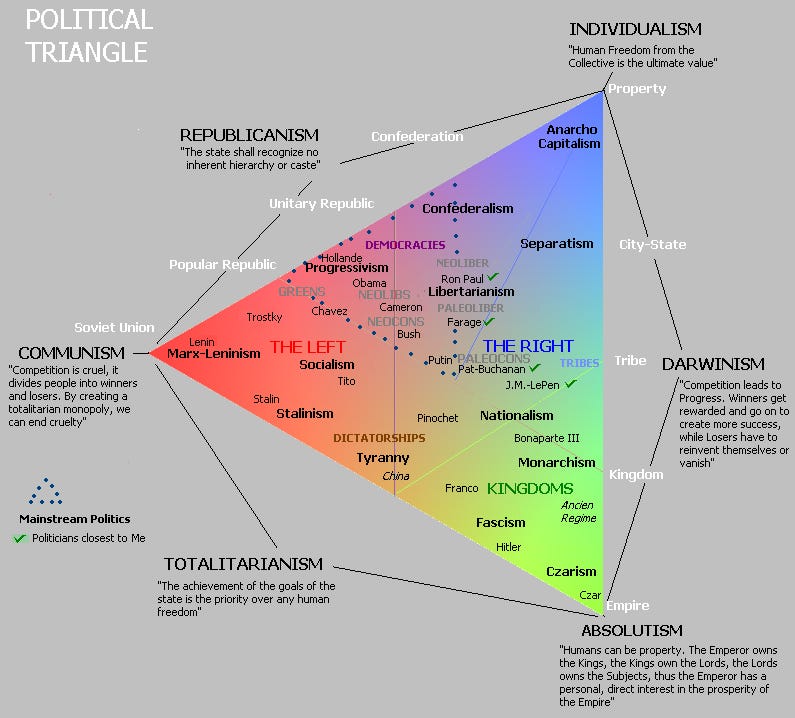
Even when there are grounds to attaching moral valence to political categories, that is something to be done carefully and sparingly, otherwise it can seriously get in the way of understanding.
Thus, using Fascist as a boo! word but Communist as a neutral, or even hurrah! word, is ridiculous. It is even more so when Fascist is used to obscure Nazis being National Socialists.
To create a Communist society requires mass appropriation (i.e., theft) of property, abolition of class differences and direction of all social effort to the transformation of humanity based on claims about Homo sapiens that are not true while using ludicrously inadequate analysis of social dynamics. This is a massive concentration of power over others based on falsehoods.
Of course Communism has demonstrated itself to be murderous, tyrannical and hostile to human flourishing. Indeed, the greater the commitment to the goals and claims of Communism, the more murderous, tyrannical and a disaster for human flourishing a regime has been.
This is all particularly so in the Marxist version—the only version of Communism of significance in modern history. For Marxism explicitly holds that there are parasite classes, whose elimination makes everyone else better off. All the Marxist mass murders used categorising people as exploitive parasites, or being lackeys thereof, as justification for mass killings.
In the 1917-1945 Bloodlands of Eastern and Central Europe that Lenin, Stalin and Hitler created; the Soviets mass-murdered deemed-parasite classes, the Nazis mass-murdered deemed-parasite races. Trying to parse moral differences between them in the face of such horrors is ridiculous.
They were also using different evolutionary strategies. The Nazis mobilised a culturally-connected—that they racially defined—set of lineages against other lineages, organised around territorial aggression, a very old pattern in our evolutionary history. Our evolutionary history includes plenty of genocides, though the Nazi scaled-up-through-industrialisation intensity was horribly new.
This is why the Nazis come across as atavistic and—in their murderous grading of entire races as unfit to live—as a profound affront to the moral universalism that Christianity embedded in Western Civilisation. But being a greater affront to particular moral sensibilities is not a moral category.
Communists use an aggressive, block-any-escape, version of a levelling down evolutionary strategy. A strategy of social aggression, eliminating those with more status and resources than themselves and transferring both status and resources through and to themselves (allegedly on behalf of others). During their respective Civil Wars, both the Bolsheviks in Russia and the CCP in China mobilised the least successful, the most angry and resentful, locals to kill the larger landowners and take their property, in a series of local massacres.

It is the moral arrogance that left-progressives so regularly display that they seek the social power to cement and enforce, hence the prevalence of dissent-suppressing mechanisms such “no debate” demands, blanket moralised condemnations, and so on. In the contemporary West, they use networking tactics rather than a centrally-directed Leninist Party, but it is the same social dominance exercise, generating many of the same patterns.
Thus, we have the equivalents of commissars/political officers (aka DEI officers, intimacy consultants, sensitivity readers, bias response teams, etc) whose “training” often involves little more than struggle sessions; Zhdanovism in the arts and literature (writer Jenny Lindsay writes about her experience, an example of much wider patterns); Lysenkoism in science and science publishing (see, for example); and censorship (originally paraded as “hate speech”, now being purveyed as anti-dis/mis/mal-information).
Notionally, the levelling-down strategy’s downward transfers are done for the general good, but there is a huge difference between those being equalised and those doing the equalising. Every Marxist revolution or takeover creates a highly exploitive bureaucratised activist elite as an inevitable consequence of the entire political project. For the total transformation of society requires total control of the society by the declared transformers.
The Bolshevik revolution in Russia was a dictatorship of the bureaucracy, not of the proletariat. But that is true, and inevitably true, of every Marxist revolution and takeover then and since. The NGO advocacy economy; the HR scolds; the moral-project bureaucracies; are the networked contemporary versions of this: a “softer, gentler” form of moralised predatory parasitism.
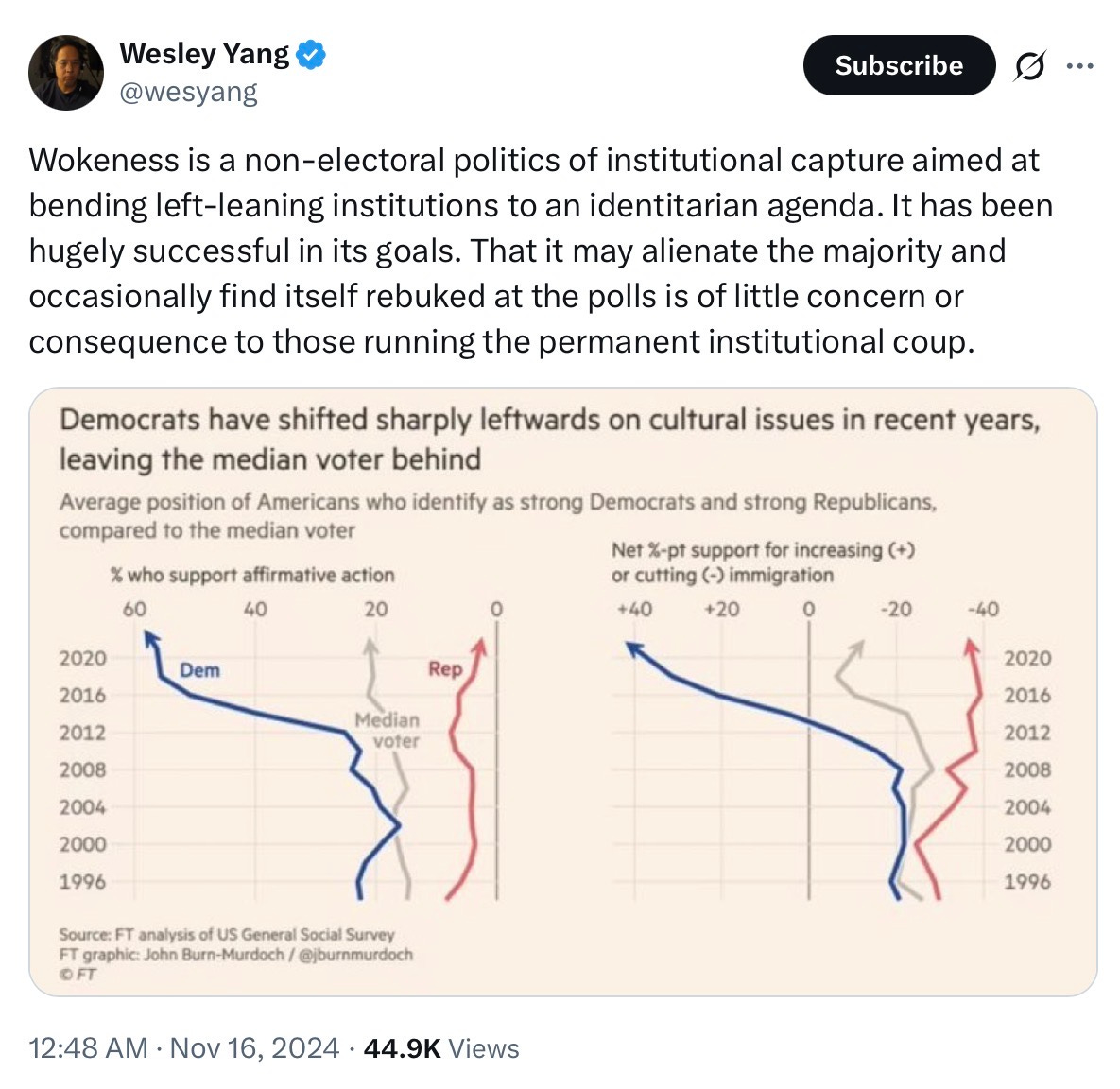
The levelling-down strategy turns some groups into righteous targets and others into righteous mascots. So, precisely because of its ostentatious commitment to equality, Left-progressivism creates moral caste systems.
DEI (Diversity, Equity, Inclusion) in contemporary Western societies is very much a moral caste system, that puts heterosexual “white” males at the bottom of the moral heap. Such moral caste systems are very apparent in the precursors to DEI: the Soviet Union’s Korenizatsiya program; Mao’s Black and Red identities; the Kim Family Regime’s Songbun system. (A short outline of the full horror of the last is here.)
The failure to confront the way their own political tradition metastasises by editing out the tyrannising mass murderers, and their regimes and their social control mechanisms, from their conception of the Left does, indeed, matter.
James Lindsay’s formulation that:
Communism represents progressive means to regressive ends;
Fascism [and Nazism] represent reactionary means to progressive ends
therefore has something to it. Marx conceived Communism as the return, on a global scale, to humanity’s “species being” as originally manifested in “primitive communism”: so, regressive ends. Left-progressivist politics, from the Jacobins onwards, has stressed the embrace of modernism, of new is better, of championing the socially disenfranchised: so, progressive means.
Conversely, Fascism and Nazism both wished to progress their favoured groups to a higher state of social being and achievement: so, progressive ends. They were clever adapters of the techniques and technology of mass politics. Nevertheless, their fetishising of military modes of social action, their glorification of the past and of military heroism, their explicit rejection of liberal and left notions of progress, their fondness for Roman imagery and forms, their corporatist harmonising of social orders (within the nation or the volk) are reasonably cast as reactionary or regressive means.
Moralised mislabelling
We are normative beings because we needed persistent and robust structures of cooperation to raise our biologically expensive children reinforced by the human predatory pattern. Hunting providing highly variable nutritional returns from day-to-day—so encouraging the pooling of risk via habitual sharing of food—further encouraged the evolution of norms as a basis for robust social cooperation.
Our emotions are a much more basic decision-making mechanism than our reason and well precede it in evolutionary development. Tribalism is also normative and can have great emotional power. Politics operates by mobilising shared emotions and sense of belonging. Normative is not the same as moral.
Such emotional and (yes, normative) tribalism makes it very easy to read political categories as also being moral categories. Easy to do, but wrong, no matter how much people seek to moralise the tribal affiliations of politics and find it congenial to do so. Political categories such as Left, Right or Socialist are not moral categories.
References
Cristina Bicchieri, The Grammar of Society: The Nature and Dynamics of Social Norms, Cambridge University Press, 2006.
Cristina Bicchieri, Norms in the Wild: How to Diagnose, Measure and Change Social Norms, Oxford University Press, 2017.
Frank Dikotter, Red Dawn Over China: How Communism Conquered a Quarter of Humanity, Bloomsbury, 2026.
Heather Heying and Bret Weinstein, A Hunter-Gatherer’s Guide to the 21st Century: Evolution and the Challenges of Modern Life, Swift, 2021.
Paul L. Hooper, Hillard S. Kaplan and Adrian V. Jaeggi, ‘Gains to cooperation drive the evolution of egalitarianism,’ Nature: Human Behavior, 5, 847–856 (2021). https://www.researchgate.net/profile/Adrian-Jaeggi/publication/349707572_Gains_to_cooperation_drive_the_evolution_of_egalitarianism/links/603e684392851c077f127935/Gains-to-cooperation-drive-the-evolution-of-egalitarianism.pdf
Timothy Snyder, Bloodlands: Europe Between Hitler and Stalin, The Bodley Head, 2010.
Jordan E. Theriault, Liane Young, Lisa Feldman Barrett, ‘The sense of should: A biologically-based framework for modeling social pressure’, Physics of Life Reviews, Volume 36, March 2021, 100-136. https://pubmed.ncbi.nlm.nih.gov/32008953/
Jessica C. Thompson, Susana Carvalho, Curtis W. Marean, and Zeresenay Alemseged, ‘Origins of the Human Predatory Pattern: The Transition to Large-Animal Exploitation by Early Hominins,’ Current Anthropology, Volume 60, Number 1, February 2019. https://ora.ox.ac.uk/objects/uuid:da2850f1-f415-4130-9d35-8ed23fdd6b89/files/r2b88qc185
To my mind politics, rightly conceived and consummated, is the social effort of crafting policy that allows for and tempers human nature to balance individual flourishing with community flourishing.
If there is any morality in politics, it is that the stability, social vitality, and individual purpose, part and parcel of healthily and honestly balancing these two competing forces, are good for both.
It is perhaps the most challenging of human endeavors. A very narrow and stoney path that requires an enormous amount of individual responsibility.
Hence the allure of the wide, smooth road of moralization. So much easier to offload responsibility onto others.
When it comes to looking stylish, the Nazis will always beat out the commies. That´s why the commies hate them.