

Speciation—the formation of new species—is perhaps the most startling claim in evolution by natural selection. We observe that species seem very stable things. Each species breeds within itself. If it can breed with another species—for example, tiger and lions can breed with each other—are they really separate species?
That there is some problem in defining the boundary of species is a bit of clue that defining sets of lineages as species is more complex than it looks. Even so, species look pretty stable things to us.
The fossil record tells us, however, that species come and go. That, and genetics, tells us that lineages “travel through” species. Your genetic lineage has passed through many, many species.
In particular, the fossil record tells us that, after each major extinction event, there is a surge in new species. For example, the most recent major extinction event—the asteroid impact that killed off the terrestrial and marine dinosaurs (birds survived)—led to a massive increase in mammal species.
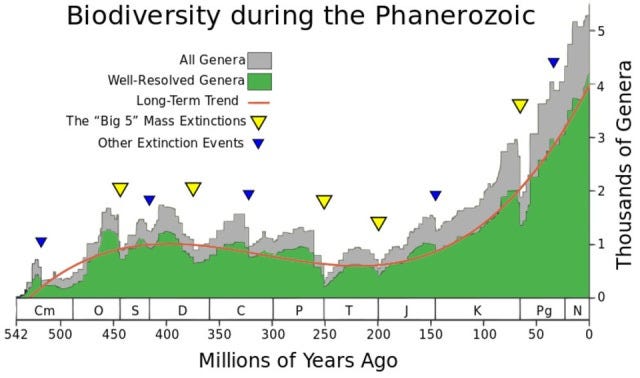
So, speciation is not a constant process. Not only that, during that period of a surge in new species, lineages spread out among to occupy, and in a sense create, a vast array of new-to-that-organism ecological niches. For example, prior to the arrival of humans, a range of ecological niches in New Zealand were occupied by bird species.
There is clearly a process of opportunity search going on. This can be reasonably seen as the exploration of frontiers.
These resource frontiers can be occupied along terrestrial (new physical spaces) and strategy/technique (new methods) frontiers or by supplanting a less capable occupants (population replacement/resource transfer). Despite birds—with their extra many millions of years of evolution—doing a range of things better than mammals (e.g. vision due to more colour receptors), various New Zealand bird species were not able to compete with introduced mammals that had adapted to similar niches in more competitive continental environments.
Each species occupies an ecological niche. Lineages within that species compete to occupy the available ecological niches. This is normal natural selection. Post-extinction surges in new species are a surge in occupied niches, in evolutionary strategies, for that group of species. Strategy shifts that would not have been competitive before the harrowing of species suddenly become so.
Living organisms constantly search for opportunities to eat and breed. This is a matter of competition and opportunity. After a mass extinction event, there is considerably less competition and many more opportunities. It is not that the processes of search have sped up, it is that those processes have way more opportunities to find successful, new-to-the-lineage, strategies. Lineages spread out among these opportunities, becoming new species on the way. Mutations do, however, speed up in occurrence as populations increase.
What is odd about Homo sapiens is that, being a technological and cultural species, we create varied social niches within our species—first a few, then scores, then hundreds, then thousands then … of such social niches. Moreover, we can move between niches.
Elite overproduction, for example, represents heightened competition for elite niches. This can lead to civil war, revolution within a polity, or even the collapse of a polity. One of the many things Marx gets wrong is that states—by their imposition of order and extraction by taxation that greatly increases available surplus: aka resources beyond subsistence—dramatically increase the number, range and form of social niches. This effect includes generating what we might call the society’s class structure.
Jungle environments have way more species occupying similar niches than do desert environments because there are more resources to support more niches. More lineages can sustain themselves through very similar strategies.
Similarly, state societies have way more, and more varied, social niches than stateless societies because, once again, they generate far more resources than do stateless societies. This is due to state taxation both extracting and thereby creating surplus plus the creation of more extensive social order enabling a greater range of transactions and connections.
You can get a lot more spontaneous (social) order when a state is able to impose sufficient order through its suppression of violence so as to regularise its revenue extraction. The combination of increased population plus assets to fight over (farms and herds) led to a massive harrowing of male lineages until the new social strategy of chiefdoms and states developed.
The process of new lineages occupying ecological niches that is so dramatic after a mass extinction event, is clearly not just a process of selection acting on random mutations. The question is whether random mutations—and particularly useful-for-survival random mutations—happen fast enough? Or is the feedback between search and genetic change stronger than that? What all those vacant niches after an extinction event means is that the bar of viable mutations, and of good-enough strategies, gets lowered.
Lactase persistence
What raised my doubts about whether the conventional story is sufficient, is the evolution of lactase persistence in Homo sapiens. Any human population that persists in pastoralism long enough develops lactase persistence—the continuation into adulthood of the capacity to digest lactose. This despite humans having relatively long generations—20-25 years or more. A recent study of late Roman and post-Roman Central Europe found an average length of generations of 28 years.
Moreover, those pastoralist populations do not develop the same mutation for lactase persistence. This suggested that it is not just some process of random mutations, that there is a mechanism of search for opportunities, of strategy-gene feedback, that is more directional than selection on random mutation. It turns out, however, that lactase persistence is a particularly easy mutation to evolve as it merely requires breaking an instruction to change the digestive response to lactose, and there are various ways to break that instruction.
Perhaps the most striking feature of living organisms—things that use information and resources to maintain themselves, what I call their directedness—is that they are anti-entropic. Right down to the cellular level, they act to reduce entropy; to incorporate what maintains or increases order within themselves and to expel what reduces it.
Life incorporates multi-level equivalents of Maxwell’s Demon. Given both the explosion of new species after a mass extinction event, and the varied evolution of lactase persistence in human pastoral populations, this anti-entropic feature, this directedness, perhaps extends down to gene-strategy feedbacks.
How? Have no idea. But this is a question that rests on how common mutation is—really quite common, as it happens, and it gets more common as our population increases. The question rests even more on how common useful mutations in particular evolutionary contexts are. The answer to that is: it depends.
One suspects, for example that mutations breaking the instruction to stop digesting lactose have turned up quite a lot. But as it was usually advantageous to wean children so one could have the next one—given how high infant mortality was—such mutations did not go anywhere until you had populations that were consuming a lot of dairy, when it suddenly became an advantageous, rather than disadvantageous, mutation.
Spiteful mutants?
But mutations can spread without being advantageous to the larger population, just particular lineages. Cancer, for example, represents cells defecting from cooperation. From each according to his abilities, to each according to his needs is the principle of both families and cancer cells.
If you are sickly (e.g. Antonio Gramsci) or physically unfortunate (e.g. Rosa Luxembourg) then that is going to degrade your experience of society. Physically attractive people are more likely to be conservative while conservative politicians are more likely to be physically attractive. Likely due to different distributions of cognitive traits, conservatives report better mental health than progressives. There is something to Josh Slocum’s notion of “wokery” as including the revenge of the uglies.
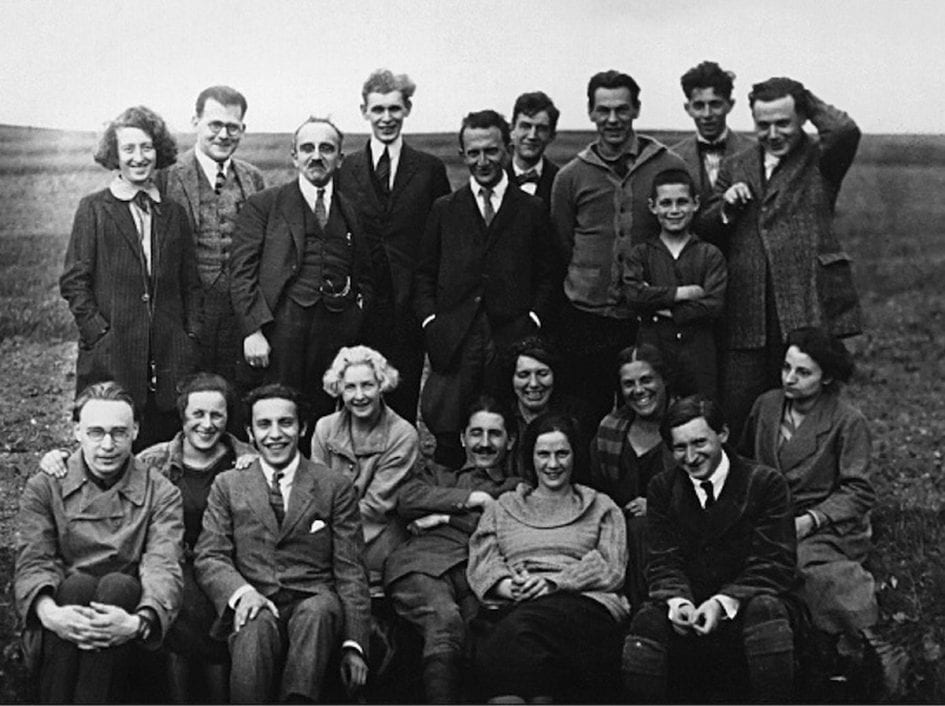
The problem becomes if you engage in grandiose theorising on the basis of personal alienation and then inflict such ideas on the rest of us. This leads to the spiteful mutant hypothesis. A rather grim hypothesis. I leave you with a picture of the members of the Frankfurt School.
References
Ali Akbari, Annabel Perry, Alison R. Barton, et al. ‘Ancient DNA reveals pervasive directional selection across West Eurasia,’ Nature (2026). https://reich.hms.harvard.edu/sites/reich.hms.harvard.edu/files/inline-files/2026_Akbari_Nature_selection_0.pdf
Jens Blöcher, Leonardo Vallini, Maren Velte et al, ‘Demography and life histories across the Roman frontier in Germany 400–700 CE,’ Nature (2026). https://www.nature.com/articles/s41586-026-10437-3
Gregory Cochran and Henry Harpending, The 10,000 year explosion : how civilization accelerated human evolution, Basic Books, [2009] 2010.
Pascale Gerbault, Anke Liebert, Yuval Itan, Adam Powell, Mathias Currat, Joachim Burger, Dallas M. Swallow and Mark G. Thomas, ‘Evolution of lactase persistence: an example of human niche construction,’ Philosophical Transactions Royal Society B, 2011 Mar 27;366(1566):863-77. https://pmc.ncbi.nlm.nih.gov/articles/PMC3048992/
Monika Karmin, et al., ‘A recent bottleneck of Y chromosome diversity coincides with a global change in culture,’ Genome Resources, 2015 Apr;25(4):459-66. https://pmc.ncbi.nlm.nih.gov/articles/PMC4381518/
Joram Mayshar, Omer Moav, Zvika Neeman, ‘Geography, Transparency, and Institutions,’ American Political Science Review, June 2017, 111, 3. 622-636. https://warwick.ac.uk/fac/soc/economics/research/workingpapers/2016/twerp_1129_moav.pdf
Joram Mayshar, Omer Moav, Luigi Pascali, ‘The Origin of the State: Land Productivity or Appropriability?,’Journal of Political Economy, April 2022, 130, 1091-1144. https://www.researchgate.net/publication/356707920_The_Origin_of_the_State_Land_Productivity_or_Appropriability
Tian Chen Zeng, Alan J. Aw & Marcus W. Feldman, ‘Cultural hitchhiking and competition between patrilineal kin groups explain the post-Neolithic Y-chromosome bottleneck,’ Nature Communications, 2018, 9:2077. https://www.nature.com/articles/s41467-018-04375-6
I usually think it's ugly and unfair to bring someone's personal appearance into the analysis of their writing and public statements and persona, but then again, sometimes it's hard not to. (The Italian poet Leopardi was a misanthropic hunchback and back then they just said, "Of course he's miserable, take a look at him!")
Take a gander at the NYT's resident anti-Jewish Jew (well, one of many), the they/them hormonal concoction that calls itself "M" Gessen:
https://www.nytimes.com/by/m-gessen
Then there's the famous feminist Andrea Dworkin:
https://en.wikipedia.org/wiki/Andrea_Dworkin
But regardless of which side they're on, I think we all meet people who seem unhappy, unbalanced, somewhat unkempt and misshapen, while also obsessive about the news and the evil of their political opponents and who pour their hearts and souls into "politics"—but it's obvious denial and and displacement.
Taking a cold hard look at yourself in the mirror, in all ways, is the hardest task of all; blaming "society" is the easiest.
Also, how much booze would you need for a Frankfurt School orgy!?! Maybe a gallon of vodka and a blindfold to start....
Thanks!
If “.. lactase persistence is a particularly easy mutation to evolve as it merely requires breaking an instruction to change the digestive response to lactose, and there are various ways to break that instruction.”
Then the theory of random mutation and selection works fine. Any mutation delaying the intolerance to lactose is rewarded in pastoralists, thus spreading over generations.