

In a recent post on Helen Dale’s Substack, I discussed the ongoing consequences of the Neolithic Y-Chromosome Bottleneck. In the words of Wikipedia:
The Neolithic Y-chromosome bottleneck refers to a period around 5000 BC where the diversity in the male y-chromosome dropped precipitously across Africa, Europe and Asia, to a level equivalent to reproduction occurring with a ratio between men and women of 1:17. Discovered in 2015, the research suggests that the reason for the bottleneck may not be a reduction in the number of males, but a drastic decrease in the percentage of males with reproductive success in Neolithic agropastoralist cultures, compared to the previous hunter gatherers.
A comment on Arnold Kling’s response post suggested I did not understand the phenomenon, citing a post by Greg Cochrane on his blog.

In understanding the bottleneck, one needs to understand that bottleneck itself was a limited-in-time phenomenon that, nevertheless, extended across generations. It was a sorting process that most male lineages did not survive even if, in any particular generation, a large proportion of men were reproducing. To understand the phenomenon, both its beginning and it (mostly) ending has to be understood.
That the bottleneck was limited in time is why an explanation resting on patrilineality and polygyny is not sufficient. Both of these things played a role in the bottleneck, but both of the these things also continued past when the bottleneck (mostly) stopped.
It is also important to separate out some male lineages having wildly disproportionate reproductive success from the large-scale elimination of male lineages. This distinction is clearest with the Han “super-grandfathers”. China had a combination of features that fostered a continuing pattern of some male lineages being wildly disproportionately successful in reproducing. It had a polygynous elite, which absolutely favours some male lineages doing disproportionately well, reproductively speaking, especially in combination with a patrilineal kin system.
China also had a non-reproducing underclass. China did not import many women relative to its population. So the transfer of women up the social scale to the polygynous elite meant that a rolling pool of men at the bottom of society were deprived of potential breeding partners. This systematic frustration of underclass breeding possibilities had a great deal to do with the banditry and peasant revolts that were such a feature of Chinese history.
Such a pattern absolutely produces wildly disproportionately reproductively-successful male lineages. It is a sorting process. It has effects on Chinese culture and distribution of genetic traits within the Han population. But it is not a male lineage bottleneck. Most male lineages continued.
A time-specific process
Why the Neolithic Y-Chromosome Bottleneck started is not hard to work out and I alluded to it in the post. The development of farming and pastoralism both greatly increased the human population and generated assets (farms and herds) worth fighting over.
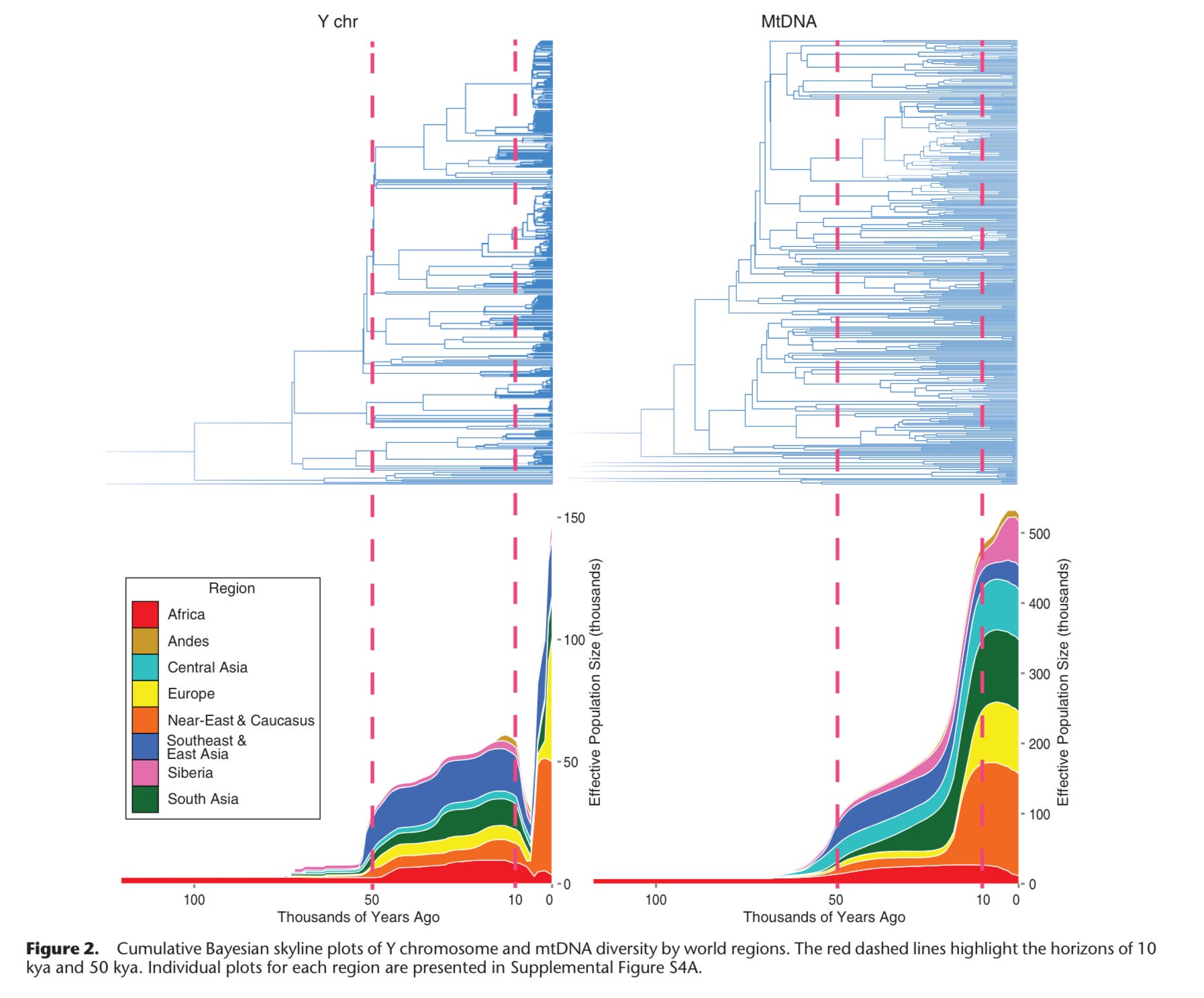
Kinship systems thus evolved and intensified to increase warrior cooperation, both to defend such assets and to seize them. Successful seizure means killing or enslaving the losing men and taking (and breeding with) their women. Do this over enough generations, and there will be systematic elimination of male lineages at scale. You can see this process particularly clearly in the population replacements uncovered by the “ancient DNA” technology.
So, what brings this bottleneck to an end? Creating a situation where winning teams have a reason to keep defeated/conquered males alive and breeding. There are names for this reason: tribute and taxes. Having conquered males retained—and indeed protected—so they then breed more generations of tribute- and tax- payers becomes the superior social strategy. Thus tribute, and especially taxes, is the social technology of exploitation ameliorating the social technology of aggression.
In evolutionary terms, we would expect one of two things to occur as a result of the harrowing of male lineages. One, that the capacity of male teams would tend to equalise across the sorting process. Two, that some alternative social strategy would evolve. Chiefdoms and states represent that alternative social strategy.
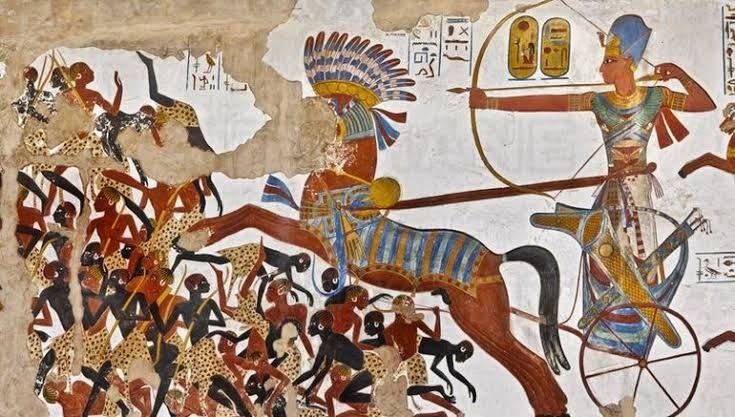
“I am mighty, I protect you from border raiders” is a regular artistic trope of rulers. The chariot-riding pharaohs of New Kingdom Egypt were particularly fond of it.
The protection-by-the-state social strategy was only available to kick-off if there were seasonal crops that provided storable food as a tax base. On the other hand, the more one relied on seasonal crops—so food and seed storage—the more incentive there was to develop/acquiesce in such a protection strategy.
The point of my original post was not about how long the harrowing of male lineages took, it was that there was (1) differential selection between male and female expression of genes (clearly true, and true quite intensely); and (2) this differential selection was particularly focused on the capacity for team work. Conquest is the ultimate expression of successful team work. But so is much of success within polities.
Note, the massive reduction in the harrowing of male lineages does not stop some male lineages being wildly reproductively successful. It does not even stop male lineages terminating. What the development of chiefdoms, and particularly states, does mean is that the male lineage bottleneck mostly goes away. The harrowing of male lineages enormously reduces.
In stateless societies, male teams—typically organised as clans—can engage in particularly brutal forms of “self-help”. Much of the function of states is precisely to suppress such “self-help” so as to protect taxpayers so they can breed more taxpayers. Chiefdoms, and especially states, organise to block the harrowing of male lineages at scale within their own territories even while they continue to enable some male lineages to be wildly disproportionately reproductively successful within—or perhaps beyond—those territories.
Foragers, farmers and pastoralists
There are some further wrinkles in this. Most eliminations of human populations in history have been elimination of forager populations, either by fellow foragers or by incoming farmers.
Foraging populations have low population densities. It is relatively easy to push their numbers below the level where they can sustain their technology; foraging populations cannot readily incorporate captives in any numbers; and there is limited transferrable skills into farming. Such elimination of forager populations has very limited differentiation between male and female lineages.
Interactions between pastoralists and farmers have a rather different dynamic. Pastoralists have higher protein diets, operate in patrilineal systems specifically evolved to create resilient and effective warrior teams, and are far more mobile, than farmers. There is a long history of pastoralists raiding, and periodically conquering, farmers. Pastoralists eliminating farming populations is much rarer, as the farmers usually dramatically outnumbered them—which makes the pattern of periodic conquest of farmers by pastoralists even more striking.
Meat-eating folk on horses (or in ships) raiding, and militarily dominating, mostly plant-eaters has a long history. The pattern is particularly intense when those mostly plant-eating farmers spend their time in water-logged fields full of pathogens and parasites. Notice how often the Nile, Tigris, Euphrates, Indus, Ganges and Yellow River valleys were conquered by pastoralist elites.
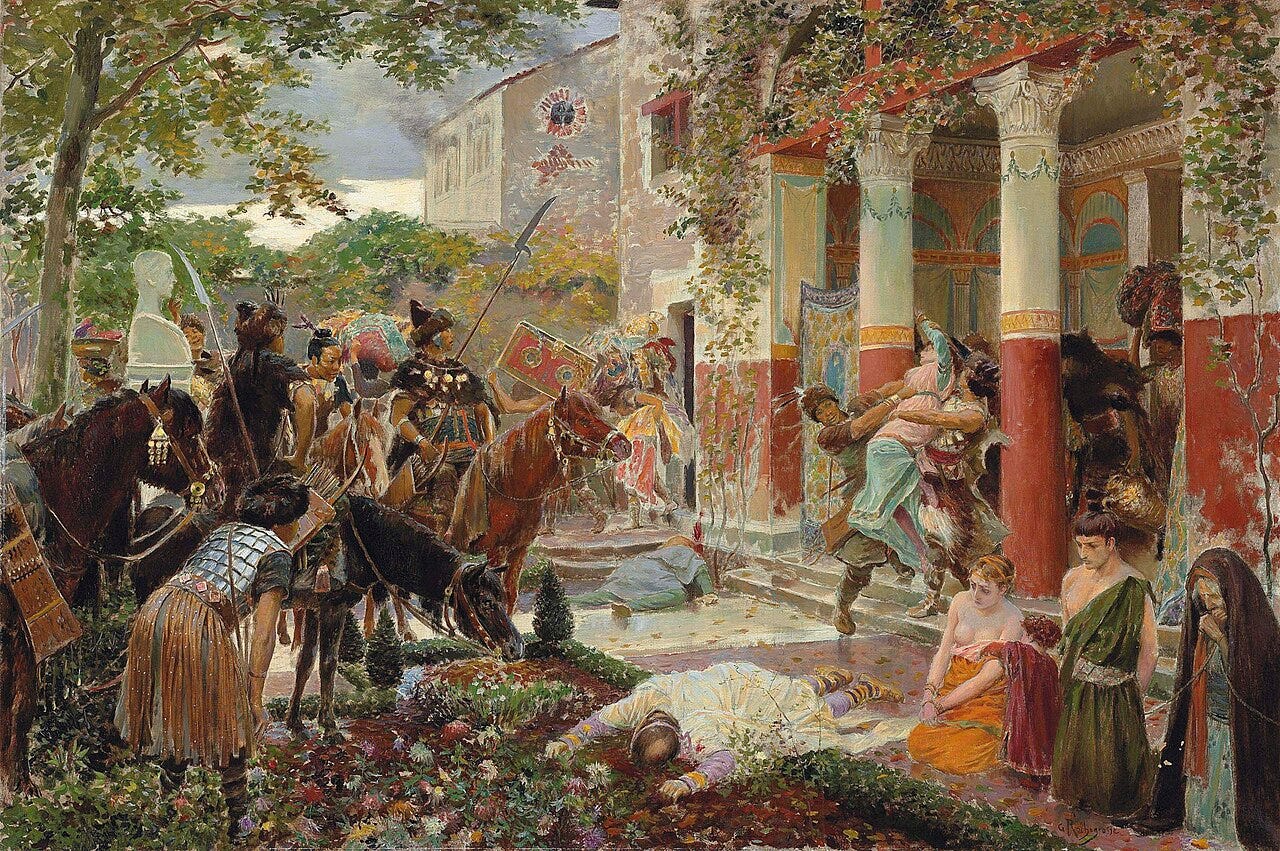
There was a lot of women-stealing, and just plain slaving, involved in pastoralist raiding. Eastern Europe continued to be ravaged by pastoralist slave raids into the third quarter of the C18th. The Cossacks formed in response, as essentially Christian warrior-pastoralist and river-pirates, raiding back against raiding and enslaving Muslim pastoralists. The Muscovite state created a series of border fortifications to defend against pastoralist slave raids.
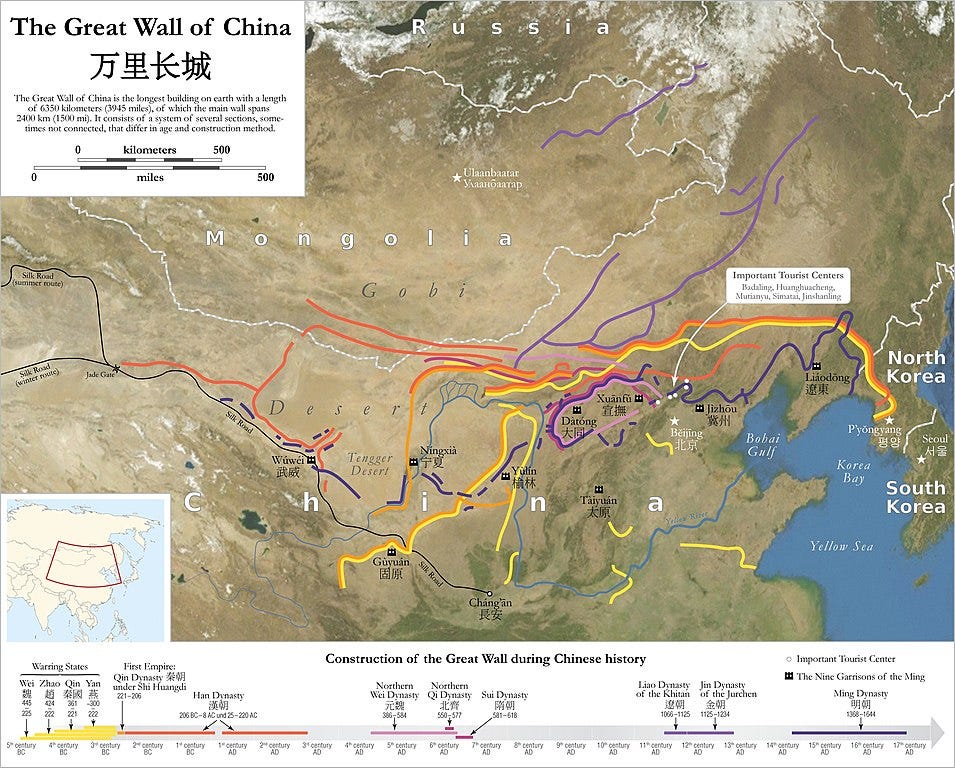
The Habsburg Militärgrenze (Military Frontier) was a similar response to protecting taxpayers from border raids. Farmer polities building border walls to block pastoralist raiders has a millennia-long history, including by far the most famous such border wall—which itself is part of a much longer pattern.
Farmer-pastoralist tensions continue to the present. A long history of a pastoralist elite (Tutsis) dominating farmers (Hutus) was a large part of the back history of the 1994 Rwanda Genocide of mostly Tutsis. The 2003-2005 Darfur Genocide was largely Arab pastoralists massacring Nilo-Saharan farmers. Syria has been experiencing clashes between Druze farmers and Bedouin pastoralists.
The farmers typically saw the pastoralists as thieving, murdering, raping, enslaving bastards. The pastoralists typically saw the farmers as weaklings who could not defend their own. In accordance with stereotype accuracy, they were both correct. It is not surprising that, if you give farming populations gunpowder weapons, and the organising capacity to use them, they become quite enthusiastic about killing pastoralists.
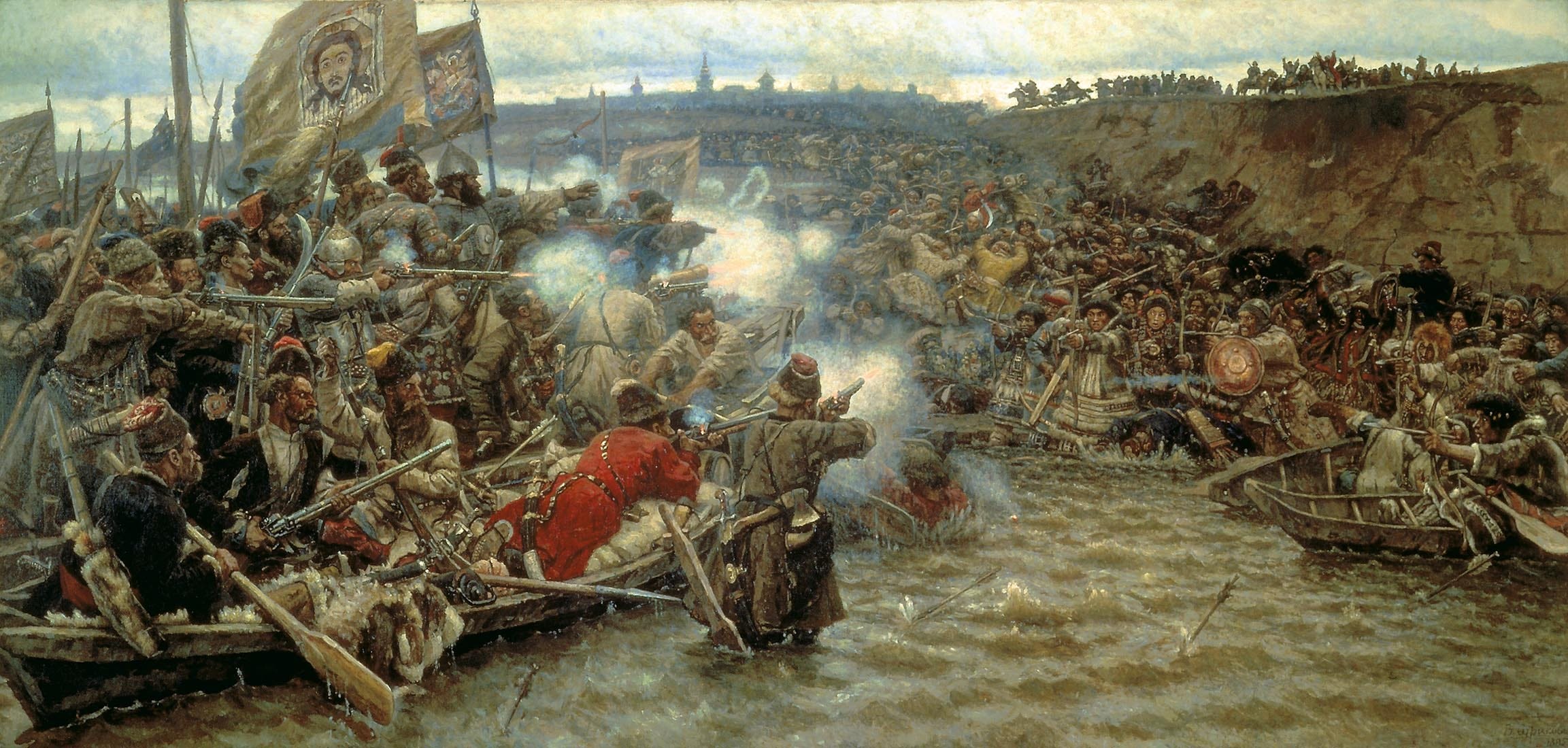
Nor is it remotely surprising that so many of the “super breeder” male lineages are from pastoralist societies. Pastoralists add recurrent violence to polygyny and patrilineality. In doing so, they provide a pattern for understanding the Neolithic Y-Chromosome Bottleneck in a world without—because before—states.
The social technology of states is like the food technology of farming. It starts in identifiable origin locations and spreads out from there. Farming populations spread as invaders. Similarly, far more of the world had states imposed on them than were origin points for states. This is part of why the Marxian view of states as subordinate-to-the-class-structure “creations” of their societies is so mistaken.
The reason why there was never another Roman Empire is that the Romans spread the social technology of statehood—albeit often through emulation—too far across Europe and Europe’s geography (unlike China’s) strongly militated against successful political union.
The Mediterranean itself encouraged political unification, but not if there were too many powerful states to its North getting in the way of such unification. As both the Eastern Roman and the Ottoman Empires discovered. The EU is not a conquest polity, so the geography is much less of an issue, even without considering how modern technology reduces geographical constraints.
Historical demographer Peter Turchin has argued that interactions between farmers and pastoralists encouraged the development of large empires through a mutual spiralling-up of raiding-and-resistance interactions. I would add that pastoralists are also traders. There is clearly an interactive correlation across history between the level of trade and the extent of empires: an interactive correlation that collapsed after 1945.
One of Africa’s many geographical and ecological disadvantages is that the tsetse fly stopped the African savannah acting like the Eurasian steppes. The savannah was unable to support pastoralist societies that could act as conduits for trade, technology and ideas while providing a prod for state formation. Yes, one could reasonable argue that, in terms of institutional learning and development, Northwestern Europe and Japan were both advantaged by being out of range of the Steppe pastoralists. Nevertheless, both civilisational regions still regularly benefited from the trade-and-transmission role of the steppes.
Modern oddities
One of the many, many oddities of the modern world is we have these very highly-taxing states who are presiding over fertility rates that are below population replacement. They are substantially failing to breed sufficient new taxpayers to sustain themselves. It is one of the reasons cited to engage in mass immigration. The point is, as the UN put it, to replace the children the locals are not having with foreigners.
The trouble is, this is so often being done incompetently, bringing in low-skill, low capital, workers who make the welfare states less sustainable. Moreover, immigrants often then proceed to replicate the fertility collapse of the locals.
Some of this is straightforward social-pathology parasitism: aka the welfare state. If you pay folk and organisations according to how many social pathologies there are, they will have an obvious interest in promoting social pathologies and further demands on the welfare state—such as from low-skill, low-capital, immigrants. They will certainly have no interest in solving or reducing such pathologies that thereby reduces their claims on resources. Have enough such networks and they will generate weird-and-wonderful politics to match.
Some of this is having elites made up of non-hereditary office holders, so with short time-horizons. There are many problems with hereditary elites, but they do have the advantage of longer time-horizons. That, plus clear succession rules, inter-generational transfers of skills and advantages in building connections, are why hereditary elites are so common in history. On the matter of incentives and time-horizons, patronage by aristocratic elites shelling out their own funds, and who cared about their reputation, generated great art, music, buildings, literature and the Scientific Revolution. Bureaucrats handing out other people’s money as grants have generated fashionable sludge, feminist Glaciology and the replication crisis.
Some of this is urbanisation, as cities tend to be demographic sinks: especially apartment block cities. Cities, especially apartment blocks, tend to strongly select against the large family “tail” that is needed to sustain positive fertility rates.
Some of this is the loss of male bargaining power, particularly lower down the social scale. The bargain of male protection and provision, in return for women providing children, that has been the basis of human mating for almost our entire history as a species, has broken down across much of modern industrialised societies.
There is also the problems of the social media panopticon and device-distraction that gets in the way of modern dating, or even just socialising. Our technological development is creating evolutionary novelties on an unprecedented scale that are way outstripping our evolutionary adaptations.
So, lots going on. Nevertheless, the Neolithic Y-Chromosome Bottleneck is not a particularly mysterious process and generated different selection effects on the male and female expression of genes, whose echoes are still with us, as discussed in the original post.


References
Patricia Balaresque, Nicolas Poulet, Sylvain Cussat-Blanc, Patrice Gerard, Lluis Quintana-Murci, Evelyne Heyer & Mark A. Jobling, ‘Y-chromosome descent clusters and male differential reproductive success: Young lineage expansions dominate Asian pastoral nomadic populations,’ European Journal of Human Genetics, January 2015. https://www.nature.com/articles/ejhg2014285
European Commission, Projecting The Net Fiscal Impact Of Immigration In The EU, EU Science Hub, 2020. https://migrant-integration.ec.europa.eu/library-document/projecting-net-fiscal-impact-immigration-eu_en
David Friedman, ‘A Theory of the Size and Shape of Nations,’ Journal of Political Economy, Vol.85, No.1, Feb. 1977, 59-77. https://www.researchgate.net/publication/24107762_A_Theory_of_the_Size_and_Shape_of_Nations
David Frye, Walls: A History of Civilization in Blood and Brick, Faber & Faber, 2018.
Léa Guyon, Jérémy Guez, Bruno Toupance, Raphaëlle Chaix, ‘Patrilineal segmentary systems provide a peaceful explanation for the post-Neolithic Y-chromosome bottleneck,’ Nature Communications, 15, 3243 (2024). https://www.nature.com/articles/s41467-024-47618-5
Monika Karmin, et al., ‘A recent bottleneck of Y chromosome diversity coincides with a global change in culture,’ Genome Resources, 2015 Apr;25(4):459-66. https://pmc.ncbi.nlm.nih.gov/articles/PMC4381518/
Joram Mayshar, Omer Moav, Zvika Neeman, ‘Geography, Transparency, and Institutions,’ American Political Science Review, June 2017, 111, 3. 622-636. https://warwick.ac.uk/fac/soc/economics/research/workingpapers/2016/twerp_1129_moav.pdf
Joram Mayshar, Omer Moav, Luigi Pascali, ‘The Origin of the State: Land Productivity or Appropriability?,’Journal of Political Economy, April 2022, 130, 1091-1144. https://www.researchgate.net/publication/356707920_The_Origin_of_the_State_Land_Productivity_or_Appropriability
Daniel Seligson and Anne E. C. McCants, ‘Polygamy, the Commodification of Women, and Underdevelopment,’ Social Science History (2021), 46(1):1-34. https://www.researchgate.net/publication/354584406_Polygamy_the_Commodification_of_Women_and_Underdevelopment
Peter Turchin, ‘A theory for formation of large empires,’ Journal of Global History, (2009), 4(2), 191-217. https://peterturchin.com/wp-content/uploads/2023/06/Turchin_JGH_2009.pdf
Mark S. Weiner, The Rule of the Clan: What an Ancient Form of Social Organization Reveals About the Future of Individual Freedom, Picador, 2014.
Shi Yan, Chuan-Chao Wang, Hong-Xiang Zheng, Wei Wang, Zhen-Dong Qin, Lan-Hai Wei, Yi Wang, Xue-Dong Pan, Wen-Qing Fu, Yun-Gang He, Li-Jun Xiong, Wen-Fei Jin, Shi-Lin Li, Yu An, Hui Li, Li Jin, ‘Y chromosomes of 40% Chinese descend from three Neolithic super-grandfathers,’ PLoS One, 2014 Aug 29;9(8):e105691. https://pmc.ncbi.nlm.nih.gov/articles/PMC4149484/
Tian Chen Zeng, Alan J. Aw & Marcus W. Feldman, ‘Cultural hitchhiking and competition between patrilineal kin groups explain the post-Neolithic Y-chromosome bottleneck,’ Nature Communications, 2018, 9:2077. https://www.nature.com/articles/s41467-018-04375-6
I got hung up on China, even though it's not the point here. I find it fascinating that China would consider male offspring superior, when their female offspring have a higher chance at upward social mobility. I guess social preferences tend to come from the top down, so the plight of underclass men would not be relevant in the predominant tastes.
In Decline of the West (1917), Oswald Spengler predicted that Europe would hold “the sterile male and the unfruitful woman.” He predicted that children would no longer be needed because there wouldn't be a reason for their existence. It should be no surprise that fatherhood itself, as opposed to motherhood, is essentially rudderless and lacking in meaning within our era.