

Two English-speaking democracies on the opposite sides of the planet have had elections within a few days of each other that have much the same message.
In Australia, in the Saturday 9 May 2026 by-election for the seat of Farrer—a House of Representatives seat that had previously been held by a Leader of the National Party (Tim Fischer) and of the Liberal Party (Sussan Ley)—the national populist One Nation candidate romped home with 40% of the vote on a stunning 33 %pt swing. By contrast, the Liberal and National Party candidates in Farrer totalled 22% of the vote between them. The winning candidate—the first One Nation candidate elected to the House of Representatives—is a figure of genuine gravitas.
This dramatic win was a manifestation of the One Nation surge in the polls that has been occurring since the 3 May 2025 Australia Federal Election and surged further after the 14 December 2025 Bondi massacre—so that One Nation is now outpolling the LNP Coalition federally. This polling surge has now become a voting surge, with the Farrer by-election win and the 21 March 2026 South Australian State election, where One Nation also gained more votes than the Liberal Party.
I have previously posted on why a Party (One Nation), that has been around for decades, is suddenly surging in the polls, and now in votes.

It has become an open question whether the Liberal Party continues to have a serious base of support. If social conservatives hive off to One Nation, and affluent Merchant Right folks vote for Teal independents, it is hard to see where their base of support is.
The Liberal Party membership has been atrophying for years. Much of its recent politics appears to have been driven by young political staffers of limited life experience who seem to think getting coverage on the public broadcaster—the ABC—is the height of political achievement. A similar pattern appears to have afflicted the Tories in Britain, prior to their crushing defeat in the 4 July 2024 UK General Election.
Meanwhile, in Blighty …
On Thursday 7 May 2026, so a few days prior to the Farrer by-election, elections were held for the Welsh and Scottish Parliaments and various English local councils.
The Welsh and English elections were catastrophic for the Labour Party. In the Welsh Parliament, Labour lost 35 seats, leaving it with 9. In English local councils elections, Labour lost 1,496 seats, winning only 1,068 seats. Given that Sir Keir Starmer is by far the most unpopular British Prime Minister since polling began, the Labour Party is clearly in lots of trouble.
The Scottish results were merely poor for Labour, losing 4 seats and winning 17 in the Scottish Parliament.
The election results were almost as bad for the Tories in Wales and England, and worse in Scotland. They lost 19 seats in the Scottish Parliament, winning 12. They lost 22 seats in the Welsh Parliament, winning 7. They lost 563 seats in English local councils, winning 801.
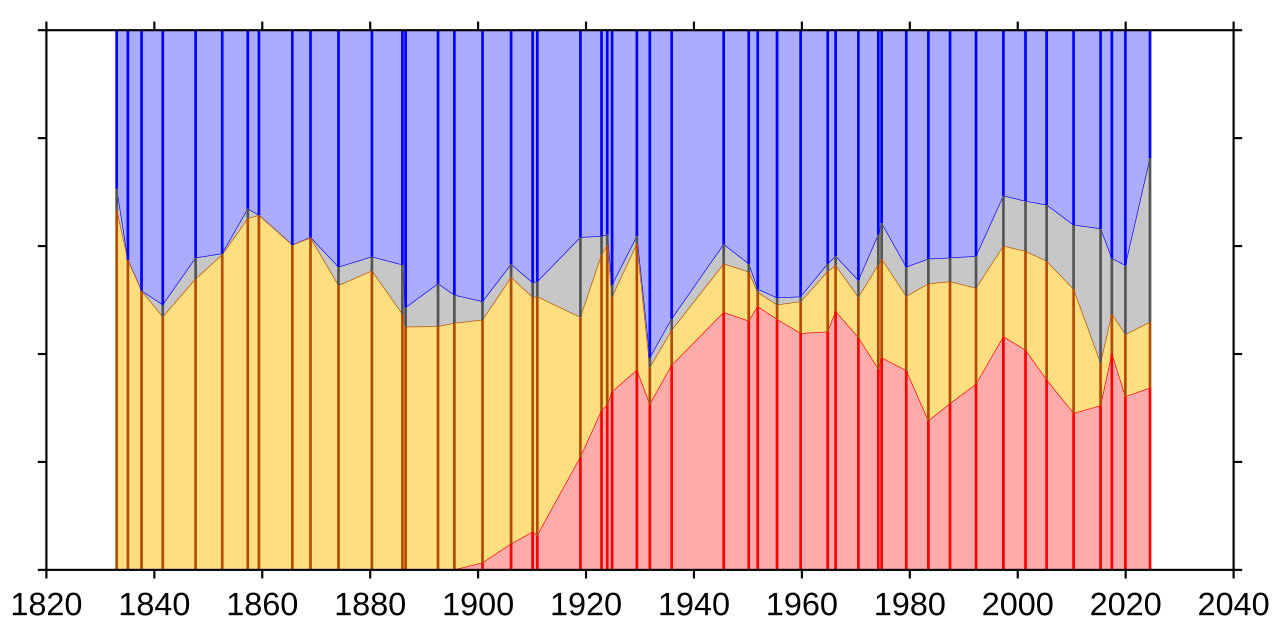
The two Parties that have governed the United Kingdom since just after World War One have been crushed. The Tories have been reduced to the fifth place in the Scottish Parliament, the fourth place in the Welsh Parliament and in wins in the English local council elections. Labour has retained second place in the Scottish Parliament, been pushed to second place in wins in the English local council elections, while being reduced from first to third in the Welsh Parliament.
Labour and the Tories lost 57 seats between them in the 96-seat Welsh Parliament. They “only” lost 23 seats in the 129-seat Scottish Parliament, where the SNP also lost 6 seats. Of the 4,967 English local council seats being voted on, Labour and the Tories lost 2,061.
Labour lost more seats in Wales and in the English local council elections than the Tories, but had a larger “ballast” of seats to begin with. This greater ballast of seats is even more true in the House of Commons, where it has an enormous majority that, on these figures, would be decimated at a general election.
The biggest winner was Reform followed by the Greens and then, rather distantly, by the Liberal Democrats. Plaid Cymru was a big winner in Wales. The rejection of mainstream politics was clearly stronger on the political “right”, and by working class voters, than elsewhere. The Tories are not picking up the intense dissatisfaction with Labour because people (rightly) blame them for not stopping the “breaking of Britain”.
Reform is essentially stripping the Tories of their past gains among working class voters. One Nation is doing the same to the Liberal and National Parties in Australia.
If one looks that the voting percentages, the results in the UK are even clearer. In the English local government elections, Reform received 26%, the Greens 18%, Labour and the Tories both 17% and the Lib Dems 16% of the vote.
This was a rejection of the UniParty. The two Parties that have governed the UK since just after World War One got 38% of the vote between them, the two insurgent Parties (Reform and the Greens) were the two biggest winners and received 44% of the vote in total.
Trying to tell a Left-Right story is more complicated. The “economic left” (Labour + Greens) got 35% of the vote. The social liberal “left” (Labour + Greens + Lib Dems) got 51% of the vote. The “economic right” (Reform + Tories + Lib Dems) got 59% of the vote.
None of these things are particularly surprising, given what trends are operating. One is the balkanisation of Britain due to multiculturalist “big lumps” immigration. This effect has been predicted for decades and is now playing out politically as well as socially.
As many observers also predicted, Muslims voted for Labour as a half-way house until their numbers reached critical mass. They are now shifting to the Greens and to Muslim independents. The shift to the Greens continues the pattern seen in the 26 February 2026 Gorton and Denton by-election where Muslim voters also shifted to the Greens (who won 41% of the vote); Reform crushed the Tories (with 29% of the vote to the Tories’ 2%); and Labour ran third (with 25% of the vote).
The second is the shift of working class votes away from the Labour Party as it becomes more and more the Party of the unaccountable classes—those paid to turn up, whose income has little connection to their performance or the social value of what they do. Typically, they are paid for process not outcomes.
The public broadcasters of the Anglosphere—the BBC, CBC, ABC, etc.—are the propaganda arm of the unaccountable classes. This is even more true of their cultural output as of their news coverage, based as both are on purveying narratives of righteousness.
If your personal income has little connection to the creation of value—as measured by reality-tested results, such as by the consent of consumers of what you do—your concerns are going to shift towards other things. Specifically, it is going to shift towards the politics of status. Moreover, this will be status that is driven by interactions within your organisational and social milieu, so with other persons whose individual incomes are also not connected to the creation of value-by-consent.
This is bad enough, but in a modern welfare state it becomes even worse, as much of the welfare state apparatus—including much of the non-profit sector—is paid, in effect, by the level of social pathology. The higher the level of social pathology, the greater their claim on authority and resources.
They are not merely paid for process not outcome, they are paid for processes that continue, or even increase, the worse outcomes actually are. For example, public health gets more money as our metabolic health gets worse. Spending on Aboriginal disadvantage gets more money as their problems get worse. Spending on the homeless gets more money as homelessness gets worse, and so on. In the classic words of the late Charlie Munger: show me the incentives and I will show you the outcome.
All this applies even more to academics. Outside STEM and municipal (i.e. domestic) Law, academics do not have to make anything actually work, all they need is the approval of fellow academics. In the absence of either systematic reality tests or strong accountability mechanisms, the politics of status—of shared status games—therefore becomes paramount. The more grandiose the moral and cognitive grandstanding, the better.
Since we live in the most successful societies in human history, such moral grandstanding has to be directed against social success. That so much of the so-called social sciences are not sciences—they fail the basic test of being consilient with what we know from evolutionary biology and evolutionary anthropology—is both an indicator of the lack of reality tests and what a weak reed approval by other academics can be. On the other hand, various utilisations of Marxian mysticism—what economist Arnold Kling calls falling into the tarpit of Marxism—have perennial appeal precisely because they provide such a sense of shared meaning, of shared grand purpose.
If you make social success a vice—a negative moral signal—you turn failure into a virtue, a positive signal. The more dysfunctional a group, the better they operate as moral mascots for such status games, because the more you have to ignore/rationalise away, so the stronger the “sacralising” of them operates as a signal of commitment to the shared moral status games.
The result is clear: the growth of the pathological politics of status based on quite toxic ideas. Politics that is not merely not concerned with creating and maintaining a functional social order; this is politics that is actively hostile to it.
If one wonders why Green Parties have sidelined the environment for Trans and Gaza—for there are no groups one has to not-notice and rationalise away more than Hamas and Trans fetishists—this is why. That is where the pathological politics of status purity spirals lead you: to the issues furthest from the practical politics of providing peace, order and good government and most about performative moral display. The Greens can play to the purity spirals of such performative status politics even better than Labour, so peel off those most focused on such purity spirals.
Those most insulated from making things work are those in the education system, particularly academe. The Greens in the UK clearly did best where higher education votes were highest.
When one examines the policies and politics that seem so mad, a consistent feature is that they increase social pathologies—and the employment opportunities therefrom—for paid-by-process folk. This is not just a matter of public sector employment, though it is most pervasive there. HR departments; various non-profit organisations—most notoriously, the homelessness-industrial complex in West Coast US; ignoring or rationalising away various negative patterns among immigrants—see Somali-based fraud and corruption in Minnesota and elsewhere or the grooming gang scandals; policies of not prosecuting “minor” crimes by “marginalised” groups; and so on.

What makes Trans even better, is that it enables state authority to reach into, and trump, parental authority. Hence schools hiding from parents the social transitioning of their children and threats to remove children from parents who oppose transitioning their children.
This is status politics based on publicly affirming the “correct” beliefs. This is status politics that actively denigrates the views of those you are asserting moral and cognitive authority over, precisely so as to elevate that sense of status and those claims of authority and on resources. It is also the politics of censorship, of the de-legitimising of dissent, as, if believing X makes you a moral person, then believing not-X must make you an immoral one. This perspective underpins the development of the censorship-industrial complex.
For instance, under such politics of de-legitimisation, it is not legitimate to express dissatisfaction with immigration. Immigration can, apparently, never be done badly, except by not having enough of it.
The creation of the DEI moral caste system—female is better than male; coloured is better than “white”; queer is better than straight; disabled is better than able-bodied; immigrant is better than native; trans is better than cis—is facilitated by many people clearly being unable (or unwilling) to think statistically, to consider trade-offs, or to think through changes/costs across time. So the binary thinking that identity politics thrives on appeals particularly strongly to the articulate but innumerate.
Because these status games operate through networks, and are inherently intolerant of dissenting views—since if believing X makes you a moral person, believing not-X must make you an immoral one—there has been a steady march through the institutions. The monopoly processes of networks—the bigger the network, the more the value in joining it—operates to facilitate increasing domination by such status games across those organisations and institutions, or sections thereof, that are dominated by those paid-for-process not for outcomes. These networks operate internationally, hence the international development of the censorship-industrial complex.
The moral hysteria over One Nation is a case in point of the delegitimisation of dissent. If one examines their actual policies, it is essentially Menzian Liberalism without the white Australia policy.
The notion that this is some sort of moral outrage, or a threat to democracy, is ludicrous hyperbole showing an ultimately totalitarian hostility to dissent. Such is, however, the natural outcome of the politics of believing X makes you a moral person, so believing not-X makes you an immoral one.
When such folk say “our democracy” they mean “democracy, but only if we get to determine what’s legitimate”. The thought-terminating cliche of far right just means “wants to take politics in a direction we do not like”.
The failure of status quo conservatism
The postwar centre-right Parties have been dominated by various forms of status-quo conservatism. These are the folk, who when in power, did little or nothing to combat or reverse any of this. At times, they actively facilitated this. That is the UniParty dynamic.
Such conventional centre-right politicians do not understand the cultural dynamics, they do not understand the institutional dynamics, they just let such march on. Typically, they did not even notice, even (perhaps especially) when they were actively facilitating such.
So, the question becomes: what have they conserved? The answer is, increasingly, nothing.
Moreover, the collapse of the Soviet Union in 1991—eliminating an external existential threat—meant that Western elites no longer had any strong reason to conciliate their working classes. The result was trade, immigration, cultural and other policies and politics actively hostile to working class interests and concerns. The debauching of various beloved entertainment franchises by a Hollywood increasing dominated by such status games—and the DEI moral caste system—is part of a much larger pattern. The spread of a shared interests across borders—so elites in various Western countries have more in common with each other than their own working classes—coordinated by shared elite status games leads to the development of an international, networked, censorship-industrial complex.
The gross failure of status-quo conservatism—plus the systematic assault on the interests, concerns and standing of local working classes—are now intersecting with the collapse of UniParty, of status quo, conservatism in the rise of national populism. The working classes are politically re-asserting themselves.
Meanwhile, the UK Greens are successfully harnessing the toxic politics of the unaccountable classes that is at the heart of the problem. UK Labour is, like most of the continental European Social Democratic Parties, losing ground to those more able and willing to either express working class concerns (national populists) or engage in the performative politics of moral display (progressive populists).
The politics of the UniParty have been a gross failure: socially, politically, culturally, organisationally, institutionally, fiscally. This has been particularly intensely so in “Broken Britain”.
Despite attempts to de-legitimise dissent, electoral systems are acting as they are supposed to: provide feedback about the concerns and dissatisfactions of voters. Whether this can be translated into genuine policy solutions in the face of enormous institutional resistance, we shall see.
References
Forrest Bohler, ‘Medicine Without Merit,’ Compact Magazine, May 07, 2026. https://www.compactmag.com/article/medicine-without-merit/
Amory Gethin, Clara Mart´inez-Toledana, Thomas Piketty, ‘Brahmin Left Versus Merchant Right: Changing Political Cleavages In 21 Western Democracies, 1948–2020,’ The Quarterly Journal Of Economics, Vol. 137, 2022, Issue 1, 1-48. https://academic.oup.com/qje/article/137/1/1/6383014
Musa al-Gharbi, We Have Never Been Woke: The Cultural Contradictions of a New Elite, Princeton University Press, 2024.
Jonathan Haidt and Jesse Graham, ‘Planet of the Durkheimians, Where Community, Authority, and Sacredness are Foundations of Morality,’ December 11, 2006. https://papers.ssrn.com/sol3/papers.cfm?abstract_id=980844
James Hankins, ‘Why I’m Leaving Harvard,’ Compact Magazine, December 29, 2025. https://www.compactmag.com/article/why-im-leaving-harvard/
Hrishikesh Joshi, ‘Democracy and the Academy,’ Philosophy & Public Affairs (2026): 1–14. https://philarchive.org/rec/JOSDAT-2
David C. Lahtia, Bret S. Weinstein, ‘The better angels of our nature: group stability and the evolution of moral tension,’ Evolution and Human Behavior, 26, 2005, 47–63. https://www.researchgate.net/profile/David-Lahti/publication/228350694_The_better_angels_of_our_nature_Group_stability_and_the_evolution_of_moral_tension/links/5a218253aca2727dd87a9e97/The-better-angels-of-our-nature-Group-stability-and-the-evolution-of-moral-tension.pdf
Jacob Savage, ‘The Lost Generation,’ Compact, December 15, 2025. https://www.compactmag.com/article/the-lost-generation/
Will Storr, The Status Game: On Social Position And How We Use It, HarperCollins, 2022.
Justin Tosi and Brandon Warmke, ‘Moral Grandstanding,’ Philosophy & Public Affairs, 2016, 44, no. 3, 197-217. https://onlinelibrary.wiley.com/doi/10.1111/papa.12075
Robert Trivers, The Folly of Fools: The Logic of Deceit and Self-Deception in Human Life, Basic Books, [2011] 2013.
Paid-by-process is a great way to put it.
"They are not merely paid for process not outcome, they are paid for processes that continue, or even increase, the worse outcomes actually are."
And indeed the reverse in that if they actually solve a problem their jobs, grants etc. go away. The make their money managing problems rather than solving them. In fact they have nothing in their mental toolbox to help them actually solve issues. Hence we see people like 2Tier Keir completely failing to actually do anything about the issues affecting the UK such as immigration. Neither he nor any of his underlings know how to
As usual, it is impossible to avoid quoting nearly every sentence from Lorenzo.