

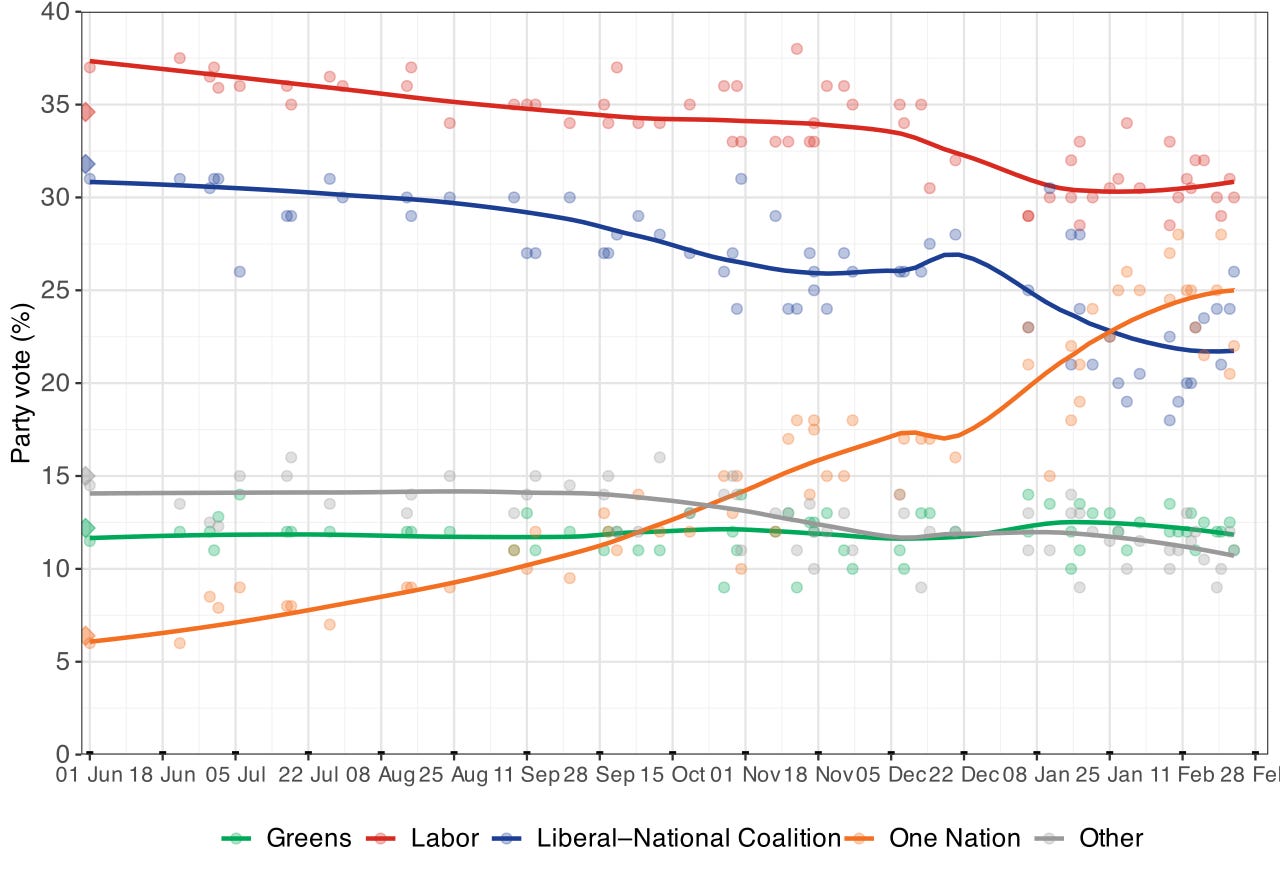
Australia is the latest developed democracy to experience conventional centre-right politics being threatened by a national populist surge. Just as country-club Republicans were Trumped, Gaullists were Le Penned, Forza Italia was Melonied, and the Tories are being Faraged, so the Liberal-National Party Coalition in Australia is getting Hansoned.
What Australia has in common with the pattern in the UK, and the rise of AfD (Alternative for Deutschland) in Germany, is the combination of Net Zero (or equivalent) with mass immigration leading to a national populist surge.
National populism well predates Net Zero. It does not predate the adoption of policies of elite display and elite benefit, particularly regarding immigration. The combination of Net Zero with mass immigration is, however, particularly conducive to surges in electoral support for national populism, as we can see in the UK, Germany and now Australia.
It is not hard to see why. Mass prosperity rests on cheap energy: that is much more important than, for instance, free trade. The Industrial Revolution is really the Mass Access To Cheap Energy Revolution. It is that access that is above all else responsible for The Great Enrichment.
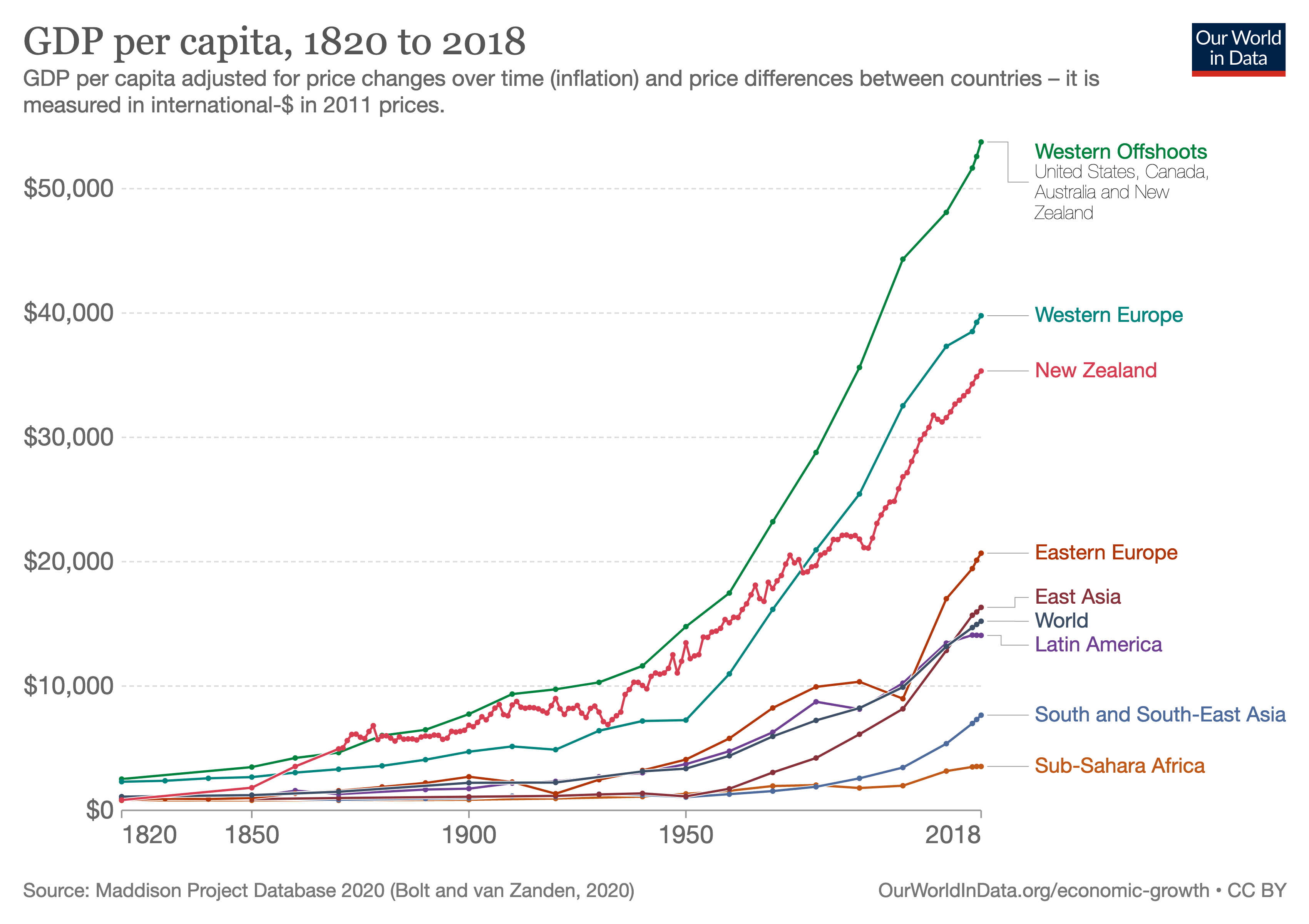
As economic historian Jack Goldstone notes:
by 1850 the average English person has at his or her disposal more than ten times the amount of moveable, deployable fuel energy per person used by the rest of the world’s population.
Net Zero means raising the price of energy, thereby narrowing access to it, and, in particular, narrowing the range of economic activity that is commercially sustainable. Even without increasing the population, that will increase contestation over resources.
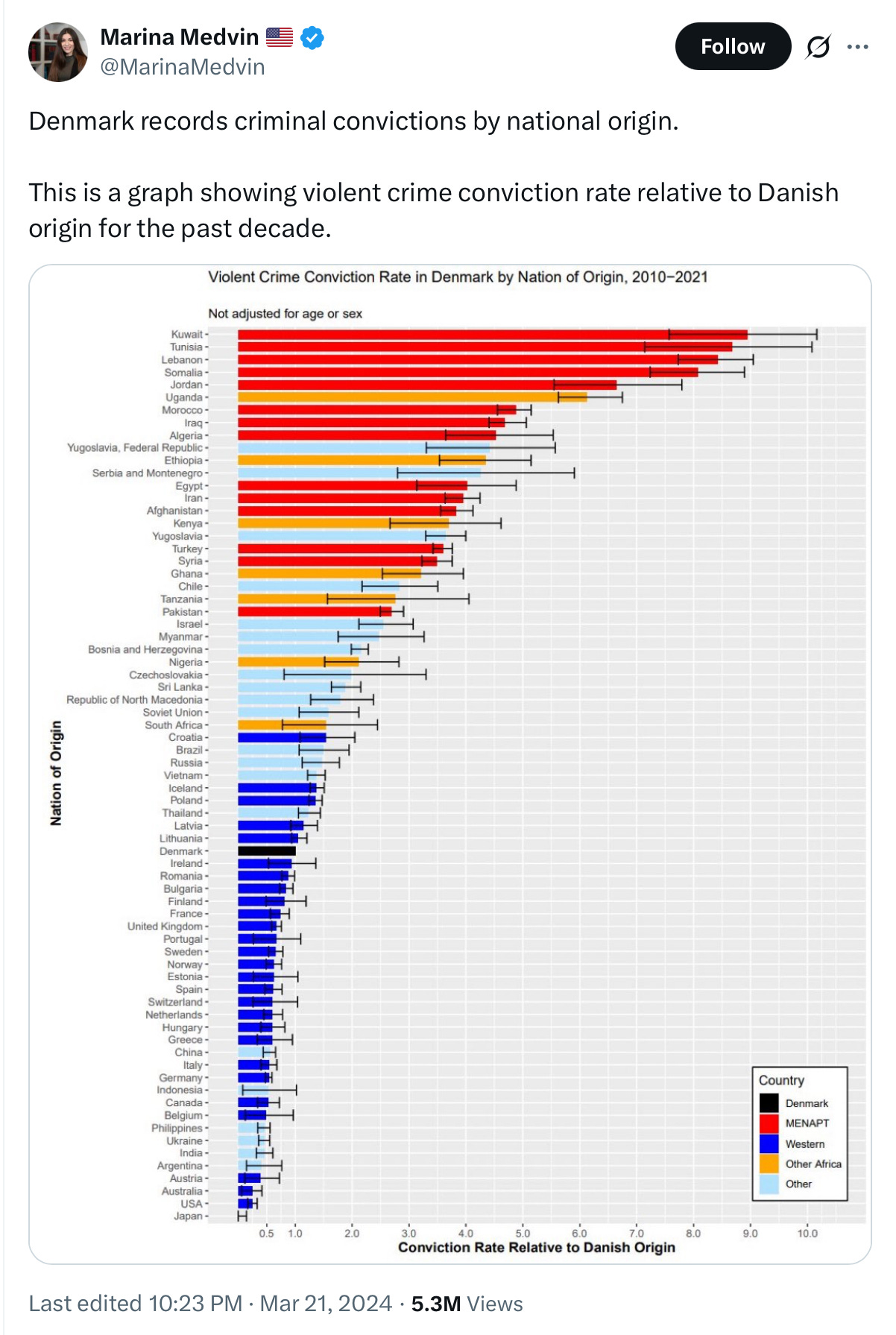
Add mass immigration to the mix, and that contestation becomes much worse. All the experienced costs of mass immigration—higher rents and house prices; increased congestion; downward pressure on wages and increased fiscal stress (if importing significant numbers of low-capital/skill immigrants); downward pressure on social trust and corrosive effects on the norms and rules that underpin institutions (if importing lots of people from very different cultures); increased crime (if importing significant numbers of people from higher crime cultures)—are then magnified. [The effect of swamping people’s locality-based social capital, so reducing their ability to manage risks, is also magnified.]
In the case of Australia, the 14 December 2025 Bondi massacre by an Islamawi immigrant father and his locally-born son brought these concerns into sharp relief, but the pushback against mass immigration had been building well before that, hence the Albanese Government sharply cutting back its immigrant quotas. (As Australia enforces its borders, the official immigration quotas actually matter.)
One would think that the obvious tension between Net Zero and mass immigration would be an open part of the public policy debate, within and without government. This is where the serial incompetence of mainstream economists in analysing immigration—incompetence that I have discussed here, here, here, here, here, here, here and especially here and also here—is very much germane. For part of their incompetence is utterly failing to produce useful models of the capacities of economies and societies to absorb immigrants. The absence of such models both represents the failure to take the costs of immigration seriously and limits the capacity to examine trade-offs with other policies, such as Net Zero.
Another factor is how much of elite politics is dominated by performative status games. One is a Good and Very Serious Person by affirming the correct narratives. The more folk are insulated from having their beliefs reality-tested, the more dominant in their networks such performative status games will be.
To ensure feedback to correct against wandering off into dysfunctional nonsense is, of course, the point of having open discourse and free elections. But those who adhere to grading people by their beliefs—so take dissent to the beliefs that make them “morally superior” people to be morally illegitimate—are highly motivated to frustrate open discourse and effective democratic feedback: hence cancel culture, the push against “disinformation” and the adoption of the non-electoral politics of institutional capture.
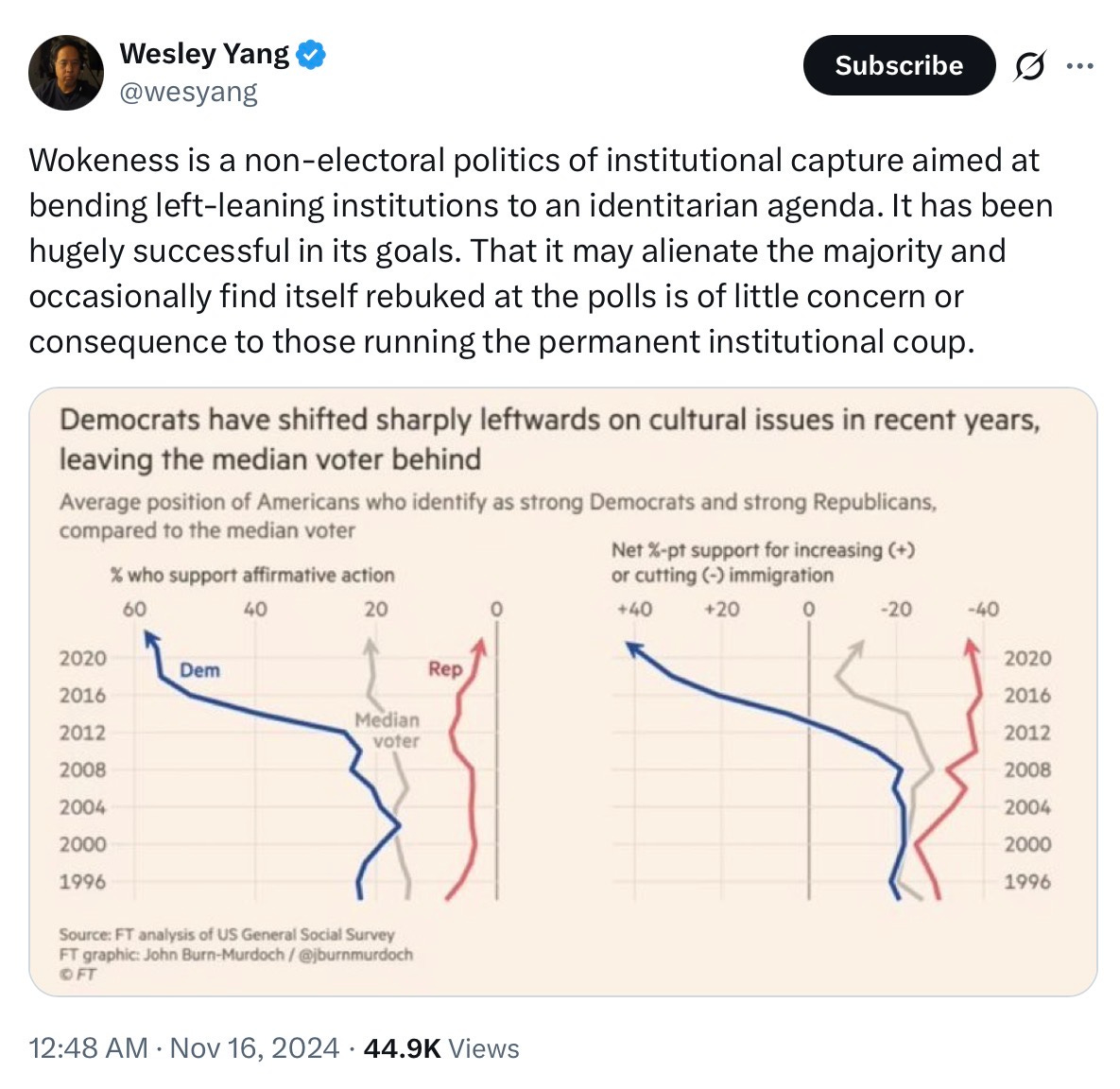
This networked incentive to frustrate open discourse and democratic feedback extends to mainstream media organisations, who have come to live off selling the narratives that affirm one is a Good and Very Serious Person.
Such pressures have led conventional centre-right politicians to either adhere to, or pander to, those elite status games. This particularly applies to politicians obsessed by getting mainstream media coverage. They then have even more reasons to pander to the Narratives That Good People Affirm pushed by mainstream journalists who are playing, and playing to, those same elite status games.
Mainstream journalists, government bureaucrats, advocacy non-profits, academe—these social milieus are all pervaded by such narratives. This is what institutional capture means. It takes a fair bit of intellectual curiousity, and moral courage, to stand against all that social pressure. Too many politicians on the conventional centre-right have neither, so fail as instruments for voters to push back.
Hence the rise of national populism. Precisely because both Net Zero and mass immigration are so much Non Player Character (NPC) “I don’t think things through, I just tick the Good Person status boxes” political/policy positions the obvious, serious, tension between the two gets overlooked. The willingness to punish those who dissent—as is required to have particular beliefs, the affirming of particular narratives, show that you are a Good Person—leads to purity spirals around an ever-narrowing set of acceptable beliefs. Such insulation from reality-tests within elite circles—and so within conventional politics—leads to the surge in non-conventional politics.
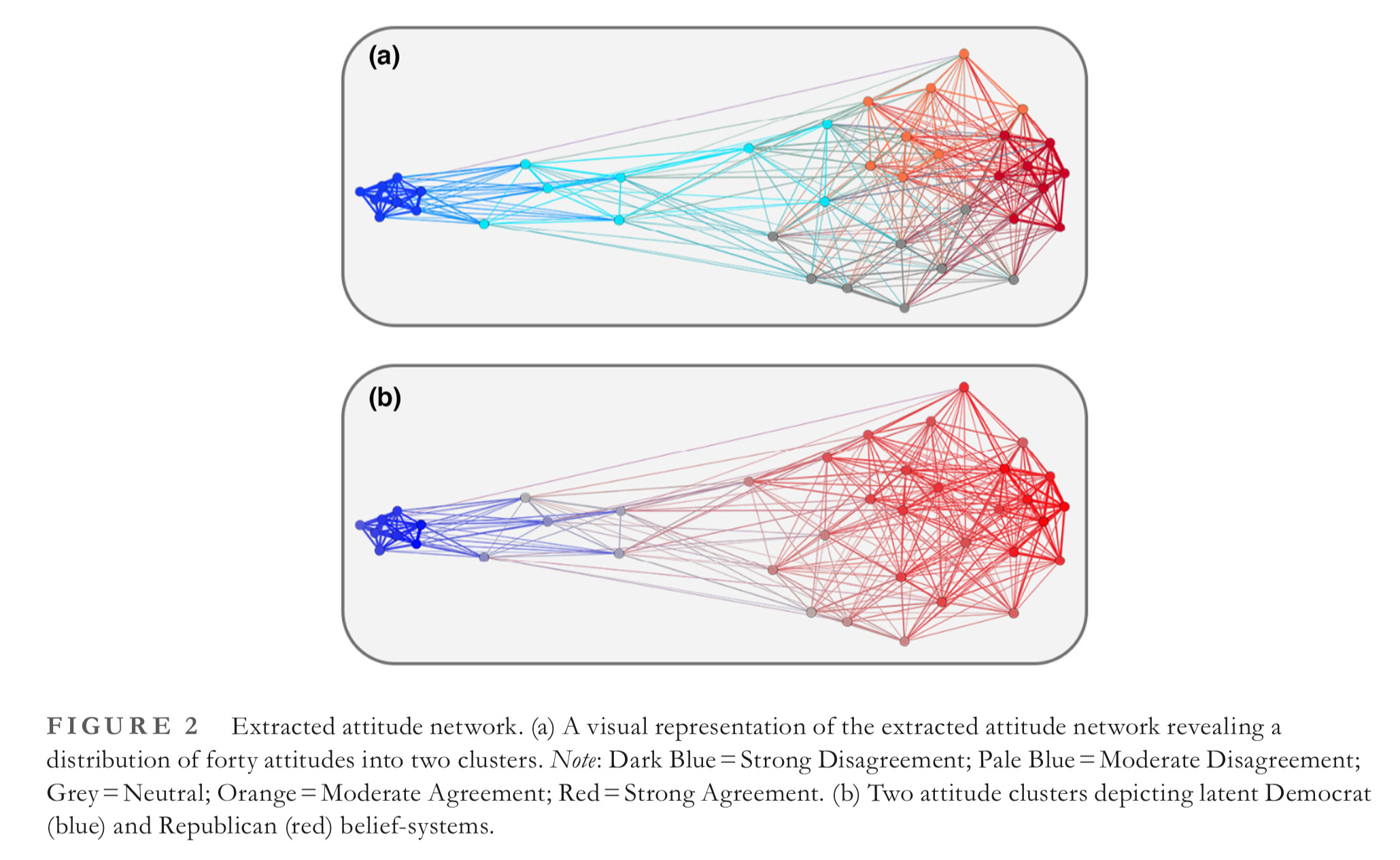
Within elite circles—among those addicted to the elite status games of affirming Correct Narratives—national populist electoral surges are viewed as a bizarre and wicked pathology. Yes, inconvenient realities are pathological for those elite status games. But that is because those elite status games are very much pathological in the first place. This is especially so given that the more one has to rationalise away or ignore, the stronger the signalled commitment to the shared status games is.
The tension between Net Zero and mass immigration is obvious if you just think things through. A deep problem across Western societies is that so many Very Serious People are playing status games that rely on not thinking things through: indeed, that actively block doing so.
ADDENDUM. Another way of looking at the non-electoral politics of institutional capture is:
An agenda you execute through courts and blocking fits a gridlocked, yell-and-confirm world perfectly. An agenda that runs through legislation and delivery starves in it.
The way that, in the US, the Democratic and Republican have conspired (sorry, legislated) to create a Two Party Cartel is really hitting home.

References
Plamen Akaliyski, Vivian L. Vignoles, Christian Welzel, & Michael Minkov, ‘Individualism–collectivism: Reconstructing Hofstede’s dimension of cultural differences,’ Journal of Personality and Social Psychology, (2025). Advance online publication. https://www.researchgate.net/publication/398587882_Individualism-Collectivism_Reconstructing_Hofstede’s_Dimension_of_Cultural_Differences
Alberto Alesina and Paola Giuliano, ‘Culture and Institutions,’ Journal of Economic Literature, 2015, 53(4), 898–944. https://www.aeaweb.org/articles?id=10.1257/jel.53.4.898
Ayaan Hirsi Ali, Prey: Immigration, Islam, and the Erosion of Women’s Rights, HarperCollins, 2021.
Jan van den Beek, Hans Roodenburg, Joop Hartog, Gerrit Kreffer, ‘Borderless Welfare State - The Consequences of Immigration for Public Finances,’ 2023. https://www.researchgate.net/publication/371951423_Borderless_Welfare_State_-_The_Consequences_of_Immigration_for_Public_Finances
Jan van de Beek, Joop Hartog, Gerrit Kreffer, Hans Roodenburg, The Long-Term Fiscal Impact of Immigrants in the Netherlands, Differentiated by Motive, Source Region and Generation, IZA DP No. 17569, December 2024. https://docs.iza.org/dp17569
Cristina Bicchieri, The Grammar of Society: The Nature and Dynamics of Social Norms, Cambridge University Press, 2006.
Cristina Bicchieri, Norms in the Wild: How to Diagnose, Measure and Change Social Norms, Oxford University Press, 2017.
George Borjas, ‘Immigration and the American Worker: A Review of the Academic Literature,’ Center for Immigration Studies, April 2013. https://cis.org/Report/Immigration-and-American-Worker
George J. Borjas, We Wanted Workers: Unraveling the Immigration Narrative, W.W.Norton, 2016.
Ben Cobley, The Tribe: The Liberal-Left and the System of Diversity, Societas essays in political & cultural criticism, Imprint Academic, 2018.
Roger Eatwell and Matthew Goodwin, National Populism: The Revolt Against Liberal Democracy, Pelican, 2018.
European Commission, Projecting The Net Fiscal Impact Of Immigration In The EU, EU Science Hub, 2020. https://migrant-integration.ec.europa.eu/library-document/projecting-net-fiscal-impact-immigration-eu_en
Amory Gethin, Clara Mart´inez-Toledana, Thomas Piketty, ‘Brahmin Left Versus Merchant Right: Changing Political Cleavages In 21 Western Democracies, 1948–2020,’ The Quarterly Journal Of Economics, Vol. 137, 2022, Issue 1, 1-48. https://academic.oup.com/qje/article/137/1/1/6383014
Musa al-Gharbi, We Have Never Been Woke: The Cultural Contradictions of a New Elite, Princeton University Press, 2024.
Ryan James Girdusky and Harlan Hill, They’re Not Listening: How the Elites Created the National Populist Revolution, Bombardier Books, 2020.
Zach Goldberg, ‘How the Media Led the Great Racial Awakening,’ Tablet, August 05, 2020. https://www.tabletmag.com/sections/news/articles/media-great-racial-awakening
Jack A. Goldstone, ‘Efflorescences and Economic Growth in World History: Rethinking the “Rise of the West” and the Industrial Revolution,’ Journal of World History, (2002) Vol. 13, No. 2, 323-389. https://culturahistorica.org/wp-content/uploads/2020/02/goldstone-efflorescences.pdf
David Goodhart, The Road to Somewhere: The New Tribes Shaping British Politics, Penguin, 2017.
Mark Granovetter, ‘The Strength of Weak Ties: A Network Theory Revisited,’ Sociological Theory, Vol.1, 1983, 201-233. https://www.csc2.ncsu.edu/faculty/mpsingh/local/Social/f15/wrap/readings/Granovetter-revisited.pdf
Laurenz Guenther, ‘Political Representation Gaps and Populism,’ February 3, 2025. https://papers.ssrn.com/sol3/papers.cfm?abstract_id=4230288
M.F. Hansen, M.L. Schultz-Nielsen,& T. Tranæs, ‘The fiscal impact of immigration to welfare states of the Scandinavian type,’ Journal of Population Economics 30, 925–952 (2017), https://link.springer.com/article/10.1007/s00148-017-0636-1
Joseph Henrich, The Secret of Our Success: How Culture Is Driving Human Evolution, Domesticating Our Species, And Making Us Smarter, Princeton University Press, 2016.
Garett Jones, The Culture Transplant: How Migrants Make the Economies They Move To a Lot Like the Ones They Left, Stanford University Press, 2023.
Eric Kaufmann, Whiteshift: Populism, Immigration and the Future of White Majorities, Penguin, 2018.
Adrian Lüders, Dino Carpentras, & Michael Quayle, ‘Attitude networks as intergroup realities: Using network-modelling to research attitude-identity relationships in polarized political contexts,’ British Journal of Social Psychology, (2024) 63, 37–51. https://www.researchgate.net/publication/372287775_Attitude_networks_as_intergroup_realities_Using_network-modelling_to_research_attitude-identity_relationships_in_polarized_political_contexts
Peter McLoughlin, Easy Meat: Inside Britain’s Grooming Gang Scandal, New English Review Press, 2016.
Stephanie Muravchik, Jon A. Shields, Trump’s Democrats, Brookings Institution Press, 2020.
Nathan Nunn, ‘Culture And The Historical Process,’ NBER Working Paper 17869, February 2012. http://www.nber.org/papers/w17869
Kenneth M. Pollack, Armies of Sand: The Past, Present, and Future of Arab Military Effectiveness, Oxford University Press, 2019.
Will Storr, The Status Game: On Social Position And How We Use It, HarperCollins, 2022.
Robert Trivers, The Folly of Fools: The Logic of Deceit and Self-Deception in Human Life, Basic Books, [2011] 2013.
Mark S. Weiner, The Rule of the Clan: What an Ancient Form of Social Organization Reveals About the Future of Individual Freedom, Picador, 2014.
Status games are largely for strivers, the professional and managerial classes.
The central driver for mass immigration at the top in Australia has always been strategic and economic. Canberra seeks engagement with Asia via migration. It aims to use migration policy to win friends and influence people overseas and to keep nominal GDP going every quarter.
The present reaction owes much to the exhaustion of the social capital built up by the White Australia policy and post-war welfare capitalism. Australia is now too socially and ethnically fragmented to maintain the old consensus on migration/multiculturalism. The surge in migration under Albanese, coupled with the mass mobilization of jihadists and their fellow-travelers and the massacre have brought it all to a boil.
The aggressive enforcement of taboos that made it impossible to discuss migration dispassionately robbed our elites of the situation awareness necessary for good policy.
My own feeling is that those with a predilection for status games are by definition incapable of 'thinking things through'. All that matters is what is reflected in their social mirror