

There is a straightforward, respectable view on immigration to Western countries. More people means more transactions, means more gains from trade, so immigration is a good thing. Immigration grows the economy, it increases GDP, so sensible folk support immigration.
There are extra bells and whistles, such as providing needed skills; compensating for falling fertility; willingness to do jobs locals are not. All the extra bells and whistles have responses. Why not train locals (i.e., citizens)? Won’t the immigrants’ fertility also fall? (Yes, though possibly more slowly.) The real willingness is to do jobs at lower wages and conditions than the locals would accept. For instance, potentially using US H1B visas to bring in entry-level employees who will work for less, and in worse conditions, than the locals.
Moreover, increasing total GDP is not the same as increasing per capita GDP. Even with per capita GDP, there are always questions about the distribution of those gains to GDP.
Nevertheless, the basic intuition is: immigration means more transactions, more gains from trade. Those who believe in markets—in positive-sum interactions—should support immigration.
This is not the trumping response it appears to be. Immigration does not only import workers—nor even just increase mutual-gain transactions—it imports people, so potentially affects all aspects of the receiving society. This means, of course, that there are a much wider range of possible concerns about immigration that “yes, but more gains from trade” is not an adequate response to.
Efficiency and number of transactions are not the only issues for a social order, particularly not a flourishing social order. There are also issues of social cohesion; social resilience; connections and social capital; the distribution of GDP gains; effects on relative prices; congestion costs; how well institutions are managing the influx; effects on local communities; cultural differences; social coordination issues and the ability to manage collective action problems; increased competition for positional goods—goods that cannot, or are blocked from, responding to increased demand.
These are all legitimate grounds for concern that are not answered by “yes, but more gains from trade”. How many of those “yes, but more gains from trade” folk have grappled with mass rape and sexual exploitation of young women and girls as a cost of culturally divergent immigration (and its systematic mismanagement)? How many of those “yes, but more gains from trade” folk have grappled with violent disturbance, even civil war, as a potential cost of immigration, even though we have historical examples of precisely that?
If, on one hand, the respectable people insist “yes, but more gains from trade” is an adequate response, and that other concerns are not legitimate, this will almost certainly be taken as the contemptuous dismissal it is. Not only will it not be persuasive, it will (and does) generate anger and resentment.
If people have concerns that the “reasonable”, “liberal-minded” folk will not deal with—or, worse, are dismissive of such concerns even being raised—then people will turn to unreasonable and illiberal folk, if they are the only people who will respond to their concerns. Significant gaps in political markets will be filled by political entrepreneurs.
If folk are told that “if you believe in markets, you have to support (high levels of) immigration” then many folk will respond with “OK, I reject markets”. Moreover, it is simply false that market economics entails that mass immigration is a good thing.
The idea that there is some economic phenomena such that marginal costs exceeds marginal benefits for all people over all ranges in all forms is not Economic thinking, it is magical thinking. (More precisely, it is class-signalling parading as Economics.)
It is magical thinking that falls foul of economist Thomas Sowell’s dictum that there are no solutions, only trade-offs. Immigrants may be engaging in lots of positive-sum, gains from trade transactions, yet still be imposing more costs than benefits on a society, and on resident citizens, precisely because societies are not just efficiency arenas for free-floating transactions and no one is just an economic transactor.
Consider rising rents and housing costs: if wages are stagnant, but rents and housing costs are rising, that means people’s living standards are falling. Large-scale immigration means rising demand for housing and, if housing supply does not keep up, then clearly rents and housing costs will rise.

It is perfectly reasonable for people suffering rising rents and house prices, and stagnant wages, to connect their falling living standards to mass immigration. People locked out of housing markets—or otherwise suffering stagnant or falling living standards—are more likely to be pushed towards zero-sum politics.
Now, it is all very well to say “but if regulation did not restrict housing supply, the problem will go away”. The reality is that the regulations are restricting housing supply, so the problem is not going away. On the contrary, mass immigration is making the problem worse—and increasing the returns from restricting housing supply, so the incentive to so restrict.
This is, quite straightforwardly, the political class managing mass immigration so badly as to make locals, citizens, worse off. It is the loss of trust that mass immigration will be managed in the interests of the general citizenry—particularly working-class citizens—that is at heart of the political contentions over immigration because, clearly, it is not being managed in their interests.
Labour competition is real
But the problem is worse than rising housing costs, because immigration can also suppress local wages. We are the fortunate heirs of the Great Enrichment—aka the Industrial Revolution but really the Energy Revolution of having wider and wider energy resources used for more and more purposes. It was kicked off by the application of steam power to railways and steamships in the 1820s.
One of the boons of the growth in productivity that is at the heart of the Great Enrichment, is that competition for labour in high productivity sectors drives up wages, even in sectors that have not shown increases in productivity. This is known as the Baumol effect. Hairdressers are paid a lot more now than in 1960—despite doing essentially the same job—because otherwise no one would be hairdressers and more prosperous people can pay more for haircuts.
If, however, you import lots of low-skill workers, that means the competition-for-labour effect is spread across the newcomers, diluting or even suppressing the Baumol effect for low-skill workers. So, importing low skill workers en masse can be simultaneously driving up rents and suppressing low-skill wage growth. “Yes, but more gains from trade” is not an adequate answer to folk who are demonstrably losing out. And guess what politics they will embrace if you tell them “but this is what pro-market policies mean”?
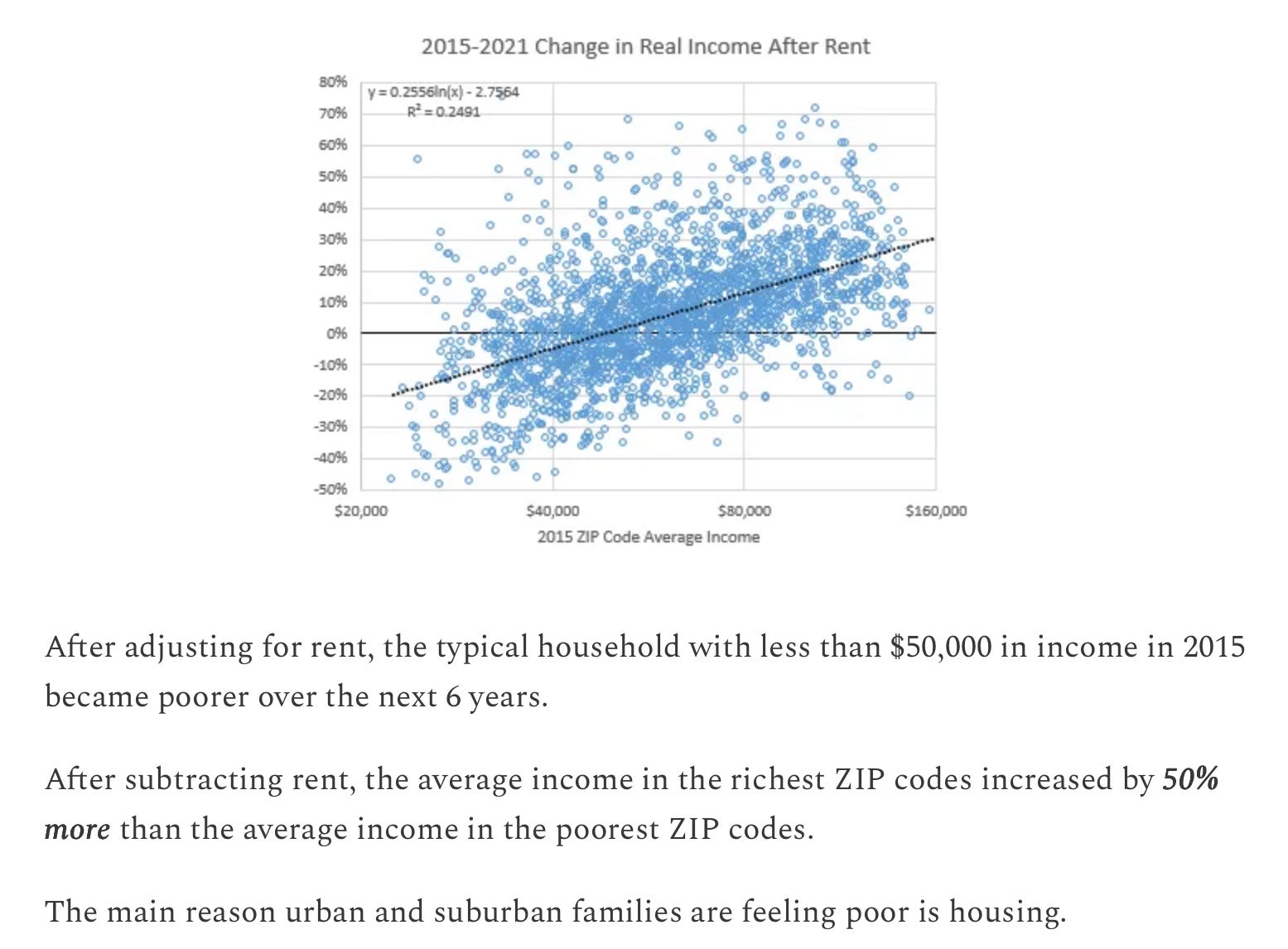
Moreover, if your welfare state transfers income from high-income people to low-income people, then importing lots of low skill, so low-income, people will put more fiscal stress on the welfare state: to the extent of imposing net fiscal costs on your society—as has been amply documented in Europe—reducing your ability to fund services for the resident citizens. Once again, “yes, but more gains from trade” is not an adequate response.
It is so obvious that increasing the supply of labour by importing workers puts downward pressure on wages, and generates competition for jobs, that various arguments are mounted to say “but it will not reduce the wages or employment of locals”. These include that the incomers bring new skills, provide new goods and services, and increase demand for local goods and services.
How strong any of these factors actually are is an empirical question, which will vary depending on circumstances and the characteristics of the immigrants. For instance, the more the newcomers send their income as remittances back to where they come from, the less demand for local goods and services they will generate. Those new goods and services will require local resources, notably land—see above comments about housing costs.
As much of the point of “yes, but more gains from trade” is to block even considering costs from immigration, this gets in the way of having intelligent public discourse about such costs, which gets in the way of immigration being well-managed.
In the US, the Covid pandemic lockdowns employment crash bottomed in April 2020. At that point, there were 111.3m native born, and 22m foreign born, people employed in the US. At the recent peak of foreign-born employment in March 2025, there were 131.8 native born employed—an increase of 18.7m (17 per cent)—and 32.2m foreign born employed—an increase of 10.2m (46 per cent).
Obviously, foreign-born folk disproportionately benefited from the increase in employment. In part because of being willing to work for lower wages and conditions than locals—particularly, of course, if they were illegal immigrants.
The ICE deportation crackdowns then began. What happened? By September 2025, native born employment was 133.2m, up by 21.9 million (20 per cent) since April 2020. Foreign-born employment and fallen back to 30.7m, so up by 8.7m (40 per cent) since April 2020. Native-born workers were getting jobs being vacated by foreign-born workers.
Economists are fond of talking about the lump-of-labour fallacy: the (false) claim that there is only a fixed amount of work to be done, so there is a zero-sum competition for available work. Yes, supply and demand for labour are both moveable feasts.
But jobs require not only labour but also coordination with land and capital, so there are lags in responsiveness. It is absolutely possible to have labour markets be flooded by people that squeeze out locals because the other factors of production do not respond quickly enough: especially when the newcomers effectively bid down wages and conditions. The lump-of-labour fallacy then stops being an act of careful analysis and becomes a signalling device—we are so clever and understand what you yokels don’t.
Here’s something the “yes, but more gains from trade” folk almost never mention. The overwhelming majority of the economic gains from immigration go to the immigrants: that is why they keep coming. Of the remainder, the overwhelming majority of the economic benefit goes to the holders of capital, including human capital.
So little of the economic gains from immigration go to resident workers that it is very easy for them to be losers from immigration: particularly if it is mismanaged. Instead of acknowledging this inconvenient bit of bog-standard Economics, we get this ludicrous class-signalling whereby any complaints from resident workers is regarded as a sign of ignorance, stupidity, or worse because “yes, but more gains from trade” so discussion of the costs of immigration is illegitimate.
This is toxic to good policy, elementary social cohesion and healthy democratic politics.
Signalling status
So much of the “debate” over immigration turns out to be various forms of class and status signalling. Consider the “grooming gang” problems in the UK. Complaining about Muslim rape gangs is not something a sound posh person does. Worrying about Islamophobia is what a sound posh person does.
These status-signalling games in the UK contrasted strongly with more egalitarian Australia, that successfully crushed its Lebanese Muslim rape gangs in a way that the UK so profoundly failed to do with is mainly Pakistani—but also overwhelmingly Greater Middle Eastern (Morocco to Pakistan) Muslim—equivalents.
Across the West, we can see that status-signalling games bedevil public discussion of, and policy in response to, immigration. Resting on Theory that says immigration is a boon because more gains from trade is what a sound, informed, reasonable, understands Economics, person does. Pointing to what is actually happening, raising questions not covered by Theory, is what an unsound, uninformed, probably racist—or playing to racism—person does.
Culture is real
What makes the “yes, but more gains from trade” even more inadequate is there is a glaring gap in Economic Theory. This gap is expressed in the Loury principle—relations before transactions. Or, as I prefer to say, connections before, and around, transactions.
People spend around 20 or so years absorbing the expectations, framings, patterns of action of their culture—culture which is mainly transmitted by families and within localities—before they become significant economic transactors. Moreover, transactions are very much embedded within connections, especially on the supply side. Connection management is at least as important as transactions to human social behaviour. Furthermore, we humans cognitively model significance (to us), not facts.
The consequence of all this is very clear:
Although using very different methodologies, the studies all provide evidence leading to the same general conclusion: individuals from different cultural backgrounds make systematically different choices even when faced with the same decision in the same environment. (Emphasis added.)
The reality that humans cognitively model significance to them not facts—so there is no objective economic value, just patterns of individual and collective valuations—also means culture matters. As military analyst Kenneth Pollack notes:
… until relatively recently, Western economics and management theory took as a bedrock assumption that universal factors such as the availability of technology and the profit motive would produce similar organizations and methods of operation in any business regardless of cultural factors. This has been challenged broadly by new studies of the impact of cultural preferences on organizations, management, and leadership, such as the massive Global Leadership and Organizational Behavior Effectiveness (GLOBE) study of such practices in 62 different countries. The GLOBE study found that societal culture had a far greater impact on leadership, management, and organizational behavior than market forces and industry effects (i.e., industry-wide practices across societies). This and other such studies have increasingly demonstrated that, despite the Darwinian competition of the marketplace (akin to the competition of combat), organizations function very differently in different societies. They have found that this holds true even for businesses nominally owned by foreign entities, which have to take on the patterns of behavior of the host country to survive and thrive. (P.408)
If you import people, you import their cultures. Cultures differ in ways that matter. As people from different cultures make different decisions in the same circumstances, how institutions and organisations operate will depend on the cultures of those within in, and interacting with, those institutions and organisations.
Western institutions have been created by, and for, WEIRD (Western Educated Industrial Rich and Democratic) people. Western institutions developed quite directly from the deliberate suppression of kin-groups: by the Greeks, by the Romans, by the Orthodox Church and (particularly) by the Catholic Church.
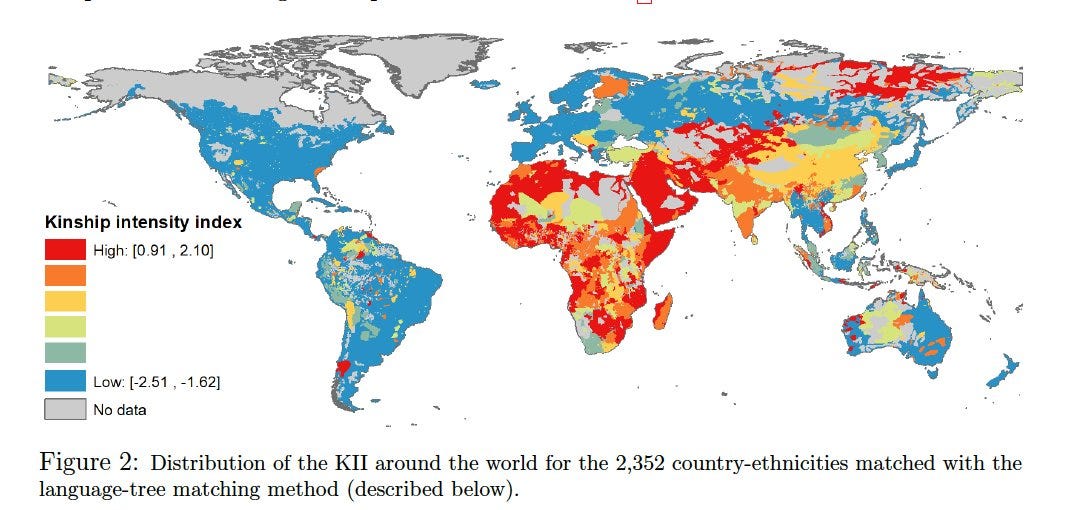
People from highly clannish societies can have very different social dynamics than those presumed by Western individualism and so can be quite antipathetic to the assumptions, the normative expectations, that Western institutions are based on.
Culture is pervasive in its importance precisely because we are cultural beings before we become economic transactors. One of the features of European (and neo-European) history has been the secular fall in homicide rates from the late medieval period to around 1900. This started in North-West Europe—in Atlantic littoral Europe—and spread South and East across centuries. Sociologist Norbert Elias identified this as the civilising process: that is, a becoming-more-civil process.
Not all cultures have gone through such a process, and not to the same degree. The result is immigrants from different cultures differ hugely in their crime rates. East Asians, particularly Japanese, immigrants have vanishingly small violent crime rates. By contrast, Somalis and Eritreans have much higher violent crime rates.
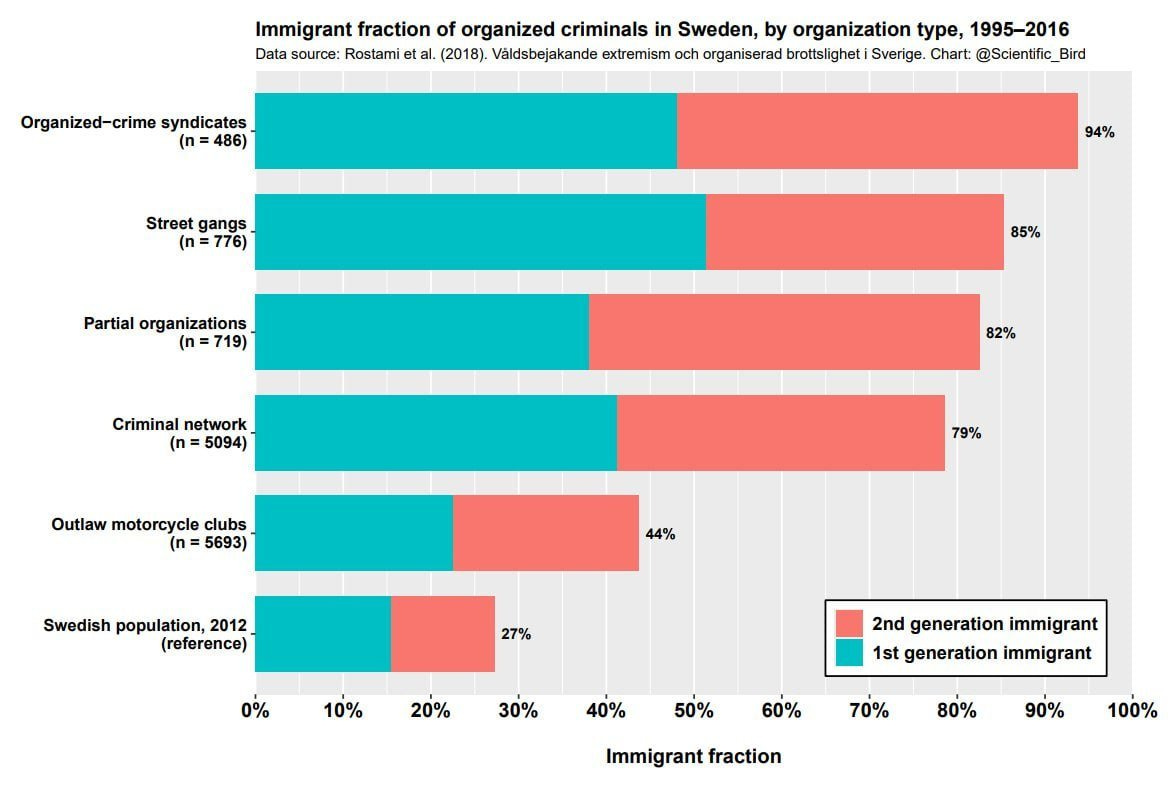
To treat immigrants as an undifferentiated category is to be stupidly unobservant or ridiculously disingenuous. To be either is a great way to destroy—indeed throwaway—trust.
Two things the “more transactions means more gains from trade” narrative do not grapple with is the distribution of those benefits and the interactions between transactors.
If increased cultural diversity generates coordination problems, that can—along with increased demand on land use—make it harder for infrastructure supply to respond to demand. This can be worsened if importing lots of low-skill people puts state finances under increased pressure, reducing its ability to finance new infrastructure. It is made worse still if metastasising bureaucracy makes it harder to approve and build new infrastructure. Apart from simple increased population density issues, all this can further increase congestion costs and demands on existing infrastructure.
But there is a simpler point: what does the immigration you are actually receiving do to the relative scarcity of labour and capital in your economy? If you import lots of low-skill workers, that makes capital relatively more scarce compared to labour. That puts upward pressure on the returns to capital and downward pressure on returns to labour (i.e., wages). The idea that local workers are automatically made better off by immigration because of “but more gains from trade” is nonsense on stilts.
The question, always and everywhere, is what are the actual patterns of immigration and how is public policy responding to them. Across the West, too often the answer to the latter is: badly. Indeed, so badly as to systematically undermine, or destroy, trust that immigration will be well-managed.
The problem is particularly acute in the UK, as the British political class has spent decades systematically lying to/misleading the voters about immigration. Systematically lying to, and misleading, voters obviously is a way to lose trust. Doing so to impose on them immigration policies they did not want, and which they can see are imposing—quite systematically—costs on them, makes it worse. This is not losing trust. This is throwing it away.
The same applies to failures to enforce borders. The only way voters can have a say on immigration is if border control is enforced. The failure to enforce border control either shrieks systematic incompetence, or contempt for the voting citizenry, or both. Once again, this is not losing trust, it is throwing it away.
It is all very well to talk of illegal immigrants as including people who have been living in the country for 20 years, but the problem was failing to enforce border control in the first place. Such failure is endemic to loss of trust. This then makes it harder to resolve such issues via an amnesty, because of the lack of trust that this will not simply be an endless cycle.
Societies are not just places where transactions happen. There is a great deal more to social order—especially, a flourishing social order—than transactions. Not least because connections are so important to human happiness, and to how societies operate.
Race: let’s just not
Something that bedevils discussion about immigration in the US is that Americans are so persistently screwed in the head about race. They regularly talk about race when they should be talking about culture (or class). This point applies to all sides of US politics. Indeed, the dynamic where each side screams at the other side about race is very much part of Americans being screwed in the head about race.
For something of gem of this dynamic see:
The post displays a classic version: talking about race so you don’t have to talk about class (except dismissively). Indeed, there is no stronger signifier of class in the US than how (and when) you speak about race.
That Trump’s victory in 2024 was the most multi-racial win by any Republican in decades should give one pause. But, then, to grapple with that, you would have to talk about class and much of the purpose of race-talk is not only so as to not talk about class, it is to signal one’s own class standing.
Here is something to even more play with people’s heads: just because someone expresses a concern in racially insensitive—or even outright racist ways—does not mean that the underlying concerns are not legitimate. If your connections, your social capital, are based in your locality, then it matters to you if those connections are swamped by newcomers.
There is a real sense in which your community is being taken away from you by mass immigration: that is a legitimate concern, and remains a legitimate concern, even if it is expressed in racist ways. But then, much of the ostentatious anti-racism is all about cutting “morally vulgar” working class voices—especially inconvenient working class concerns—out of public discourse.
How immigration is managed, matters. If you let in “large lumps” of specific cultural groups, then it is much easier for newcomers to retain existing norms, expectations, patterns of interaction within largely self-enclosed communities. You create balkanised neighbourhoods that both maximise the risk of alienating the locals and the potential for future civil order problems.
Conversely, if you have lots of small groups, then you maximise the chance that they will much more rapidly adopt the norms of the demographically dominant group. This both is much less alienating for the locals and much less likely to generate future problems. Once again, this is yet another way that Australia has managed immigration far more intelligently than the UK.
My local cafe shows the difference between being multi-ethnic and multi-cultural

The local cafe I go to most regularly—I like their Dirty Chai (coffee + chai)—is very Western Melbourne. It is an ordinary cafe in a local suburban mall. Its clientele represents the enormous ethnic diversity of the area. It is run by a Chinese-Australian family some of whom have very Australian accents. Its customers include East Africans, South Asians…
If, however, you are stick with “immigration is a boon and all critiques and concerns are illegitimate” you cut off your ability to have an intelligent conversation about the costs and benefits of immigration. If “good people” only talk about benefits from immigration, and raising the issue of costs from immigration make you a “bad person”, your public discourse about immigration will get very stupid, very quickly. Which more or less guarantees immigration will be managed badly, destroying trust in the management of immigration by those who bear, or otherwise see, the costs.
If you cannot even admit that there are costs from immigration, you are a deeply stupid person—I don’t care what your academic credentials are. Immigrants are people, of course there will be costs. Costs that will vary according to their characteristics and by locality.
Immigration policy operates at scale. Intelligent policy therefore has to consider differences between the average qualities of different groups of migrants.
For instance, if various immigrant source groups have been marrying their cousins for 1400 years, that drives up your health costs. Hence people of Pakistani origin in the UK are about four percent of British births but generate 30 per cent of British birth defects.
Of citizenship and borders
The concept of citizenship exists for a reason, just as national borders exist for a reason. All public goods—goods which are non-rivalrous (lots of people can consume it simultaneously) and non-exclusory (you cannot stop people consuming it)—have a scope problem. Whom do you tax? Whom/where do you protect? The answer that both private and public providers of public goods come up to is to territorialise the provision of public goods: tax and protect people within or from a specific territory.
The original Classical city-state concept of citizen was: fight for your city-state, get a vote, get a say. The modern version became: be available to be mobilised for your state, get a vote.
There cannot be democracy without a sufficiently coherent demos that the state apparatus can be forced to be accountable to. It is quite clear that a lot of Western elites want an ethnically fractured electorate so that they can play favour-divide-and-dominate games (aka identity politics).
Democratic citizenship is a response to the potential for total war but also the way falling transport and communication costs—and the separation of households from production—spread social bargaining power. After the end of the Cold War—and the disappearance of any sense of an existential geopolitical threat—Western elites clearly became much less reluctant to alienate their working classes. When the salience of external threats retreat, then the salience of internal differences are elevated.
One of Australia’s advantages is that the combination of compulsory voting and preferential voting means you cannot drive the working class away from the polls, so politicians have to take cognisance of working class concerns. Both Australian PM Anthony Albanese (Albo) and UK PM Sir Keir Starmer won large Parliamentary majorities on 34 per cent of the vote. The difference is that PM Albo won because another 20 per cent of the electorate gave him their second preference votes: if that falls to 14 per cent, he loses the next election, so he has to pay attention. (Albo is also much the more competent PM and politician while being, unlike Two-Tier Keir, a patriot.)
Western elites becoming much less concerned, post 1991, with alienating their working classes does much to explain how mass immigration has developed—and even more how atrophied what passes for mainstream public discourse about it has become. This is most obvious in the constant resort to thought-terminating cliches—e.g., everyone annoyed at some aspect of immigration, or its mismanagement, is far right.
Around half of the citizens in Western societies are Somewheres: people with primarily inherent/ascribed identities whose connections are overwhelmingly local. They both value these connections and use them as social capital: as ways to identify and manage threats and opportunities. This is the strength of weak ties phenomenon. Thus, friends, relatives, acquaintances is persistently the most important labour market intermediary. Weak local connections also makes it harder to impose accountability on local politicians (see the elite-convenience of ethnically fracturing electorates).
If your connections, your social capital, are overwhelmingly local, then flooding your area with new people degrades your social capital quite directly. That is a genuine cost from immigration. One that is almost completely invisible to academics and others whose connections, whose social capital, are very much not locality based.
If one adds in linguistic taboos that police how such concerns can be expressed, that actively blocks even considering such concerns. This is the people unlike me problem that so bedevils public policy in the contemporary West.


Connecting, in self-reinforcing ways, a body of citizens to a territory is how you get social cohesion. It is how you get flourishing societies able to deal well with collective action problems. Devaluing both citizenship and borders is to the path to angry, alienated citizens much more likely to balkanise into hostile sub-groups.
High-trust societies are built on powerful, embedded, shared expectations reinforced by easy mutual communication. Increasing cultural diversity is a great way to undermine that trust. Destroying trust by not listening, by managing immigration badly because elites are not listening, is to actively throw away the benefits of a high-trust society.
How to do collapse
Lots of states and civilisations have collapsed across history. Typically there will be broken feedbacks involved: corrosive patterns that are not responded to effectively or in time.
It is startling how often destructive status games are involved in those broken feedbacks. Specifically, elites who are so busy playing internal-to-them status games that they do not notice, or respond to, or even aggravate, patterns that end up breaking their state, society, civilisation. There are plenty of destructive status-signalling games—leading to not-listening elites—generating broken feedbacks in contemporary Western societies.
If you discuss immigration as if it is a homogenous phenomenon—and immigrants as if they are a homogeneous group—you are not discussing immigration as a thing in the world, you are playing a social-signalling game. If you are not willing to engage in debate and discussion about the difference between high and low skill immigration, and between culturally compatible and incompatible immigration, you are intellectually bankrupt. If you dismiss all concerns about immigration—especially from working class citizens—as illegitimate, you are contemptible.
If you combine support for high immigration with support for net zero CO2 admissions, you are deeply stupid (or toxically destructive, or both). At the heart of the economic transformation that has spread across the globe over the last two centuries is expanding access to energy and expanding use of that energy. As economic historian Jack Goldstone notes:
by 1850 the average English person has at his or her disposal more than ten times the amount of moveable, deployable fuel energy per person used by the rest of the world’s population.
Every aspect of your modern life-style rests on cheap and abundant energy. The Green Chicken (aka Doomberg) is correct. If you import lots of people while restricting access to, and use of, energy, of course there will be increased, even bitter, contestation over resources, with the attitudes to match.
Yes, I am aware that Net Zero plus high immigration is the policy of both the previous Conservative and current Labour UK Governments. As I said, deeply stupid, toxically destructive, or both. The way, from the election of (Sir) Tony Blair in 1997 onwards, UK Governments transferred decision-making from Parliament to quangoes, and to judges via human rights legislation, quite systematically atrophied feedback from the electorate in the British system, thereby massively empowering elite networks.
US, now Hungarian resident, commentator Rod Dreher reports that:
6:45 I talked to this one American student who was in Oxford studying and he said, “Look, this is not my country, but looking at it from the outside, if the people who actually ran Great Britain, if they actively hated the British people, I don’t know how they would behave any different than what they’re doing.”
The comment by YouTuber Rudyard Lynch (Whatifalthist), on his History 102 channel, that British politics has become the globalising London elite destroying the rest of the country so they don’t have to listen to them, is a lot less hyperbolic than it should be. Of course, if you are getting your information from The New York Times, The Washington Post and similar mainstream media sources, you have no idea what he, the American student, or immigration sceptics are talking about.
Different informational universes
These folk pontificating on immigration. Do they have an incentive to get it right, in the sense of accurate about the world? Not really. They have an incentive to be seen to be getting it right, to be persuasive within the norms and assumptions of their epistemic community. So it rather matters, which epistemic community are they in and who are they attempting to be persuasive to, or simply signal to.
In the case of immigration, economists have their structure of Theory. Their standing as economists comes from their mastery of Theory. Theory that specifies what is relevant evidence to what question, and how that evidence can be used. Things that economic Theory ignores, or has trouble incorporating (e.g., culture and cultural differences), can very easily—and regularly do—get discounted.
Moreover, it is very clear that those who rely on the mainstream media live in a very different informational universe than those who use other sources. Mainstream media has become very much about narrative management, about purveying narratives about the world that mark adherents of said narratives as good people. Even if consumers of mainstream media do not buy into any specific narrative, the demands of those narratives are still curating the information they are—and even more crucially are not—receiving via mainstream media.
Since it is very much a key narrative that immigration is a boon—even a necessary boon—to Western societies, and that there is no legitimate critique of immigration, mainstream media curates the information it presents on immigration, and related matters, so as to downplay, or even simply ignore, information that undermines the immigration is a boon narratives. Such as: mass rape of young, including underage, girls by Muslim gangs; or the wildly different crime rates between different ethnocultural groups.
As part of what mainstream media is selling is the message that “by consuming what we provide, you are made into an informed person”, it is very easy for even highly intelligent people to fail to realise what a very partial view they are getting, even of their own societies, let alone relevant experience of other countries. That they are living in a specific—and information-curated—information universe. That media siloes are real and they are living in one.
What we have is at least two different information universes; one where all sound folk support immigration and another where mass immigration is regarded as a serious threat to communities and to the Western democracies. But it is worse than that, as the former group has the institutional high ground—and is more or less universally contemptuous of dissent on this issue—while the latter are often across the mainstream claims, know they are being systematically ignored or misrepresented, and are various levels of frustrated, angry and resentful at the refusal to seriously engage with their concerns.
A narrative-managing mainstream media—turning information into cognitive and moral assets to be defended—has a great deal to do with how Western elites have been destroying—indeed throwing away—trust that they have, can, or will manage immigration in the interests of the wider citizenry. Something that, it is quite clear, in all sorts of ways, they have not been doing.
The response “but it would not be a problem if we just did X” is a lame cop-out; X is not happening, so yes, it is a problem. Yes, immigration is being mismanaged—in part, because X is not happening.
Of course, it is also fairly obvious that many in Western elites mostly don’t care about the inconvenient interests of their citizens, especially their working-class citizens. They certainly don’t care enough to be other than dismissive of their concerns. They certainly don’t care enough to have the humility to genuinely enquire what, how and why things look to people unlike themselves.
After all, Western elites have all these cognitive and moral assets that proclaim they are clever, smart, informed, moral people. They are the masters of Theory.
The civilisational disaster of Anglo-American academe

Contemporary Western democracies face a wide range of challenges and dysfunctions. These include a pervasive loss of trust in our institutions. We have huge difficulties discussing—as societies, rather than as separate information domains—what those dysfunctions even
Clearly, there cannot be any moral or intellectual weight to the concerns of those who disagree; to people unlike themselves; to people who patently have to be less moral, less informed, less smart than themselves.
In fact, they are such morally and intellectually greater beings, they know what the real interests of those citizens are better than they do. (Which is not what Economic theories of value, dispersed knowledge, rational decision-making and public choice actually say, but there you are.)
If you don’t care about the interests of your fellow citizens, it is contemptible self-righteousness to complain that they do care. And, of course, they will not trust you.
The big issue with immigration is the destruction of trust. Not merely destruction of trust by creating (new) cultural gulfs within Western societies, but destruction of trust by elites not listening and so mismanaging immigration.
Those who are most guilty in that destruction of trust are too morally and cognitively arrogant to realise that they are, in fact, the problem. It is that arrogance that is throwing away trust.
Then again, arrogance has a self-blinding tendency. That self-blinding is what creates the stupidity of arrogance. I believe the Greeks called it Hubris. It does not end well.
References
M. Ajaz, N. Ali, G. Randhawa, ‘UK Pakistani views on the adverse health risks associated with consanguineous marriages,’ Journal of Community Genetics, 2015;6(4):331-342. https://pmc.ncbi.nlm.nih.gov/articles/PMC4567984/
Alberto Alesina and Paola Giuliano, ‘Culture and Institutions,’ Journal of Economic Literature, 2015, 53(4), 898–944. https://www.aeaweb.org/articles?id=10.1257/jel.53.4.898
Ayaan Hirsi Ali, Prey: Immigration, Islam, and the Erosion of Women’s Rights, HarperCollins, 2021.
Jan van den Beek, Hans Roodenburg, Joop Hartog, Gerrit Kreffer, ‘Borderless Welfare State - The Consequences of Immigration for Public Finances,’ 2023. https://www.researchgate.net/publication/371951423_Borderless_Welfare_State_-_The_Consequences_of_Immigration_for_Public_Finances
Jan van de Beek, Joop Hartog, Gerrit Kreffer, Hans Roodenburg, The Long-Term Fiscal Impact of Immigrants in the Netherlands, Differentiated by Motive, Source Region and Generation, IZA DP No. 17569, December 2024. https://docs.iza.org/dp17569
Abdulbari Bener, Ramzi R. Mohammad, ‘Global distribution of consanguinity and their impact on complex diseases: Genetic disorders from an endogamous population,’ The Egyptian Journal of Medical Human Genetics. 18 (2017) 315–320. https://www.sciencedirect.com/science/article/pii/S1110863017300174
Cristina Bicchieri, The Grammar of Society: The Nature and Dynamics of Social Norms, Cambridge University Press, 2006.
Cristina Bicchieri, Norms in the Wild: How to Diagnose, Measure and Change Social Norms, Oxford University Press, 2017.
George Borjas, ‘Immigration and the American Worker: A Review of the Academic Literature,’ Center for Immigration Studies, April 2013. https://cis.org/Report/Immigration-and-American-Worker
George J. Borjas, We Wanted Workers: Unraveling the Immigration Narrative, W.W.Norton, 2016.
Bryan Caplan and Zach Weinersmith, Open Borders: The Science and Ethics of Migration, First Second, 2019.
Sahil Chinoy, Nathan Nunn, Sandra Sequeira, Stefanie Stantcheva, ‘Zero-Sum Thinking And The Roots Of US Political Differences,’ NBER Working Paper 31688, September 2023, Revised April 2025. http://www.nber.org/papers/w31688
Michael A. Clemens, ‘Economics and Emigration: Trillion-Dollar Bills on the Sidewalk?,’ Journal of Economic Perspectives, Volume 25, Number 3, Summer 2011, 83–106. https://www.aeaweb.org/articles?id=10.1257/jep.25.3.83
European Commission, Projecting The Net Fiscal Impact Of Immigration In The EU, EU Science Hub, 2020. https://migrant-integration.ec.europa.eu/library-document/projecting-net-fiscal-impact-immigration-eu_en
Roger Eatwell and Matthew Goodwin, National Populism: The Revolt Against Liberal Democracy, Pelican, 2018.
Mohd Fareed and Mohammad Afzal, ‘Genetics of consanguinity and inbreeding in health and disease,’ Annals Of Human Biology, 2017 Vol. 44, No. 2, 99–107. https://www.academia.edu/33934871/Genetics_of_consanguinity_and_inbreeding_in_health_and_disease
Robert William Fogel, Without Consent or Contract: The Rise and Fall of American Slavery, W.W.Norton, [1989] 1994.
Herbert Gintis, Carel van Schaik, and Christopher Boehm, ‘Zoon Politikon: The Evolutionary Origins of Human Political Systems’, Current Anthropology, Volume 56, Number 3, June 2015, 327-353. https://pubmed.ncbi.nlm.nih.gov/29581024/
Ryan James Girdusky and Harlan Hill, They’re Not Listening: How the Elites Created the National Populist Revolution, Bombardier Books, 2020.
David Goodhart, The Road to Somewhere: The New Tribes Shaping British Politics, Penguin, 2017.
Mark Granovetter, ‘The Strength of Weak Ties: A Network Theory Revisited,’ Sociological Theory, Vol.1, 1983, 201-233. https://www.csc2.ncsu.edu/faculty/mpsingh/local/Social/f15/wrap/readings/Granovetter-revisited.pdf
M.F. Hansen, M.L. Schultz-Nielsen,& T. Tranæs, ‘The fiscal impact of immigration to welfare states of the Scandinavian type,’ Journal of Population Economics, 30, 925–952 (2017), https://link.springer.com/article/10.1007/s00148-017-0636-1
Garett Jones, ‘Measuring the Sacrifice of Open Borders,’ George Mason University, November 2019. http://digamoo.free.fr/garettjones2019.pdf
Garett Jones, The Culture Transplant: How Migrants Make the Economies They Move To a Lot Like the Ones They Left, Stanford University Press, 2023.
David C. Lahtia, Bret S. Weinstein, ‘The better angels of our nature: group stability and the evolution of moral tension,’ Evolution and Human Behavior, 26, 2005, 47–63. https://www.researchgate.net/publication/228350694_The_better_angels_of_our_nature_Group_stability_and_the_evolution_of_moral_tension
Glenn C. Loury, The Anatomy of Racial Inequality: The W.E.B Du Bois Lectures, Harvard University Press, 2002.
Peter McLoughlin, Easy Meat: Inside Britain’s Grooming Gang Scandal, New English Review Press, 2016.
Tommaso Nannicini, Andrea Stella, Guido Tabellini, and Ugo Troiano, ‘Social Capital and Political Accountability,’ American Economic Journal: Economic Policy, 2013, 5 (2): 222–50. https://www.aeaweb.org/articles?id=10.1257/pol.5.2.222
Nathan Nunn, ‘Culture And The Historical Process,’ NBER Working Paper 17869, February 2012. http://www.nber.org/papers/w17869
Jordan Peterson, Maps of Meaning: The Architecture of Belief, Routledge, 1999.
Kenneth M. Pollack, Armies of Sand: The Past, Present, and Future of Arab Military Effectiveness, Oxford University Press, 2019.
Edward Peter Stringham, Private Governance: Creating Order in Economic and Social Life, Oxford University Press, 2015.
United Nations, Replacement Migration: Is it A Solution to Declining and Ageing Populations?, Population Division Department of Economic and Social Affairs United Nations Secretariat, 21 March 2000. https://www.un.org/development/desa/pd/sites/www.un.org.development.desa.pd/files/unpd-egm_200010_un_2001_replacementmigration.pdf
The mass of immigrants into the U.S. under the Biden administration were not all granted status to legally work. So whatever housing they were consuming, they weren't paying for it, and presumably NGOs laundering taxpayer dollars were. File that under adding insult to injury (and the elites expecting everyone impacted to just smile and dumbly nod their heads). We may have reached the point of exceeding the insularity, and insolence, of 18th century French aristocracy.
Mercy, this was a great blog post. Yes, there are some benefits to immigration.
I do have one small quibble. If a domestic population decides it wants to entirely forgo the benefits of immigration, even tolerate lower living standards so as to protect their language, culture, customs, work ethics, traditions, religion, way of life, and stability, I think that is the right of the citizenry.
I am not Japanese, but in Japan this question is being raised now. I would understand if the Japanese decide they are better off with very limited immigration.
South Korea really faces some drama ahead. We will see if labor scarcity drives up wages, lowers housing costs, and then birth rates climb again.