

The first post in this series looked at how the term capitalism is used to romanticise the state. The second post examined how the terms capitalism and capitalist mislead about the dynamics of commerce. This post is an interlude looking at the anti-entropic nature of life, the centrality of search for biological processes and for the social processes that emerge from them.
The search pressure within commerce discussed in the previous post is worth dwelling on. In comparison to the overall physical structure of the universe, the striking thing about life is that it is anti-entropic, that it is actively ordering—in the sense of organisms creating states of affairs conducive to their continuing existence and functioning. From cells upwards, the structures of biological beings act as a layered, interactive, hierarchy of Maxwell’s demons, seeking to incorporate what keeps the organism going and blocking or expelling what does not.
Life wages an endless war against entropy, against states of affairs where it becomes less functional. Death is highly entropic.
Life is how purpose gets into the universe.
Life is organisms keeping themselves going by frustrating the second law of thermodynamics. Cancer is cells defecting from such anti-entropic cooperation. It is a destructive version of: from each according to his ability, to each according to his needs.
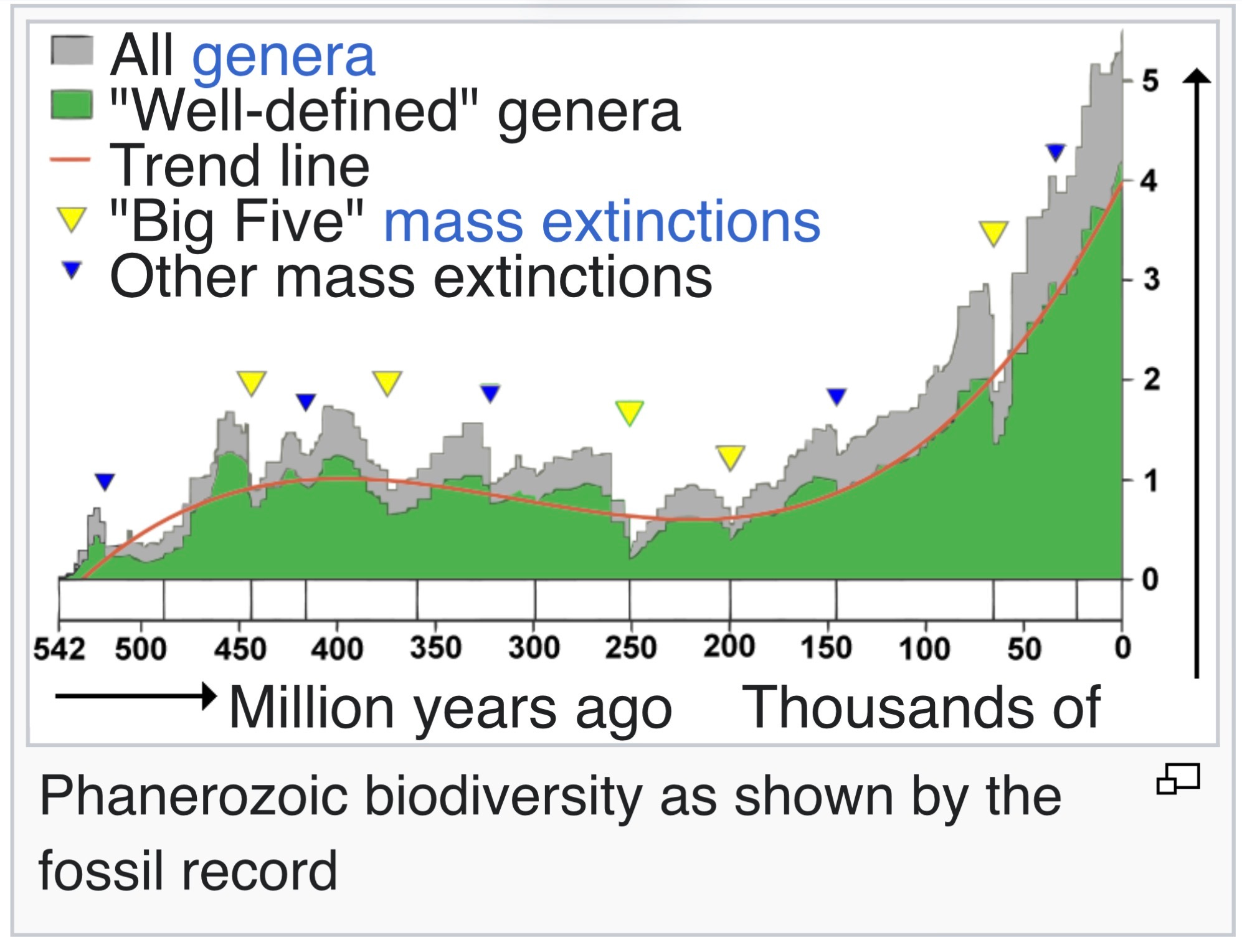
We can see that, across the history of the biosphere, the strong tendency of life has been towards greater complexity, not less, precisely because life is anti-entropic. While there are cases of organisms/species simplifying their architecture—most common in the case of parasites, as they feed off another organism’s complexity—these are more the exception than the rule, as competition for niches generally selects for higher, not lower, complexity.
The evolution of sexual reproduction was very much part of this tendency towards increasing complexity. Incorporating all the extra stages that sexual reproduction entails through requiring the conjunction of two gametes—one small and motile, the other large and sessile—then sustaining pregnancy, birth and (in eusocial insects, in birds, in mammals) supported infancy, creates filters for successful biological investment in extra complexity.
Hence all species above a certain level of complexity sexually reproduce. Nor is it an accident that the species with the most biologically expensive children in the biosphere—us Homo sapiens—has created the highest level of complexity in purposes and in niche construction and diversity.
The origin-of-life question is: how does something anti-entropic arise in a physical universe that inherently tends towards entropy? A universe that is structured but otherwise lacks purposefully self-ordering things. The search which is built into biological beings using information and resources to maintain themselves is very much part of the anti-entropic nature of life.
There are currently two contenders for mechanisms that allow anti-entropic life to rise in an entropic material universe. One is complexity (notably, Assembly Theory) which does not work. First, there is no complexity line that divides the biotic from the abiotic. Second, much of the complexity of life comes from it being anti-entropic. Something more is needed.
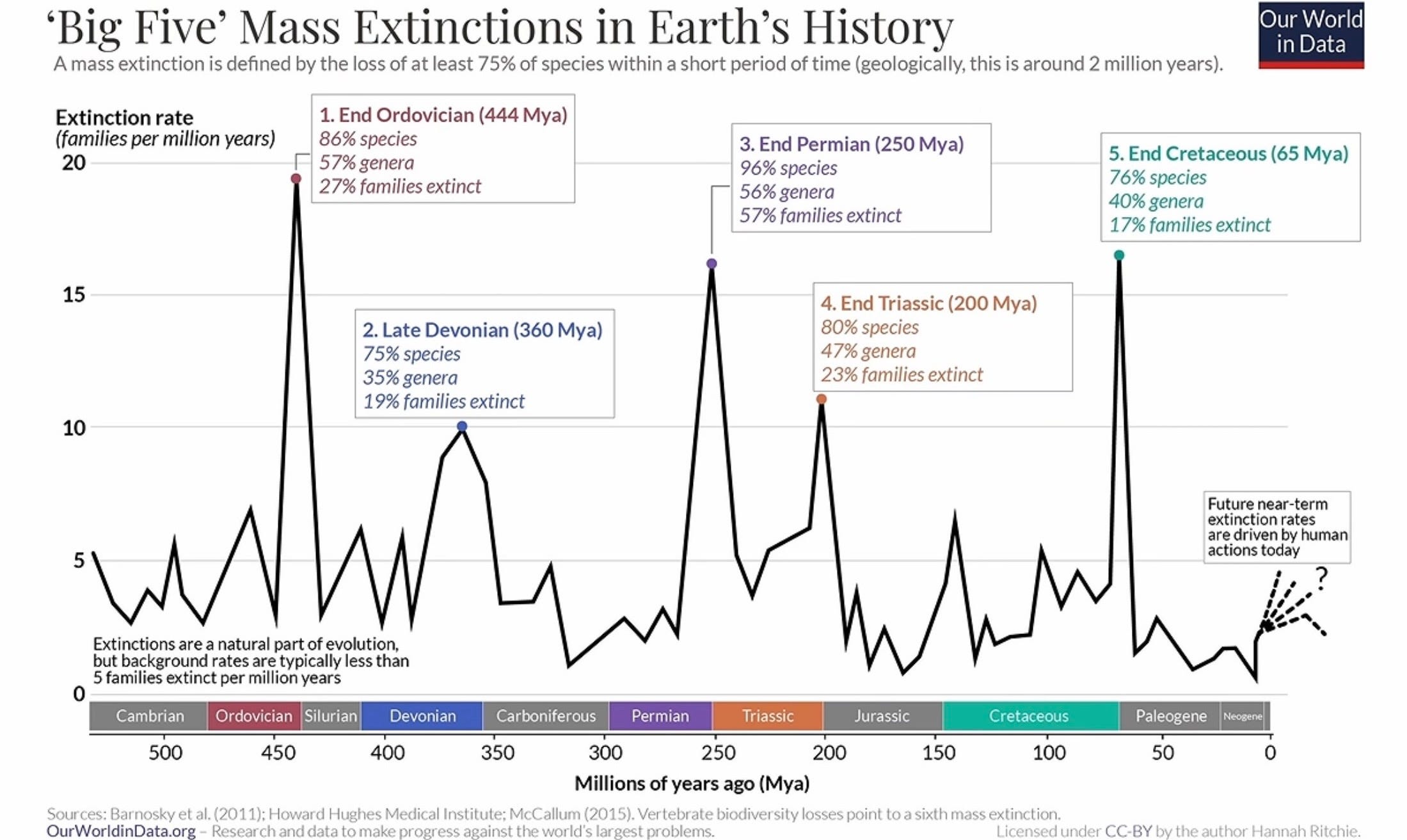
The other contender for generating the shift to the anti-entropic is randomness, which also does not work, as evolution requires periodic surges in coherent changes to create new species (or any species at all): at various points, after the mass extinction events, a lot of new species emerge in relatively short time periods. Mass extinction events create a huge number of niches open to being created and occupied, so it is clear why there are surges in new species after such events.
It is less clear how there is such multiplications of new species relatively quickly (though only relatively quickly: it still takes millions of years). An organ such as the eye has a much longer time period over which to evolve from selective pressure on random changes—with apparently just two pathways of development—than the mass of new species that emerge after a mass extinction event.
The greatly expanded opportunities after an extinction event has wiped out the previous occupants of niches mean that it is easier for genetic changes to find a niche. This is the same principle whereby ecologies rich in exploitable resources—such as jungles—can support a remarkable range of niches, even quite similar niches, than can more resource-starved ecologies such as deserts.
Nevertheless, even given the millions of years involved, there is a pattern of lots of coherent changes that remain something of an analytical puzzle. Just as the origins of life remain something of an analytical puzzle. In both cases, we see dramatically anti-entropic, self-ordering phenomena.
There is some principle operating that we have not yet worked out. (The analogy that comes to mind is the theory of natural selection before the discovery of genes and genetics.)
Critics of evolutionary theory regularly overstate the difficulties of randomness, as the feedback-and-response inherent in organisms that use information and resources to maintain themselves is not itself random, it is purposeful in a way that non-biotic (i.e. non-living) processes are not.
About us humans
The fossil record shows that our genus (Homo) evolved comparatively quickly once we became a technological species. Our investment in technology and cooperation “upped” our use of search, opening up new possibilities of action. The social emerging from the biological upped search further, once again opening up new possibilities of action.
The breakthrough to mass energy use that we call The Industrial Revolution has done all this yet again. The breakthrough to mass information and computing has done so yet again. Indeed, it has become an open question whether our technology will overwhelm our evolutionary adaptations, as we keep layering on top of the (much slower) processes of genetic search ever faster structures of search and realms of action.
This is without considering how the elimination of infant and child mortality may be having dysgenic effects: that is, weakening such genetic search as there now is within our species. This could well be weakening prosocial cooperation, or even actively undermining it (the spiteful mutant hypothesis).
What physicist-turned-social-analyst Samo Burja refers to as the great founder effect in understanding institutions and organisations is well-motivated search that leads to successful implementation. The problem for organisations and institutions is that the routinisation that eventually overtakes them undermines both motivated search and innovation. This is due both to the requirements of routinisation and its incentive and selection effects.
Anyone who looks seriously at how bureaucracies evolve—how their pathologies tend to get worse over time—becomes well aware of the problems of routinisation and adverse selection effects. Bureaucracies are not social “machines”, they are interactions between biological beings and so experience processes of social selection: processes whose tendency is—unless they are put under prosocial forms of systematic pressure—towards increasing pathologies, increasing dysfunctions including (in the absence of effective character tests) selection for manipulative personalities. Anyone familiar with the processes of decay in late Chinese dynastic regimes is aware that bureaucracies can become not merely dysfunctional, but increasingly so: this is a problem corporations also struggle with.
Imperial demographic booms and social order busts (plus contemporary resonances)

The first post in the series discussed the pitfalls of evolutionary reasoning and advanced 42 propositions about the development of human tool use, cooperation and mating patterns. The second post advances a further 78 propositions on use of fire, norms, language, prestige, propriety, diet, social aggression, male/female differences, religion, and murde…
The surface ordering of bureaucracies can generate chaotic or disordering effects. One of the problems with totalitarian regimes is that their enforced controls operate to destroy or suppress feedbacks. Living in such societies can actually be rather more chaotic than rule-of-law mercantile societies, though this can be not very visible to outsiders.
But you do not have to have the totalitarian urge to subordinate every realm of social action to politics to generate such problems. Contemporary Western welfare-warfare states are very much afflicted by the problems of expanding bureaucratic pathologies and dysfunctions.
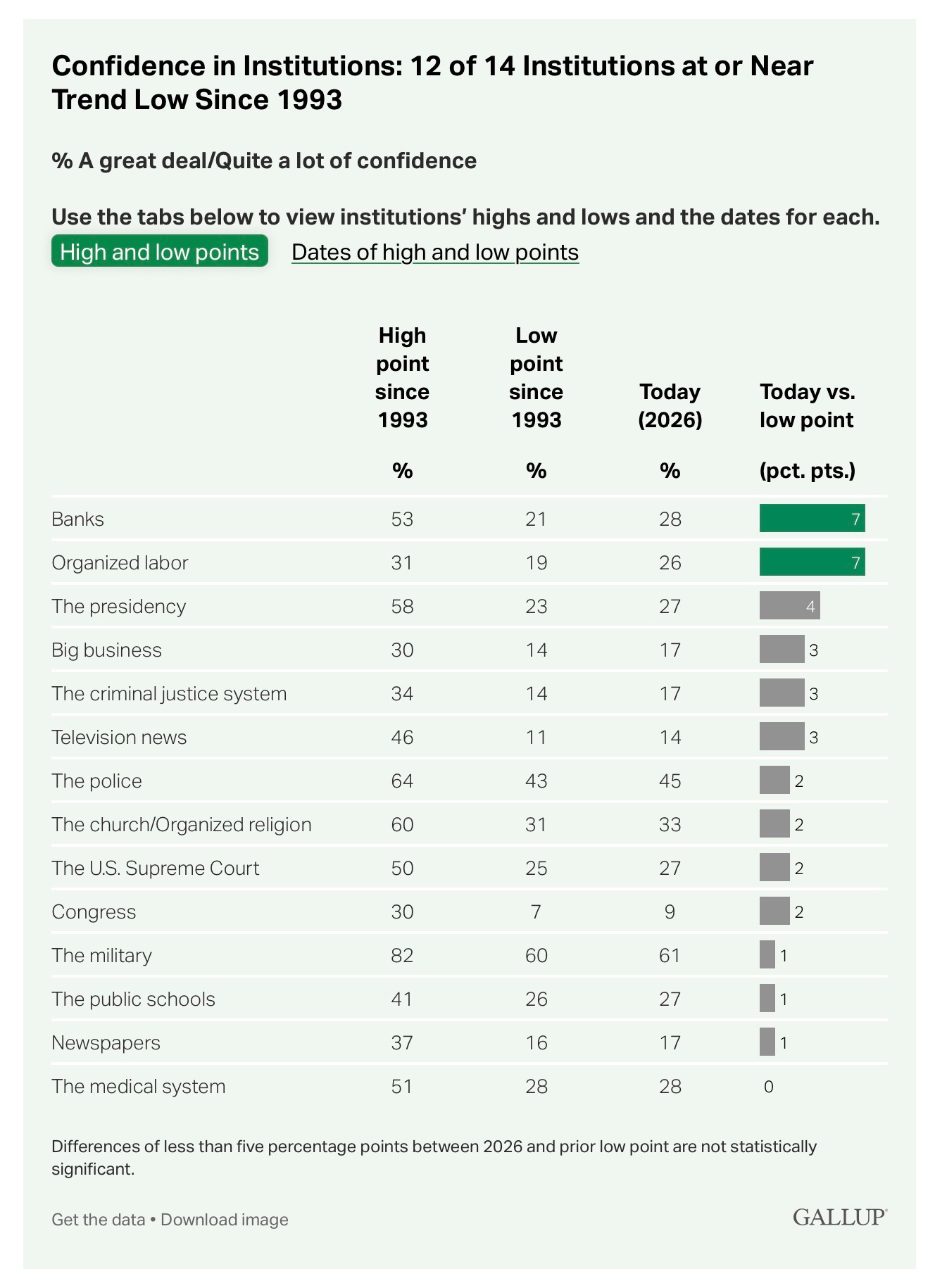
Such dysfunctions are deeply intertwined with the loss of trust in institutions subject to bureaucratic patterns, including the elevation of processes over outcomes and the tendency to select for increased inefficiency. Patterns of dysfunction and distrust one can see in, for example, the late Western Roman Empire as well as the decay periods of Chinese dynasties.
Contemporary centre-left politics has increasingly become the politics of such dysfunction—of the unaccountable classes (those paid to turn up)—with conventional centre-right politics collapsing because its practitioners have neither seriously noticed, nor done much effective against, such dysfunction and its associated politics.
Placing elected officials on top of bureaucratic structures does not inherently solve either the accountability or the effectiveness problems. A reality that is particularly stark in contemporary Britain but is hardly restricted to there.
If you are insulated from the consequences of your beliefs, moralising everything becomes an effective status play. It also poisons discourse, because it justifies censorship of “immoral” opinions, raises the rhetorical and identity stakes, and thereby inhibits admitting error, engaging in compromise or trade-offs, or even acknowledging inconvenient facts of the case. Such overblown, status-seeking moralisation blocks, poisons or distorts feedback.
Lacking systematic outside pressure to perform, our universities have become increasingly toxically dysfunctional, both in their expanding bureaucracies but also simple academic dysfunctions. Though much of those dysfunctions are themselves driven by the perverse incentives created by the dysfunctions of bureaucratised research grants, as will be discussed in the next post in this series.
Commercial corporations engage in search, seek to upscale the results and then risk falling prey to the problems of routinisation of their upscaling. Command economies largely kill motivated search, except in matters military, where there is still powerful competitive feedback-and-response effects. (This may be connected to why the US military has been notably better at maintaining public trust than other US institutions.)
Civilisational patterns
That we now live in the Anthropocene comes from our creating more complex structures—i.e., our anti-entropic efforts—moving up to a whole new level. This then creates further levels of required anti-entropic efforts to keep going. One can reasonably argue that polities, even civilisations, can go under because they reach a level of complexity whose structures cannot sustain the anti-entropic effect needed to keep going, usually due to insufficient or misdirected feedbacks.
No civilisation or polity has ever collapsed because of dysfunctions interior to commerce. Various levels of social and polity collapse have come from dysfunctions from the state apparatus. This includes creating dysfunctional incentives and status games. Western civilisation multiplying people insulated from the consequences of their ideas—and, worse, actively profiting from social pathologies—is not well placed for maintaining necessary levels of anti-entropic effort. It is suffering from too many broken, absent or even socially-destructive feedbacks.

Precisely because government agents wield, and are insulated by, coercive power—so more likely to have dysfunctional feedback and incentive structures and on grander scales—government failure is much more likely, and much more potentially catastrophic, than so-called market failure. Especially if markets are not judged by the nonsense standards of complete (so free) information and perfect rationality (i.e., costless cognition) which apply nowhere, so are not an appropriate standard of judgement for anything.
As noted above, the notion that sitting elected politicians on top of expanding state bureaucracies “solves” the accountability problem is demonstrably false. In this podcast—which I highly recommend as the deeply informed antidote to much nonsense—veteran journalist Richard Miniter discusses the routine bureaucratic dysfunction within the US national security state.
The same bureaucratic dysfunctions that produced the loss in Vietnam in 1963-1975 produced the loss in Afghanistan 2001-2021. Unlike the operational military capacity, there had been no operational learning embedded in the bureaucracies that led to the US national-security state to perform better strategically. (It did, however, perform much more expensively per soldier deployed.)
About capitalism
Physicist Sabine Hossenfelder makes a powerful point when she says:
5:50 Capitalism is the most important emergent feature that the human species has produced, yet, right after languages. It’s a decentralized, self-organized system to distribute resources that works whether or not people understand how it works, which is its beauty. Maybe it’s not the best system, but so far we haven’t found a better one.
A powerful point, if we are clear by what she means by capitalism. Does she mean commerce? Does she mean corporate commerce? Does she mean mass energy use? Does she mean commercial innovation at scale?
The comparison with language is revealing. We are the only primates who are vocal learners, who can learn sounds from others. In our case, not only from parents and peers but also from teachers and mentors.
Language increased our communication possibilities by orders of magnitude. The key thing about language is that it coordinates.
Some scholars focus on language as a tool of persuasion. Yes, persuasion matters given we are such a social species, but persuasion is only part of what language does. This is especially so given that it evolved when we were still struggling with basic problems of subsistence.
The possibility to warn, to describe, to coordinate all matter. Persuasion only works if it accords with and/or generates common purposes. The demands of subsistence dominated those purposes for millennia.
What turns out to matter profoundly is that language requires self-consciousness. It demands the ability to interrogate, assemble, transmit and receive packages of information. A large part of what language comes to be about is managing the problems and issues of self-consciousness.
Self-consciousness is what makes us the religious species, is what gives myths their power. If we define theology as a structure of meaning and purpose, so many of our debates are theological at their base. This very much includes the culture war and political struggles between the Constrained and Unconstrained Visions, to use economist Thomas Sowell’s terminology.
It is very likely that an important way language massively increased our ability to coordinate was by beta males getting together to drive away/kill alpha males, so using our proactive aggression to systematically select against reactive aggression. Murdering our way to niceness enabled us to become much more cooperative than any other primates. By suppressing dominance, language as mechanism of coordination enabled prestige and propriety to become currencies of social cooperation.
Language not only enabled much richer exchange of information, it selected for the emotional basis of cooperation. A selection that was also physical: we are the most gracile member of our genus because we are the most cooperative member. We selected for facial features that could better signal emotions, rather than physically resilient robustness. We are the only surviving member of our genus, almost certainly because we became the most cooperative.
What Sabine Hossenfelder is pointing to in her reference to capitalism is coordination via massively economising on information through prices that also merge feedback effects with cooperative incentives: so, commerce. But commerce has been around for millennia.
What has been the real take-off point is the breakthrough to mass energy use. That has enabled commerce to scale up in all sorts of ways. Falling transport and communication costs, plus economies of scale in production from increased energy use—and the technologies that both enabled it and were enabled by it—led to production moving out of households into factories while also enabling much more dense and extensive trading networks.
It is very clear that it was commercial innovation that drove this: not merely invention, but its implementation via commerce. It was jobbing artisans solving commercial problems through commerce-tested innovation—that no elite coalition blocked—that created the energy-use breakthrough.
What became known as the Industrial Revolution was learning-by-experiment at scale embedded in the information economising incentives and feedbacks of commerce creating the breakthrough to mass energy use. The coordination of land, labour and capital interacted with an expanding pattern of discovery.
It is understandable that we would want a catch-all terms for all this. Nevertheless, capitalism is an unfortunate term to try and distill all this. As a friend noted:
Always seemed a bit like “cis-“ to me - a way of marginalising, pathologising and misunderstanding the normal and organic.
Commerce is remarkable, but commerce coupled with learning-by-experiment at scale was even more remarkable.
Mass energy use also enabled even higher levels of ordering. It dramatically upped the anti-entropic effects of human social action by increasing our ability to act to be ordering, to be anti-entropic. Of course, it also upped our capacity to be profoundly destructive.
There is nothing about the terms capitalism or capitalist that captures, or even nods towards, the anti-entropic effect; that captures the importance of information landscapes; that captures what is key to the mass prosperity take-off; or that the mass prosperity take-off has taken the anti-entropic effect of the social emerging from the biological to a whole new level. Even more to the point, by so centring capital, both capitalism and capitalist encourage not taking coordination, not taking all the information, risk, search, learning, incentives, feedbacks, etc., seriously that “crank the handle” analytical approaches simply assume. A failing that the attempts to replace “capitalism” starkly and disastrously expose.
The next post explores how misled and misleading “crank the handle” approaches to social and historical analysis led to the innovation cargo cult that has had remarkably toxic effects on universities.
References
Owen Barfield, Poetic Diction: A Study in Meaning, Barfield Press, [1928] 2010.
Yoram Barzel, Economic Analysis of Property Rights, Cambridge University Press, [1989] 1997.
Andreas Bergh, Christian Bjørnskov, Luděk Kouba, ‘The growth consequences of socialism,’ Journal of Comparative Economics, Volume 53, Issue 2, 2025, 609-626. https://www.sciencedirect.com/science/article/pii/S0147596725000289
Cristina Bicchieri, The Grammar of Society: The Nature and Dynamics of Social Norms, Cambridge University Press, 2012.
Cristina Bicchieri, Norms in the Wild: How to Diagnose, Measure and Change Social Norms, Oxford University Press, 2017.
George Borjas, ‘Immigration and the American Worker: A Review of the Academic Literature,’ Center for Immigration Studies, April 2013. https://cis.org/Report/Immigration-and-American-Worker
Liam Brunt & Edmund Cannon, ‘A grain of truth in medieval interest rates? Re-examining the McCloskey-Nash hypothesis,’ (1999). https://www.researchgate.net/publication/228434881_A_grain_of_truth_in_medieval_interest_rates_Re-examining_the_McCloskey-Nash_hypothesis
Satyajit Chatterjee, ‘A theory of asset price booms and busts and the uncertain return to innovation’, Business Review, Federal Reserve Bank of Philadelphia, 2011, issue Q4, 1-8. https://www.philadelphiafed.org/-/media/frbp/assets/economy/articles/business-review/2011/q4/brq411_theory-of-asset-price-booms-and-busts.pdf
R. H. Coase, The Firm, The Market and the Law, University of Chicago Press, 1988. Includes ‘The Nature of the Firm’ (1937) and ‘The Problem of Social Cost’ (1960).
Ronald Coase & Ning Wang, How China Became Capitalist, Palgrave Macmillan, 2013.
Gregory Cochran and Henry Harpending, The 10,000 year explosion : how civilization accelerated human evolution, Basic Books, [2009] 2010.
David Friedman, ‘A Theory of the Size and Shape of Nations,’ Journal of Political Economy, Vol.85, No.1, Feb. 1977, 59-77. https://www.researchgate.net/publication/24107762_A_Theory_of_the_Size_and_Shape_of_Nations
Chris D. Frith, ‘The role of metacognition in human social interactions,’ Philosophical Transactions of the Royal Society B, 2012, 367, 2213–2223. https://pmc.ncbi.nlm.nih.gov/articles/PMC3385688/
Yegor Gaidar, ‘The Soviet Collapse: Grain and Oil,’ AEI, April 2007, 2007-09 #21440, compiled from a lecture delivered by Yegor Gaidar at AEI on November 13, 2006. https://www.scribd.com/document/428148552/Grain-and-Oil
Herbert Gintis, Carel van Schaik, and Christopher Boehm, ‘Zoon Politikon: The Evolutionary Origins of Human Political Systems’, Current Anthropology, Volume 56, Number 3, June 2015, 327-353. https://pubmed.ncbi.nlm.nih.gov/29581024/
Mark Granovetter, ‘The Strength of Weak Ties: A Network Theory Revisited,’ Sociological Theory, Vol.1, 1983, 201-233. https://www.csc2.ncsu.edu/faculty/mpsingh/local/Social/f15/wrap/readings/Granovetter-revisited.pdf
F. A. Hayek, ‘The Use of Knowledge in Society,’ American Economic Review, Sep. 1945, XXXV, No. 4, 519-30. https://statisticaleconomics.org/wp-content/uploads/2013/03/the_use_of_knowledge_in_society_-_hayek.pdf
Israel M. Kirzner, ‘The Alert and Creative Entrepreneur: A Clarification,’ IFN Working Paper No. 760, 2008. https://papers.ssrn.com/sol3/papers.cfm?abstract_id=1224842
Arnold Kling and Nick Schulz, Invisible Wealth: The Hidden Story of How Markets Work, Encounter Books, [2009] 2011.
Frank H. Knight, Risk, Uncertainty and Profit, Cosimo, [1921] 2005.
Meir Kohn, ‘An Alternative Theoretical Framework for Economics,’ Cato Journal, Vol. 41, No. 3 (Fall 2021). https://www.cato.org/cato-journal/fall-2021/alternative-theoretical-framework-economics
Robert W. Komer, Bureaucracy Does Its Thing: Institutional Constraints on U.S.-GVN Performance in Vietnam, R-967-ARPA, RAND, August 1972. https://www.rand.org/pubs/reports/R967.html
Steffen Korsgaard, Henrik Berglund, Claus Thrane, and Per Blenker, ‘A Tale of Two Kirzners: Time, Uncertainty, and the “Nature” of Opportunities,’ Entrepreneurship Theory and Practice, (2016), 40: 867–889. https://www.researchgate.net/publication/272240594_A_Tale_of_Two_Kirzners_Time_Uncertainty_and_the_Nature_of_Opportunities
Arthur Lewis, ‘Economic Development with Unlimited Supplies of Labour,’ The Manchester School, May 1954. https://la.utexas.edu/users/hcleaver/368/368lewistable.pdf
Glenn C. Loury, The Anatomy of Racial Inequality: The W.E.B Du Bois Lectures, Harvard University Press, 2002.
Michael Lynch, ‘Mutation and Human Exceptionalism: Our Future Genetic Load,’ Genetics, March 2016, Vol. 202, 869–875. https://academic.oup.com/genetics/article/202/3/869/5930150
D. N. McCloskey and John Nash, ‘Corn at Interest: The Extent and Cost of Grain Storage in Medieval England‘, The American Economic Review, Vol. 74, No. 1 (Mar., 1984), 174-187. https://www.jstor.org/stable/1803317
D. N. McCloskey, ‘The Open Fields of England: rent, risk, and the rate of interest, 1300-1815,’ in David W. Galenson (ed.), Markets in history: Economic studies of the past, Cambridge University Press, 1989. https://www.deirdremccloskey.com/docs/pdf/Article_50.pdf
Xavier Marquez, ‘A Model of Cults of Personality,’ APSA 2013 Annual Meeting Paper, Last revised: 26 Aug 2013. https://www.academia.edu/4205457/A_Model_of_Cults_of_Personality
Xavier Marquez, ‘Two Models of Political Leader Cults: Propaganda and Ritual,’ Politics, Religion, & Ideology, Volume 19, Issue 3, 2018, 265-285. https://papers.ssrn.com/sol3/papers.cfm?abstract_id=3208495
Joram Mayshar, Omer Moav, Zvika Neeman, ‘Geography, Transparency, and Institutions,’ American Political Science Review, June 2017, 111, 3. 622-636. https://warwick.ac.uk/fac/soc/economics/research/workingpapers/2016/twerp_1129_moav.pdf
Joram Mayshar, Omer Moav, Luigi Pascali, ‘The Origin of the State: Land Productivity or Appropriability?,’Journal of Political Economy, April 2022, 130, 1091-1144. https://www.researchgate.net/publication/356707920_The_Origin_of_the_State_Land_Productivity_or_Appropriability
Nathan Nunn, ‘Culture And The Historical Process,’ NBER Working Paper 17869, February 2012. http://www.nber.org/papers/w17869
Mancur Olson, The Logic of Collective Action: Public Goods and the Theory of Groups, Harvard University Press, [1965] 1982.
Mancur Olson, The Rise and Decline of Nations: Economic Growth, Stagflation and Social Rigidities, Yale University Press, 1982.
Mancur Olson, Power and Prosperity: Outgrowing Communist and Capitalist Dictatorships, Basic Books, 2000.
Jordan Peterson, Maps of Meaning: The Architecture of Belief, Routledge, 1999.
Kenneth M. Pollack, Armies of Sand: The Past, Present, and Future of Arab Military Effectiveness, Oxford University Press, 2019.
Yingyi Qian, ‘How Reform Worked in China,’ William Davidson Working Paper, Number 473, June 2002. https://papers.ssrn.com/sol3/papers.cfm?abstract_id=317460
James C. Scott, Seeing Like a State: How Certain Schemes to Improve the Human Condition Have Failed, Yale University Press, 1998.
James C. Scott, Against the Grain: A Deep History of the Earliest States, Yale University Press, 2017.
Thomas Sowell, A Conflict of Visions: Ideological Origins of Political Struggles, Quill William Morrow, 1987.
Will Storr, The Status Game: On Social Position And How We Use It, HarperCollins, 2022.
Edward Peter Stringham, Private Governance: Creating Order in Economic and Social Life, Oxford University Press, 2015.
Jordan E. Theriault, Liane Young, Lisa Feldman Barrett, ‘The sense of should: A biologically-based framework for modeling social pressure,’ Physics of Life Reviews, Volume 36, March 2021, 100-136. https://pubmed.ncbi.nlm.nih.gov/32008953/
Richard W. Wrangham, ‘Two types of aggression in human evolution,’ PNAS, January 9, 2018, Vol.115, No.2, 245–253. https://www.pnas.org/doi/10.1073/pnas.1713611115
Chenggang Xu, ‘The Fundamental Institutions of China’s Reforms and Development’, Journal of Economic Literature, 2011, 49:4, 1076–1151. https://www.researchgate.net/publication/227363166_The_Fundamental_Institutions_of_China’s_Reforms_and_Development
A brilliant piece. I will enjoy reading all the links. You have openend my eyes
Thank you for al that hard work Lorenzo.