

The first post in this series looked at how the term capitalism is used to romanticise the state and touched on some of the complexities the term capitalism abstracts away from. This post examines how the terms capitalism and capitalist mislead about the dynamics of commerce.

The term capitalism implies that the crucial thing in understanding the economic system is capital, its distribution and use. Just as the term capitalist implies that the crucial thing in business is ownership and use of capital.
That Marx uses a different definition of capital than does mainstream Economics—the perennial using-your-language-but-not-your-vocabulary pattern that is a feature of all strains of thought that descend from Marx—is part of the difficulty with the terms capitalism and capitalist. In Marx’s thought:
Capital is not just wealth, but wealth in a specific historically developed form: wealth that grows through the process of circulation.
In mainstream Economics, capital is:
those durable produced goods that are in turn used as productive inputs for further production” of goods and services.
Whichever definition of capital one is using, the claims that the crucial thing in understanding the economic system is capital, its distribution and use, and that the crucial thing in business is ownership and use of capital, are false. In mainstream Economics, they lead to “crank the handle” theories of economic growth based on Cobb-Douglas production functions and to “just add capital” concepts of foreign aid that have generated so much wasteful failure.
As living organisms, we use information and resources to maintain ourselves and achieve our purposes. Understanding social dynamics therefore requires accurately mapping information landscapes, and how we navigate them, as a key part of our patterns of resource acquisition and use.
This is something mainstream Economics can be quite deficient at, due to insufficiently grappling with cognition and information also being costly, so being matters of choice under scarcity. This is why, for example, mainstream Economics lacks a robust analysis of long-term economic growth and—very much a related matter—is generally seriously deficient in its analysis of large-scale immigration, as it lacks a robust analytical framework of what are the relevant factors.
When it comes to analysing social dynamics, there are direct attempts to understand reality’s observable features. Then there are attempts to “explain” such things in a way that is congenial to Theory. In particular, using Theory to select what counts as evidence, and how it is used, so as to remain within the confines of said Theory and its alleged analytical authority.
Marx’s theorising is bedevilled with this problem, as are all the strains of thought that descend from him—nowadays, typically via Critical Theory—but it also afflicts mainstream Economics. Profit (and loss) turns out to be a feature of social reality that recurrently gets the “Theory” treatment. Profit (and loss) also expose deep problems with the terms capitalism and capitalist.
To most of us, profit is a simple thing: you have been able to produce (and sell) more (usually monetary) value than you used (and paid for). Loss is the reverse of profit. Any explanation of profit has to be also an explanation of loss. If your Theory has difficulty with this elementary requirement, your Theory is wrong.
When the Classical economists such as Adam Smith (1723-1790) and David Ricardo (1772-1823) decided that value was driven by labour, this created a puzzle about where profit came from. One might think the response—since both profit and loss are clearly things, indeed highly motivating things—would be to revisit whether labour drives value. This was, eventually, the response of mainstream Economics, in the marginal analysis revolution. Well, sort of, as Theory then turned profit into a “problem” once more.
Moving away from deciding value was driven by labour was, famously, not the response of Karl Marx (1818-1883), whose labour theory of value turned profit (well, surplus value) into illegitimate parasitism from the alienating effect of private property plus the exploitive social power of the owners of capital. He later adjusted his theory somewhat (not that many folk noticed). It was not, however, a successful adjustment.
A key reason why Marx’s analysis fails is that he ran a Conflict Theory of social dynamics: that the dominant feature of human societies—including complex human societies—is conflict. Hence the famous first sentence of the first chapter of The Communist Manifesto (1848):
The history of all hitherto existing society is the history of class struggles.
This is flatly not true.
The key feature of Homo sapiens as a social species is that we are by far the most successful species at non-kin cooperation. The more complex a society, the more it is generally dominated by cooperative mechanisms. Indeed, Western global domination was built on European states and societies putting non-kin cooperation on steroids. One of the key reasons why Marxist regimes are so disastrous for human flourishing is that they are so destructive of cooperative social mechanisms.
One of the more disgraceful manifestations of Marx’s social analysis emphasising conflict—and so obscuring, downplaying or denying cooperative mechanisms—is his characterisation of employment as wage-slavery. This does what so many Marxian inflations of oppression does: it belittles actual and serious oppression (slavery) to engage in grandiose rhetorical inflations. In reality, a key element in the employment relationship is precisely its cooperative nature.
A fair criticism of mainstream Economics is its tendency to over-focus on transactions and under-rate connections. Coase’s famous theory of the firm is that the boundary of the firm is determined by whether transaction costs made it preferable to produce something inside the firm (via connection) than buy it from outside the firm (by exchange transactions).
The employment relationship is managing a connection where so much of the interaction cannot be explicitly specified in the employment contract. This has the effect of elevating the social-signalling importance of what is specified in employment contracts, especially wages.
Hence, it is often better to terminate specific employment connections by sacking some of your workers rather than poison the connections with all of your workers by cutting wages; i.e., by unilaterally changing—against the interests of workers—the most important thing explicitly specified in the employment contract. Hence also the benefit of bonuses: you can vary payment to employees through positive signalling that does not undermine your trustworthiness as a contractor. That your trustworthiness as a contractor matters comes from employment being a cooperative mechanisms even if, as is true for so many human connections and transactions, relative bargaining-power also matters.
Suppression of cooperative mechanisms is a default pattern of totalitarian regimes in general and of Marxism (and its derivatives) in particular. The CCP in China—having presided over a post-1978 loosening of suppression of cooperative social mechanisms in letting commerce operate much more freely—is now, under Xi Jinping, reverting to a more suppressive pattern.
The West has also experienced suppression of cooperative social mechanisms in the guise of human liberation and fighting “oppression”. These have typically been on the basis of Conflict Theory characterisation of social dynamics that are often at least partly derivative from Marxism.

Conflict Theory as an analytical presumption obscures, denies, belittles or subsumes the cooperative via a Conflict prism that has the great advantage of providing moralising motivation and claims to superior cognitive and moral authority (one is “fighting oppression”). As a consequence, the Inquisitor/Commissar’s principle—error has no rights and we can determine error—is alive and well in the contemporary West, from DEI to “disinformation”.
Biological basis of valuing
Everything social is emergent from the biological. So, here is a simple question. Why do we labour? Why do we direct our labour to particular ends? Because we value those ends. Do we have a conception of those ends as having value before we start? Yes. Are our efforts always successful? No. Are they always successful to the same degree? Also no.
We are biological beings and, as such, we use resources and information to maintain ourselves and reproduce. That is why we value things, because being biological beings makes us purposeful. Indeed, we are not only purposeful, we are significantly consciously so. Not only consciously so, as the vast majority of the processes in our bodies directed towards using information and resources to maintain our existence are not at all conscious. (This is why I dislike the philosophical concept of sense data: it gives way too much prominence to what information we are conscious of—a fraction of the information flows we are embedded in—which it then “separates out” from our cognition in a misleading way.)
Nevertheless, we are significantly consciously purposeful. Not only that, we are more so than any other species because we are a self-conscious species with language.
We humans being self-conscious social beings adds complexities to what we value and why. Nevertheless, our valuing things is a consequence of being biological beings that use resources and information for purposes of survival (and wider flourishing). Thus, there are things we seek to attain and others that we seek to avoid.
Our labour is an instrument of us being biological and so purposeful. Value does not come from labour, labour is a form of action we use to acquire and create things we value. It is neither the only such means of doing so nor is it always successfully so used.
That we judge how successfully or unsuccessfully labour has been used shows our valuations are independent of labour, which is why our valuing directs our labour. (It directs it towards creating use-value if we are doing it for ourselves, exchange-value if we are doing it to sell.)
The use of labour can fail. This is something everyone in business understands, but Marx—and those who follow his lead—functionally do not even if much of the complexity (and later adjustment) of his theory of value is to rationalise, and not-notice, this problem away.
One of the key failures of reasoning in Marx’s theory is the claim that:
The contradiction within capital is this: capital arises only in and through the exchange of commodities, but on average commodities are exchanged at their value, so no new value can arise simply by the exchange of commodities for one another.
This is also just false. Why do people exchange items? Because they value what they are receiving more than what they are giving up. This is the basis of gains from trade. Commerce is built on it. It is central to commerce as a cooperative social mechanism.
The price used in an exchange is an intersection point between subjective valuations. Marxist regimes suppress commerce based on a Conflict Theory of social dynamics, and a theory of value, that are disastrously wrong.
Theory as block to understanding
Conflict Theories of social dynamics drive folk to (false) zero-sum thinking, so to theories of social parasitism—they are taking things from you!—and of oppressor/oppressed dynamics, where every disliked constraint can be passed off as “oppression”. False theories can, however, be very effective at motivating, binding and coordinating people.
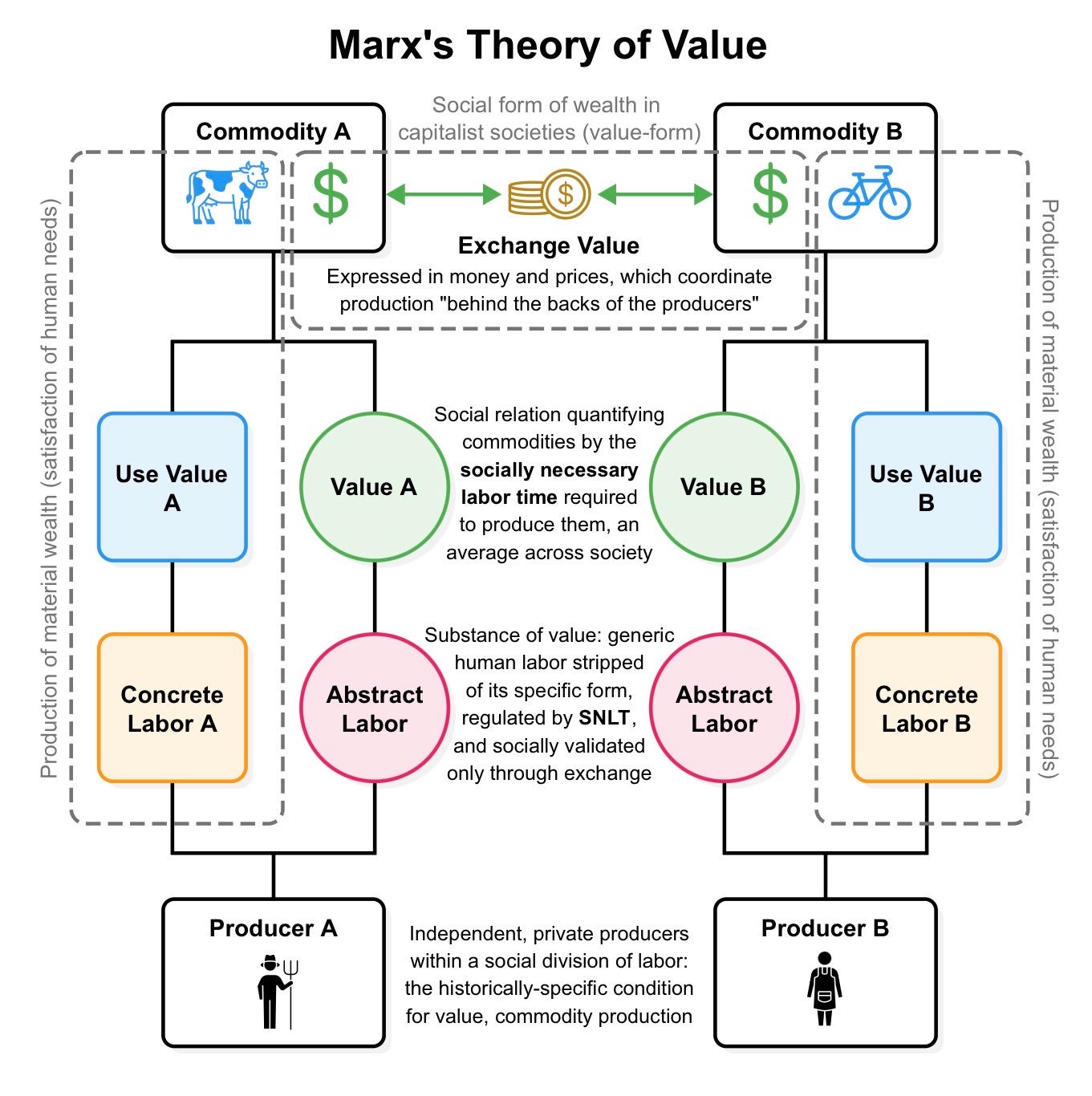
While Marx’s labour theory of value is false, it is a highly functional falsity. It creates a complicated model with special jargon for cognoscenti to master. It requires a lot of not-noticing and rationalising away—with its own special vocabulary—that signals in-group commitment. It casts entire groups of people as blocks to social liberation to be eliminated, creating the social devils that fuel mass movements. It makes its adherents the owners of morality who “know” the correct direction of history, with the right-to-decide who or what is legitimate and impose that on the entire society.
Giving up on any form of the labour theory of value due to having grasped that value comes from humans valuing things—or, to put it another way, from us being biological beings who use information and resources to maintain ourselves, whether individually or cooperatively, or even coercively, as we are also social beings—mainstream Economics promptly turned profit into a “problem” again. The problem being that, if land, labour and capital were paid their “full” contribution to production, there was no space for profit left in the production function.
Once again, one might think that profit (and loss) being such pervasive, and motivating, things, that might lead to some revisiting to the underlying Theory. To which the answer is sort of—with the concept of profit as residual income—but not enough.
Go back to using resources and information to maintain oneself. Hence we direct labour towards what we expect to be of value, but not always successfully. It is perfectly possible to create value-subtracting economic processes, even firms, that produce less value than they use.
Add in a rather crucial detail: there is no information from the future, so we have to anticipate, hence expectations about other people, and their expectations, are so important to social action. We have to direct our efforts to what we value or expect others to value. We have to have a sense of value—both for ourselves and what others value—in order to direct our labour towards creating (or finding), with risk of failure being part of the deal.
Add in further details: the acquisition and use of information is costly and we—as biological beings confronting constantly shifting problems and opportunities—are satisficers who economise on cognitive effort, and on perception, so have limited information and cognitive capacity. Moreover, being conscious enables us to focus attention—so perception (and action)—which is a form of economising in allocating scarce cognitive and perception resources.
Any biologist can tell you how nutritionally and calorifically expensive cognitive capacity is, and how limited perceptual apparatuses are, and how strong the pressure to economise on both is. Analyses that rely on complete (so free) information and perfect rationality (so costless cognition) are biological nonsense: they utterly fail the consilience with more fundamental structures that is basic to science.
Every action space is also an information landscape. Assuming that information landscape is flat and pellucid, with the acquiring, processing and use of that information being costless, is not only biologically ridiculous, it is a profoundly uneconomic—in the sense of choice under scarcity—way of analysing human agency and social dynamics. We have habits, routines, heuristics, etc. precisely to economise on cognitive effort.
The importance, and complexities, of information landscapes are why Utilitarianism, as an ethical system, does not scale down to the level of individual conduct, and why virtue ethics do not scale up beyond the level of individual conduct.
Utilitarianism allows one to economise on information, so one can use it as a normative framing for public policy. But that economising then means Utilitarianism does not grapple with the deep connections and importance of personal characteristics of individuals in our own lives. It is why people who try to turn it into a complete moral system come across as somewhat inhuman and it can all too readily act as such an abstracted moralism as to create an immoral consequentialism. Effective Altruism displays these problems in spades. We are not built to have undifferentiated obligations, undifferentiated concerns, undifferentiated connections; nor should we be expected to act as if we did.
Virtue ethics can absolutely cope with the layers of personal connections and people as having individual characteristics. It cannot cope with trade-offs one has to make at a public policy level. It is just too informationally complex and too restrictively demanding, too hostile to necessary trade-offs.
In other words, Utilitarianism and virtue ethics operate at different levels of the information landscapes. Norms, and our normative capacity, evolved as a functional means of making our social cooperation more robust through shared normative capacity and frameworks. There is no reason to expect that what is functional at one scale is functional at another. This is especially as feedbacks and their effectiveness vary wildly between different scales.
Even at macro levels, while Utilitarianism makes sense as a policy metric, it cannot be an homogenised universal standard, because that destroys loyalty and social resilience. Just as there must be a scope limit in the funding and delivery of public goods—hence both public and private providers “territorialise” them—there must be a scope limit to various moral and political obligations in order to have functioning polities. This is both for motivational reasons, and to have effective feedback and accountability. A lot of globalist moral grandiosity is about subverting or overriding inconvenient accountability to one’s fellow citizens.
In order to have robust institutions—with robust norms and so enforced rules—a polity has to have a robust civic culture with shared norms and cognitive framings. This is why mass immigration can have a socially corrosive effect if it involves importing a large mass of people with very different normative and cognitive framings. We can see this, for example, with the systematic corruption issues with Somalis in Minnesota. While their behaviour is corrosive of US institutions, it is perfectly normal behaviour back in Somalia: that is the point. This overlaps with the so-called Curley Effect that was notable in Boston but particularly corrosive in Detroit.
As for the inadequacy of a homogenous Utilitarianism, it matters, for instance, that most of the economic benefits of immigration go to the immigrants themselves—that’s why they keep coming—and almost all the remaining benefits go to the possessors of various forms of capital. The ludicrously “flat” informational analysis so many mainstream Economists use in analysing immigration—including ignoring, or belittling, institutional and cultural dynamics—is a key reason why such analysis can be remarkably inadequate and is leading many to discount the entire discipline.
Central to commerce
What does someone in business do? They coordinate—that is assemble and manage (factors of production)—anticipate (what people will buy) and manage risks. The coordination can be said to be management, so a form of labour, though it still involves information and feedback. The other two roles of anticipation and risk-management, not so much. (Hence the push to make entrepreneurship a factor of production.) If you pull off all three—coordinating, anticipating, risk managing—successfully, you make a profit. Too little success in doing so, you make a loss.
The profit/loss continuum motivates people to search for better ways to coordinate, to anticipate, and to manage risk. For instance, it motivates people to eliminate inefficiencies when they can make money from releasing resources into commercial exchange.
Such commerce also, via processes of market exchange, uses prices to massively economise on information; including to connect incentives and feedback. Search, entrepreneurship and innovation are all intimately connected. (Israel Kirzner’s analysis of entrepreneurship is too hung up on plans, rather than search and feedback.)
Profit and loss are not some weird extra feature of commerce. Profit and loss are at the heart of what makes commerce work. They are the results of information and cognition being costly and there being no information from the future.
In a world of costly information and cognition, where there is no information from the future, we cannot eliminate search. As urbanisation has increased, agglomeration effects have also increased, in an interactive process. Physical proximity fostering social interaction, along with conferences and exhibitions, provide ways of keeping up with competitors and benefiting from information flows. Positive agglomeration effects tend to be informational; negative agglomeration effects (e.g. congestion) tend to be physical.
The trick for human flourishing is to have pro-socially operant search. This includes having mechanisms that economise on information and provide feedback that is informationally and motivationally effective. There are reasons that countries that allow commerce to flourish are much more productive than those that suppress it.
Managing risk
Risk is why capital is connected to ownership of firms. To be a successful firm, you have to be solvent—able to cover expenses—and avoid bankruptcy—do not end up being being unable to cover your losses/obligations. Having capital means you can (at least potentially) cover the risks of trading. Supplying labour does not generate such risk-covering capacity. Hence, ownership of firms is typically based on capital, not on labour.
The boundary of a firm are those transactions whose risks are covered by the ownership capital of the firm. Such things as warranties evolve because different transactors are better able to cover various risks.
Financial intermediation exists because there is no information from the future plus the acquisition and use of information is costly. What economists call liquidity is a function of something being of value to others, its ease of transfer, and what information burden it imposes on transactors. Hence transaction friction is the reverse of liquidity.
The less information burden an easily transferrable asset imposes on transactors, the lower its transaction friction, so the more liquid it will be. Money becomes such a ubiquitous transaction good because it is a widely accepted means of payment, very easy to transfer, with a minimal information burden. Indeed, money illusion comes from using money’s face (“nominal”) value to over-shoot economising on information (remembering that neither information nor cognition is costless).
See here for an amusing example of highly illiquid mooncakes being replaced by highly liquid claims on mooncakes.

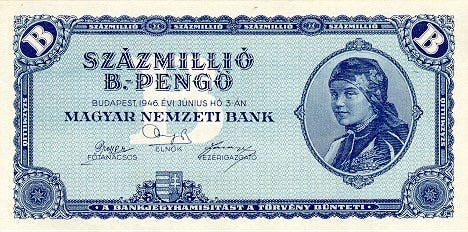
The economising-on-information role of money is so valuable, people continue to use money during hyperinflation episodes, when money is—by orders of magnitude—the worst store of value in the economy. They just unload it as quickly as possible, fuelling the hyperinflation spiral whereby money circulates faster and faster while its output-value heads towards zero.
Risk and uncertainty
If your analysis of profit and loss does not cover risk, it is utterly inadequate analysis. Risk comes from incomplete information; from there being no information from the future; and from information being costly to collect and use. There is risk that you can reasonably calculate probabilities for and risk that you have no basis to do so—that latter is Knightian uncertainty.
Risk is the range of information where we are, presumptively, able to calculate probabilities relevant to some purpose, to some state(s) we wish to attain and/or avoid because we are biological, which is to say purposeful, beings. Risk is thus the range of information relative to some purpose between Knightian uncertainty, where information is so insufficient probabilities cannot be calculated, and certainty, where there is such complete information that no change in the outcome is possible.
As I have discussed elsewhere, Knightian uncertainty leads to herd behaviour in asset markets, as people—unable to independently calculate risks within the realm of uncertainty—“go along with the herd” to minimise the risk of doing worse than anyone else and seek to benefit from those on the “information edge”. In other words, being unable to make economic calculations, they move to social calculations they can make while positioning themselves to respond to any new information reaching any participant in the market as quickly as possible. Such “animal spirits” are very much analogous to flocking or herd behaviour in other species.
A crucial element in such herd or flocking dynamics in asset markets is that uncertainty can be read positively or negatively. Positively-read uncertainty is particularly a factor in tech booms, which typically come to a halt because of a decrease in uncertainty about the new technology. Conversely, negatively-read uncertainty is a feature of financial crises.
Uncertainty comes from a lack of information—i.e., from an information void. Tech booms begin when a new technology is clearly productive but there is much uncertainty about which versions will be and to what extent, creating a positively-read information void. Tech booms come to an end when information about what works, why, and how well (or not) increases, shrinking the information void and increasing the differentiation between companies and their shares.
Thus, the level of economising on information falls, as the information landscape becomes more differentiated by the receding of the information void, so the overall transaction friction increases—i.e. the average liquidity of such assets falls due to their increasing information differentiation. This raises the average risk premium—how much excess return that is required by an individual to compensate being subjected to an increased level of risk—leading to a fall in such stocks overall.
Financial crises have similar dynamics in reverse. Confidence in the ability to judge the risk of financial assets collapses, leading to a flattened information landscape dominated by the uncertainty void. People flee to assets they have good information about—i.e., that they have sufficient information, and positive information, about. These are the proverbial “safe” assets that rise about the information void.
There is a dramatic increase in transaction friction—i.e. the average liquidity of other assets falls, often all the way to zero. The uncertainty is reversed when the information landscape becomes more differentiated, by more assets rising out of a shrinking information void. The more assets people are confident in assessing the risks of, the wider the range of assets people will invest in. Transaction friction falls—i.e. liquidity rises (since negatively-read uncertainty has zero liquidity) while risk premiums become more broadly operative as the range of assets with calculable risks rises.
In financial crises, central banks injecting funds into the system reduces uncertainty, and lowers risk premiums, because it increases confidence that overall spending levels (so incomes) will be stable. That is, more assets will be judged to be part of the assessable information “peaks” and so not in the uncertainty information-void.
The Great Depression as technocratic failure
What made the 1930s Depression so disastrous is that money kept rising in output-value—i.e., the exchange rate between money and goods and services—so people spent less and less money because it would buy more later, so incomes fell, so more and more loans failed, so bankruptcies increased. To put it another way, money rising in output-value drove down spending thereby increasingly destroying the value of other assets, especially financial assets. It was a drastic illustration of how much money is the hinge between present and future, between the goods-and-services (output) economy and assets.
Money kept rising in value, because all the major economies were on the gold standard, so gold set the output-value of money, and the Bank of France kept taking gold out of the monetary system, increasing the scarcity—so the value—of the gold still in the system. This was a process the most powerful central bank—the US Federal Reserve—did nothing to reverse. As gold set the output-value of money, if the output-value of gold was rising, so was the output-value of money, leading to a downward deflationary spiral.
Because four central banks—the US Federal Reserve, the Bank of England, the Bank of France and the Reichsbank—dominated gold holdings, the gold standard had become technocratic money and the Bank of France technocrats did what technocrats do. They focused on a technocratic goal—not have inflation—to the exclusion of wider considerations and with dramatic over-confidence in their own level of understanding.
Never was the principle that experts should be on tap, but not on top, more disastrously evidenced. Only the failures of the Covid public health technocracy have come close as a technocratic disaster. Though Covid is a much weirder case:
5:10 the guy that created the COVID pandemic [by funding gain-of-function research at the Wuhan Lab] was then put in charge of responding to it and the first thing he does is he covers up how he caused the pandemic.
Believing a totalitarian regime’s (CCP China’s) claims about its own successes and then copying its policies—rejecting previously agreed pandemic policy protocols—was very much part of the weirdness.
Of course, if technocratic “management” of immigration does lead to civil insurgency in one or more Western democracies, it will also go into the list of catastrophic technocratic failures. Currently, the fiscal damage such “technocratic” justifications of immigration policy has done to various European welfare states; the daily congestion problems; the driving up of rents and house-prices; the mass rapes and sexual assaults; and political turmoil it has been causing does not yet raise mass immigration to the level catastrophic technocratic failure.
(An alternative read is that Western elites have been deliberately using immigration to break up working-class communities; suppress their wages via suppressing labour scarcity premiums; while also de-legitimising working-class discourse and their cultural heritage. The way the British elite actively humiliates—particularly its working class—citizens by failing to enforce the borders; using the citizens’ taxes to pay to house such illegal immigrants in working-class neighbourhoods; give the illegals financial resources; plus access to the NHS; thus actively encouraging illegal immigration; is concurrent with a more hostile read. Whether that is so, mainstream Economics has provided technocratic “expert” cover for mass immigration, based on pervasively inadequate analysis of the importance of information landscapes.)
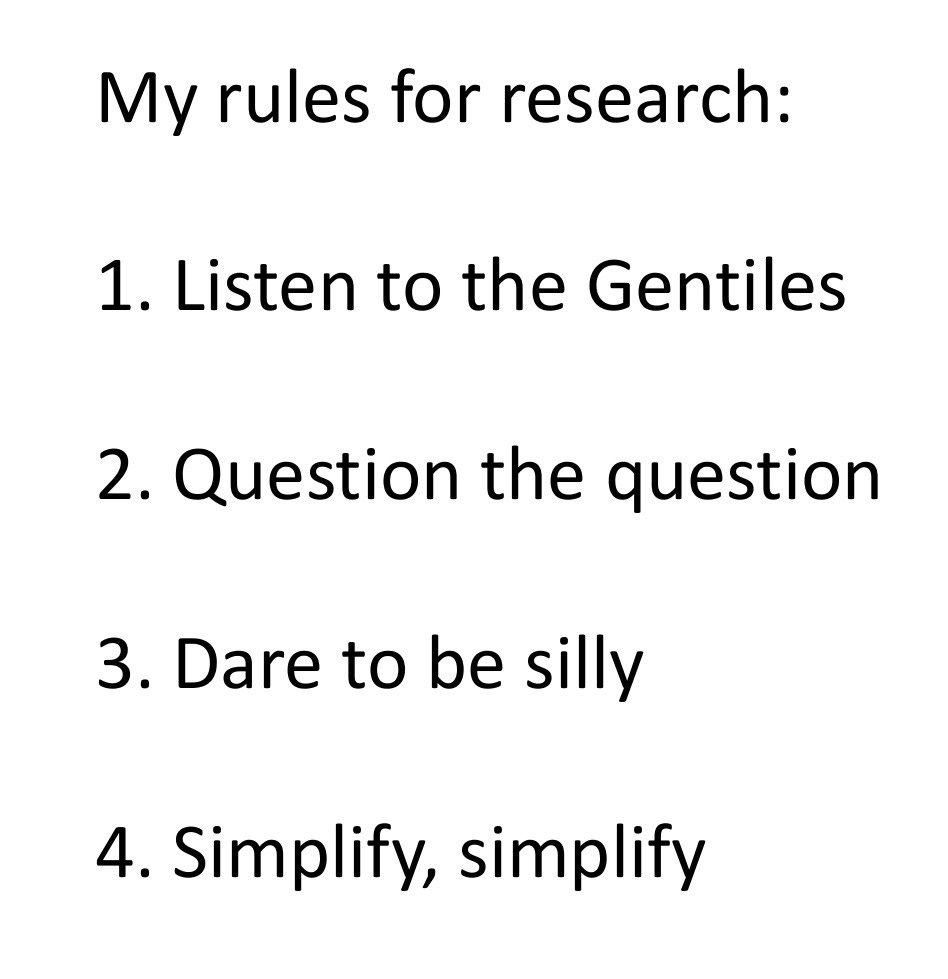
But what a lot of economists are doing in their immigration commentary and analysis is not serious social science, it is serious social signalling. It certainly does not follow Paul Krugman’s rules for research:
Such social signalling clearly interacts with the way mainstream media—which still operates as elite signalling mechanisms—sells its affirming this makes one a Smart, Moral Informed person narratives, so trains its subscribers to curate their information flows to defend such cognitive “assets”.
Innovation and risk
Venture capital puts financial intermediation at the service of commercial search aka innovation. A major reason why the rate of innovation was so low across most of human history was because of the limited ability to support risk taking.
Innovation did not really take-off at all until we became sedentary. That is, until local population levels were no longer so low that it was easy for technology to be lost and we were not limited to inventing things that we could carry.
Peasants would have lots of small fields—thereby reducing their average productivity—because it also reduced their variability in production, so minimising the chance they would fall below subsistence. They dispersed risk across space because concentrating their fields—so dispersing risk across time—was too risky. Falling interest rates in Britain—so better ability to manage risks across time—led to concentration of fields, plus increased search for, and use of, new methods, and so increased agricultural production.
In contemporary societies, workers’ vulnerability to risk drives much of their political behaviour. This is especially so regarding immigration, as they use local social connections—their locality-based social capital—as risk and opportunity management mechanisms. Thus, friends, relatives, acquaintances is persistently the most important labour market intermediary. For the working class, those are typically local friends, relatives, acquaintances, which is why they are often reluctant to move out of their locality and are resistant to floods of newcomers diluting or replacing those networks.
Humans vary in their ability to cope with variance in income due to how close they are to key negative thresholds (such as starvation). Peasants had a low ability to cope with variance, and the closer to subsistence they were, the less ability to cope they had.
This variance in ability to cope with risk interacts with expectations about income. Crashing incomes due to transaction crashes—aka recessions and depressions—push more people and firms below the thresholds of solvency and bankruptcy.
A major reason why Australia was so macro-economically stable from 1991 to Covid was because its Reserve Bank stabilised expectations both about the output-value of the A$ and about the future path of total spending (so income) in the Australian economy. Australia also had superior prudential regulation. It thus avoided both the Global Financial Crisis and the Great Recession.
Shares versus bonds
Shares impose a considerable greater burden of information—due to much greater variance in return—on investors than do government bonds, hence shares have persistently higher rates of return overall than do government bonds. That overall return for shares measure by share indices such as the Dow Jones obscures a high turnover within stocks because of the variance of and between individual stocks—General Electric was the only firm in the Dow Jones in 1907 which was still there in 1999.
The key variance for investment in shares is not the overall movement up and down of share-price indices such as the Dow Jones, but of all the individual stocks within such indices. That much greater information burden, due to increased differentiation and variance between stocks—so required risk premiums—leads to higher overall returns from stocks than bonds.
There is always some uncertainty in asset markets, as new information cannot be predicted (because new) and so cannot be incorporated in risk calculations. Such residual uncertainty is read positively in bull markets and negatively in bear markets. The interaction between shifts the extent of uncertainty, and how it is read, interacting with shifts in risk premiums, is enough to generate Keynes’s animal spirits.
If we have no information to differentiate between time periods, then we have no reason to change our actions. For example, all fiat currencies come to an end, but they have no set life-span and no set way they come to an end. If there is no information about their end that differentiates between time periods, it is as if they are eternal.
On the other hand, if it clear that a fiat currency is going to be come worthless due to some approaching event—such as the collapse of the state issuing the currency—then that will set off a hyperinflation spiral as people attempt to unload the currency as quickly and completely as possible. A clear example is the hyperinflation collapse of the Confederate dollar as the Confederacy’s defeat in the US Civil War became ever more imminent.
Risk failures
When one looks at how commerce is structured across human societies, the biggest single factor driving how commerce and firms are organised is risk management. Capital is certainly useful, but so is labour (and land), and a key use of capital is for risk management.
Why are state-owned enterprises so often so disappointing in their performance? Because the decision-makers within the enterprise do not have to cover the risks—that is loaded onto the state (and so the taxpayer). Nor do they get benefits from successful discovery (i.e., anticipation) or increasing efficiency. On the contrary, inefficiency often makes life easier for them. For state-owned enterprises, the motivation to search for better ways of coordinating, anticipating people’s wants, or managing risks, is weak.
When command economies have appeared to do well, it is because they have been transferring peasants from low-productivity farms to higher-productivity factories while copying the technology discovered by mercantile societies; societies where people are rewarded for successful discovery. In command economies, these processes peter out over time. That is the best case scenario: often, socialist states do not even do that well.
Even in that best-case scenario, you run out of peasants to transfer into factories while the inefficiencies of state production mount over time. (China’s declining population—and so declining labour force—will not fully bite until the process of moving people from less productive farms to more productive factories and other firms has been completed.)
The process within command economies of copying technology from mercantile societies tended to stagnate into repetition of existing patterns of production because the search motivations were weak, or even socially perverse. Over time, the gaps between the performance of command economies compared to mercantile societies got worse as, in mercantile societies, commerce continued to be motivated to search for new goods and services to provide—and better ways to provide existing ones—in a way that state-owned enterprises are not.
Even in mercantile societies, individual corporations can structure themselves for routinised production in ways that fail to adapt to changing circumstances. In other words, they can shift too thoroughly from search to planning—or even follow received scripts that do not rise to the level of effective planning.
The pathologies of bureaucracy can apply as much to corporate bureaucracies as government ones. Corporate bureaucracies do not, however, generally have the coercive power of the state to shield them from the consequences of their bureaucratic pathologies.
There are no equivalent mechanisms to commercial insolvency and bankruptcy in command economies for removal of economic “barnacles”—social nodes that systematically bleed off value or otherwise degrade the economic system. Thus, in command economies, such economic “barnacles” increase over time, pushing the system towards economic stagnation, even collapse.
Command economies can end up with value-subtracting firms: firms that take valuable land (resources), labour and capital and turn such into things of less value than the resources they used. As previously noted, we value things because we are biological beings that use information and resources to maintain ourselves. We can also have a sense of what others value, because we have a theory of mind. But merely using labour—or, for that matter, land or capital—provides no guarantees at all of creating more value than we use.
The CCP (Chinese Communist Party) has discovered how to harness commerce for its geopolitical goals. Huawei is a manifestation of how the CCP is much cleverer than the CPSU (Communist Party of the Soviet Union) but is still every bit as predatory to its people and workers.
Like postwar Japan, the CCP has used financial repression to fund decades of economic boom based on surging manufacturing exports. Like Japan, this suppression of feedback resulted in a massive property boom and bust and dubious overseas investments.
The effect of the property bust in China has been to shift investment from real estate to the CCP’s manufacturing goals. China uses cheap capital, and other state support, to achieve dominance in various global industries by driving down prices, and so gutting the no-longer price-competitive manufacturing capacity of other countries. As mainstream Economics worships efficiency and pays little attention to resilience—the ability to cope with changing circumstances—Western economists tend to just parrot free trade mantras rather than considering the full complexities of CCP policy.
Resilience is adaptive efficiency—the ability to productively change patterns of action—interacting with circumstances. If your adaptive efficiency is high, and the constraints and opportunities relatively stable, then you will be increasingly productive: especially if you are being innovative in ways that reduce constraints and increase opportunities. The lower your adaptive efficiency, and the more variable the constraints and opportunities, the worse you are likely to do.
It is likely that we humans developed our big brains—and the cognitive plasticity that goes with them—plus our nutritional flexibility as resilience responses to fluctuating ecological circumstances. The combination allowed us to colonise a huge range of ecological niches and then to become the niche-creating species par excellence.
Bureaucracies—especially bureaucracies insulated by coercive power—tend to have low (or even negative) adaptive efficiency. Authoritarian states suffer because they suppress feedback for political preservation reasons.
Welfare states suffer because their state apparats effectively colonise social pathologies—the greater the level of social pathologies, the wider the ambit of action (so authority and resources) of said apparat. For instance, the metabolically sicker Western populations get, the more resources that flow through public health: not a positive incentive structure. Similarly, low-skill immigration puts negative fiscal pressure on European welfare states, but the increased welfare expenditure benefits those employed in the welfare state apparatus.
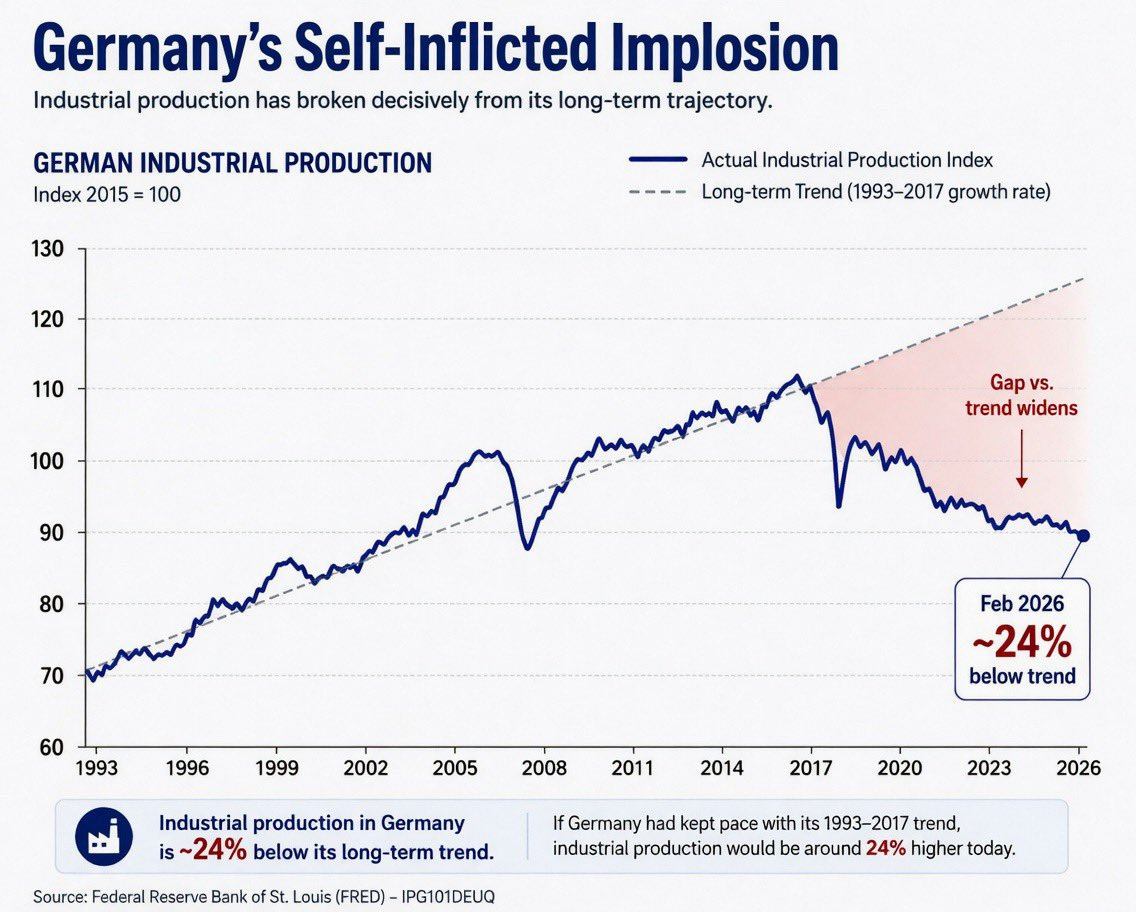
Commerce can compensate for the deficient adaptive efficiency of state bureaucracies, though that will depend on such things as availability of venture capital, ease of market entry, and how much transaction friction regulation imposes. Command economies lack that commercial compensation (with the partial exception of black markets). Europe is falling behind China and the US in tech because it is weak in venture capital, tends to discourage market entry, and imposes relatively high regulatory transaction friction, exacerbated by high energy prices.
The centrality of profit and loss
So we can see that loss and bankruptcy are vital parts of commerce, as they select against inefficient use of resources, poor/unsuccessful risk management and incorrect anticipation. The market for managerial control—aka corporate takeovers—is very much part of this. Profit and loss so operates because every action space is also an (uneven) information landscape, there is no information from the future, plus the acquisition and use of information are costly.
Profit-and-loss are a continuum that motivates search and keeps commerce functioning. They are not some weird extra feature that has to be “explained”. If your Theory turns profit and loss into such a thing, your Theory is wrong.
As I will discuss in a later post, the problem with the Cobb-Douglas production functions is that they essentially repeat the labour theory of value mistake of ignoring all the information, risk and coordination problems involved in productive human action; they just do so while adding capital (and possibly land) to labour. Hence, such production functions turn profit-and-loss back into a “problem”. They analytically flatten the information landscape far too much
Cobb-Douglas production functions are thus utterly inadequate bases or framings for understanding patterns of long-term economic growth, due to not grappling with:
the role of institutions in affecting information flows, risk patterns, feedback effects, and so on; and
the role of culture in generating cognitive framings that drive purpose and incentives, given that we humans—being purposive satisficers, where information and cognition are costly, who are raised embedded in connections long before we become significant transactors—cognitively model (graspable) significance, not facts.
Cognitive significance is hugely affected by culture. Unless you are incorporating culture in your analysis of the differing economic outcomes between societies and groups, you are not taking the subjective nature of human valuation seriously. Production functions not only over-flatten the information landscape, they also over-homogenise human motivation, and so action.
Adding a productivity and other “fudge factors” to a production function does not solve these problems. A production function cannot provide the basis for a robust analysis of long-term economic growth. The lack of such a robust analysis that identifies the key features driving long-term growth patterns leads directly to mainstream economists having been so often so inadequate—due to being far too narrow—in their analysis of immigration. They use Theory to decide what counts as evidence and how to use it and the state of their Theory is nowhere up to that burden.
The delusion that effectiveness—for example, in teaching—is mainly a resource/spending problem also analytically flattens the complexities of human interaction, information and agency.
Clearly, there is way more to human economic action in general—and commerce in particular—than just using capital. This is especially so, given that many people in business are often using other people’s capital more than they are using their own. Calling people in business capitalists is hugely misleading.
The next post in the series is an interlude looking at the anti-entropic nature of life.
References
Yoram Barzel, Economic Analysis of Property Rights, Cambridge University Press, [1989] 1997.
Andreas Bergh, Christian Bjørnskov, Luděk Kouba, ‘The growth consequences of socialism,’ Journal of Comparative Economics, Volume 53, Issue 2, 2025, 609-626. https://www.sciencedirect.com/science/article/pii/S0147596725000289
Cristina Bicchieri, The Grammar of Society: The Nature and Dynamics of Social Norms, Cambridge University Press, 2012.
Cristina Bicchieri, Norms in the Wild: How to Diagnose, Measure and Change Social Norms, Oxford University Press, 2017.
George Borjas, ‘Immigration and the American Worker: A Review of the Academic Literature,’ Center for Immigration Studies, April 2013. https://cis.org/Report/Immigration-and-American-Worker
Liam Brunt & Edmund Cannon, ‘A grain of truth in medieval interest rates? Re-examining the McCloskey-Nash hypothesis,’ (1999). https://www.researchgate.net/publication/228434881_A_grain_of_truth_in_medieval_interest_rates_Re-examining_the_McCloskey-Nash_hypothesis
Satyajit Chatterjee, ‘A theory of asset price booms and busts and the uncertain return to innovation’, Business Review, Federal Reserve Bank of Philadelphia, 2011, issue Q4, 1-8. https://www.philadelphiafed.org/-/media/frbp/assets/economy/articles/business-review/2011/q4/brq411_theory-of-asset-price-booms-and-busts.pdf
R. H. Coase, The Firm, The Market and the Law, University of Chicago Press, 1988. Includes ‘The Nature of the Firm’ (1937) and ‘The Problem of Social Cost’ (1960).
Ronald Coase & Ning Wang, How China Became Capitalist, Palgrave Macmillan, 2013.
Gregory Cochran and Henry Harpending, The 10,000 year explosion : how civilization accelerated human evolution, Basic Books, [2009] 2010.
Chris D. Frith, ‘The role of metacognition in human social interactions,’ Philosophical Transactions of the Royal Society B, 2012, 367, 2213–2223. https://pmc.ncbi.nlm.nih.gov/articles/PMC3385688/
Yegor Gaidar, ‘The Soviet Collapse: Grain and Oil,’ AEI, April 2007, 2007-09 #21440, compiled from a lecture delivered by Yegor Gaidar at AEI on November 13, 2006. https://www.scribd.com/document/428148552/Grain-and-Oil
Herbert Gintis, Carel van Schaik, and Christopher Boehm, ‘Zoon Politikon: The Evolutionary Origins of Human Political Systems’, Current Anthropology, Volume 56, Number 3, June 2015, 327-353. https://pubmed.ncbi.nlm.nih.gov/29581024/
Mark Granovetter, ‘The Strength of Weak Ties: A Network Theory Revisited,’ Sociological Theory, Vol.1, 1983, 201-233. https://www.csc2.ncsu.edu/faculty/mpsingh/local/Social/f15/wrap/readings/Granovetter-revisited.pdf
F. A. Hayek, ‘The Use of Knowledge in Society,’ American Economic Review, Sep. 1945, XXXV, No. 4, 519-30. https://statisticaleconomics.org/wp-content/uploads/2013/03/the_use_of_knowledge_in_society_-_hayek.pdf
Israel M. Kirzner, ‘The Alert and Creative Entrepreneur: A Clarification,’ IFN Working Paper No. 760, 2008. https://papers.ssrn.com/sol3/papers.cfm?abstract_id=1224842
Arnold Kling and Nick Schulz, Invisible Wealth: The Hidden Story of How Markets Work, Encounter Books, [2009] 2011.
Frank H. Knight, Risk, Uncertainty and Profit, Cosimo, [1921] 2005.
Meir Kohn, ‘An Alternative Theoretical Framework for Economics,’ Cato Journal, Vol. 41, No. 3 (Fall 2021). https://www.cato.org/cato-journal/fall-2021/alternative-theoretical-framework-economics
Steffen Korsgaard, Henrik Berglund, Claus Thrane, and Per Blenker, ‘A Tale of Two Kirzners: Time, Uncertainty, and the “Nature” of Opportunities,’ Entrepreneurship Theory and Practice, (2016), 40: 867–889. https://www.researchgate.net/publication/272240594_A_Tale_of_Two_Kirzners_Time_Uncertainty_and_the_Nature_of_Opportunities
Glenn C. Loury, The Anatomy of Racial Inequality: The W.E.B Du Bois Lectures, Harvard University Press, 2002.
Arthur Lewis, ‘Economic Development with Unlimited Supplies of Labour,’ The Manchester School, May 1954. https://la.utexas.edu/users/hcleaver/368/368lewistable.pdf
Michael Lynch, ‘Mutation and Human Exceptionalism: Our Future Genetic Load,’ Genetics, March 2016, Vol. 202, 869–875. https://academic.oup.com/genetics/article/202/3/869/5930150
D. N. McCloskey and John Nash, ‘Corn at Interest: The Extent and Cost of Grain Storage in Medieval England‘, The American Economic Review, Vol. 74, No. 1 (Mar., 1984), 174-187. https://www.jstor.org/stable/1803317
D. N. McCloskey, ‘The Open Fields of England: rent, risk, and the rate of interest, 1300-1815,’ in David W. Galenson (ed.), Markets in history: Economic studies of the past, Cambridge University Press, 1989.
Xavier Marquez, ‘A Model of Cults of Personality,’ APSA 2013 Annual Meeting Paper, Last revised: 26 Aug 2013. https://www.academia.edu/4205457/A_Model_of_Cults_of_Personality
Xavier Marquez, ‘Two Models of Political Leader Cults: Propaganda and Ritual,’ Politics, Religion, & Ideology, Volume 19, Issue 3, 2018, 265-285. https://papers.ssrn.com/sol3/papers.cfm?abstract_id=3208495
Joram Mayshar, Omer Moav, Zvika Neeman, ‘Geography, Transparency, and Institutions,’ American Political Science Review, June 2017, 111, 3. 622-636. https://warwick.ac.uk/fac/soc/economics/research/workingpapers/2016/twerp_1129_moav.pdf
Joram Mayshar, Omer Moav, Luigi Pascali, ‘The Origin of the State: Land Productivity or Appropriability?,’Journal of Political Economy, April 2022, 130, 1091-1144. https://www.researchgate.net/publication/356707920_The_Origin_of_the_State_Land_Productivity_or_Appropriability
Nathan Nunn, ‘Culture And The Historical Process,’ NBER Working Paper 17869, February 2012. http://www.nber.org/papers/w17869
Mancur Olson, The Logic of Collective Action: Public Goods and the Theory of Groups, Harvard University Press, [1965] 1982.
Mancur Olson, The Rise and Decline of Nations: Economic Growth, Stagflation and Social Rigidities, Yale University Press, 1982.
Mancur Olson, Power and Prosperity: Outgrowing Communist and Capitalist Dictatorships, Basic Books, 2000.
Jordan Peterson, Maps of Meaning: The Architecture of Belief, Routledge, 1999.
Kenneth M. Pollack, Armies of Sand: The Past, Present, and Future of Arab Military Effectiveness, Oxford University Press, 2019.
Yingyi Qian, ‘How Reform Worked in China,’ William Davidson Working Paper, Number 473, June 2002. https://papers.ssrn.com/sol3/papers.cfm?abstract_id=317460
James C. Scott, Seeing Like a State: How Certain Schemes to Improve the Human Condition Have Failed, Yale University Press, 1998.
James C. Scott, Against the Grain: A Deep History of the Earliest States, Yale University Press, 2017.
Edward Peter Stringham, Private Governance: Creating Order in Economic and Social Life, Oxford University Press, 2015.
Jordan E. Theriault, Liane Young, Lisa Feldman Barrett, ‘The sense of should: A biologically-based framework for modeling social pressure,’ Physics of Life Reviews, Volume 36, March 2021, 100-136. https://pubmed.ncbi.nlm.nih.gov/32008953/
Chenggang Xu, ‘The Fundamental Institutions of China’s Reforms and Development’, Journal of Economic Literature, 2011, 49:4, 1076–1151. https://www.researchgate.net/publication/227363166_The_Fundamental_Institutions_of_China’s_Reforms_and_Development