

The first post in the series discussed the pitfalls of evolutionary reasoning and advanced 42 propositions about the development of human tool use, cooperation and mating patterns. The second post advances a further 78 propositions on use of fire, norms, language, prestige, propriety, diet, social aggression, male/female differences, religion, and murdering our way to niceness. This third post is an interlude on why niches matter, even in complex societies, and how this throws light on contemporary social and political patterns.
About niches
Natural selection proceeds by competition between genetic lineages over the available niches members of those lineages can occupy. The more resources available to sustain such niches, the more niches there can be, in number and type. Tropical jungles team with life, deserts don’t.
One of the striking things about humans is our ability to generate new niches, and to move between them, due to our technology and cognitive plasticity. At a dozen or so localities within five or six regions around the world, populations moved from occupying foraging niches to creating and occupying farming niches.
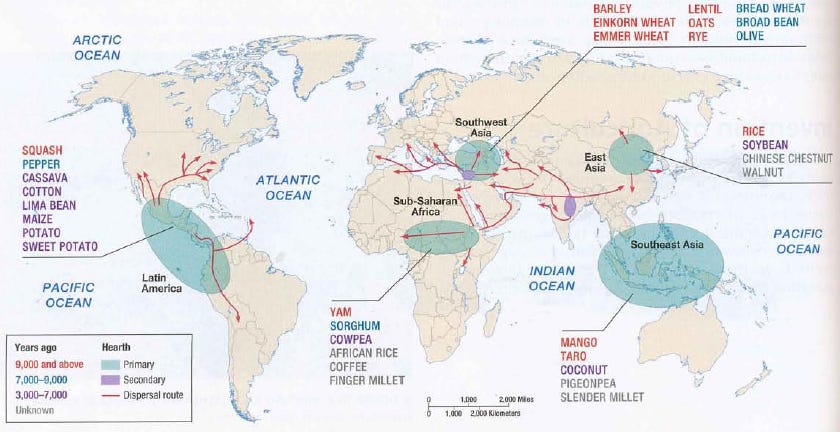
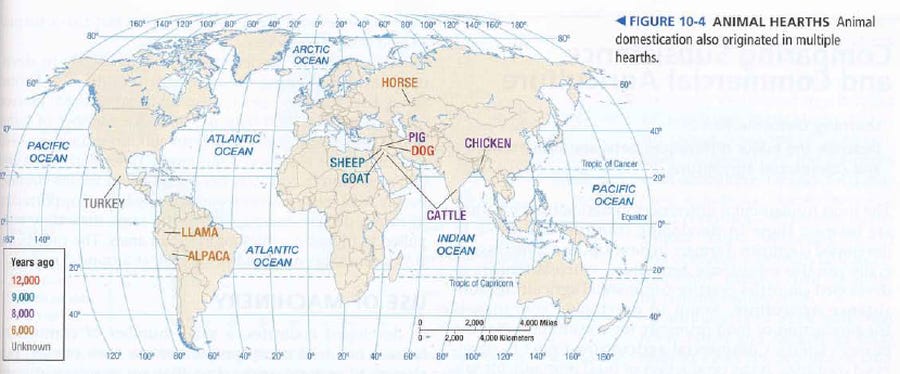
Foragers started the opening up of the steppes for human use by domesticating horses—along with dogs and reindeer, the only animals domesticated by foragers. Adding axles to wheels meant wagons, which enabled animal herders (i.e., pastoralists) to wander, with their herds, across the steppes. It later also meant chariots, which made them very dangerous to other groups.
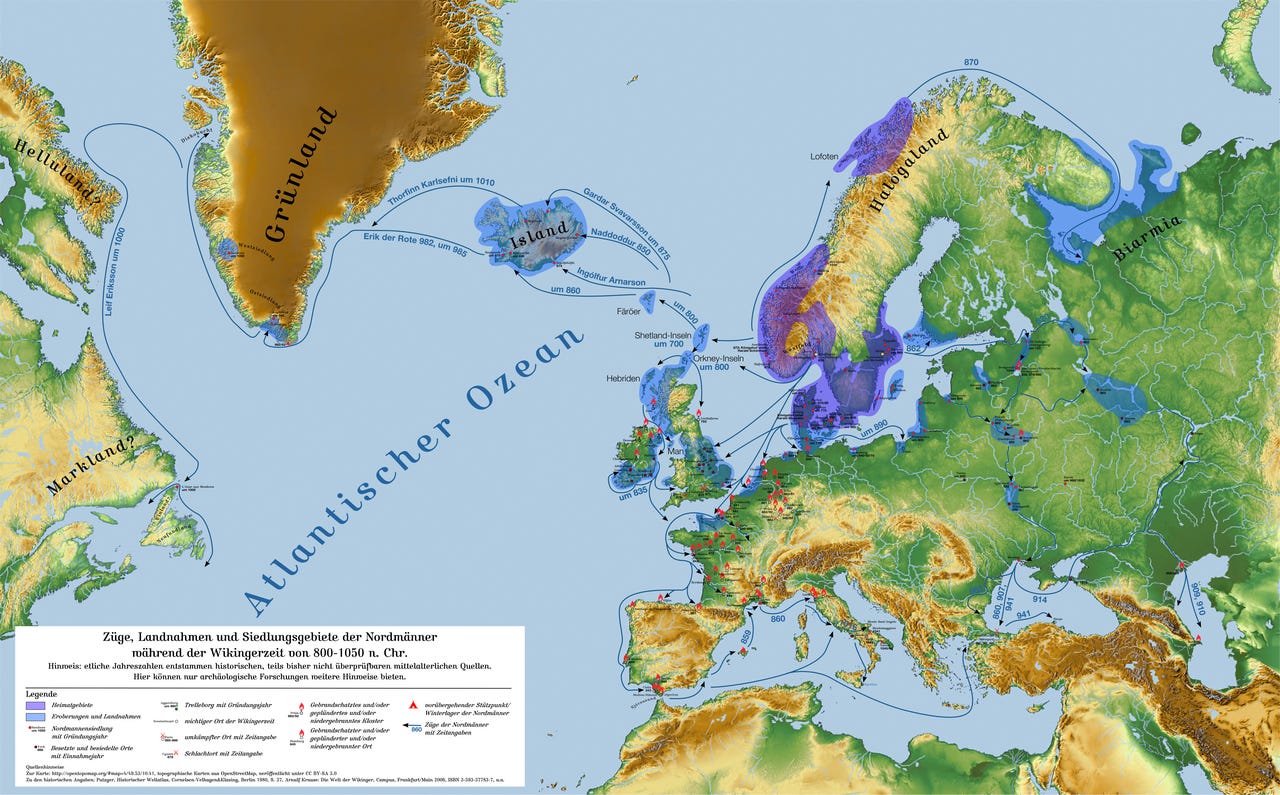
Later still, the invention of the recurve bow meant that horse archers could shoot as far and with as much power as people on chariots or foot, while being much more effective raiders. Massed horse archers created the basis for steppe empires, starting with the Scythians.
Both farming and pastoralism dramatically increased the number of human niches compared to foraging. But having children does not automatically create niches for them. As in all species, human lineages compete for the available niches.
Males in particular compete for marriage/mating opportunities. One of the things polygyny does is intensify such intra-male competition, as a marriage does not take a male out of the ongoing competition but does remove their wife from the marriage market.
Polygyny tends to distribute women up the social scale, leaving men at the bottom without marriage prospects within the group. Thus, insisting on single-spouse marriage helps social cohesion within a group or society.
Single-spouse marriage also creates partnership marriages, where the wife could—and regularly did—deputise for her husband in his absence. Having a wife deputise for her husband in a polygynous household where wives (and concubines) were competing for the prospects for their children was a recipe for disaster.
Elite polygyny in Chinese society generated a non-breeding male underclass. It also helped generate the outlaws, rebellious sects and peasant revolts that are such a feature of Chinese history. In our own time, Gulf state polygyny helps generate recruits for jihadism in poorer Arab countries.
Polygyny plus horse archery, or boats, is a great way to create a raiding culture, on the basis of “those people over there have women, steal theirs” and “wealth raises my status and so my marriage prospects”. Monasticism, by contrast, can be a way of “soaking up” excess males (and corralling the non-normies).
A key feature of Middle Eastern history is that areas of farming and pastoralist niches are geographically interwoven, to the extent that people have regularly moved between the two. There was thus a social selection advantage in being able to unite people across those ecological divides: something monotheism, with its unified moral, ritual and doctrinal framing, did very well. Hence the region is the source for all the major monotheisms.
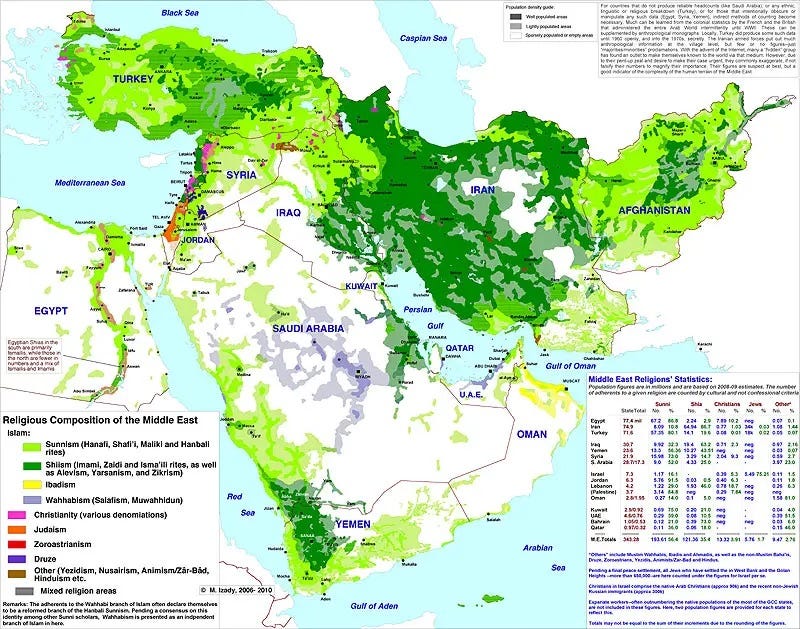
Since the C7th Arab break-out, the region has been dominated by the monotheism that sanctified the Arabian pastoralist synthesis: polygyny, patrilineal kin-groups, raiding and enslaving non-believing outsiders (including taking their women), law based on revelation and high levels of cousin marriage.

Prior to that, the Iranian plateau had been dominated for over a millennia by the proto-monotheism of Zoroastrianism and the lands westward had been dominated for around three centuries by the monotheism that sanctified the Roman farming synthesis—single-spouse marriage, law as a human creation, no consanguineous marriage, female consent for marriage, individual wills coupled with testamentary freedom, suppression of kin-groups—while also anathematising sex outside marriage.
Rivers provide fertile soil, animal and plant resources, so could support relatively dense human forager populations and even denser farming populations. This meant that early city-building cultures typically arose in river valleys. Plant-eating, river-valley farmers working in irrigated fields full of pathogens and parasites were then periodically conquered by meat-eating pastoralists.
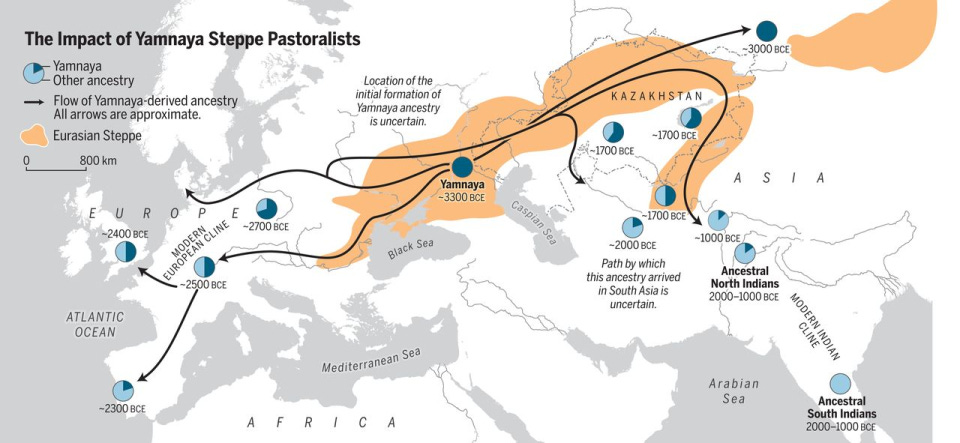
The massive expansion out of the Pontic steppes by the Yamnaya that led to half the world speaking Indo-European languages as their first, or a second, language was a dramatic example, but so were the histories of the Nile, Tigris, Euphrates, Indus, Ganges and Yellow river valleys: all of which were in range of pastoralists, whether from North Africa, Arabia, nearby uplands such as the Zagros mountains, or the steppes.
The Mekong did not so suffer—no pastoralists within range. On the contrary, the upland horticulturalists suffered regular slaving raids from the riverine states.
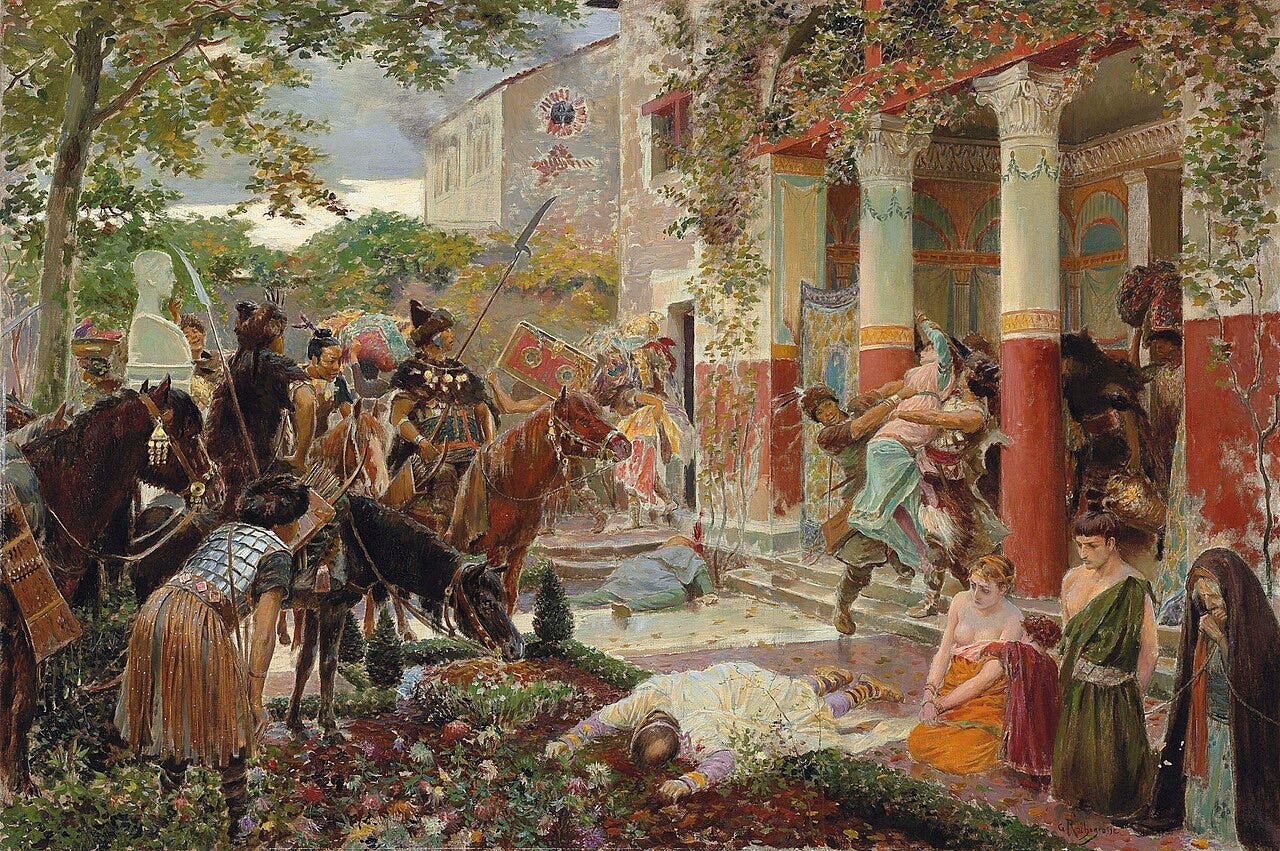
The farmers regarded pastoralists as raiding, thieving, woman-stealing, raping, murderous, human pests. The pastoralists regarded farmers as weaklings who could not defend their own. In accordance with stereotype accuracy, they were both correct.
The demographics of imperial success leading to imperial failure
The Chinese dynastic cycle was also driven by constraints on the number of niches. A founder establishes a dynasty, unifying the Han heartland. This brings peace. Farming production and trade, so resources, increases. The population expands because more niches are generated.
Eventually, the farming population begins to reach the limits of sustainable farming niches, given the existing technology. The farming niches shrink in size, making taxes more onerous. Excess population is squeezed out of farming niches, into banditry.
Putting that in more conventional economic terms, food prices rise as population increases faster than production. The return to labour thus falls, while those to land (rents) and capital (interest) rise. As the costs of land and capital rise—and distress increases—the concentration of ownership of both land and capital is likely to increase, further increasing inequality. Material stress—including the sharpening of status differentiations—makes family formation harder and violence a more attractive strategy.
Given elite polygyny, the aspiring-elite population increases faster than do elite niches. Increased contestation over resources corrodes norms, allowing bureaucratic pathologies to worsen. (This is especially so if there is no character test among the elite, such as the duel of honour.)
Disappointed elite aspirants form a counter-elite and organise the increasingly numerous outlaws and desperate peasants in large-scale revolts, often via religious sects. The Taiping Rebellion is an extreme manifestation of this repeated pattern: one reason Chinese political culture is so obsessed with order and harmony is when order breaks down, millions die.
At some stage, the dynasty is overwhelmed and collapses; war, disorder and disease massively culls the population, and the cycle begins again.
Historical modelling suggests that normative cohesion—what the pioneer of systematic social analysis Ibn Khaldun called asabiyya—was weakest within Chinese polities when population pressure was most intense and strongest when it was least intense. The balance of external threat and internal tensions affecting normative cohesion is a recurring pattern in human affairs.
Norms evolved to generate more robust common expectations, enabling higher levels of cooperation. Of course a decline—or, worse, collapse—in normative cohesion within societies and polities is bad for human cooperation and flourishing (and the polity).
We can see, for example, the collapse of the Soviet Union—so the removal of an external threat and of the concern within Western elites that it might be necessary to mobilise their own working class to deal with an existential threat—has been succeeded by increasingly polarised Western politics, including Western elites becoming increasingly hostile to (indeed, contemptuous of) the interests and concerns of their own working classes.
This assault on working class interests and concerns includes trade policies that off-shored manufacturing; technology that hollowed out local manufacturing employment; mass immigration that broke up working-class communities, and so their locality-based social networks, while generating a fractured demos; denigration of the local majority’s cultural heritage, often using immigration as an excuse to do so; morally grandstanding debauching of beloved entertainment franchises; housing policies that drove up rents and house price by restricting supply and driving up demand through mass immigration; education, policing and prosecution policies that put the local working class as the lowest priority; using metastasising linguistic taboos to—via moral abuse, cancel culture and outright censorship—block and de-legitimise working class speech as unacceptable morally vulgar; plus a general shift to non-electoral—often transnational—institutional policy-making that by-passes working class votes. Quantitative easing, by inflating asset prices, increased the experiential and perspective gap between elites and workers.
When working class voters—in reaction to all this—started voting national populist, this became an excuse for another wave of moral abuse and de-legitimisation. Ibn Khaldun was not wrong to note that normative cohesion (aka asabiyya) within a polity waxes and wanes, and this matters.
Versions of the cycle of the creation of domestic order generating population growth that then creates both elite and popular pressures on social order have afflicted polities since states—and especially empires—began. While pre-1820s economic history did generate various economic “efflorescences”—periods of growing living standards—these never lasted because the technological take-off required to break out of the Malthusian constraints did not happen.
Until, of course, it did: in Britain, in what we call the Industrial Revolution. Britain became the first country to adopt learning-by-experimentation at scale. The commercialised technological breakthroughs by jobbing artisans enabled ever greater use of energy to create more, more varied, and larger, human niches.
Crucially, no elite coalition vetoed this take-off.
A classic example of technological/economic take-off being vetoed by an elite coalition is the Ottoman Empire’s ban from the C15th to early C18th of the use of the printing press by Muslims: a ban that was not fully lifted until the C19th. The use that Christian Europe made of the printing press from 1440 to 1830—uses that Islam eschewed—explains much of the very different trajectories in the adjacent civilisations over that time.
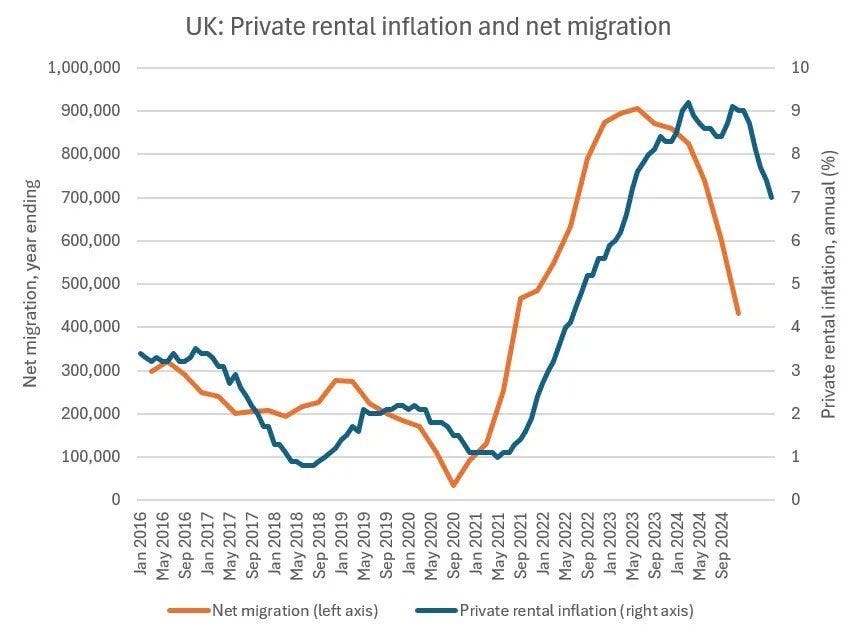
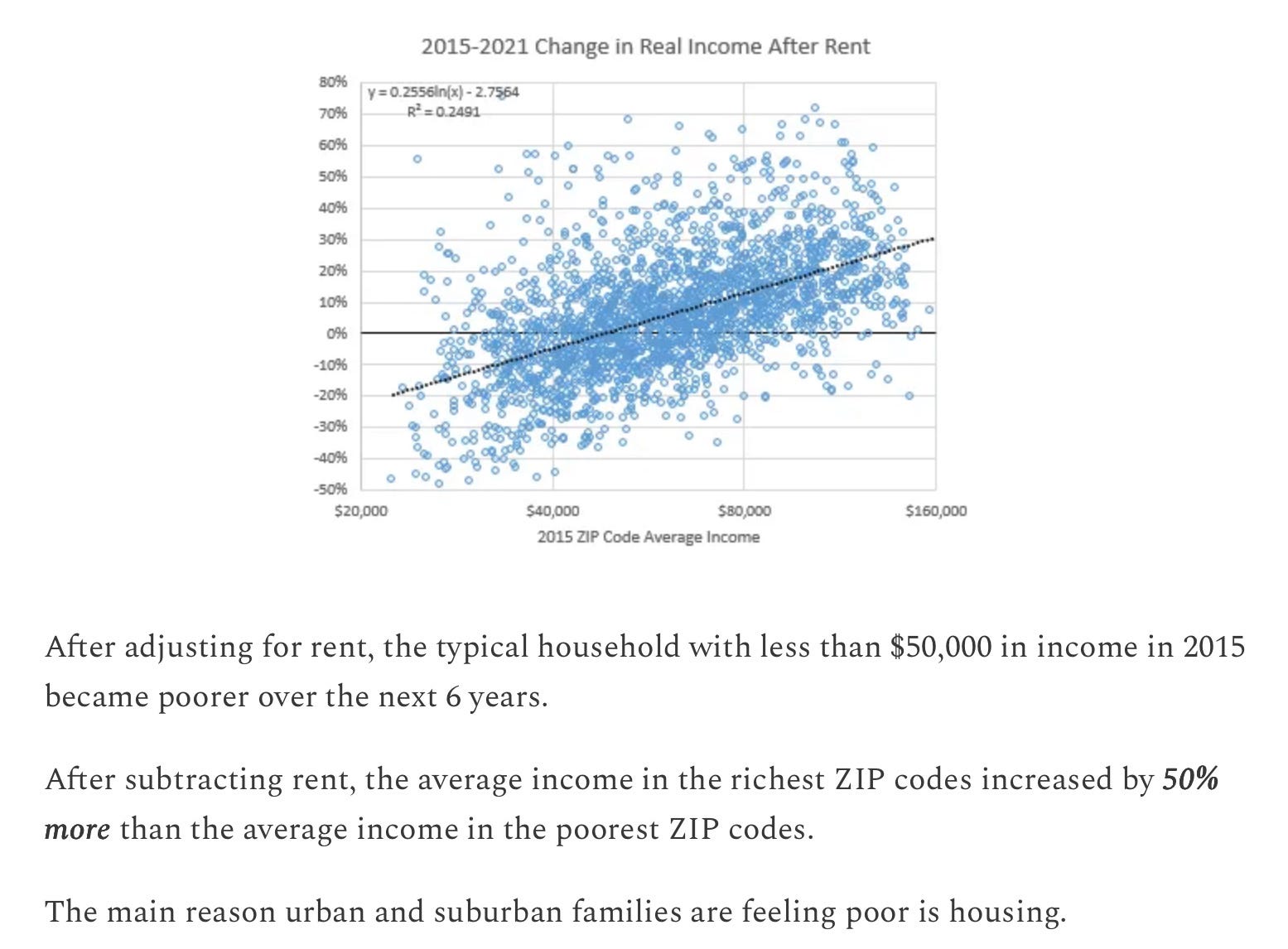
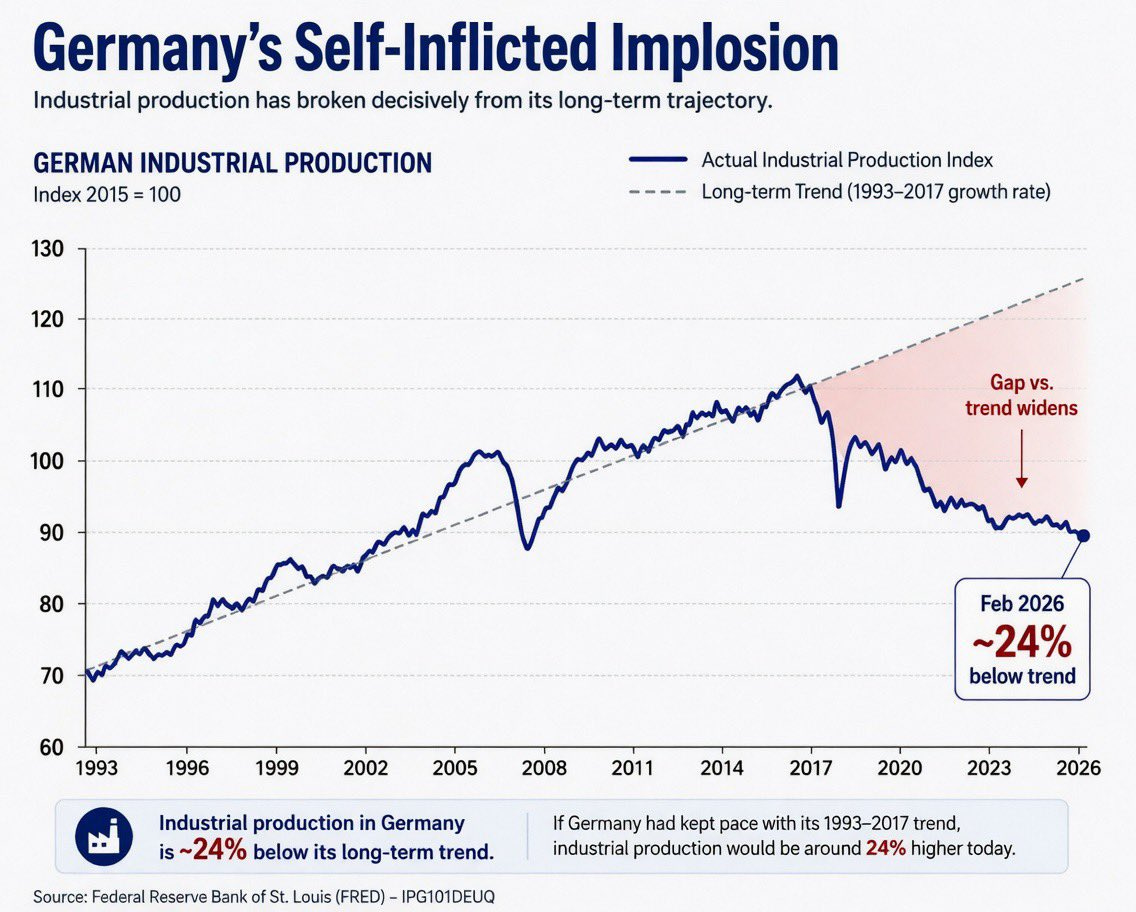
‘Net Zero’ and its equivalents—such as denuclearisation—represent contemporary elite coalitions vetoing economic advance, worsening contestation over resources and thereby destabilising the existing political Party system. This is especially so when constraining the supply of housing, while using mass immigration to drive up the demand, thereby increasing rents and house prices, turns into a new way to have increasing population/land ratios put downward pressure on the size of niches.
Cheap energy was the escape from the Malthusian constraints. Turning against it is not a path for human flourishing.
Universities that massively overproduce elite aspirants, while generating elite status games systematically hostile to human flourishing—due to being based on systematically false claims about humans, and human social dynamics, plus dubious ones about our wider environment—are not a good civilisational prospect.
So—having seen why niches matter in human history—the next post resumes the propositions about basic features of humans and human sociality, focusing on the rise of states, culture, cognitive dimorphism, and mass production.
References
Books
Douglas Allen, The Institutional Revolution: Measurement and the Economic Emergence of the Modern World, University of Chicago Press, 2012.
Scott Atran, In Gods We Trust: The Evolutionary Landscape of Religion, Oxford University Press, [2002] 2004.
Roy F. Baumeister, Is There Anything Good About Men?: How Cultures Flourish by Exploiting Men, Oxford University Press, 2010.
Joyce F. Benenson with Henry Markovits, Warriors and Worriers: the Survival of the Sexes, Oxford University Press, 2014.
Stephanie Coontz, Marriage, a History: How Love Conquered Marriage, Penguin, 2005.
Alfred W. Crosby, Throwing Fire: Projectile Technology Through History, Cambridge University Press, 2002.
Martin Daly and Margo Wilson, The Truth about Cinderella: A Darwinian View of Parental Love, Yale University Press, 1998.
Roger Eatwell and Matthew Goodwin, National Populism: The Revolt Against Liberal Democracy, Pelican, 2018.
David Frye, Walls: A History of Civilization in Blood and Brick, Faber & Faber, 2018.
Bryan Hayden, The Power of Ritual in Prehistory: Secret Societies and the Origins of Social Complexity, Cambridge University Press, [2018] 2020.
Heather Heying and Bret Weinstein, A Hunter-Gatherer’s Guide to the 21st Century: Evolution and the Challenges of Modern Life, Swift, 2021.
Philip Jenkins, The Next Christendom: The Coming of Global Christianity, Oxford University Press, [2002] 2003.
Garett Jones, The Culture Transplant: How Migrants Make the Economies They Move To a Lot Like the Ones They Left, Stanford University Press, 2023.
Robert L. Kelly, The Lifeways of Hunter-Gatherers: The Foraging Spectrum, Cambridge University Press, [1995] 2013.
Frank H. Knight, Risk, Uncertainty and Profit, Cosimo, [1921], 2005.
Victor Lieberman, Strange Parallels, Southeast Asia in Global Context, c.800–1830: Volume I, Integration on the Mainland, Cambridge University Press, [2003] 2010.
Victor Lieberman, Strange Parallels, Southeast Asia in Global Context, c.800–1830: Volume 2, Mainland Mirrors: Europe, Japan, China, South Asia and the Islands, Cambridge University Press, [2009] 2013.
William H. McNeill, Keeping Together in Time: Dance and Drill in Human History, Harvard University Press, 1996.
Jordan Peterson, Maps of Meaning: The Architecture of Belief, Routledge, 1999.
Kenneth M Pollack, Armies of Sand: The Past, Present, and Future of Arab Military Effectiveness, Oxford University Press, 2019.
Yossef Rapoport, Becoming Arab: The Formation of Arab Identity in the Medieval Middle East, Princeton University Press, 2025.
Christian Rudder, Dataclysm: Who We Are (When We Think No One’s Looking), Fourth Estate, 2014.
Erwin Schrödinger, What Is Life? The Physical Aspect of the Living Cell with Mind And Matter & Autobiographical Sketches, Cambridge University Press, [1944, 1958, 1992] 2013.
James C. Scott, The Art of Not Being Governed: An Anarchist History of Upland Southeast Asia, University of Yale Press, 2009.
Kevin Simler and Robin Hanson, The Elephant in the Brain: Hidden Motives in Everyday Life, Oxford University Press, 2018.
Will Storr, The Status Game: On Social Position And How We Use It, HarperCollins, 2022.
Robert Trivers, The Folly of Fools: The Logic of Deceit and Self-Deception in Human Life, Basic Books, [2011], 2013.
Peter Turchin, End Times: Elites, Counter-Elites and the Path of Political Disintegration, Penguin, 2024.
Articles, essays, blogposts, etc
P. W. Anderson, ‘More is Different,’ Science, New Series, Vol. 177, No. 4047. (Aug. 4, 1972), 393-396. https://cse-robotics.engr.tamu.edu/dshell/cs689/papers/anderson72more_is_different.pdf
Menelaos Apostolou, ‘Sexual selection under parental choice: the role of parents in the evolution of human mating,’ Evolution and Human Behavior, 28 (2007) 403–409. https://www.researchgate.net/publication/237929517_Sexual_Selection_Under_Parental_Choice_The_Role_of_Parents_in_the_Evolution_of_Human_Mating
Scott Atran, ‘“Devoted Actor” versus “Rational Actor” Models for Understanding World Conflict,’ Briefing to the National Security Council, White House, Washington, DC, September 14, 2006. https://core.ac.uk/download/pdf/6801978.pdf
Scott Atran, Robert Axelrod, Richard Davis, ‘Sacred Barriers to Conflict Resolution,’ Science, Vol. 317, 24 August 2007, 1039-1040. https://www.researchgate.net/publication/6123217_Sacred_Barriers_to_Conflict_Resolution
Joyce F. Benenson, Henry Markovits, Caitlin Fitzgerald, Diana Geoffroy, Julianne Flemming, Sonya M. Kahlenberg and Richard W. Wrangham, ‘Males’ Greater Tolerance of Same-Sex Peers,’ Psychological Science 2009 20: 184-190. https://www.jstor.org/stable/40065052
Paul M. Bingham, ‘Human Uniqueness: A General Theory,’ The Quarterly Review of Biology, Vol. 74, No. 2 (Jun., 1999), 133-169. https://www.academia.edu/83860282/Human_Uniqueness_A_General_Theory
Paul M. Bingham, ‘Human evolution and human history: A complete theory,’ Evolutionary Anthropology: Issues, News, and Reviews, (2000) 9: 248-257. https://www.academia.edu/83860856/Human_evolution_and_human_history_A_complete_theory
Christopher Boehm, ‘Egalitarian Behavior and Reverse Dominance Hierarchy,’ Current Anthropology, Vol. 34, No.3. (Jun., 1993), 227-254 (with Comments by Harold B. Barclay; Robert Knox Dentan; Marie-Claude Dupre; Jonathan D. Hill; Susan Kent; Bruce M. Knauft; Keith F. Otterbein; Steve Rayner and Reply by Christopher Boehm). https://lust-for-life.org/Lust-For-Life/_Textual/ChristopherBoehm_EgalitarianBehaviorAndReverseDominanceHierarchy_1993_29pp/ChristopherBoehm_EgalitarianBehaviorAndReverseDominanceHierarchy_1993_29pp.pdf
Barry Bogin, Jared Bragg, Christopher Kuzawa, ‘Humans are not cooperative breeders but practice biocultural reproduction,’ Annals of Human Biology, 2014 Jul-Aug; 41(4): 368-80. https://www.researchgate.net/publication/263130566_Humans_are_not_cooperative_breeders_but_practice_biocultural_reproduction
Selina Brace, Yoan Diekmann, Thomas J. Booth, Lucy van Dorp, Zuzana Faltyskova, Nadin Rohland, Swapan Mallick, Iñigo Olalde, Matthew Ferry, Megan Michel, Jonas Oppenheimer, Nasreen Broomandkhoshbacht, Kristin Stewardson, Rui Martiniano, Susan Walsh, Manfred Kayser, Sophy Charlton, Garrett Hellenthal, Ian Armit, Rick Schulting, Oliver E. Craig, Alison Sheridan, Mike Parker Pearson, Chris Stringer, David Reich, Mark G. Thomas, and Ian Barnes, ‘Ancient genomes indicate population replacement in Early Neolithic Britain,’ Nature Ecology & Evolution, 2019 May;3(5):765-771. Epub 2019 Apr 15. Erratum in: Nature Ecology & Evolution 2019 Jun;3(6):986-987. https://pmc.ncbi.nlm.nih.gov/articles/PMC6520225/
Judith K. Brown, ‘A Note on the Division of Labor by Sex,’ American Anthropologist, Vol.72, Issue 5, October 1970, 1073-1078. https://anthrosource.onlinelibrary.wiley.com/doi/10.1525/aa.1970.72.5.02a00070
William Buckner, ‘On secret cults and male dominance,’ Traditions of Conflict blog, January 31, 2018. https://traditionsofconflict.com/blog/2018/1/31/on-secret-cults-and-male-dominance
William Buckner, ‘Where are the matriarchies?’ Traditions of Conflict blog, March 18, 2018. https://traditionsofconflict.com/blog/2018/3/17/where-are-the-matriarchies
Michael L. Burton, Lilyan A. Brudner, and Douglas R. White, ‘A model of the sexual division of labor,’ American Ethnologist, (1977) 4: 227-252. https://www.researchgate.net/publication/227823427_A_Model_of_the_Sexual_Division_of_Labor
R. Calsbeek, ‘Ecological rules for global species distribution also predict performance variation in Ironman triathletes,’ PLoS ONE, 2023, 18(5): e0283282. https://journals.plos.org/plosone/article?id=10.1371/journal.pone.0283282
Satyajit Chatterjee, ‘A theory of asset price booms and busts and the uncertain return to innovation’, Business Review, Federal Reserve Bank of Philadelphia, 2011, issue Q4, pages 1-8. https://www.philadelphiafed.org/-/media/frbp/assets/economy/articles/business-review/2011/q4/brq411_theory-of-asset-price-booms-and-busts.pdf
O¨rjan Falk, Ma¨rta Wallinius, Sebastian Lundstro¨m, Thomas Frisell, Henrik Anckarsa¨ter, No´ra Kerekes, ‘The 1% of the population accountable for 63% of all violent crime convictions,’ Social Psychiatry & Psychiatric Epidemiology, 2014, 49, 559–571. https://link.springer.com/content/pdf/10.1007/s00127-013-0783-y.pdf
Jo Freeman, ‘Trashing: The Dark Side of Sisterhood,’ Ms magazine, April 1976, pp. 49-51, 92-98. https://www.jofreeman.com/joreen/trashing.htm
Chris D. Frith, ‘The role of metacognition in human social interactions,’ Philosophical Transactions of the Royal Society B, 2012, 367, 2213–2223. https://pmc.ncbi.nlm.nih.gov/articles/PMC3385688/
Zachary H. Garfield, Kristen L. Syme, Edward H. Hagen, ‘Universal and variable leadership dimensions across human societies,’ Evolution and Human Behavior, Volume 41, Issue 5, 2020, 397-414. https://tinyurl.com/muykzzpb
David C Geary, Jennifer Byrd-Craven, Mary K Hoard, Jacob Vigil, Chattavee Numtee, ‘Evolution and development of boys’ social behavior,’ Developmental Review, Volume 23, Issue 4, 2003, 444-470. https://citeseerx.ist.psu.edu/document?repid=rep1&type=pdf&doi=453100fc9af781a989a5bedb4eb8f1a298435a07
Herbert Gintis, Carel van Schaik, and Christopher Boehm, ‘Zoon Politikon: The Evolutionary Origins of Human Political Systems’, Current Anthropology, Volume 56, Number 3, June 2015, 327-353. https://pubmed.ncbi.nlm.nih.gov/29581024/
Jack A. Goldstone, ‘Efflorescences and Economic Growth in World History: Rethinking the “Rise of the West” and the Industrial Revolution,’ Journal of World History, 2002, Vol. 13, No. 2, 323-389. http://culturahistorica.org/wp-content/uploads/2020/02/goldstone-efflorescences.pdf
Mark Granovetter, ‘The Strength of Weak Ties: A Network Theory Revisited,’ Sociological Theory, Vol.1, 1983, 201-233. https://www.csc2.ncsu.edu/faculty/mpsingh/local/Social/f15/wrap/readings/Granovetter-revisited.pdf
Jonathan Haidt and Jesse Graham, ‘Planet of the Durkheimians, Where Community, Authority, and Sacredness are Foundations of Morality,’ December 11, 2006. https://papers.ssrn.com/sol3/papers.cfm?abstract_id=980844
Kim Hill, Michael Barton, and A. Magdalena Hurtado, ‘The Emergence of Human Uniqueness: Characters Underlying Behavioral Modernity,’ Evolutionary Anthropology, 2009, 18:187–200. https://tinyurl.com/4xp4csdk
Erik P. Hoel, Larissa Albantakis, and Giulio Tononi, ‘Quantifying causal emergence shows that macro can beat micro,’ PNAS, December 3, 2013, vol. 110, no. 49, 19790–19795. https://www.pnas.org/doi/10.1073/pnas.1314922110
Z. Hofmanová, S. Kreutzer, G. Hellenthal, C. Sell, Y. Diekmann, D. Díez-del-Molino, L. van Dorp, S. López, A. Kousathanas, V. Link, K. Kirsanow, L.M. Cassidy, R. Martiniano, M. Strobel, A. Scheu, K. Kotsakis, P. Halstead, S. Triantaphyllou, N. Kyparissi-Apostolika, D. Urem-Kotsou, C. Ziota, F. Adaktylou, S. Gopalan, D.M. Bobo, L. Winkelbach, J. Blöcher, M. Unterländer, C. Leuenberger, Ç. Çilingiroğlu, B. Horejs, F. Gerritsen, S.J. Shennan, D.G. Bradley, M. Currat, K.R. Veeramah, D. Wegmann, M.G. Thomas, C. Papageorgopoulou, & J. Burger, ‘Early farmers from across Europe directly descended from Neolithic Aegeans,’ Proceedings of the National Academy of SciencesU.S.A., 113 (25) 6886-6891. https://www.pnas.org/doi/10.1073/pnas.1523951113
Meng Hu & Emil O. W. Kirkegaard & John Fuerst, ‘Income and Education Disparities Track Genetic Ancestry,’ OpenPsych. (2023) 10.26775/OP.2023.09.11. https://www.researchgate.net/publication/373840894_Income_and_Education_Disparities_Track_Genetic_Ancestry
Emily Hurren, Carleen Thompson, Brian Jenkins, April Chrzanowski, Troy Allard, Anna Stewart, ‘Who are the Perpetrators of Child Maltreatment?,’ Report to the Criminology Research Advisory Council Grant: CRG 18/13-14, May 2018. https://www.aic.gov.au/sites/default/files/2020-05/18-1314-FinalReport.pdf
Ian Janssen, Steven B. Heymsfield, ZiMian Wang, and Robert Ross, ‘Skeletal muscle mass and distribution in 468 men and women aged 18–88 yr,’ Journal of Applied Physiology, 2000 89:1, 81-88. https://www.researchgate.net/publication/12415379_Skeletal_muscle_mass_and_distribution_in_468_men_and_women_aged_18-88_yr
Rachel Jewkes, Emma Fulu, Tim Roselli, Claudia Garcia-Moreno, ‘Prevalence of and factors associated with non-partner rape perpetration: findings from the UN Multi-country Crosssectional Study on Men and Violence in Asia and the Pacific,’ Lancet Global Health, Vol.1, October 2013, e208-e218. https://tinyurl.com/3amv4ds6
Ada Johansson, Pekka Santtila, Nicole Harlaar, Bettina von der Pahlen, Katarina Witting, Monica Algars, Katarina Alanko, Patrick Jern, Markus Varjonen, and N. Kenneth Sandnabba, ‘Genetic Effects on Male Sexual Coercion,’ Aggressive Behavior, 2008 Volume 34, 190–202. https://www.researchgate.net/publication/6011396_Genetic_effects_on_male_sexual_coercion
Tim Kaiser, Marco Del Giudice, Tom Booth, ‘Global sex differences in personality: Replication with an open online dataset,’ Journal of Personality, 2020, 88, 415–429. https://www.researchgate.net/publication/334279951_Global_Sex_Differences_in_Personality_Replication_with_an_Open_Online_Dataset
Hillard Kaplan, Kim Hill, A. Magdalena Hurtado, and Jane Lancaster, ‘The embodied capital theory of human evolution,’ in Peter T. Ellison (ed.) Reproductive ecology and human evolution, De Gruyter, (2001), 293-317. https://www.unm.edu/~jlancas/EmbCapTheoryHumEvo2001.pdf
Hillard Kaplan, Kim Hill, Jane Lancaster, A. Magdalena Hurtado, ‘A theory of human life history evolution: Diet, intelligence, and longevity,’ Evolutionary Anthropology, August 2000, Vol.9, Iss.4, 156-185. https://www.unm.edu/~hkaplan/KaplanHillLancasterHurtado_2000_LHEvolution.pdf
Hillard Kaplan, Jane Lancaster & Arthur Robson, ‘Embodied Capital and the Evolutionary Economics of the Human Life Span’, in Carey, James R. and Shripad Tuljapurkar (eds.), Life Span: Evolutionary, Ecological, and Demographic Perspectives, Supplement to Population and Development Review, vol. 29, 2003. New York: Population Council, 152-182. https://www.unm.edu/~jlancas/EmbCapTheoryHumEvo2001.pdf
Monika Karmin, et al., ‘A recent bottleneck of Y chromosome diversity coincides with a global change in culture,’ Genome Resources, 2015 Apr;25(4):459-66. https://pmc.ncbi.nlm.nih.gov/articles/PMC4381518/
Katherine J. Latham, ‘Human Health and the Neolithic Revolution: an Overview of Impacts of the Agricultural Transition on Oral Health, Epidemiology, and the Human Body,’ Nebraska Anthropologist, 2013, 187, 95-102. https://digitalcommons.unl.edu/nebanthro/187/
David C. Lahtia, Bret S. Weinstein, ‘The better angels of our nature: group stability and the evolution of moral tension,’ Evolution and Human Behavior, 26, 2005, 47–63. https://www.researchgate.net/publication/228350694_The_better_angels_of_our_nature_Group_stability_and_the_evolution_of_moral_tension
Michael P. Lombardo, Robert O. Deaner, ‘Born to Throw: The Ecological Causes that Shaped the Evolution of Throwing In Humans,’ The Quarterly Review of Biology, March 2018 Vol. 93, No. 1, 1-16. https://www.researchgate.net/publication/323411478_Born_to_Throw_The_Ecological_Causes_that_Shaped_the_Evolution_of_Throwing_In_Humans
Debin Ma, ‘Rock, scissors, paper: the problem of incentives and information in traditional Chinese state and the origin of Great Divergence,’ Economic History Working Papers 37569, London School of Economics and Political Science, Department of Economic History, 2011. https://www.lse.ac.uk/Economic-History/Assets/Documents/WorkingPapers/Economic-History/2011/WP152.pdf
Debin Ma & Jared Rubin, ‘The Paradox of Power: Principal-agent problems and administrative capacity in Imperial China (and other absolutist regimes),’ Journal of Comparative Economics, (2019), 47(2), 277-294. https://digitalcommons.chapman.edu/esi_working_papers/212/
C.F. Martin, R. Bhui, P. Bossaerts, T. Matsuzawa, & C. Camerer, ‘Chimpanzee choice rates in competitive games match equilibrium game theory predictions,’ Scientific Reports, 2014, 4, 5182. https://www.researchgate.net/publication/262885591_Chimpanzee_choice_rates_in_competitive_games_match_equilibrium_game_theory_predictions
A.E. Miller, J.D. MacDougall, M.A. Tarnopolsky, D.G. Sale, ‘Gender differences in strength and muscle fiber characteristics,’ European Journal of Applied Physiology and Occupational Physiology, 1993; 66(3): 254-62. https://macsphere.mcmaster.ca/bitstream/11375/22586/1/miller_andrea_1990Dec_masters.pdf.pdf
Nathan Nunn, ‘Culture And The Historical Process,’ NBER Working Paper 17869, February 2012. http://www.nber.org/papers/w17869
Olalde, I., Brace, S., Allentoft, M. et al., ‘The Beaker phenomenon and the genomic transformation of northwest Europe.,’ Nature (2018) 555, 190–196. https://www.researchgate.net/publication/323916898_The_Beaker_phenomenon_and_the_genomic_transformation_of_northwest_Europe
C. O’Madagain, M. Tomasello, ‘Shared intentionality, reason-giving and the evolution of human culture,’ Philosophical Transactions of the Royal Society B, 2021, 377: 20200320. https://www.researchgate.net/publication/357000359_Shared_intentionality_reason-giving_and_the_evolution_of_human_culture
V. M. Narasimhan et al., ‘The formation of human populations in South and Central Asia,’ Science, 365, eaat7487 (2019). https://reich.hms.harvard.edu/sites/reich.hms.harvard.edu/files/inline-files/eaat7487.full_.pdf
M.B, Petersen, M. Osmundsen, & J. Tooby, ‘The Evolutionary Psychology of Conflict and the Functions of Falsehood,’ in (David C. Barker and Elizabeth Suhay eds.) The Politics of Truth in Polarized America: Concepts, Causes and Correctives, Oxford University Press, 2020. https://www.cep.ucsb.edu/wp-content/uploads/2023/06/Petersen-et-al-Evolutionary-Psychology-of-Conflict-and-Functions-of-Falsehood-REVISED-20082020-1.pdf
Ian E. Phillips, ‘Big Five Personality Traits and Political Orientation: An Inquiry into Political Beliefs,’ The Downtown Review, Vol. 7, Iss. 2 (2021). https://www.annualreviews.org/content/journals/10.1146/annurev-polisci-051010-111659
Peter J. Richerson, and Robert Boyd, ‘The evolution of human ultra-sociality,’ in Irenäus Eibl-Eibesfeldt and Frank K. Salter (eds.), Indoctrinability, ideology, and warfare: Evolutionary perspectives, Berghahn, 1998, 71-95. https://www.researchgate.net/publication/2314563_The_Evolution_of_Human_Ultra-sociality
Harold Robertson, ‘Complex Systems Won’t Survive the Competence Crisis,’ Palladium: Governance Futurism, June 1, 2023. https://www.palladiummag.com/2023/06/01/complex-systems-wont-survive-the-competence-crisis/
S. Roman, ‘Historical dynamics of the Chinese dynasties,’ Heliyon, 7, e07293. https://www.researchgate.net/publication/352435560_Historical_dynamics_of_the_Chinese_dynasties
Laurie A. Rudman and Stephanie A. Goodwin, ‘Gender differences in automatic in-group bias: why do women like women more than men like men?,’ Jornal of Personality and Social Psychology, 2004 Oct;87(4):494-509. https://rutgerssocialcognitionlab.weebly.com/uploads/1/3/9/7/13979590/rudmangoodwin2004jpsp.pdf
R. Schacht and K.L. Kramer, ‘Are We Monogamous? A Review of the Evolution of Pair-Bonding in Humans and Its Contemporary Variation Cross-Culturally,’ Frontiers in Ecology and Evolution, 2019, 7:230. https://www.researchgate.net/publication/334518077_Are_We_Monogamous_A_Review_of_the_Evolution_of_Pair-Bonding_in_Humans_and_Its_Contemporary_Variation_Cross-Culturally
David P. Schmitt, Martin Voracek, Anu Realo, Ju¨ri Allik, ‘Why Can’t a Man Be More Like a Woman? Sex Differences in Big Five Personality Traits Across 55 Cultures,’ Journal of Personality and Social Psychology, 2008, Vol. 94, No. 1, 168–182. https://www.researchgate.net/publication/5671655_Why_Can’t_a_Man_Be_More_Like_a_Woman_Sex_Differences_in_Big_Five_Personality_Traits_Across_55_Cultures
Daniel Seligson and Anne E. C. McCants, ‘Polygamy, the Commodification of Women, and Underdevelopment,’ Social Science History (2021), 46(1):1-34. https://www.researchgate.net/publication/354584406_Polygamy_the_Commodification_of_Women_and_Underdevelopment
Kevin Simmler, Social Status: Down the Rabbit Hole (13 October 2015); Social Status: Further Thoughts (13 October 2015); and Minimum Viable Superorganism (11 February 2016). https://meltingasphalt.com/social-status-down-the-rabbit-hole/
Tuan-Hwee Sng, ‘Size and dynastic decline: The principal-agent problem in late imperial China, 1700–1850,’ Explorations in Economic History, Volume 54, 2014, 107-127. https://conference.nber.org/confer/2011/CE11/Sng.pdf
Jordan E. Theriault, Liane Young, Lisa Feldman Barrett, ‘The sense of should: A biologically-based framework for modeling social pressure’, Physics of Life Reviews, Volume 36, March 2021, 100-136. https://pmc.ncbi.nlm.nih.gov/articles/PMC8645214/
Jessica C. Thompson, Susana Carvalho, Curtis W. Marean, and Zeresenay Alemseged, ‘Origins of the Human Predatory Pattern: The Transition to Large-Animal Exploitation by Early Hominins,’ Current Anthropology, Volume 60, Number 1, February 2019. https://ora.ox.ac.uk/objects/uuid:da2850f1-f415-4130-9d35-8ed23fdd6b89/files/r2b88qc185
John Tooby and Leda Cosmides, ‘The Psychological Foundations of Culture,’ in The Adapted Mind: Evolutionary psychology and the generation of culture, J. Barkow, L. Cosmides, J. Tooby (eds), Oxford University Press, 1992, 19-136. https://www.researchgate.net/publication/243708265_The_Psychological_Foundations_of_Culture
Michael Tomasello, ‘The ultra-social animal,’ European Journal of Social Psychology, 2014, 44, 187–194. https://www.researchgate.net/publication/261567999_The_ultra-social_animal
Robert Trivers, ‘Parental investment and sexual selection,’ in B. Campbell, Sexual Selection and the Descent of Man, Aldine de Gruyter, 1972, 136–179. https://www.researchgate.net/publication/288653750_Parental_Investment_and_Sexual_Selection
Harvey Whitehouse, Pieter François, Patrick E. Savage, Daniel Hoyer, Kevin C. Feeney, Enrico Cioni, Rosalind Purcell, Jennifer Larson, John Baines, Barend ter Haar, Alan Covey & Peter Turchin, ‘Testing the Big Gods hypothesis with global historical data: a review and “retake,”’ Religion, Brain & Behavior, (2022) 13(2), 124–166. https://www.tandfonline.com/doi/full/10.1080/2153599X.2022.2074085
Polly Wiessner, ‘Hunting, healing, and hxaro exchange: A long-term perspective on !Kung (Ju/’hoansi) large-game hunting,’ Evolution and Human Behavior, 23 (2002) 407–436. https://www.sciencedirect.com/science/article/abs/pii/S109051380200096X
Richard W. Wrangham, James Holland Jones, Greg Laden, David Pilbeam, and NancyLou Conklin-Brittain, ‘The Raw and the Stolen: Cooking and the Ecology of Human Origins,’ Current Anthropology, Volume 40, Number 5, December 1999, 567-594. https://web.stanford.edu/~jhj1/papers/wrangham_etal1999.pdf
Richard W. Wrangham, ‘Two types of aggression in human evolution,’ PNAS January 9, 2018, Vol.115, No.2, 245–253. https://www.pnas.org/doi/abs/10.1073/pnas.1713611115
Richard W. Wrangham, ‘Targeted conspiratorial killing, human self-domestication and the evolution of groupishness,’ Evolutionary Human Sciences, 2021 Apr 6;3:e26. https://pmc.ncbi.nlm.nih.gov/articles/PMC10427284/
So interesting. Thank you.
Brilliant continuation of the analysis - looking forward to the next chapter!
You described the dynamics of the elites particularly well. Though the elite overproduction of recent decades exceeding half the population is worth noting. The elite embrace of woke intersectionality has now led to them being self-displaced by the very token groups they once elevated to maintain power. The tokens are taking over. And these new power holders often champion third-worldism, woke ideology, and aggressive redistribution - policies that go well beyond even those of their recent Democratic Party benefactors.
The result is a clear erosion of asabiyya in the United States. As usual, conservatives mostly moan and complain about the absurdity of it all, while infighting within their slim majorities in the Senate and House renders them largely impotent.
On a related note, here’s a strong long-form piece from *Aporia* titled “Non-linear Ethnic Niches.” It offers another insightful angle on yet another type - ethnic niches - that proliferate in open borders politics, and the destruction of social cohesion:
https://www.aporiamagazine.com/p/non-linear-ethnic-niches