
This is the fifth post in series on using evolutionary reasoning. The first post discussed pitfalls of evolutionary reasoning and advanced 42 propositions about human tool use, cooperation and mating patterns. The second post advanced another 78 propositions on norms, language, prestige, propriety, social aggression, diet, religion, and murdering our way to niceness. The third post discussed the role of niches in human societies and how they generate demographic boom and social-order bust cycles in human polities, cycles that very much have contemporary resonances. The fourth post advanced 90 propositions about states, culture, cognitive dimorphism, mass production, social corrosion and masked impoverishment of human flourishing.
This post examines how the failure to accept the constraint that everything social is emergent from the biological means that much of social “science” is not, in fact, science.
The thing that made the modern world was the breakout into mass prosperity from developing the technology, and the institutions, that enabled ever more access to ever cheaper energy.
The existence of the technology is not enough, you have to have the institutions to successfully adopt and use the technology. This, in turn, requires a highly functional institution-culture interaction, as culture—our normative and cognitive framings—profoundly affects how institutions operate.
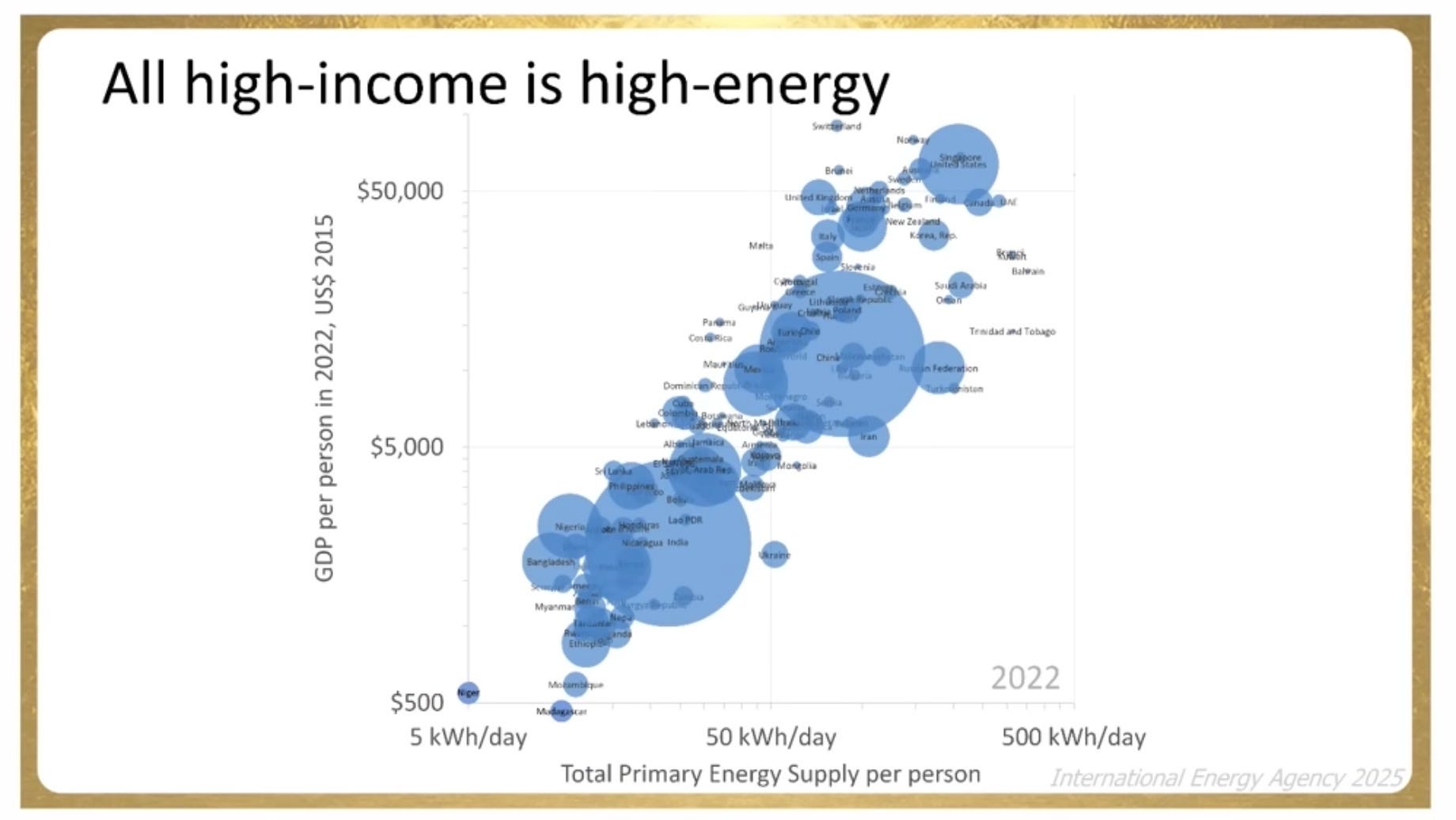
From about 400BC to about 1300, China dominated human invention because it had the combination of numbers of people, a common script, and enough commercial and institutional vitality, to be first and foremost in learning-by-experience.

Competitive jurisdictions plus development of learning-by-experiment meant that Europe became the centre of institutional and technological dynamism from about 1300 onwards. The early modern Scientific Revolution built on earlier medieval patterns. The true take-off, however, was when Britain became the first country to adopt learning-by-experiment at scale while not having any elite coalition veto the resultant cheap energy take-off.
Our expanding technology now threatens to overwhelm our evolutionary adaptations. This problem is aggravated by too many people using pre-Darwinian analytical approaches to analyse and discuss social and human dynamics.
Mass prosperity—including the collapse in infant and child mortality—removes many of the selection filters that used to operate on the human genome. This means that people who would not have previously survived do so and have children, many of whom would also not have previously survived. The potential dysgenic effects of demographic booms—particularly when coupled with increased insulation from selection pressures due to medical and other interventions—is clearly something that should be seriously examined, especially as there is already evidence for the populations in developed countries becoming, in effect, sicker and stupider.
As a 2016 paper points out:
without any compelling counterarguments at this time, it remains difficult to escape the conclusion that numerous physical and psychological attributes are likely to slowly deteriorate in technologically advanced societies, with notable changes in average preintervention phenotypes expected on a timescale of a few generations, i.e., 100 years, in societies where medical care is widely applied.
Moreover:
The key point here is that the one truly exceptional human attribute, brain function, may be particularly responsive to mutation accumulation …
As regularity of features is an indicator of genetic fitness, there may be a genetic element to “the revenge of the uglies”, hence the spiteful mutants thesis.
Physical attractiveness is associated with more conservative political views, though one can see how a lack of physical attractiveness would encourage feelings of alienation from society. Note, however, such alienation is not grounded in how positive (or not) one’s society is for human flourishing. On the contrary, the more people are insulated—due to mass prosperity—from the consequences of their ideas, or from making things work, the more salient such alienation is likely to be.
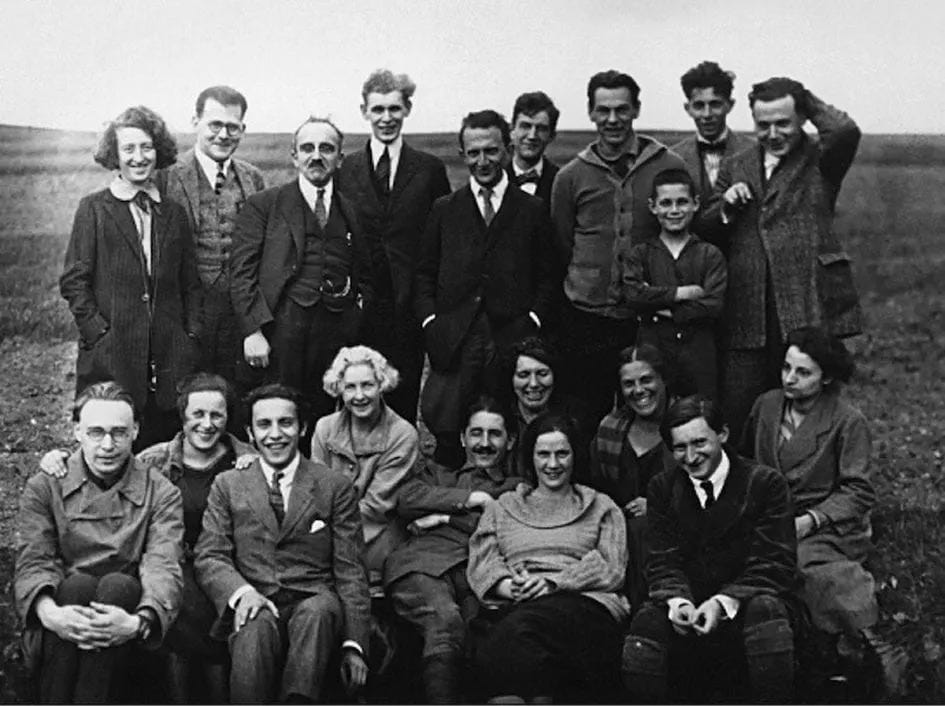
In other words, increased prosperity and social complexity leads to more dysfunctional alienation, increasing tendencies to civilisational suicide. An implication is that (for instance) academe—who don’t have to make things work and are highly insulated from the consequences of their ideas—becomes increasingly the domain of the dysfunctionally weird.
Outside relatively small numbers of heretics, the possibility of dysgenic effects from the relaxation of selection pressures on us humans are either not even considered or regarded as violation of analytical taboos due to the fetishisation of equality that has come to dominate Western public discourse.
Some pre-Darwinian approaches are so in that the key ideas were developed before the publication of On The Origin of Species (1859) and The Descent of Man, and Selection in Relation to Sex (1871). Many are pre-Darwinian because they have failed—or even refused—to grapple with humans being the products of biological evolution, with the social emerging from the biological, with the social being mediated by the genetic. This refusal has become more virulent in recent years, as morally grading people by their (actual or alleged) belief has been used to attack the scientific enterprise itself, through mobilising various fashionable terms of moral abuse, leading to genderwoo Lysenkoism.
The methodology of science is built on testing the accuracy of claims against reality. It marshals our diversity of traits and experience, generating claims and counter-claims fed into a methodology that tests claims against reality. If your structure of analysis is not consilient with more fundamental structures of reality, you have failed to incorporate what previous tests of the nature of reality have established.
Every so-called social science that fails to grapple adequately with everything social being emergent from the biological is not a science. It is, at its core, a pretend-science. It may use various aspects of the methodology of science but it fails the consilience with more fundamental structures of reality that serious science requires.
We thereby end up with social “sciences” that are not sufficiently scientific while diverting attention and intellectual resources away from grappling successfully with our technology threatening to overwhelm our evolutionary adaptations. Worse, Theory that is simply not compatible with the social emerging from our biology is used to drive analysis, commentary and policies, thereby making our societies operationally stupider.
Any study of humans is dealing with very complex phenomena, which is hard to do well. Any area of study that is hard to do well is easy to do to an agenda. This is very much a problem in the field of nutrition, for example, but applies right across the human and social sciences. This is especially so as we have to infer so much of what is going on in human cognition, as we cannot observe it directly. (Even our own introspection is limited.)
The notion that human groups are identical across all relevant factors not only supports a simple equalitarian moralism—any difference in outcomes must be due to some external (and presumptively maleficent) factor—but it defaults studies within the social almost-sciences towards such inferences, as it is so easy to fail to control to for some factor that turns out to be relevant (thereby failing to test against reality).
If we accept the reality-constraints of the social being emergent from the biological, then that human groups are identical in the distribution of traits becomes clearly presumptively false, not presumptively true. (The pervasive moral fetishisation of equality—thereby requiring that all relevant traits be deemed to be equally distributed among all human groups—is a large reason why that reality-constraint is not accepted.)
People vary in distribution of genetic traits both between individuals (so within human groups) and between groups. To grasp this requires thinking statistically, especially as “tail” effects are often crucial in differences between groups.
Fundamental to the out-of-Africa origins of Homo sapiens is that there are strong founder effects due to the very small sizes of the populations exiting Africa. Genetic drift is much stronger in smaller populations, so the notion that all relevant genetic traits are evenly distributed in human populations becomes utter nonsense. A nonsense that becomes even more obvious when the importance of cognitive framings, and thus cultural patterns, generating further differences in patterns of human behaviour, is also considered.
Dramatic cultural flowerings in particular times and places (e.g. Classical Athens) may well be in part due to genetic drift resulting in a local surge in the high-achieving “tail” in the population, given that genetic drift is stronger in smaller populations. Thinking statistically is, however, something a lot of people clearly find difficult to do.
As humans cognitively model significance, rather than facts—and significance that is graspable and sufficiently vivid—one’s cognitive framing drives one’s responses to incentives. Our cognitive plasticity is one of our crucial features as a species.
People vary in cognitive framings—both from culture and other sources—which means their responses to the same incentives will vary because, cognitively, they are not the same incentives. Humans are very much not interchangeable social particles and the wider the range of relevant interactions with our fellow humans, the more causally salient that lack of interchangeability becomes.

In particular, we vary significantly in executive functions, something most Libertarian thought fails to grapple seriously with (or, often, at all). Executive functions are highly heritable, which is almost certainly a large part of why social mobility is consistently so low in human societies and so little influenced by social interventions—especially as IQ is also significantly heritable. The complexity of human social orders are such that making human liberty/autonomy the absolutely trumping human value is ridiculous—indeed, potentially disastrous.
The social not-really-sciences fail by (1) not being consilient with evolutionary biology and evolutionary anthropology; (2) in the absence of accepting the constraints of consilience, using approved-within-the-discipline Theory to decide what evidence to pay attention to and how; and (3) regularly being far more historically illiterate than much more historically-informed past thinkers. In these failures they, again and again, end up making contemporary Western societies stupider.
It is a perennial difficulty even in the “hard” science that accepted Theory can be used to curate what evidence is paid attention to and how. This is especially when we are invested in our cognitive framings: whether for moral, social or expertise reasons. Hence physicist Max Planck’s observation about science advancing one funeral at a time.
The problem is much worse in the “soft” sciences. First, the human and social “sciences” are much more directly relevant to people’s moral and political beliefs. This creates networks of people invested in shared cognitive framings for moral and political reasons as well as being the basis of claimed expertise.
In the absence of strong reality-tests, this can increase—both individually and collectively—the efficient level of self-deception to defend one’s cognitive assets of expertise and moralised identity. The efficient level of self-deception is that which minimises cognitive load—deliberate deception puts heavy demands on memory and adds an extra layer of cognitive concern—for a given level of effectiveness of persuasion and motivation without generating too high costs (such as from being in error that generates negative feedback effects for the self-deceiver).
This is why error detection—the development of effective reality-tests—is so crucial to the success of science. It is also why outlandish doctrines about realms from which there is no reliable information—the supernatural, the future—can be such an effective marker of in-group membership; of “soundness”. Though sufficient in-group enforcement in shared status games of moral “soundness” can make that work even for things about which there is plenty of evidence, such as biological sex. Indeed, the consequent elevated level of not-noticing and rationalisation can be an excellent in-group soundness signal, though it does still require that the cost for pushing false claims be less than the benefits from doing so. The larger the size of the unaccountable classes—those paid to turn up, not for performance—the more salient such status games will be.
Second, the sheer complexity of the phenomena being confronted with can mean that Theory provides a reassuring simplicity. Alas, refusing to accept the constraints of consilience—and the reality-testing that implies—means that the accepted Theory is both much more likely to be false and is much easier to select for on the basis of moral and political preferences, as well as claimed expertise.
Sociology and Cultural Anthropology fail largely due to falling into what economist Arnold Kling nicely calls the tarpit of Marxism, as Marxism and its derivatives are profoundly pre-, even anti-, Darwinian. Indeed, the “study” of Sociology has deteriorated so badly into activist propagation of toxic nonsense—such that even otherwise admirable analyse are blighted by false framings—that there is a very strong argument for abolishing the discipline.
Nevertheless, one can reasonably argue that the pre-Darwinian nature of mainstream Economics has done more damage, as a discipline, to the contemporary West. Economics’ bias towards treating humans as interchangeable social “particles”—as that makes the maths so much easier—flagrantly violates the observable (and to be evolutionarily expected) diversity of humans, both as individuals and groups.
In particular, mainstream Economic’s elevation of efficiency over resilience; of transactions over connections; its Samuelsonian Physics-envy treating people as “social particles”, as interchangeable widgets; has generated seriously—potentially catastrophically—inadequate analyses of mass immigration.
A more biologically-grounded, and so consilient, Economics would have noticed that, in biological systems, selection is for resilience to dominate efficiency; that a social being operates via connections first and transactions second; that an evolved being generates variation, not only among individuals, but also in the distribution of traits between groups; that a cultural being generates varied cognitive framings that act as information transfer and expectation management mechanisms with behavioural consequences; that normative coherence is necessary for robust (i.e. resilient) institutions.
A historically literate discipline would have grappled with the historical cases of mass immigration leading to civil war. This failure is particularly ridiculous in American commentary on immigration as, of the three civil wars fought on what is now its territory—the American War of Independence (1775-1783), the Texas Revolution (1835-1836) and the Civil War (1861-1865)—the latter two were cases of mass immigration stressing existing social fault-lines of a polity to the point of open warfare.
This was another consequence of the energy breakthrough, as the development of steamships and railways in the 1820s made voluntary movement of people so much cheaper. It was a manifestation of Jevon’s Paradox: increased efficiency means more use.
Mainstream Economics has generated analyses of immigration that—with few exceptions—fail to grapple with any of the above. The failure to grapple with stressing-a-polity-to-the-point-of-civil-war is particularly egregious as a Nobel memorial Laureate in Economics—Robert Fogel—published a book precisely on how mass immigration fractured the American Republic along its fault-line of slavery.
The way so much American pro-immigration commentary fails to grapple with, not only their own history, but the contemporary European experience of mass immigration, is another indicator that we are dealing with pretend science, not the real thing. It is Economics being used to manifest what sociologist Christopher Lasch famously called the revolt of the elites via overblown—and ultimately self-serving, especially as status games—claims of expertise to dismiss the concerns of fellow citizens, especially working-class citizens.
Immigration brings out how analytically serious is the failure of mainstream Economics to accept the constraints of consilience, the constraint that everything social is emergent from the biological, because immigration imports people, with mass immigration importing people in large numbers. Those people interact across the full spectrum of human interactions, so must be expected to affect the full range of how the receiving society operates—up to, and including, potentially fracturing a polity into civil war. Examples of this include the two mentioned above and Palestinian migrations leading to civil wars in Jordan (1970-1) and Lebanon (1975-1990). The wider the range of human social interactions one is dealing with, the more serious the analytical failure of accepting the constraints of consilience—that everything social is emergent from the biological—can be expected to be.
The risk of mass immigration fracturing polities is likely the most egregious analytical failure in mainstream Economics treating immigration with ridiculous “more transactions, so more gains from trade, so good for GDP” simplicity, but is not remotely the only one.
This ridiculous simplicity may not just be analytical failure. One of the conspicuous patterns in modern Western politics is those who are not having children—or not enough to sustain the local population—are using mass immigration to politically and socially crowd out those who are having enough children. They are pushing what the UN was pleased to call replacement migration—replacing the children folk, particularly they, are not having with newcomers.
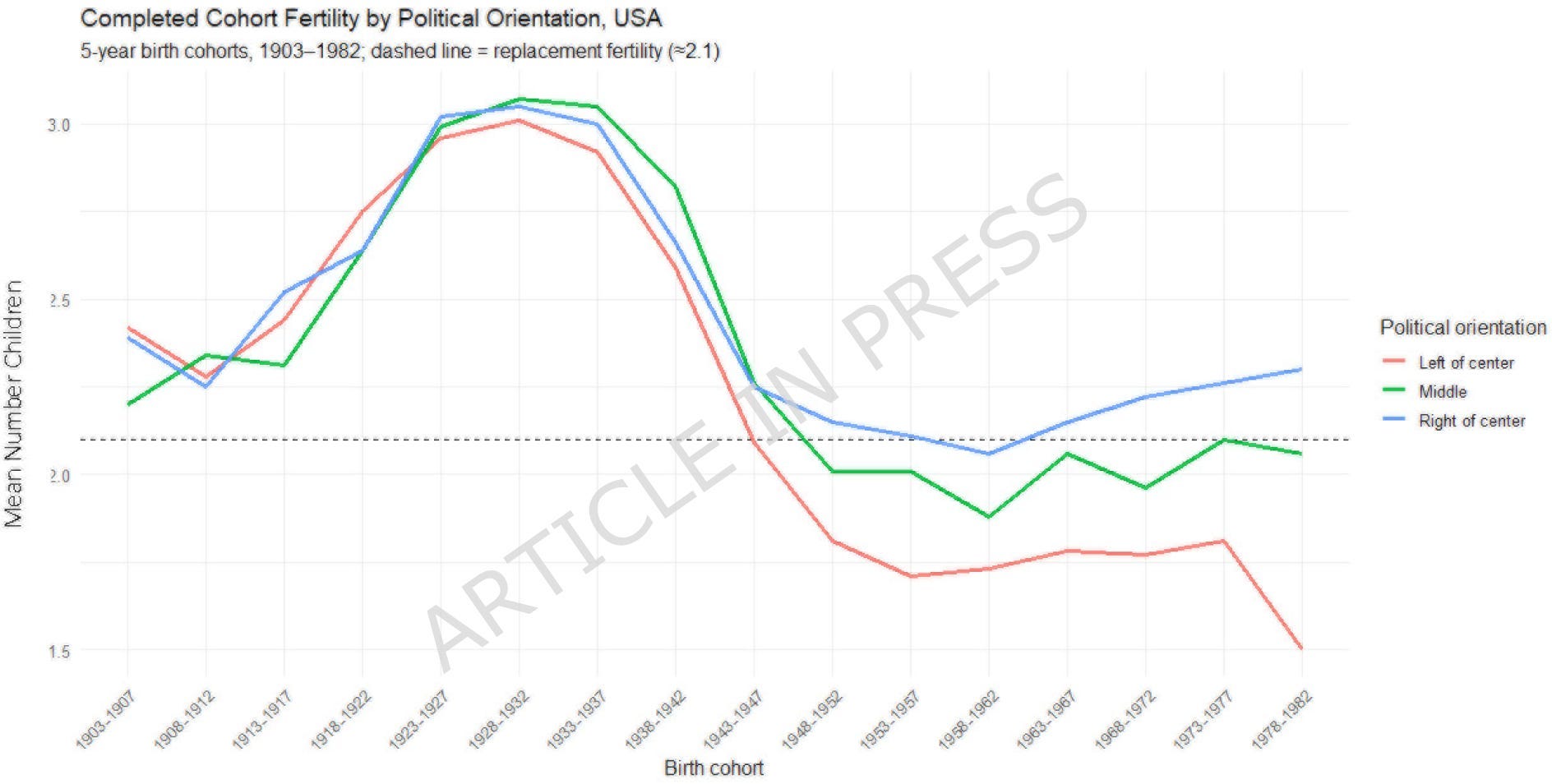
Moreover, they are often either actively hostile to any discussion of costs of mass immigration for the cultural and social coherence and heritage of the society receiving the immigrants or actively endorse such effects (see “decolonising the curriculum”, race-swapping characters in films and TV series, etc). Raising any concerns about immigration, or even wanting to control borders, is attacked as showing moral and cognitive failure.
Another way to put this, is that members of terminating human lineages are typically showing a much more hostile attitude towards preservation of the cultural heritage—or even basic functioning—of their societies than are members of continuing lineages. Why should we be surprised that those willing to invest time, effort and care in having and raising children might have systematically different commitments to the preservation of their society than those who are not so willing?
Plenty of human societies did not recognise one as a “full” adult male until one had become a father. It is worth considering what effects restricting the franchise to those with children, who show that basic level of commitment to the continuance of society, might have. Such commitments matter. The “marriage premium”—the extra incentive to provide and signal the ability to provide—continues to operate in our societies.
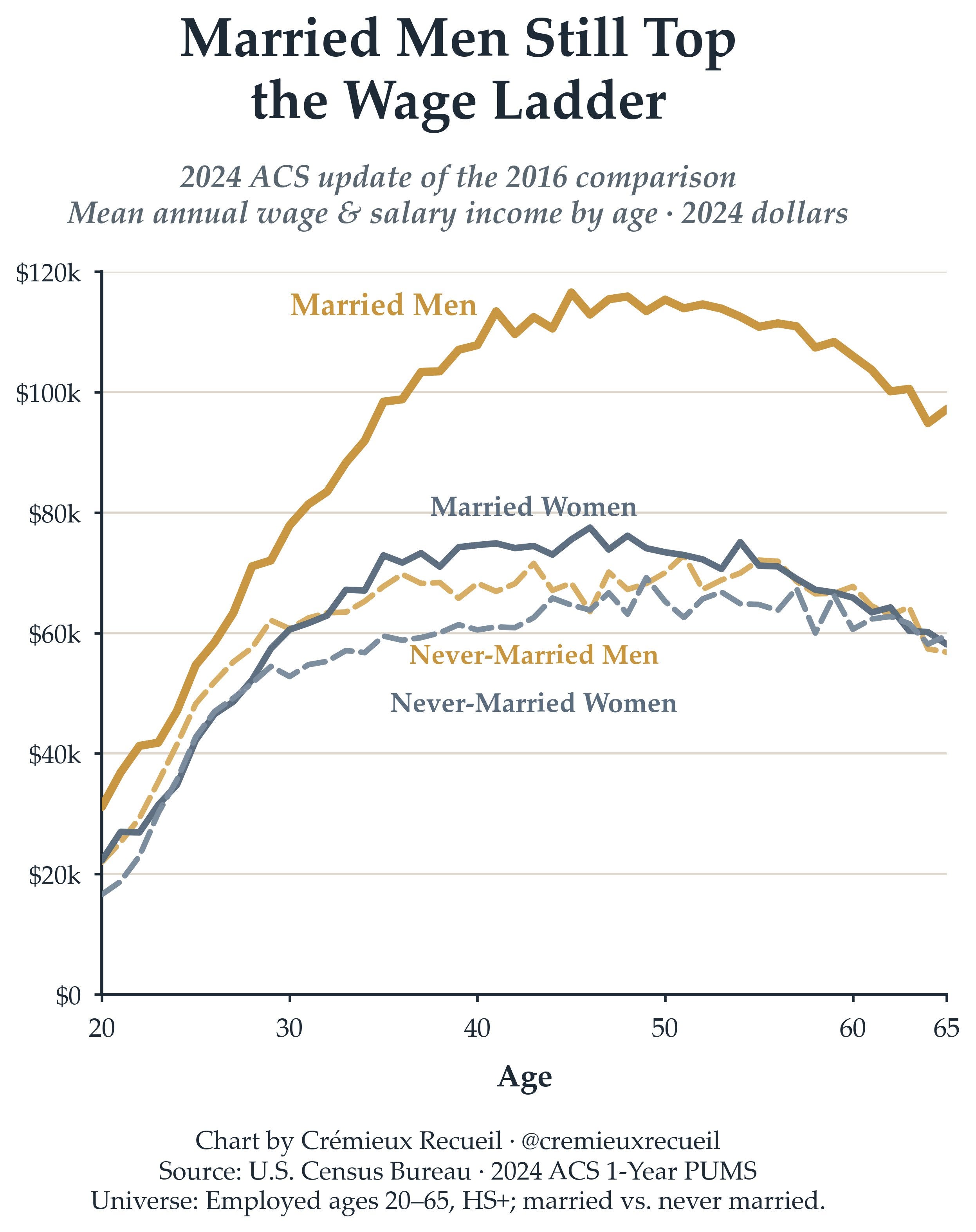
The failures regarding analysis of immigration are part of a much wider pattern of failure in Economics from elevating transactions that can be measured over connections that are much less so. This not only conflates value with being measurable, it reverses the basis for emotionally rich human flourishing, for which good connections are often much more important than useful transactions.
Yes, transactions allow many human interactions, and our use of resources, to be scaled up, often dramatically. There are many, many ways this has proved to be a boon to human capacities. The problem comes if that then eats into the connections we humans have adapted to flourish within. The rule of thumb is that transactions drive prosperity, connections drive happiness.
Mathematician, journalist, author and defender of sex-based rights Helen Joyce makes the point about the power and dangers of markets well:
But markets are like a universal solvent. Everything that they enter, they dissolve, and they break down into their constituent parts. And so many things have become marketized now that it’s hard to fit people who are close to irreducibly non-marketized transactions or activities. And that’s women much more than men because we make babies. Getting someone else to carry your baby for you or to breastfeed your baby or to look after your baby when the baby is small, it’s not substitutable. The baby loves the mother best. It can be the father. I know fathers can look after babies. But anyway, their primary caregiver, which is usually their mother, is the person they love most. And other people cannot substitute for them. So unless we accept that markets have limits … But setting limits in markets is incredibly difficult, so I think it’s going to be very hard.
…
It’s also just that you don’t have to create markets. One of the extraordinary things about markets is that they create themselves. Nobody’s set out to create a market in dating. Somebody just created a dating app, and everybody came there. And now it’s actually rather difficult to get together with another young person if you’re not both on the app. And the thing is that they ratchet. Once you have a market, this is one of the magic things about markets—and also one of the terrifying things about them—is that it compounds. Whatever it is it does, it just keeps compounding and changing. And so you get to the point where you have 90% of the people—I saw in an article yesterday—on dating apps are men and 10% are women. Men and women have very different ways of making decisions on dating apps. They’re much more similar in real life than they are on dating apps. And this just evolves.
Helen Dale: Yes. And you finish up with a situation where nobody gets what they want.
Helen Joyce: Exactly.
Helen Dale: Everybody’s unhappy.
Helen Joyce: And very hard to reverse. I don’t know how you could reverse that one. Nobody regulated dating apps. Nobody set out to create a world in which that’s how young people overwhelmingly meet each other with the purpose of having intimate relations.
Forcing people—especially young people—to purchase transactional replacements for what used to be provided by the social connections people were embedded in has been profoundly socially impoverishing, even as GDP has gone up. As Substacker Johann Kurtz observed in a recent post:
On the surface it does seem as if the young are fine. Real median incomes are higher than they were for their parents at the same age, unemployment has spent most of the past decade at historic lows, and purchasing power has risen roughly 63 percent since 1973. Televisions, clothing, food, and air travel are cheaper than ever.
And yet this generation is also not marrying, not buying homes, not having children, and seem pretty miserable. I think we’re clearly in the midst of a tremendous measurement failure.
My argument is that previous generations received an enormous stock of social capital: trusted neighbors, functional public schools, a productive courtship culture, predictable career arcs, and a public square in which children could roam and adults could be relied upon. That stock, once given for free, has now been substantially liquidated.
Instead, the young must now buy back, item by item and at retail prices, what their grandparents received as a bounty of prior civilizational investments. The young must do so out of incomes that rose modestly while the prices of the essential elements of life rose radically. Price indexes measure the individual cost of discrete goods, but they are not intended to convey the total cost of personally repurchasing a destroyed commons.
…
The young are told they are richer, and in the currency of flat-screen televisions they are. But the goods that constitute a life — house, spouse, children, good school, good neighbors — have inflated so far beyond wages that the ordinary life path of 1965 now requires an extraordinary income. It turns out that we do actually need social capital. They are not doing well!

This conflation of measurable with valuable has been a classic example of Goodhart’s Law on a society-wide scale—that when a measure becomes a target, it ceases to be a good measure. As with the mis-analysis of mass immigration, it has been social “science” making Western societies operationally stupider on a grand scale precisely because of the refusal to accept the constraints of consilience with more basic structures of reality (i.e. biology) that are required to be a science, so not noticing that we Homo sapiens evolved around connections first and transactions a distant second.
If there is Physics envy in Economics, then that misunderstands the nature of economic phenomena relative to the basic structures of the universe. As physicist Richard Feynman noted, the physicist is interested in specific features of this universe, not abstract features across possible universes.
Looking to the example of Physics as a discipline means looking “past” all the layers of structure between the basic structures of the universe that Physics concerns itself with and the social. The economist is not studying abstract social beings. He is studying beings structured by their biology, by their evolution. He is studying the social interactions of a specific species, Homo sapiens.
As with any study of any species, comparisons with other species may well be useful, and there are general patterns in biology. Game Theory, for example, has very general application—even down to the level of genes, as all that is needed for it to operate is feedback and response. But even with Game Theory, the patterns of how humans play strategy games differs systematically from how Pan troglodytes, Chimpanzees, do.
Chimpanzees adhere more closely to Game Theory predictions—so to Homo economicus—than we do. Given we are so much more numerous, able to thrive in a much wider range of ecological conditions, our patterns of divergence from Homo economicus are clearly an evolutionary advantage.
Our ability to transact comes not from our rationality alone, but also from us being far more normative than our primate cousins. Transactions rely on conceptions of property, of rights-to-decide, and property relies not on mine!—any silverback gorilla male can manage that—but on yours! That takes sharing both theory of mind and normative expectations generating broad conventions about rights-to-decide. It is our deviations as a species from Homo economicus that makes us so much more successful than our ape cousins.

We can walk into any bazaar or marketplace in the world and understand the basic underlying conventions of ownership and exchange, of who has the right-to-decide over what. That comes from our shared normative capacity and patterns of thinking generating common conventions. One of the reasons that mainstream Economics has tended to overstate the significance of explicit legal property rights is precisely that it has subsumed our normative nature into a falsely simplifying notion of rationality that is very much not good science.
For another great sin of mainstream Economics is to postulate a biologically impossible level of human rationality. We display bounded rationality as we must as biological beings. Biological systems satisfice rather than maximise as they are constantly dealing with shifting mixes of threats and opportunities.
A living organism uses information and resources to keep itself functioning. In that sense, life is systematically ordering, it is systematically anti-entropic, with a clear tendency to more complexity, not less.
All organisms exist in an multidimensional action-space with shifting information and limited attention and resources. Due to limited capacities and shifting salience, gains/benefits will show decreasing marginal utility (i.e. patterns of satiation). Due to threshold effects—particularly death—losses/costs will show increasing marginal disutility (i.e. increased damage and risk of catastrophic failure).
We can put that satisficing is optimising for biological beings somewhat formally:
If X and Y are actions with marginal utility X(mu) and Y(mu),
then the resilient pattern is to satisfice as follows:
Do X when information is X(mu) > any not-X(mu).
As soon as information is Y(mu) > any not-Y(mu), do Y.
For a biological organism, maximising does not optimise. Moreover, efficiency—the thing mainstream Economics typically presumes rationality seeks to maximise—has to serve resilience, the ability to respond to changes in circumstances, for the species to survive: a point that also applies to social systems. Most risk management is about resilience not efficiency.
Attention and cognition are both limited resources, which we economise on the use of. Hence we have habits, routines, rules-of-thumb, etc. Money illusion, for example, is the result of economising on cognitive effort.
The use of an all-encompassing conception of human rationality—understood (falsely) as maximising rather than satisficing—analytically crowds out consideration of the importance of normative orders and the importance of implicit or explicit bargaining in economic—and particularly commercial—outcomes. Thus, the enshittification of tech that we can all observe is the Chicago School attack on anti-trust enforcement by what turned out to be the ludicrously oversimplifying Theory of Consumer Welfare making American policy stupider.
One of its many adverse results was to make regulatory capture worse by allowing the creation of huge tech monopolies and monopsonies. It also made it easier to organise censorship of opinions and information.
A biologically aware Economics would have asked the question: what are the Game Theory implications of allowing so-called “efficient” monopolies? The obvious answer is what we have experienced: they stop being efficient.
An ironic part of the Physics envy of Economics is to too often take action across time out of consideration: specifically, the likely evolution of consequences. The Consumer Welfare approach takes a concept of Theory (allocative efficiency) and treats it as if it is a timeless achievement, that we do not have to consider the likely evolution of corporate concentration. In part, this is because the, biologically ridiculous, maximising notion of—allegedly predictably quantifiable—rationality squeezes out norms and bargaining.
The reality is that allocative efficiency achieved under a particular market structure cannot be expected to persist if that market structure changes. It really cannot be expected to persist if corporate concentration makes coordination to achieve regulatory capture that much easier.
Bad Theory led to worse policy—the older approach to anti-trust was more sensible. The application of Theory that fails consilience made American society functionally stupider, resulting in, among other things, the enshittification of Tech we now suffer under.
Too often, social “sciences” pay attention neither to what is general in biological beings nor what is specific to us as an evolved species.
The failure to respect the constraints that the social is emergent from the biological is the failure to respect the constraints of science, which means one is not really engaged in science, but a pretence thereof. As the above examples show, this matters—especially when the claimed authority of being “scientific” is used to promote ill-conceived policy to unfortunate, even disastrous, effect. So many claims of expertise have turned out to be overblown precisely because of the failure to accept the scientific constraint of consilience.
Tradition and normative coherence
One of the problems with our technological dynamism is that it makes it easier to believe the central delusion of modernism—new is always better—and the central delusion of progressivism—that the sinful past cannot teach us anything that constrains our vision of the future. Both claims are nonsense. We remain Homo sapiens and past experience is the vast memory well of what that means and implies.
Tradition is common responses to shared constraints and opportunities plus memory. Yes, technology changes those constraints and opportunities, but not all of them and not all at once. Given the importance of normative cohesion (aka asabiyya) in making polities functional—for institutions are mixtures of norms and rules that require a strong civic culture to be resiliently functional—and the importance of tradition in maintaining such normative cohesion, a dismissive reaction to tradition is not merely infantile, it very readily becomes socially corrosive.
Being socially—even civilisationally—corrosive, alas, is often precisely what is intended. The catastrophically toxic, pseudo-sophisticated nonsense of Critical Theory and its derivatives—that extols complaining about well, everything, so that any disliked constraint gets recast as “oppression” while taking absolutely no responsibility for doing anything practical to make things better—is, in their march through academe, as sign of how toxically irresponsible so much academic “Theorising” is: theorising by people who do not have to make anything actually work, who can push truly disastrous ideas with no effective pushback as long as they play well enough to academic status games. This is the does not know how problem. We end up with ridiculous wish-list politics that no one with a serious understanding of C20th history would believe for a moment pushed by clearly catastrophically mis-educated university graduates.
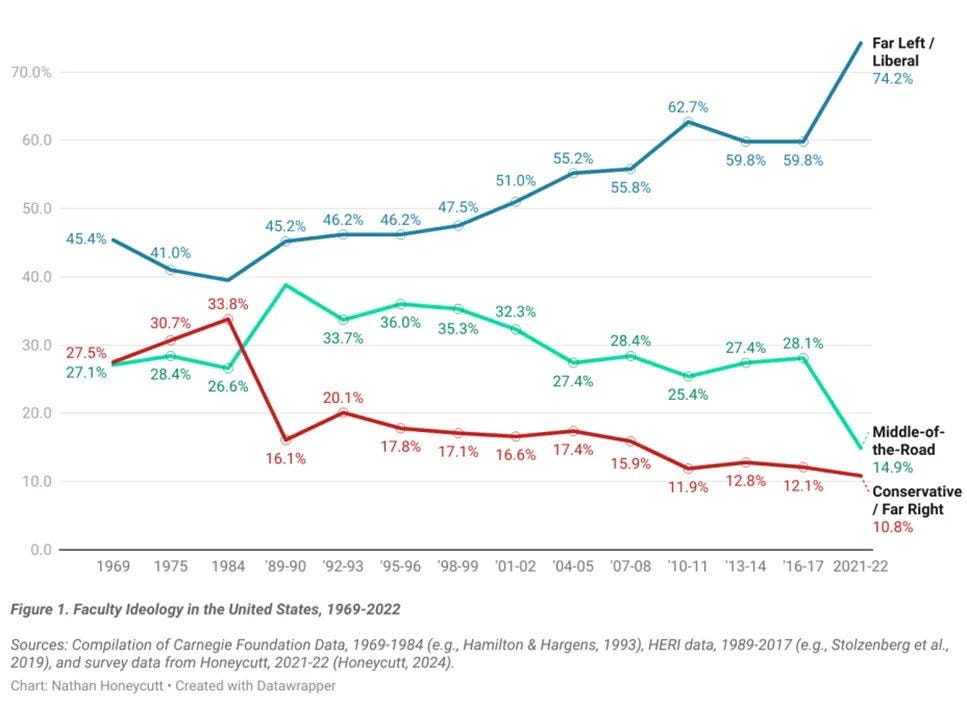
Such moral grandstanding is regularly based on ludicrously simplifying conspiracy theories of human action whereby various blindnesses—not, of course, shared by the alienated-but-oh-so-enlightened—are somehow universal among all those who are so cognitively and morally deficient as to dissent. As James Lindsay observes:
This is why Critical Theory always has to be a conspiracy theory, because it has to hold that everybody is actually captured at some level by the same set of views, which are independent somehow of reality.
Such moralising of disagreement has proved to be toxic to public discourse and sense-making. It is precisely the genius of science that it can marshal even people’s biases for its methodology of testing claims against reality.
Accepting the constraints of consilience—that everything social is emergent from the biological—would get in the way of the moral grandstanding and pretence of trumping expertise that has become so much of modern academe: especially, of the moralising zealots within it. The demands of science are a constraint they dislike, so have declared “oppressive”—except when they are spuriously invoking its authority to de-legitimise dissent.
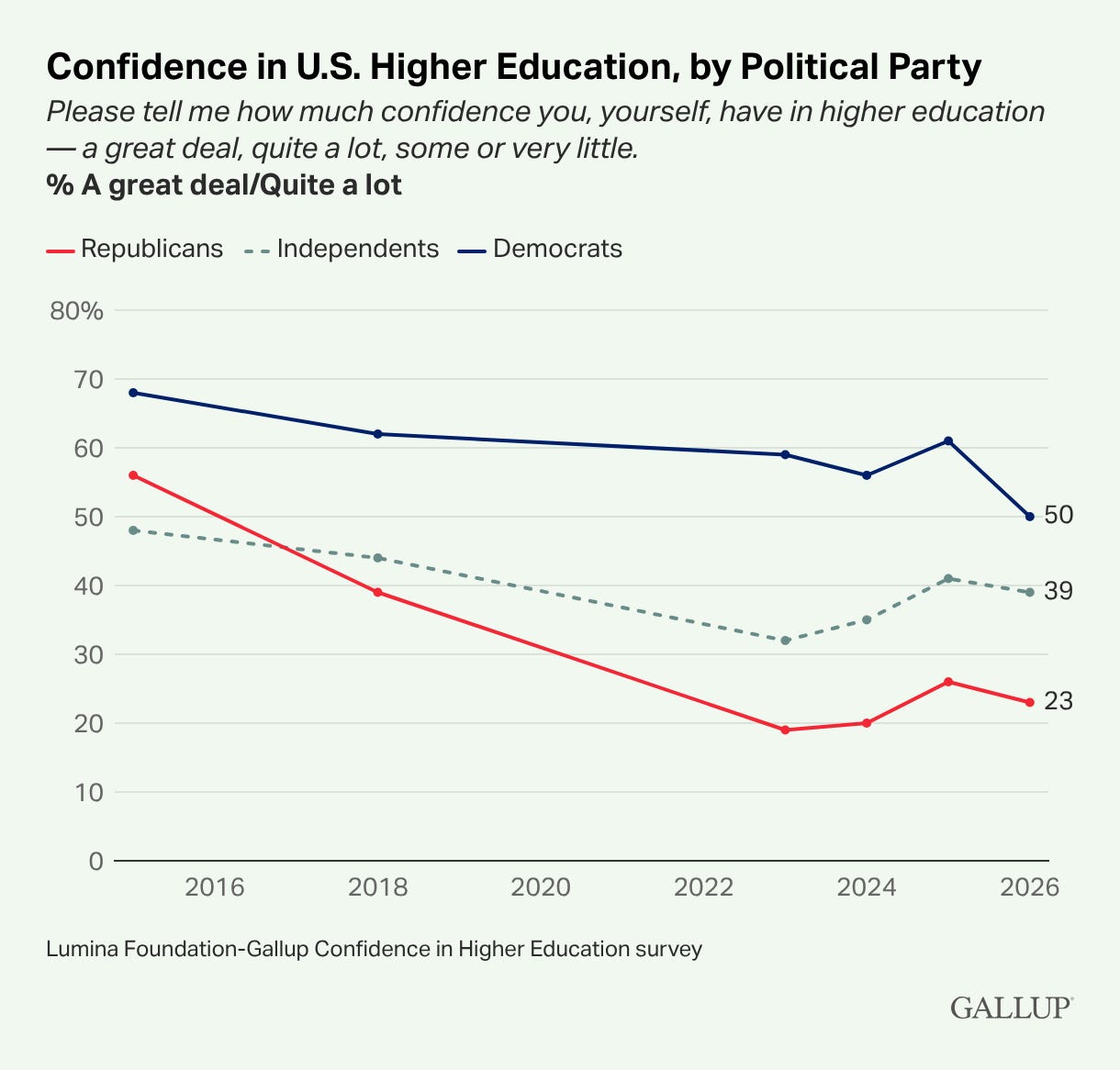
It is precisely such failures, however, that show the incentive structures of academe to be disastrous, hence should not have taxpayer funding poured into perpetuating them. This is especially so for social “sciences” that are nothing of the kind.
This series of posts—advancing various propositions about humans and human dynamics—explores what accepting the constraints of consilience implies. It is in service of understanding our past and present while seeking to assist better movement into the future.
The sixth post and final in the series will consider implications of evolutionary reasoning for patterns of female behaviour within organisations.
References
Books
Douglas Allen, The Institutional Revolution: Measurement and the Economic Emergence of the Modern World, University of Chicago Press, 2012.
Scott Atran, In Gods We Trust: The Evolutionary Landscape of Religion, Oxford University Press, [2002] 2004.
Roy F. Baumeister, Is There Anything Good About Men?: How Cultures Flourish by Exploiting Men, Oxford University Press, 2010.
Joyce F. Benenson with Henry Markovits, Warriors and Worriers: the Survival of the Sexes, Oxford University Press, 2014.
Gregory Clark, The Son Also Rises: Surnames and the History of Social Mobility, Princeton University Press, 2014.
Stephanie Coontz, Marriage, a History: How Love Conquered Marriage, Penguin, 2005.
Alfred W. Crosby, Throwing Fire: Projectile Technology Through History, Cambridge University Press, 2002.
Martin Daly and Margo Wilson, The Truth about Cinderella: A Darwinian View of Parental Love, Yale University Press, 1998.
Roger Eatwell and Matthew Goodwin, National Populism: The Revolt Against Liberal Democracy, Pelican, 2018.
David Frye, Walls: A History of Civilization in Blood and Brick, Faber & Faber, 2018.
Jean Gimpel, The Medieval Machine: The Industrial Revolution of the Middle Ages, Pimlico, [1976] 1992.
Bryan Hayden, The Power of Ritual in Prehistory: Secret Societies and the Origins of Social Complexity, Cambridge University Press, [2018] 2020.
Heather Heying and Bret Weinstein, A Hunter-Gatherer’s Guide to the 21st Century: Evolution and the Challenges of Modern Life, Swift, 2021.
Philip Jenkins, The Next Christendom: The Coming of Global Christianity, Oxford University Press, [2002] 2003.
Garett Jones, The Culture Transplant: How Migrants Make the Economies They Move To a Lot Like the Ones They Left, Stanford University Press, 2023.
Robert L. Kelly, The Lifeways of Hunter-Gatherers: The Foraging Spectrum, Cambridge University Press, [1995] 2013.
Frank H. Knight, Risk, Uncertainty and Profit, Cosimo, [1921] 2005.
Victor Lieberman, Strange Parallels, Southeast Asia in Global Context, c.800–1830: Volume I, Integration on the Mainland, Cambridge University Press, [2003] 2010.
Victor Lieberman, Strange Parallels, Southeast Asia in Global Context, c.800–1830: Volume 2, Mainland Mirrors: Europe, Japan, China, South Asia and the Islands, Cambridge University Press, [2009] 2013.
William H. McNeill, Keeping Together in Time: Dance and Drill in Human History, Harvard University Press, 1996.
Jordan Peterson, Maps of Meaning: The Architecture of Belief, Routledge, 1999.
Kenneth M Pollack, Armies of Sand: The Past, Present, and Future of Arab Military Effectiveness, Oxford University Press, 2019.
Yossef Rapoport, Becoming Arab: The Formation of Arab Identity in the Medieval Middle East, Princeton University Press, 2025.
Christian Rudder, Dataclysm: Who We Are (When We Think No One’s Looking), Fourth Estate, 2014.
Erwin Schrödinger, What Is Life? The Physical Aspect of the Living Cell with Mind And Matter & Autobiographical Sketches, Cambridge University Press, [1944, 1958, 1992] 2013.
James C. Scott, The Art of Not Being Governed: An Anarchist History of Upland Southeast Asia, University of Yale Press, 2009.
Kevin Simler and Robin Hanson, The Elephant in the Brain: Hidden Motives in Everyday Life, Oxford University Press, 2018.
Will Storr, The Status Game: On Social Position And How We Use It, HarperCollins, 2022.
Michael Strevens, The Knowledge Machine: How an Unreasonable Idea Created Modern Science, Penguin, 2022.
Robert Trivers, The Folly of Fools: The Logic of Deceit and Self-Deception in Human Life, Basic Books, [2011] 2013.
Peter Turchin, End Times: Elites, Counter-Elites and the Path of Political Disintegration, Penguin, 2024.
Articles, essays, blogposts, etc
P. W. Anderson, ‘More is Different,’ Science, New Series, Vol. 177, No. 4047. (Aug. 4, 1972), 393-396. https://cse-robotics.engr.tamu.edu/dshell/cs689/papers/anderson72more_is_different.pdf
Menelaos Apostolou, ‘Sexual selection under parental choice: the role of parents in the evolution of human mating,’ Evolution and Human Behavior, 28 (2007) 403–409. https://www.researchgate.net/publication/237929517_Sexual_Selection_Under_Parental_Choice_The_Role_of_Parents_in_the_Evolution_of_Human_Mating
Scott Atran, ‘“Devoted Actor” versus “Rational Actor” Models for Understanding World Conflict,’ Briefing to the National Security Council, White House, Washington, DC, September 14, 2006. https://core.ac.uk/download/pdf/6801978.pdf
Scott Atran, Robert Axelrod, Richard Davis, ‘Sacred Barriers to Conflict Resolution,’ Science, Vol. 317, 24 August 2007, 1039-1040. https://www.researchgate.net/publication/6123217_Sacred_Barriers_to_Conflict_Resolution
Joyce F. Benenson, Henry Markovits, Caitlin Fitzgerald, Diana Geoffroy, Julianne Flemming, Sonya M. Kahlenberg and Richard W. Wrangham, ‘Males’ Greater Tolerance of Same-Sex Peers,’ Psychological Science 2009 20: 184-190. https://www.jstor.org/stable/40065052
Paul M. Bingham, ‘Human Uniqueness: A General Theory,’ The Quarterly Review of Biology, Vol. 74, No. 2 (Jun., 1999), 133-169. https://www.academia.edu/83860282/Human_Uniqueness_A_General_Theory
Paul M. Bingham, ‘Human evolution and human history: A complete theory,’ Evolutionary Anthropology: Issues, News, and Reviews, (2000) 9: 248-257. https://www.academia.edu/83860856/Human_evolution_and_human_history_A_complete_theory
Christopher Boehm, ‘Egalitarian Behavior and Reverse Dominance Hierarchy,’ Current Anthropology, Vol. 34, No.3. (Jun., 1993), 227-254 (with Comments by Harold B. Barclay; Robert Knox Dentan; Marie-Claude Dupre; Jonathan D. Hill; Susan Kent; Bruce M. Knauft; Keith F. Otterbein; Steve Rayner and Reply by Christopher Boehm). https://lust-for-life.org/Lust-For-Life/_Textual/ChristopherBoehm_EgalitarianBehaviorAndReverseDominanceHierarchy_1993_29pp/ChristopherBoehm_EgalitarianBehaviorAndReverseDominanceHierarchy_1993_29pp.pdf
Barry Bogin, Jared Bragg, Christopher Kuzawa, ‘Humans are not cooperative breeders but practice biocultural reproduction,’ Annals of Human Biology, 2014 Jul-Aug; 41(4): 368-80. https://www.researchgate.net/publication/263130566_Humans_are_not_cooperative_breeders_but_practice_biocultural_reproduction
Selina Brace, Yoan Diekmann, Thomas J. Booth, Lucy van Dorp, Zuzana Faltyskova, Nadin Rohland, Swapan Mallick, Iñigo Olalde, Matthew Ferry, Megan Michel, Jonas Oppenheimer, Nasreen Broomandkhoshbacht, Kristin Stewardson, Rui Martiniano, Susan Walsh, Manfred Kayser, Sophy Charlton, Garrett Hellenthal, Ian Armit, Rick Schulting, Oliver E. Craig, Alison Sheridan, Mike Parker Pearson, Chris Stringer, David Reich, Mark G. Thomas, and Ian Barnes, ‘Ancient genomes indicate population replacement in Early Neolithic Britain,’ Nature Ecology & Evolution, 2019 May;3(5):765-771. Epub 2019 Apr 15. Erratum in: Nature Ecology & Evolution 2019 Jun;3(6):986-987. https://pmc.ncbi.nlm.nih.gov/articles/PMC6520225/
Judith K. Brown, ‘A Note on the Division of Labor by Sex,’ American Anthropologist, Vol.72, Issue 5, October 1970, 1073-1078. https://anthrosource.onlinelibrary.wiley.com/doi/10.1525/aa.1970.72.5.02a00070
William Buckner, ‘On secret cults and male dominance,’ Traditions of Conflict blog, January 31, 2018. https://traditionsofconflict.com/blog/2018/1/31/on-secret-cults-and-male-dominance
William Buckner, ‘Where are the matriarchies?’ Traditions of Conflict blog, March 18, 2018. https://traditionsofconflict.com/blog/2018/3/17/where-are-the-matriarchies
Michael L. Burton, Lilyan A. Brudner, and Douglas R. White, ‘A model of the sexual division of labor,’ American Ethnologist, (1977) 4: 227-252. https://www.researchgate.net/publication/227823427_A_Model_of_the_Sexual_Division_of_Labor
R. Calsbeek, ‘Ecological rules for global species distribution also predict performance variation in Ironman triathletes,’ PLoS ONE, 2023, 18(5): e0283282. https://journals.plos.org/plosone/article?id=10.1371/journal.pone.0283282
Satyajit Chatterjee, ‘A theory of asset price booms and busts and the uncertain return to innovation’, Business Review, Federal Reserve Bank of Philadelphia, 2011, issue Q4, pages 1-8. https://www.philadelphiafed.org/-/media/frbp/assets/economy/articles/business-review/2011/q4/brq411_theory-of-asset-price-booms-and-busts.pdf
Laura E. Engelhardt, Daniel A. Briley, Frank D. Mann, K. Paige Harden Tucker-Drob, ‘Genes Unite Executive Functions in Childhood,’ Psychological Science, 2015 August, 26(8), 1151–1163. https://pmc.ncbi.nlm.nih.gov/articles/PMC4530525/
O¨rjan Falk, Ma¨rta Wallinius, Sebastian Lundstro¨m, Thomas Frisell, Henrik Anckarsa¨ter, No´ra Kerekes, ‘The 1% of the population accountable for 63% of all violent crime convictions,’ Social Psychiatry & Psychiatric Epidemiology, 2014, 49, 559–571. https://link.springer.com/content/pdf/10.1007/s00127-013-0783-y.pdf
Martin Fieder & Susanne Huber, ‘Falling fertility on the left as key driver of US birth decline,’ Scientific Reports (2026). https://www.nature.com/articles/s41598-026-57582-3
Jo Freeman, ‘Trashing: The Dark Side of Sisterhood,’ Ms magazine, April 1976, pp. 49-51, 92-98. https://www.jofreeman.com/joreen/trashing.htm
Chris D. Frith, ‘The role of metacognition in human social interactions,’ Philosophical Transactions of the Royal Society B, 2012, 367, 2213–2223. https://pmc.ncbi.nlm.nih.gov/articles/PMC3385688/
Zachary H. Garfield, Kristen L. Syme, Edward H. Hagen, ‘Universal and variable leadership dimensions across human societies,’ Evolution and Human Behavior, Volume 41, Issue 5, 2020, 397-414. https://tinyurl.com/muykzzpb
David C Geary, Jennifer Byrd-Craven, Mary K Hoard, Jacob Vigil, Chattavee Numtee, ‘Evolution and development of boys’ social behavior,’ Developmental Review, Volume 23, Issue 4, 2003, 444-470. https://citeseerx.ist.psu.edu/document?repid=rep1&type=pdf&doi=453100fc9af781a989a5bedb4eb8f1a298435a07
Herbert Gintis, Carel van Schaik, and Christopher Boehm, ‘Zoon Politikon: The Evolutionary Origins of Human Political Systems’, Current Anthropology, Volume 56, Number 3, June 2015, 327-353. https://pubmed.ncbi.nlm.nih.gov/29581024/
Jack A. Goldstone, ‘Efflorescences and Economic Growth in World History: Rethinking the “Rise of the West” and the Industrial Revolution,’ Journal of World History, 2002, Vol. 13, No. 2, 323-389. http://culturahistorica.org/wp-content/uploads/2020/02/goldstone-efflorescences.pdf
Mark Granovetter, ‘The Strength of Weak Ties: A Network Theory Revisited,’ Sociological Theory, Vol.1, 1983, 201-233. https://www.csc2.ncsu.edu/faculty/mpsingh/local/Social/f15/wrap/readings/Granovetter-revisited.pdf
Jonathan Haidt and Jesse Graham, ‘Planet of the Durkheimians, Where Community, Authority, and Sacredness are Foundations of Morality,’ December 11, 2006. https://papers.ssrn.com/sol3/papers.cfm?abstract_id=980844
Zoe Harcombe, ‘Dietary fat guidelines have no evidence base: where next for public health nutritional advice?,’ British Journal of Sports Medicine, 2017, 51, 769–774. https://bjsm.bmj.com/content/51/10/769
Kim Hill, Michael Barton, and A. Magdalena Hurtado, ‘The Emergence of Human Uniqueness: Characters Underlying Behavioral Modernity,’ Evolutionary Anthropology, 2009, 18:187–200. https://tinyurl.com/4xp4csdk
Erik P. Hoel, Larissa Albantakis, and Giulio Tononi, ‘Quantifying causal emergence shows that macro can beat micro,’ PNAS, December 3, 2013, vol. 110, no. 49, 19790–19795. https://www.pnas.org/doi/10.1073/pnas.1314922110
Z. Hofmanová, S. Kreutzer, G. Hellenthal, C. Sell, Y. Diekmann, D. Díez-del-Molino, L. van Dorp, S. López, A. Kousathanas, V. Link, K. Kirsanow, L.M. Cassidy, R. Martiniano, M. Strobel, A. Scheu, K. Kotsakis, P. Halstead, S. Triantaphyllou, N. Kyparissi-Apostolika, D. Urem-Kotsou, C. Ziota, F. Adaktylou, S. Gopalan, D.M. Bobo, L. Winkelbach, J. Blöcher, M. Unterländer, C. Leuenberger, Ç. Çilingiroğlu, B. Horejs, F. Gerritsen, S.J. Shennan, D.G. Bradley, M. Currat, K.R. Veeramah, D. Wegmann, M.G. Thomas, C. Papageorgopoulou, & J. Burger, ‘Early farmers from across Europe directly descended from Neolithic Aegeans,’ Proceedings of the National Academy of SciencesU.S.A., 113 (25) 6886-6891. https://www.pnas.org/doi/10.1073/pnas.1523951113
Meng Hu & Emil O. W. Kirkegaard & John Fuerst, ‘Income and Education Disparities Track Genetic Ancestry,’ OpenPsych. (2023) 10.26775/OP.2023.09.11. https://www.researchgate.net/publication/373840894_Income_and_Education_Disparities_Track_Genetic_Ancestry
Emily Hurren, Carleen Thompson, Brian Jenkins, April Chrzanowski, Troy Allard, Anna Stewart, ‘Who are the Perpetrators of Child Maltreatment?,’ Report to the Criminology Research Advisory Council Grant: CRG 18/13-14, May 2018. https://www.aic.gov.au/sites/default/files/2020-05/18-1314-FinalReport.pdf
Ian Janssen, Steven B. Heymsfield, ZiMian Wang, and Robert Ross, ‘Skeletal muscle mass and distribution in 468 men and women aged 18–88 yr,’ Journal of Applied Physiology, 2000 89:1, 81-88. https://www.researchgate.net/publication/12415379_Skeletal_muscle_mass_and_distribution_in_468_men_and_women_aged_18-88_yr
Rachel Jewkes, Emma Fulu, Tim Roselli, Claudia Garcia-Moreno, ‘Prevalence of and factors associated with non-partner rape perpetration: findings from the UN Multi-country Crosssectional Study on Men and Violence in Asia and the Pacific,’ Lancet Global Health, Vol.1, October 2013, e208-e218. https://tinyurl.com/3amv4ds6
Ada Johansson, Pekka Santtila, Nicole Harlaar, Bettina von der Pahlen, Katarina Witting, Monica Algars, Katarina Alanko, Patrick Jern, Markus Varjonen, and N. Kenneth Sandnabba, ‘Genetic Effects on Male Sexual Coercion,’ Aggressive Behavior, 2008 Volume 34, 190–202. https://www.researchgate.net/publication/6011396_Genetic_effects_on_male_sexual_coercion
Tim Kaiser, Marco Del Giudice, Tom Booth, ‘Global sex differences in personality: Replication with an open online dataset,’ Journal of Personality, 2020, 88, 415–429. https://www.researchgate.net/publication/334279951_Global_Sex_Differences_in_Personality_Replication_with_an_Open_Online_Dataset
Hillard Kaplan, Kim Hill, A. Magdalena Hurtado, and Jane Lancaster, ‘The embodied capital theory of human evolution,’ in Peter T. Ellison (ed.) Reproductive ecology and human evolution, De Gruyter, (2001), 293-317. https://www.unm.edu/~jlancas/EmbCapTheoryHumEvo2001.pdf
Hillard Kaplan, Kim Hill, Jane Lancaster, A. Magdalena Hurtado, ‘A theory of human life history evolution: Diet, intelligence, and longevity,’ Evolutionary Anthropology, August 2000, Vol.9, Iss.4, 156-185. https://www.unm.edu/~hkaplan/KaplanHillLancasterHurtado_2000_LHEvolution.pdf
Hillard Kaplan, Jane Lancaster & Arthur Robson, ‘Embodied Capital and the Evolutionary Economics of the Human Life Span’, in Carey, James R. and Shripad Tuljapurkar (eds.), Life Span: Evolutionary, Ecological, and Demographic Perspectives, Supplement to Population and Development Review, vol. 29, 2003. New York: Population Council, 152-182. https://www.unm.edu/~jlancas/EmbCapTheoryHumEvo2001.pdf
Monika Karmin, et al., ‘A recent bottleneck of Y chromosome diversity coincides with a global change in culture,’ Genome Resources, 2015 Apr;25(4):459-66. https://pmc.ncbi.nlm.nih.gov/articles/PMC4381518/
Katherine J. Latham, ‘Human Health and the Neolithic Revolution: an Overview of Impacts of the Agricultural Transition on Oral Health, Epidemiology, and the Human Body,’ Nebraska Anthropologist, 2013, 187, 95-102. https://digitalcommons.unl.edu/nebanthro/187/
David C. Lahtia, Bret S. Weinstein, ‘The better angels of our nature: group stability and the evolution of moral tension,’ Evolution and Human Behavior, 26, 2005, 47–63. https://www.researchgate.net/publication/228350694_The_better_angels_of_our_nature_Group_stability_and_the_evolution_of_moral_tension
Michael P. Lombardo, Robert O. Deaner, ‘Born to Throw: The Ecological Causes that Shaped the Evolution of Throwing In Humans,’ The Quarterly Review of Biology, March 2018 Vol. 93, No. 1, 1-16. https://www.researchgate.net/publication/323411478_Born_to_Throw_The_Ecological_Causes_that_Shaped_the_Evolution_of_Throwing_In_Humans
Michael Lynch, ‘Mutation and Human Exceptionalism: Our Future Genetic Load,’ Genetics, March 2016, Vol. 202, 869–875. https://academic.oup.com/genetics/article/202/3/869/5930150
Debin Ma, ‘Rock, scissors, paper: the problem of incentives and information in traditional Chinese state and the origin of Great Divergence,’ Economic History Working Papers 37569, London School of Economics and Political Science, Department of Economic History, 2011. https://www.lse.ac.uk/Economic-History/Assets/Documents/WorkingPapers/Economic-History/2011/WP152.pdf
Debin Ma & Jared Rubin, ‘The Paradox of Power: Principal-agent problems and administrative capacity in Imperial China (and other absolutist regimes),’ Journal of Comparative Economics, (2019), 47(2), 277-294. https://digitalcommons.chapman.edu/esi_working_papers/212/
C.F. Martin, R. Bhui, P. Bossaerts, T. Matsuzawa, & C. Camerer, ‘Chimpanzee choice rates in competitive games match equilibrium game theory predictions,’ Scientific Reports, 2014, 4, 5182. https://www.researchgate.net/publication/262885591_Chimpanzee_choice_rates_in_competitive_games_match_equilibrium_game_theory_predictions
A.E. Miller, J.D. MacDougall, M.A. Tarnopolsky, D.G. Sale, ‘Gender differences in strength and muscle fiber characteristics,’ European Journal of Applied Physiology and Occupational Physiology, 1993; 66(3): 254-62. https://macsphere.mcmaster.ca/bitstream/11375/22586/1/miller_andrea_1990Dec_masters.pdf.pdf
Nathan Nunn, ‘Culture And The Historical Process,’ NBER Working Paper 17869, February 2012. http://www.nber.org/papers/w17869
Olalde, I., Brace, S., Allentoft, M. et al., ‘The Beaker phenomenon and the genomic transformation of northwest Europe.,’ Nature (2018) 555, 190–196. https://www.researchgate.net/publication/323916898_The_Beaker_phenomenon_and_the_genomic_transformation_of_northwest_Europe
C. O’Madagain, M. Tomasello, ‘Shared intentionality, reason-giving and the evolution of human culture,’ Philosophical Transactions of the Royal Society B, 2021, 377: 20200320. https://www.researchgate.net/publication/357000359_Shared_intentionality_reason-giving_and_the_evolution_of_human_culture
C.F. Martin, R. Bhui, P. Bossaerts, T. Matsuzawa, & C. Camerer, ‘Chimpanzee choice rates in competitive games match equilibrium game theory predictions.’ Scientific Reports, 2014, 4, 5182. https://www.nature.com/articles/srep05182
V. M. Narasimhan et al., ‘The formation of human populations in South and Central Asia,’ Science, 365, eaat7487 (2019). https://reich.hms.harvard.edu/sites/reich.hms.harvard.edu/files/inline-files/eaat7487.full_.pdf
M.B, Petersen, M. Osmundsen, & J. Tooby, ‘The Evolutionary Psychology of Conflict and the Functions of Falsehood,’ in (David C. Barker and Elizabeth Suhay eds.) The Politics of Truth in Polarized America: Concepts, Causes and Correctives, Oxford University Press, 2020. https://www.cep.ucsb.edu/wp-content/uploads/2023/06/Petersen-et-al-Evolutionary-Psychology-of-Conflict-and-Functions-of-Falsehood-REVISED-20082020-1.pdf
Ian E. Phillips, ‘Big Five Personality Traits and Political Orientation: An Inquiry into Political Beliefs,’ The Downtown Review, Vol. 7, Iss. 2 (2021). https://www.annualreviews.org/content/journals/10.1146/annurev-polisci-051010-111659
Peter J. Richerson, and Robert Boyd, ‘The evolution of human ultra-sociality,’ in Irenäus Eibl-Eibesfeldt and Frank K. Salter (eds.), Indoctrinability, ideology, and warfare: Evolutionary perspectives, Berghahn, 1998, 71-95. https://www.researchgate.net/publication/2314563_The_Evolution_of_Human_Ultra-sociality
Harold Robertson, ‘Complex Systems Won’t Survive the Competence Crisis,’ Palladium: Governance Futurism, June 1, 2023. https://www.palladiummag.com/2023/06/01/complex-systems-wont-survive-the-competence-crisis/
S. Roman, ‘Historical dynamics of the Chinese dynasties,’ Heliyon, 7, e07293. https://www.researchgate.net/publication/352435560_Historical_dynamics_of_the_Chinese_dynasties
Laurie A. Rudman and Stephanie A. Goodwin, ‘Gender differences in automatic in-group bias: why do women like women more than men like men?,’ Jornal of Personality and Social Psychology, 2004 Oct;87(4):494-509. https://rutgerssocialcognitionlab.weebly.com/uploads/1/3/9/7/13979590/rudmangoodwin2004jpsp.pdf
R. Schacht and K.L. Kramer, ‘Are We Monogamous? A Review of the Evolution of Pair-Bonding in Humans and Its Contemporary Variation Cross-Culturally,’ Frontiers in Ecology and Evolution, 2019, 7:230. https://www.researchgate.net/publication/334518077_Are_We_Monogamous_A_Review_of_the_Evolution_of_Pair-Bonding_in_Humans_and_Its_Contemporary_Variation_Cross-Culturally
David P. Schmitt, Martin Voracek, Anu Realo, Ju¨ri Allik, ‘Why Can’t a Man Be More Like a Woman? Sex Differences in Big Five Personality Traits Across 55 Cultures,’ Journal of Personality and Social Psychology, 2008, Vol. 94, No. 1, 168–182. https://www.researchgate.net/publication/5671655_Why_Can’t_a_Man_Be_More_Like_a_Woman_Sex_Differences_in_Big_Five_Personality_Traits_Across_55_Cultures
Daniel Seligson and Anne E. C. McCants, ‘Polygamy, the Commodification of Women, and Underdevelopment,’ Social Science History (2021), 46(1):1-34. https://www.researchgate.net/publication/354584406_Polygamy_the_Commodification_of_Women_and_Underdevelopment
Kevin Simmler, Social Status: Down the Rabbit Hole (13 October 2015); Social Status: Further Thoughts (13 October 2015); and Minimum Viable Superorganism (11 February 2016). https://meltingasphalt.com/social-status-down-the-rabbit-hole/
Tuan-Hwee Sng, ‘Size and dynastic decline: The principal-agent problem in late imperial China, 1700–1850,’ Explorations in Economic History, Volume 54, 2014, 107-127. https://conference.nber.org/confer/2011/CE11/Sng.pdf
Jordan E. Theriault, Liane Young, Lisa Feldman Barrett, ‘The sense of should: A biologically-based framework for modeling social pressure’, Physics of Life Reviews, Volume 36, March 2021, 100-136. https://pmc.ncbi.nlm.nih.gov/articles/PMC8645214/
Jessica C. Thompson, Susana Carvalho, Curtis W. Marean, and Zeresenay Alemseged, ‘Origins of the Human Predatory Pattern: The Transition to Large-Animal Exploitation by Early Hominins,’ Current Anthropology, Volume 60, Number 1, February 2019. https://ora.ox.ac.uk/objects/uuid:da2850f1-f415-4130-9d35-8ed23fdd6b89/files/r2b88qc185
John Tooby and Leda Cosmides, ‘The Psychological Foundations of Culture,’ in The Adapted Mind: Evolutionary psychology and the generation of culture, J. Barkow, L. Cosmides, J. Tooby (eds), Oxford University Press, 1992, 19-136. https://www.researchgate.net/publication/243708265_The_Psychological_Foundations_of_Culture
Michael Tomasello, ‘The ultra-social animal,’ European Journal of Social Psychology, 2014, 44, 187–194. https://www.researchgate.net/publication/261567999_The_ultra-social_animal
Robert Trivers, ‘Parental investment and sexual selection,’ in B. Campbell, Sexual Selection and the Descent of Man, Aldine de Gruyter, 1972, 136–179. https://www.researchgate.net/publication/288653750_Parental_Investment_and_Sexual_Selection
United Nations, Replacement Migration: Is it A Solution to Declining and Ageing Populations?, Population Division Department of Economic and Social Affairs United Nations Secretariat, 21 March 2000. https://www.un.org/development/desa/pd/sites/www.un.org.development.desa.pd/files/unpd-egm_200010_un_2001_replacementmigration.pdf
Harvey Whitehouse, Pieter François, Patrick E. Savage, Daniel Hoyer, Kevin C. Feeney, Enrico Cioni, Rosalind Purcell, Jennifer Larson, John Baines, Barend ter Haar, Alan Covey & Peter Turchin, ‘Testing the Big Gods hypothesis with global historical data: a review and “retake,”’ Religion, Brain & Behavior, (2022) 13(2), 124–166. https://www.tandfonline.com/doi/full/10.1080/2153599X.2022.2074085
Polly Wiessner, ‘Hunting, healing, and hxaro exchange: A long-term perspective on !Kung (Ju/’hoansi) large-game hunting,’ Evolution and Human Behavior, 23 (2002) 407–436. https://www.sciencedirect.com/science/article/abs/pii/S109051380200096X
Richard W. Wrangham, James Holland Jones, Greg Laden, David Pilbeam, and NancyLou Conklin-Brittain, ‘The Raw and the Stolen: Cooking and the Ecology of Human Origins,’ Current Anthropology, Volume 40, Number 5, December 1999, 567-594. https://web.stanford.edu/~jhj1/papers/wrangham_etal1999.pdf
Richard W. Wrangham, ‘Two types of aggression in human evolution,’ PNAS January 9, 2018, Vol.115, No.2, 245–253. https://www.pnas.org/doi/abs/10.1073/pnas.1713611115
Richard W. Wrangham, ‘Targeted conspiratorial killing, human self-domestication and the evolution of groupishness,’ Evolutionary Human Sciences, 2021 Apr 6;3:e26. https://pmc.ncbi.nlm.nih.gov/articles/PMC10427284/
This five-post series on evolutionary reasoning is a genuine tour-de-force: each instalment demands careful reading, re-reading and digestion as it steadily builds a rigorous framework for understanding human societies. The culminating essay drives home its most profound point - that much of what passes for social “science” is not science at all, precisely because it refuses the constraint of consilience with more fundamental biological realities. By showing how the social is emergent from the biological, and how pre-Darwinian frameworks plus equality taboos divert attention from that fact, it exposes why these approaches leave us operationally stupider in the face of technology that already threatens to overwhelm (and even degrade) our evolutionary adaptations. A fitting and forceful close to an outstanding series.
As I began reading this essay, I had a sense of you having some underground termoil and anger at how this deviance from incorporating biological aspects into social thinking is so obvious it should never have gotten to this stage! By all means, keep those embers lit, but controlled to avoid an unwise "flare up". :-) Just a perception - all of which are subject to cognitive deficits.
"... cases of mass immigration stressing existing social fault-lines of a polity to the point of open warfare." I am not sure why you wouldn't apply this criteria to the American
Revolution as well? Four million European immigrants and their posterity, mostly of English heritage with ideas of governance and common law they felt were being violated by Parliament and the crown?
"It is Economics being used to manifest what sociologist Christopher Lasch famously called the revolt of the elites via overblown—and ultimately self-serving, especially as status games—claims of expertise to dismiss the concerns of fellow citizens, especially working-class citizens." I can see how the business and ecomonic and academic "elites" would look at globization as a good thing: "we are now internationalizing our expertise and capability into wider markets, leading to wider prosperity for all!" But it must have also been the case that union leaders thought of themselves as elites, too. "We are going to control the labor pools that support our eliteness, and ignore any laborers so foolish as to not join our cause".