

The first post in this series looked at how the term capitalism is used to romanticise the state. The second post examined how the capitalism and capitalist mislead about the dynamics of commerce. The third post is an interlude looking at the anti-entropic nature of life and the undervaluation of search and information. This post examines how the research grant system has corrupted academe, based on a quite false “crank the handle” notion of innovation that also massively under-rates information landscapes and reality-tests.
By “crank the handle” notions, I mean analyses that focus so much on resources that they end up massively underestimating the importance of information—and information landscapes—in understanding human social dynamics, given that we are biological beings who use information and resources to maintain ourselves. So, a “just add capital” approach to foreign aid is a “crank the handle” approach. Attempted analysis of long-term economic growth based on some derivation of a Cobb-Douglas production function is a “crank the handle” approach. (The disastrous—and revealing—limitations of such production functions will be discussed further in the next post in the series.)
One of the many problems with the “crank the handle” approaches that the terms capitalism and capitalist so encourage—by implying use and control of capital is the crucial thing, regardless of information landscapes and reality-tests—is the innovation-is-good cargo cult that has generated disastrous incentives in and for academe. Like all cargo cults, the innovation-is-good cargo cult mimics some of the surface appearance of successful innovation without replicating (or understanding) any of the substance.

Yes, it is absolutely true that technological innovation generated mass prosperity. But there are several key features to note.
Most new ideas are crap. (So are a lot of old ideas: especially those repackaged by folk who don’t have to make things work.)
Technological innovation is not merely a process of invention, it also requires successful implementation.
Commercial innovation has a strong reality-test: does it make a buck? The profit/loss continuum tests ideas (both old and new) and their implementation.
The energy take-off that we call the Industrial Revolution arose from Britain being the first society to adopt learning-by-experiment at scale; so learning via inherent feedbacks from what did, or did not, work.
That energy use take-off occurred because no elite coalition vetoed it.
The post-1945 adoption of the bureaucratically-delivered research grant system was a reaction in part to the Second World War—which was so much a technological war—and to the pressures of Cold War geopolitical competition with the Soviet Union. War generates serious reality-tests for weapons and other military technology. This reality-testing of weapons continued throughout the Cold War, as both Western and Soviet weapons were used in various conflicts.
The bureaucratised research grant model—whether government or non-profit—used to fund “innovation” within academe fails to grapple with what made either industrial innovation (with its commercial reality-tests) or military innovation (with rather brutal reality-tests) work. There also turn out to be major problems with trying to bureaucratise the Scientific Revolution.
Bureaucratised research grants treat innovation as presumptively good, when most new ideas are crap. It treats mere invention as some achievement, when inventing new ideas is hardly difficult or reliably useful. Such invention is even less difficult if there is no reality tests; if those propagating and judging those ideas do not have to make anything work in any practical, seriously-constrained-by-reality—not-just-performative—sense.
Outside the military realm and STEM (Science Technology Engineering Medicine), there are no reality-tests systematically built into the research grant process: only what plays to academic status games due to academic approval becoming the operative test. Academic approval is an amazingly weak filter. Consider Adam Smith’s famous remark about English universities:
An English university is a sanctuary in which exploded systems and obsolete prejudices find shelter and protection after they have been hunted out of every corner of the world.
Marxism and its derivatives (e.g. Critical Theory) come to mind. Any use of Marxism—or its derivatives—requires massive discounting and rationalising away of tens of millions of deaths and a couple of dozen tyrannies. (So, of course, does any use of Left as a positive moral category, given that being Left includes Lenin, Stalin, Mao, Pol Pot, Mengistu, Kim il-Sung …)
Moreover, across much of academe, we do not see the use of experimentation or observation to test claims, but rather “findings” baked into the “research”. “Findings” that are validated precisely because they garner academic approval.

Academe has become pervaded by veto coalitions of the politically-committed who are actively hostile to any intellectual search that goes against the presumptions that their ideological activism is based on, as can be seen from patterns in academic course bibliographies. As the authors conclude from their study of course bibliographies in the US:
On the whole, though, it appears that professors generally insulate their students from the wider intellectual disagreements that shape these important controversies. That is the academic norm, at least in the cases we studied.
They later add:
What is troubling is that so many professors at secular institutions, many of which are public, are behaving as if they teach in a seminary.
So, it is as if academe has become increasingly dominated by a Critical Theory magisterium. Which, of course, it has; largely due (as we shall see) to the innovation research grant cargo cult.
Misreading history
After the Second World War, the most murderous and destructive war in human history, demonstrated—from radar and sonar to the atomic bomb—the geopolitical power of technology, there was a massive effort to upscale scientific research. As the great advantage of bureaucracy is precisely to routinise, and scale up, administration, research grant bureaucracies were set up to fund scientific research on an unprecedented scale. Alas, that also meant building in the pathologies of bureaucracy, which tend to get worse over time.
When the West had patronage via aristocrats handing out their own money—and who cared about their reputation—we got great art, literature, buildings, music, the Scientific Revolution and the Enlightenment. Now we have anonymous bureaucrats handing out other people’s money, we have fashionable slop—including “social justice” slop, such as feminist glaciology, that allows funding dispensers and academics to parade as moral heroes on someone else’s money—and the replication crisis.
The only area where the bureaucratic research grant model relatively consistently produces things that work is DARPA (or its equivalents), and that is for the same reason as such efforts can work in command economies—weapons are used in warfare, which has brutal reality-tests.
Now, consider a university system flooded by research grants based on the innovation cargo cult whose selection filter is approval by other academics: that is, what plays to academic status games. What will generate such approval? Playing to a sense of moral and cognitive heroism among academics.
So, what will be selected for? Whatever generates the greatest sense of such moral and cognitive heroism. What will generate that? Asserting oneself as a moral and cognitive elite, as having superior concerns to those of ordinary citizens; as being awake to, and being able to reveal, the deep flaws within the received heritage of fellow citizens.
This is especially so when there already exists a framework that generates such a sense of moral and cognitive heroism: a template that can be indefinitely expanded across realms of social life, which is precisely what Marxism and its derivates—most notably Critical Theory and its derivatives—provide. Critical Theory explicitly holds that (1) critique (Critical Theory) is superior to descriptive understanding (Traditional Theory) and (2) bringing down Western civilization so as to allow the utopian future free of—whatever designated social ills—to arise is the proper goal of social action, including scholarly action.
Hence the pattern of asserting moral dominance games against the most successful civilization in history in the name of an imagined future which not only has no reality tests—being purely imagined and there being no information from the future—it actively eschews the reality tests of how such “post-capitalist” politics has repeatedly led to monstrous outcomes. An essay published in January 1996 observes that:
Today the rich fruity preposterous discourse of the academic Left would seem to suggest that [C.P.] Snow’s bifurcated culture has become flamboyantly fractured. Like a glass pane struck a sharp blow, the large project of the physical sciences has been shown at last to be socially regressive, or politically hegemonistic, or hopelessly gendered, or ethnically contaminated, or simply anachronistic. Quantum mechanics, after all, was anticipated—so we are told—by proud African warriors, men who in the Sudan or the marshes of the Nile conveyed Schrödinger’s wave equation as an oral tradition.
Nothing has changed in the 30 years except such nonsense has become further entrenched and has escaped the academy by feeding into elite status games.

As long as academics do not actually have to make things work, selection via academic approval will strongly tend towards what gives academics a sense of cognitive and moral heroism. More particularly, it will be for moralised unrealism. For the more people have to not notice and rationalise away, the stronger the signal of moral and cognitive “soundness”; the stronger the signal of commitment to the shared moralised status game; the stronger the signal for maximum separation from their moral and cognitive “inferiors”.
By defining any unwanted constraint as “oppression”—and so discovering it in all realms of human action—academics can preen themselves with maximum self-righteousness as “discoverers” and “enemies” of “oppression”. The social universe becomes populated, indeed dominated, by evil demiurgic forces—capital, the bourgeoisie, patriarchy, white supremacy, heteronormativity, etc …—multiplied as necessary, whose malign mythic power must be believed in and whose denial constitutes wicked, evil-complicit, heresy.
Trying to derail this shared status game of moral and cognitive heroism becomes an unforgivable social crime. The performance of moral and cognitive becomes the basis for judgement of what is “good”—i.e., supports the shared status game—scholarship. The taxpayers end up paying for an ever-larger structure of morally self-aggrandising febrile fictions, all supported by—as we shall see—an expanding empire of academic Theory.
To claim that, as a citizen of a modern liberal democracy, that one is oppressed is to massively belittle historical experience of actual oppression. Then again, Critical Theory and its derivatives are built on belittling, ignoring and rationalising away the reality, and significance, of the tyrannical, mass murdering oppressions of actually implemented Marxism.
It is ridiculous posturing by tenured members of the most privileged scholar class in history to pretend that they are identifying, fighting or—even more contemptibly—experiencing oppression.
The use of academic approval as the selection mechanism is not politically neutral in its operation because it favours whatever moral and cognitive signaling generates the strongest coordination and mutual support effects. Thus, having to ignore Marxism’s serial mass murders and tyrannies generates mutual coordination via shared signaling. This is especially so when you add enough Theoretical bells and whistles—as Critical Theory and its derivatives do—to justify such discounting.
To even raise the awkward history shows how one is not politically kosher (or perhaps politically halal) and—more to the point—undermines everyone who has bought into that status game. As also does pushing back against the ridiculous moral conflations categorizing dissent as bigotry, so inherently morally illegitimate. In the absence of reality-tests that bite, provably disastrous ideas are not selected against; they are selected for if they provide a sufficient shared sense and social signal of moral and cognitive grandeur.
The empire of Theory
The less one relies on interrogating empirical data, the easier it is to be “innovative” and to play to moral grandiosity—and so get academic approval. The inflation of Theory is a natural result of the innovation cargo cult’s incentive structures. Hence we get papers that rely on tiny samples, or even single individuals. The shift to just using your own experience (“autoethnography”) as the basis of “study” is the epitome of this: the maximum cognitive and moral inflation from the minimum of empirical input or effort.
In the humanities and social sciences—that are mostly not sciences—Theory regularly serves to increase the level of operant falsities and analytical inadequacies. Theory is used to curate what counts, and is used, as evidence, and in what way, so as to reinforce the Theory. Theory regularly operates to block search and to inhibit updating assumptions.
Actively not-noticing, or rationalising away, the inconvenient aspects of reality displays your Theory credentials. This is a problem in the “hard” sciences—hence Planck’s principle that Science proceeds one funeral at a time. It is far worse in other disciplines.
Theory so often becomes a feedback-strangling tool for moral and cognitive arrogance. Anonymous bureaucrats handing out other people’s money for “innovation” without reality-tests have done a great deal to create and sustain this burgeoning Empire of Theory. This includes all the opinion-conformity-encouraging compulsory Theory courses that have become such a feature of universities from the 1990s onward.
To a large degree, Theory ate the humanities, something painfully obvious in English/Literature Departments where Theory has overwhelmed study of literature. The pose of moral and cognitive grandeur made Theory trumps.
A recent paper on the history of the universities notes:
… the hegemonic presence in universities of the ‘social sciences’ model to the detriment of humanities. …
… the hegemonic emergence of the social sciences during the first two-thirds of the twentieth century absorbed the humanities until the 1980s.
The failure to accept the constraints of consilience—that the social emerges from the biological—not only meant that the social sciences are mostly not, in fact, science. By this unmooring from this basic, reality-test of attending to biological constraints and realities, the social “sciences” became much more vulnerable to the postures of moral and cognitive grandiosity that so appeal to academic status-seeking narcissism and are so readily generated by the politics of the imagined, transformative future.
The selection for moral grandiosity—as that plays so well to academic status games—favours Conflict Theory approaches to social analysis that generate a sense of moral urgency and moral heroism by being on the “correct” side of such Conflicts.
In reality, human societies are dominated by cooperative mechanisms and the more complex and successful a society, the more that is so. But the search for approved—because “morally heroic”—innovation encourages serial “unmasking” of “hidden” oppressions. It encourages declaring any unwanted constraint as oppression.
This favours a socio-gnosticism where the social order is seen as imprisoning people in “oppression” due to various demiurgic powers—bourgeoisie, patriarchy, white supremacy, heteronormativity or whatever. This in turns encourages, and funds, a totalitarian politics that seeks to intrude its performances of moral heroism into all realms of society, often having destructive effects on social trust while doing so. For the essence of totalitarianism is imposing politics on all realms of human action: of not allowing such realms to be themselves, to keep their own internal logics.
We can see the effects of systematic, across decades, elevation of Conflict Theory ideology over respect for cooperative mechanisms in the destruction of cooperative norms in mainland China, compared to Taiwan and Hong Kong. The Critical Theory magisterium has been similarly destructive of the norms of civility—including of simple professionalism—within academe.
It is not that all research grants operate in this way. It is that this is the direction of travel, and it has become more and more so over time. The less genuine intellectual weight—so potential intellectual prestige—a discipline has, the more appeal the pose of moral and cognitive heroism has, and the more conducive to funding toxic nonsense the research grant innovation cargo cult will be. The selection processes from bureaucratised research grants based on the innovation cargo cult must be expected to generate exactly what we observe: an academy generating not only various overvalued beliefs, but toxic nonsense based on moralised unrealisms.
DEI is the epitome of toxic moral grandiosity based on Theory, rather than serious empiricism, escaping the academy. The institutional history of DEI—the first version was in the Soviet Union, then Mao’s China, then the Kimdom of North Korea—displays its ideological roots in the oppressed/oppressor template of Marxism updated in the West via Critical Theory funded by the innovation cargo cult.
Any identity structure based on the oppressed/oppressor template is going to create an identity hierarchy, rating identities by their level of “marginalisation”; by their level of “privilege”; by their oppressed/oppressor status. What’s more, it demands action to redress its designated moral injuries.
The cognitively-closed classrooms we see in academic reading lists get further reinforcement from this sense of moral heroism. This includes asking about one’s demonstrated diversity, inclusion and equity commitment in applications for academic positions and simple grading of applicants by where they sit in the DEI moral hierarchy. This is explicitly done in Canada. It is done slightly more surreptitiously in the US, given that it is illegal there. But only slightly more surreptitiously: hence a Harvard professor being repeatedly told that white males would not be hired in academe in what is clearly a wider pattern.
As part of the aforementioned elite status games—arising out of, and spread by the institutions that educate Western elites—there have been the elevation of “being subversive” as the morally and cognitively heroic pose. The notion of that History has a Direction—that the moral and cognitive elite can grasp—operates to de-legitimise all contrary choices. This includes all contrary electoral choices.
The result is remarkably feckless Western elites, who systematically fail to take responsibility for things going wrong, or even seriously wrestle with what is required to make things work. The analytical primacy of Conflict Theory generates a profoundly impoverished sense of the demands of social order, something that is particularly clear in elite attitudes to mass immigration as being unproblematically good, regardless of content and scale.
The push to de-legitimise “wrong” electoral politics is a natural result of such elite status games. The natural tendency becomes to try and turn elections into legitimating rituals that do not challenge any of the policies that become markers of elite righteousness. Electoral politics is not to be a powerful feedback mechanism but something to be, as far as possible, neutered or bypassed in non-electoral politics of institutional capture. The politics of contempt for the choices, beliefs and heritage of one’s fellow citizens flows directly from performative moral and cognitive heroism within academe.
Peer review and citation metrics
In service of the routinisation of the “crank the handle” innovation cargo cult via bureaucratised research grants, academe has had imposed on it process measures—peer review and citation metrics—that do not work as advertised. They operate, as process measures often do, to serve bureaucratic routinisation while becoming gate-keeping mechanisms.
Neither the Scientific nor the Industrial Revolution had, needed, or used “we agree that this is sound” pre-publication peer review or “we like this” citation metrics. Instead, there were networks of natural philosophers turning into scientists making claims others could test and jobbing artisans trying to create things—both social and physical technologies—that would make a buck.
Peer review generates an invidious interaction with the growing feminisation of universities. As one observer has noted (private communication):
Peer review facilitates Mean Girl behaviour, because it’s about getting cliques to like you. Unlike writing columns for newspapers or even the high-end magazine work … there is no requirement to be popular or readable. That means it is cliques and popularity contests all the way down, and women will simply rule at playing that game. This is another part of why men are so fucked in higher ed, and give every appearance of [being emasculated].
Publishing a piece of “feminist glaciology” toxic nonsense that appeals to academic status games—precisely because how much not-noticing and rationalising away one has to do to affirm it makes it an excellent signal of shared “soundness”—can get you lots of academic credit. If you want to understand how Western universities became vectors for so much toxic nonsense—including claims that are not only ill-supported but flatly false—then the flow of bureaucratised research grant money that replicates the surface form of useful innovation without its reality-tested substance is the biggest single cause.
The publish-or-perish mentality that bureaucratised process measures imposed on academe generates academic crankery. Not even Physics is immune. String Theory is a prime example of how the mentality can infect even the hard sciences, given that it has produced nothing for 40 years or so. As an observer has noted (private communication):
The academy has another incentive - if there is endless struggle to solve String Theory, there is lifetime employment and funding for the high priests of such “science”. If they weren’t paid to do it, only a few crackpots would persist.
Grant dominance games
Even STEM can be deformed by vicious academic status games. Academic science has been regularly disfigured by the use of vicious personal attacks to enforce/establish an orthodoxy.
STEM at least has the reality-tests that make a science a “hard” science available to it. The social sciences and humanities do not even have that.
Such academic status games within STEM are made worse when they intersect over fights over research grants. Even in STEM, research grants can have deeply invidious effects.
One invidious effect is encouraging administrative bloat, as often a large percentage of a research grant goes to “administration”. What makes this worse, is it typically goes to the University’s central administration, encouraging their moral project aggrandisement which has done so much to raise the cost, and lower the functionality, of universities. To the extent that there are administrative costs in research, payment for such should to go the local Department, not the central administration.
Another deeply invidious effect of research grants in STEM is the use of the threat of the loss of grants to enforce public policy conformity. Having the people giving public policy advice also be in charge—directly or indirectly—of handing out research grants is a massive conflict of interest. This was most blatantly obvious during the Covid pandemic, when public health bureaucracies that handed out research grants could, and clearly did, use that as a whip hand to ensure academic scientists did not publicly contradict the line public health bureaucracies were putting out. This is, of course, an utter perversion of how science is supposed to operate, but an absolutely natural, and predictable, pathology of bureaucracy.
The epitome of this was putting Dr Anthony Fauci—who had help arrange the gain-of-function research at the Wuhan Lab (including conveniently re-defining what counted as “gain of function”); a lab-leak from which was very likely the source of the Covid pandemic—effectively in charge of the US’s response to the pandemic. Naturally, he used his position—including his control over access to grants—to silence examination of his own role.
But it’s worse than that
When considering any approach to public policy and institutional design, it is always important to ask: what does this select for? One of the very large problems with the innovation cargo cult is that the central lie of modernism—new is reliably better—gets such a boost from its “we are funding new knowledge” claims. The efforts, discoveries and struggles of the past become naturally discounted: they are not “innovative”.
One sign of what nonsense these citation metrics and peer review process measures are, is that producing a textbook that usefully summarises a field for practitioners both in and outside academe gets you little or no credit. It is not “innovation”.
So, what gets supported by the research grants of the innovation cargo cult? Anything that is committed to change, to “improvement”. The research-grant innovation cargo cult is made for activist scholarship. It is built for activism and for grading scholarship according to its moral imperatives. The normative imperatives of activism come to override the norms of the search for truth and even of basic civility.
No taxpayer funding whatsoever should support activist scholarship, as it privileges preconceived political aims over what the evidence actually suggests. A fundamental principle of a free society is that the various realms of human action are allowed to be themselves, to operate according to their own logics.
The essence of totalitarian politics is to import politics into every sphere of social life. The innovation cargo-cult naturally encourages such totalitarian politics—such “improving” innovation parading as moral heroism—into all realms of human action, starting with scholarship itself.
An experienced journalist observed the results of the burgeoning empire of pseudo-innovative Theory:
the worst journalism grads he saw … were ones from the Sandstones [the Australian equivalent of the Ivy League]. He said that they’d all been fed Theory but knew nothing. He said the best ones were from the University of New England, which was very practical and sent them all out investigating.
The more universities—particularly elite universities—have come to dominate the “training” of journalists, the worse the standing of mainstream media has fallen (like the standing of higher education itself).
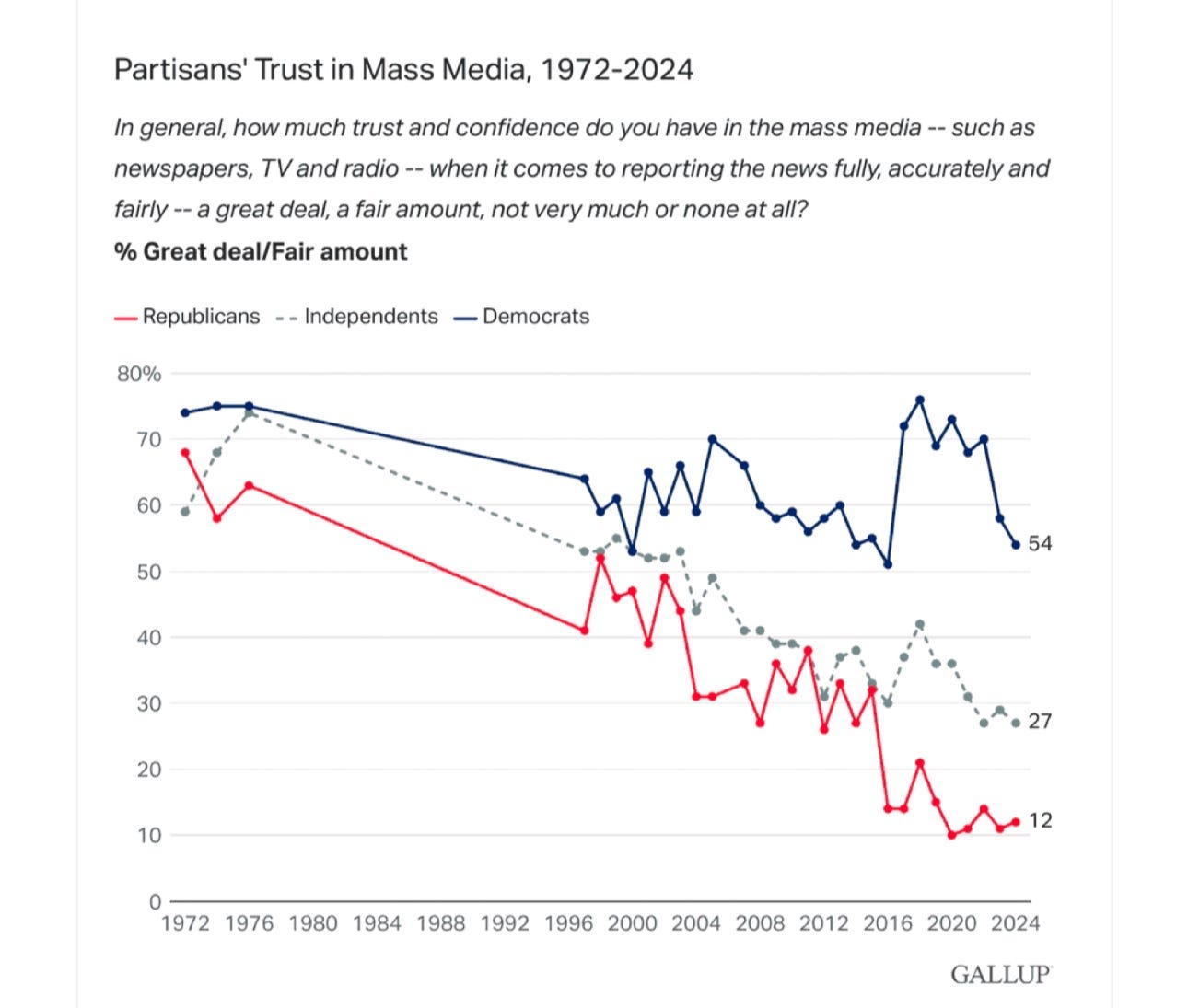
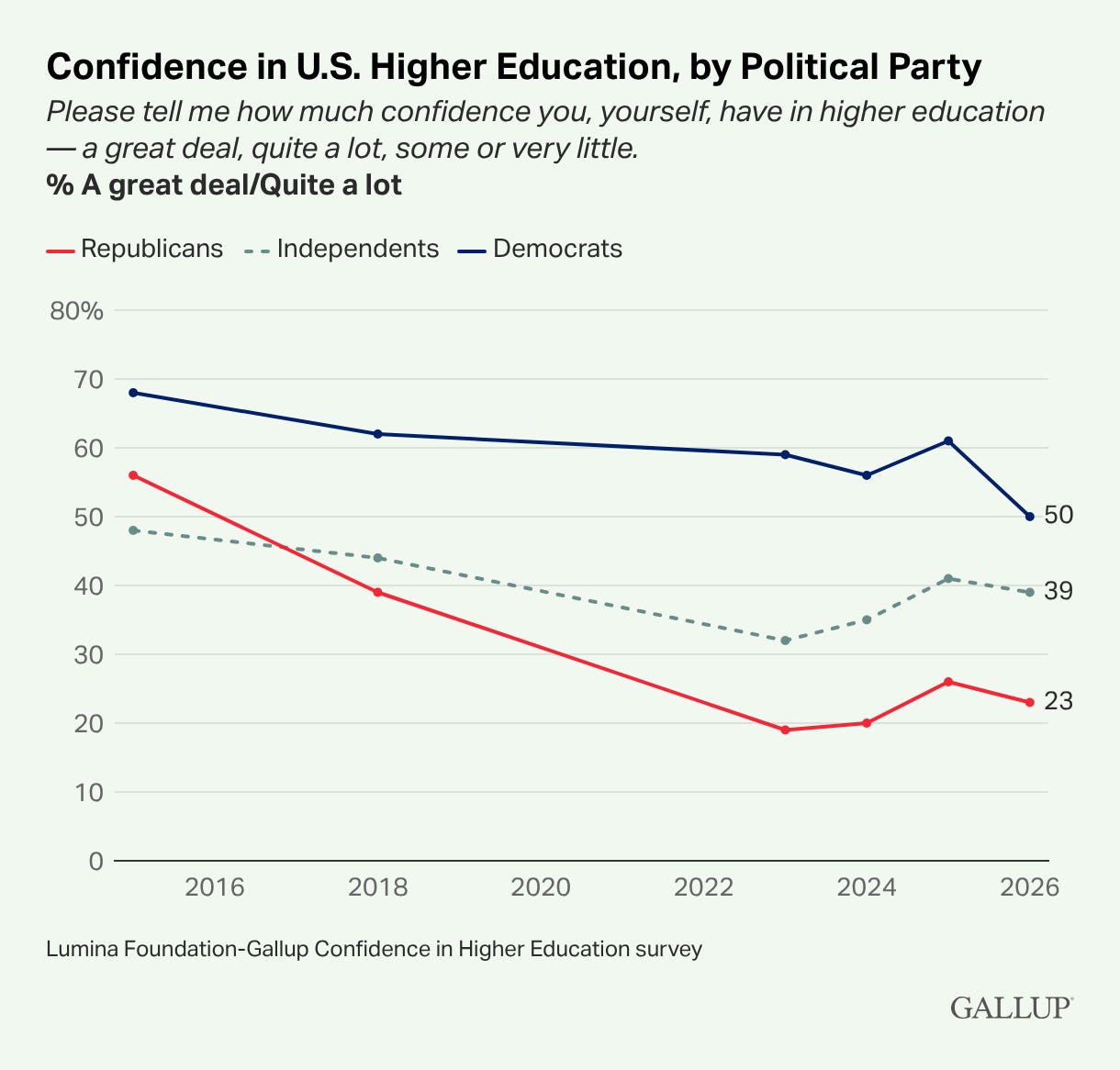
There are even worse problems with the training of teachers, with failed pedagogical approaches regularly getting re-packaged, resulting in problems even in just teaching (or failing to teach) literacy.
In both cases, academic status games and pretensions of moral heroism matter far more than the wider social effects or functional effectiveness. Universities are a bad way to train teachers, journalists or nurses because the default is not to train them—as the systematic feedbacks for effective and useful training are lacking. The default for University courses is to use them as foils for academic status games based on postures of moral and cognitive heroism (hence feeding them Theory): status games that the innovation cargo cult turbocharges.
Not only does the bureaucratised research grant innovation cargo cult select for such performative politics, it selects for making such moralised academic status games increasingly pervasive. Research grants—and their process measures such as peer review and citation metrics—become mechanisms for enforcing status-aggrandising conformity.
Beliefs as moral markers
This massive subsidising of a sense of moral and cognitive heroism among academics, based on what’s in their heads, has entrenched and spread the notion that what you believe or affirm is the main determinant of whether you are a good person or not. This is a deeply pernicious nonsense.
The core of norms is to constrain how you behave towards other people. Elevating public affirmation of correct belief as the dominant marker of morality licenses bad behaviour—often very bad behaviour—against those who dissent.
It generates a very easy sense of moral superiority for minimal effort that does the opposite of limiting bad behaviour, for it generates a shared moralised status game that encourages shaming and shunning of dissenters. For, if believing X makes you a good person, believing not-X makes you a bad one. This uses network effects to generate a spreading conformity through institutions and organizations via shaming and shunning those who fail to play the shared status game.
This is most intense in the institutions that the bureaucratized innovation cargo cult has paid for it to occur: universities. Their increasing political conformity is a natural result of the bureaucratized research grants innovation cargo cult devaluing past experience—and the transmission of past knowledge and heritage—by subsidizing the activist scholarship that can generate the most moralized “innovation”.
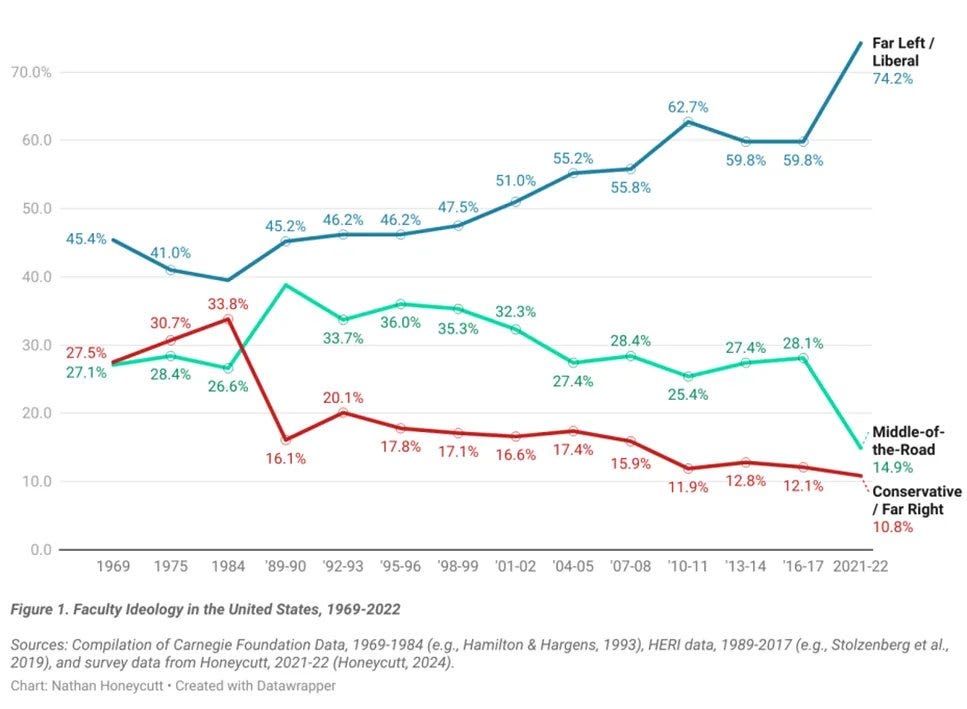
This elevation of what’s in people’s head—where the more not-noticing and rationalizing away is required, the stronger the signal of commitment to shared status games—not only poisons discourse, blocks feedback and elevates toxic nonsense, it rewards unreality. One ends up encouraging just-so stories that play to “this makes me a good person” narratives. Just-so stories that are often of a conspiratorial bent because they substitute malign human action for inconvenient aspects of reality.
The epitome of this is Trans. It elevates an affirmed identity over one’s own body and biological reality. The level of required not-noticing and rationalizing away required is heroic. What can be a greater filtering signal of soundness than claiming that hormonally and surgically mutilating and sterilising a minor is a sign of “care and compassion”?
All forms of social constructivism feed this elevation of what is affirmed over inconvenient reality. People—to defend their moralised sense of status—become committed to a moral metaphysics that systematically blocks them from even considering the possible truth of inconvenient aspects of reality. Turning this into an elite status game is very dangerous for the health and functionality of societies, polities; of an entire civilisation. So much of academe—spreading from there to schools, mainstream media and other institutions—both teach and model self-righteous epistemic closure precisely because to update your priors represents an attack on one’s moralized sense of identity and will expel you from the shared status game.
One of the basic problems is the notion of knowledge production. The notion that people are being paid to be knowledge producers immediately elevates what they do, what comes from their heads: even more so when reality-tests are so systematically inadequate or absent. The contrary take that knowledge is discovered entails a constraining humility in the face of reality.
There is a larger philosophical problem here. The concept of knowledge-as-truth too readily smuggles in certainty about what is true into realms where such certainty is not available. Most of the time, we are stuck with various levels of approximately true and of probably correct.
On the other hand, resiling from any concept of truth lets loose all sorts of toxic nonsense by freeing people from acknowledging reality-constraints—at least in their writings: their physical interactions with the world cannot escape them. As philosopher Stephen Hicks notes:
The failure of epistemology made post-modernism possible. The failure of socialism made post-modernism necessary.
The social constructivism of post-modernism/post-structuralism that has become so endemic in academe enables the oppression-oppressor template to be freed from reality-constraints. One is free to tell any just-so stories that play to the required moralised status-games while avoiding wrestling with inconvenient reality.
One of the problems with the technological dynamism of modern civilisation is that it makes it easier to believe the central delusion of modernism—new is always better—and the central delusion of progressivism—that the sinful past cannot teach us anything that constrains our vision of the future. The bureaucratised research-grant innovation cargo cult puts these effects on subsidised steroids.
Living in a technologically dynamic civilisation makes what to keep versus what to dispense with an ongoing issue. But we remain Homo sapiens. The historical record contains much relevant experience in being Homo sapiens.
Taking that relevant experience seriously is both liberating and confining. Liberating in the sense of illuminating past, present, and likely future behaviour. Confining in the sense of requiring acquisition of such knowledge and in what is likely to be achievable. Biologist E.O.Wilson’s quip about Communism—great idea, wrong species—applies.
The more fluid human possibilities are, the more grandiose imagined human social transformation can be, and so the more morally and cognitively heroic is commitment to them. That is why taking genetic influences on human behaviour and capacities seriously is so anathematised by the Critical Theory magisterium.
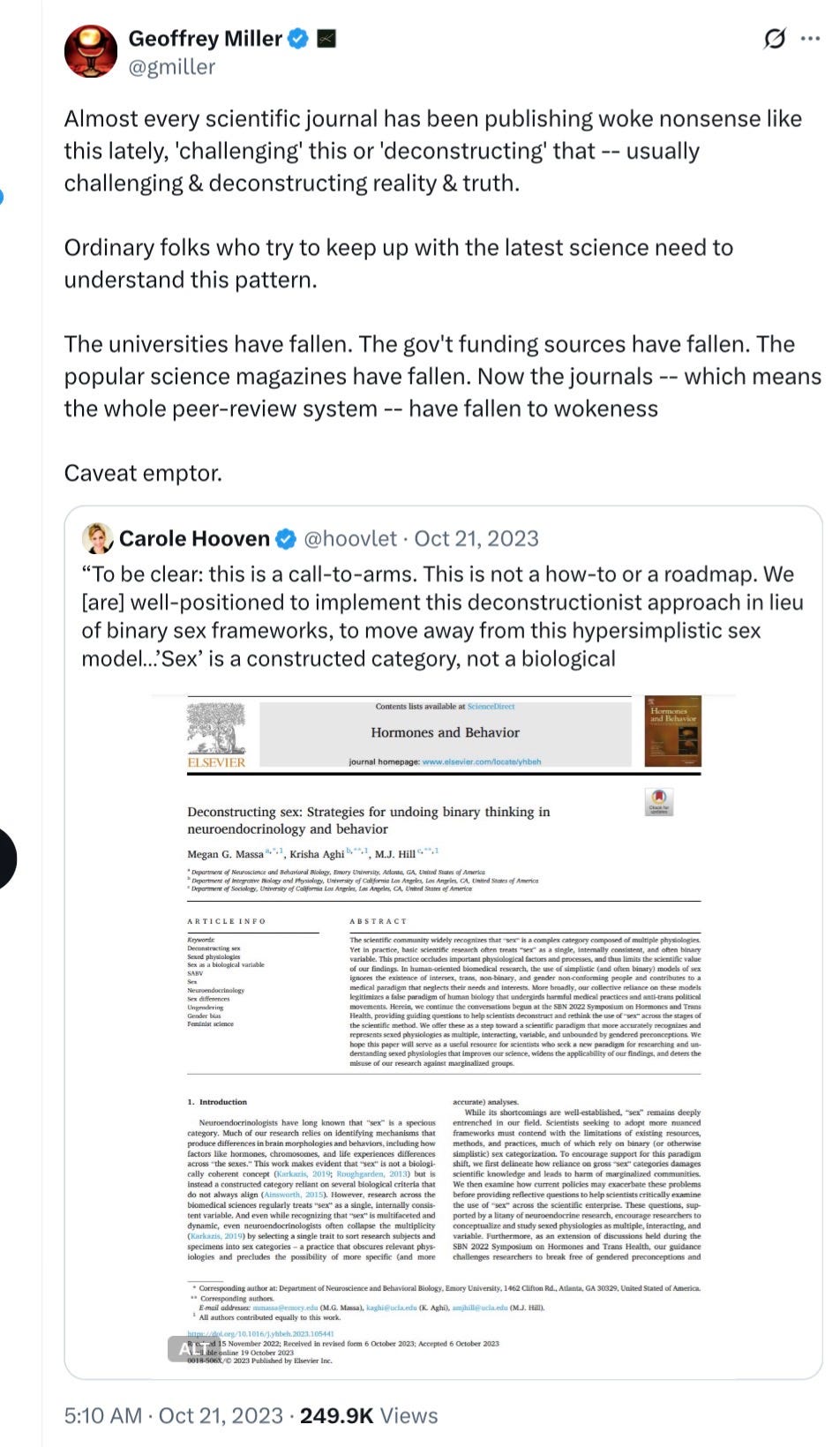
Taking genetic influences and constraints seriously literally brings human possibilities down to Earth, placing them within confining trade-offs that have to be explored, they cannot be simply imagined away. The genderwoo Lysenkoism—with its censorious “social justice” moral grandiosity—that has been infecting science publishing is a natural consequence of using academic approval as a selection device. The research-grant innovation cargo cult has so catastrophically failed to bureaucratise the Scientific Revolution that it is now funding a war against Science itself.
It is worse in the Arts
All the above points apply even more strongly to bureaucrats handing out other people’s money as literary or arts grants. There is no reality-tests for such grants even in theory.
The notion that anonymous bureaucrats handing out other people’s money will show reliable aesthetic discrimination is ridiculous (and demonstrably false). It is even more so when the entire trend of “approved” thought has been to attack any such notion of objective standards of beauty and aesthetics and, even more, the notion of a rightful transmission of a worthy heritage.
Managerialism in the cultural, literary and artistic realms—with its elevation of process and of status games operating across social realms—naturally leads to systematic failure to grapple with aesthetics and art and culture as autonomous realms of human action.
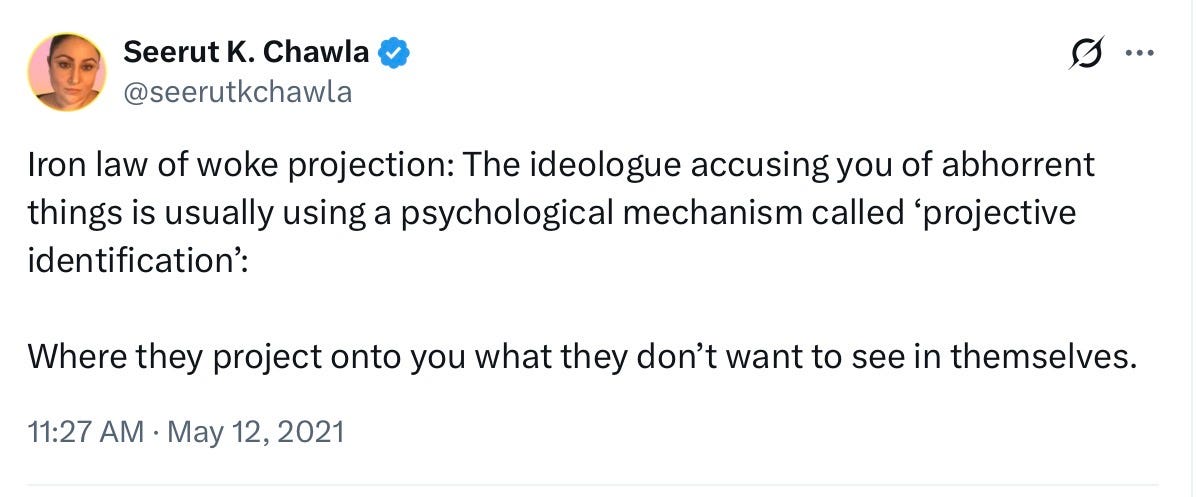
What we get instead is utterly predictable: even more rigid conformism and gatekeeping in the arts and literary fields than we see in academe, with the same totalitarian urge to impose politics on all realms of human social action. There is no more colonial project than “de-colonising the curriculm”—a self-righteous elite informs the locals that their cultural heritage is contemptible and needs to be remade in the image of the colonising elite. It is the Iron Law of Woke Projection in particularly redolent form.
The more institutions and organisations become gripped by status games that elevate political beliefs over other considerations, such as competence, functionality and doing the job the organisation is notionally paid to do; that elevate Conflict Theory—not only over the health of cooperative mechanisms but being actively hostile to them—the more you end up with “skin suit” institutions that throw away public trust. After all, a sense of moral and cognitive superiority over the general public and their cultural heritage is the point of the status games being played. The active alienation of dissenters, and the blocking of all inconvenient feedback—thereby directly degrading the functioning of such institutions—is at the heart of such status games.
Abolishing the innovation research-grant cargo cult is not “anti-Science”. Its abolition is needed to rescue Science, healthy discourse and vibrant intellectual enquiry.
Pathologies of process
All the above is about as far from the dynamics of commerce as it is possible to be. Yet the notion that what is central to commerce and social dynamics is capital, and its possession—with the concomitant under-rating of the importance of information landscapes and reality-tests—still sits are the bottom of the “crank the handle” approach of the amazingly destructive innovation cargo cult.
“Crank the handle” approaches appeal to the bureaucratic/managerial mindset, as both hold that process drives outcome. Like the labour theory of value, “crank the handle” approaches assume success from “correct” process. Such an assumption abstracts away from the normative, cognitive framing, coordination, risk-management, and other information issues involved in human action—including the reality-testing—that achieves useful/pro-social outcomes.
The processes that gave us the Scientific and Industrial Revolutions used capital, and they expanded our ability to create and use capital, but that was not the heart of what went on and it is direly misleading to think so—including for attempts to replicate, sustain and expand either.
How to reverse the disaster
Tax-funded grants should be entirely abolished for the arts and literature. Tax-funded research grants should be entirely abolished for the humanities and for any social science that is not consilient with evolutionary biology.
All activist scholarship should be banned from receiving any taxpayer funding. This will require closing entire Departments, Faculties and disciplines.
For STEM and biology-consilient social sciences, all research grants should be replaced by block grants to University Departments within those disciplines. These grants should be audited to ensure:
they are spent on research that is subject to clear reality-tests plus the direct administration thereof;
all that research is published; and
a proportion (say 30 per cent) is spent on replication studies.
Otherwise, the block grants should be let be. In particular, they should not be subject to direct, or implied, control by officials charged with providing public policy advice.
This will generate resistance, especially from the central university administrations, which need to be gutted. The administrative share of total university expenditure needs to be severely capped, as does the share of that expenditure spent on the central administration, thereby forcing devolution and dispersal of such resources back to Faculties and Departments. Secret ballots by the permanent academic staff need to be able to overrule the administrators, who have to be reduced to being the hired help.
The incentive structures created by a hugely misconceived research grant system in service of the innovation cargo cult has systematically degraded universities, with consequences that have spread out across our institutions. Only the root-and-branch extirpation of the entire structure, and its replacement with systems whose incentive structures are much more carefully considered, can hope to reverse these socially, politically, and civilisationally corrosive processes.
References
Jaume Aurell, ‘The origins of the university: Questions of identity and historical continuity,’ Church, Communication and Culture, (2024) 9:2, 137-150. https://www.tandfonline.com/doi/full/10.1080/23753234.2024.2396411
Herbert Gintis, Carel van Schaik, and Christopher Boehm, ‘Zoon Politikon: The Evolutionary Origins of Human Political Systems,’ Current Anthropology, Volume 56, Number 3, June 2015, 327-353. https://pubmed.ncbi.nlm.nih.gov/29581024/
F. A. Hayek, ‘The Use of Knowledge in Society,’ American Economic Review, Sep. 1945, XXXV, No. 4, 519-30. https://statisticaleconomics.org/wp-content/uploads/2013/03/the_use_of_knowledge_in_society_-_hayek.pdf
Stephen Hicks, Explaining Postmodernism: Skepticism and Socialism from Rousseau to Foucault, Ockham’s Razor Publishing, [2004] 2014.
Richard E. Mayer, ‘Should There Be a Three-Strikes Rule Against Pure Discovery Learning?: The Case for Guided Methods of Instruction,’ American Psychologist, January 2004, Vol. 59, No. 1, 14–19. http://www.davidlewisphd.com/courses/EDD8001/weeklys/2004-Mayer.pdf
Nathan Nunn, ‘Culture And The Historical Process,’ NBER Working Paper 17869, February 2012. http://www.nber.org/papers/w17869
Daphne Patai & Noretta Koertge, Professing feminism: Cautionary tales from the strange world of women’s studies, Basic Books/Hachette Book Group, 1994.
Kenneth M. Pollack, Armies of Sand: The Past, Present, and Future of Arab Military Effectiveness, Oxford University Press, 2019.
Harold Robertson, ‘Complex Systems Won’t Survive the Competence Crisis,’ Palladium: Governance Futurism, June 1, 2023. https://www.palladiummag.com/2023/06/01/complex-systems-wont-survive-the-competence-crisis/
Jon A. Shields & Stephanie Muravchik, ‘Closed Classrooms,’ National Affairs, No.69, Fall 2026. https://nationalaffairs.com/publications/detail/closed-classrooms
Thomas Sowell, A Conflict of Visions: Ideological Origins of Political Struggles, Quill William Morrow, 1987.
Will Storr, The Status Game: On Social Position And How We Use It, HarperCollins, 2022.
Michael Strevens, The Knowledge Machine: How an Unreasonable Idea Created Modern Science, Penguin, 2022.
Jordan E. Theriault, Liane Young, Lisa Feldman Barrett, ‘The sense of should: A biologically-based framework for modeling social pressure,’ Physics of Life Reviews, Volume 36, March 2021, 100-136. https://pubmed.ncbi.nlm.nih.gov/32008953/