

This is the fourth post in series on using evolutionary reasoning. The first post discussed pitfalls of evolutionary reasoning and advanced 42 propositions about human tool use, cooperation and mating patterns. The second post advanced another 78 propositions on norms, language, prestige, propriety, social aggression, diet, religion, and murdering our way to niceness. The third post discussed the role of niches in human societies and how they generate demographic boom and social order bust cycles in human polities, cycles that very much have contemporary resonances. This post advances 90 propositions about states, culture, cognitive dimorphism, mass production, social corrosion and masked impoverishment of human flourishing.

Human males and females have distinct, but overlapping, patterns of cognitive traits. The distribution of cognitive traits among human males being “flatter” than among human females, plus those distributions having different averages, results in a large majority of both males and females having a pattern of cognitive traits that does not occur in the other sex.
Thus, we are a significantly cognitively dimorphic species.
As these differences are clearly selected for, it is not an advantage to human lineages to have male and female cognitive patterns converge “too much”.
If members of a lineage with a high degree of such cognitive convergence become sexually oriented to their own sex, this impedes continuing such cognitive convergence between the sexes within the lineage. It also generates lineage members able to invest more in cultural and other social-connection goods rather than in their own children, to the internal and external advantage of the lineage. (Gay men are wildly disproportionately likely to work in caring and cultural professions.)
If there is a range within which cognitive convergence is conducive to successful human mating, this will strengthen these patterns.
The development of productive assets (salmon runs, arable land, animal herds) provided mechanisms for dominance—usually via coalitions—to re-enter human societies.
Such productive assets both enabled, and regularly expressed, such dominance, including through much increased capacity for polygyny.
The development of productive assets also increased the incentive for women to engage in hypergamy (seeking high-status mates). That human males are primed to value physical signs of fertility made this a practical option.
Women tend to show more concern for status than men in mating, given the resource and social-connection advantages of a higher status mate for their children and greater male focus on physicality.
This greater female operational concern for status extends to friendship networks: women are far less likely to have lower-status friends than men, as female friendships are based on emotional investment to generate robust support for raising our very biologically expensive children, and lower status women are unlikely to to be “worth” the investment.
As men are far less likely to find women threatening than women are to find men threatening, and men focus more on things and performance of roles, women show far higher rates of social preference for other women than men do other men.
One way religions can promote fertility is by embedding women in strong maternity-promoting social networks. Such plays to greater female social preference for other women and their stronger tendency to normative conformity.
Conversely, men are much more likely than women to have lower status friends, as you never know when you might want them on your “team”. This, along with the strong female social preference for other women, makes men more the social solidarity sex than women.
Teams as such are morally neutral—the Mongols and the Waffen SS were both excellent at building effective teams. Nevertheless, effective institutions usually operate as expanded teams.
As teams are the archetypal non-kin connection for men, male friendships tend to be emotionally thinner, broader, and more flexible in who they include, than female friendships. Men are also more likely to continue to invest in maintaining friendships despite disputes.
As the physically weaker sex with bubs in tow, women tend to avoid physical aggression among adults, but are more likely to use relational or social aggression. This is both more effective, and safer, if they present it—including to themselves—as “just” social or moral concern, using our considerable capacity for self-deception, as most of our cognition is not conscious.
As part of assessing threat and commitment, women tend to be better at reading other people’s emotions than men. Men tend to be more aware of their own aggression than are women.
As women are typically more alert to other people’s emotions, and see relationships in terms of emotional investment, women tend to be systematically better at networking than men. The elimination of male same-sex social spaces therefore tends to disadvantage men.
As war provides intense stress and emotional connection, conflict can often provide men with an intensity of connection they struggle to find elsewhere.
Much of male social interaction is about testing potential team members—if I say outrageous things, will you still support me? if I put you under pressure, will you fold?
Women working in male-dominated environments can easily find them emotionally bruising. Conversely, it is hard to build trust if folk are “walking on egg shells” in very tone-policed milieus.
Female groups are typically built from the emotional-commitment pattern. Such cliques tend to be more emotionally intense, more conformist, socially narrower and more unstable than male teams.
In particular, within female networks, disagreement is more likely to seem either hurtful, or as a threat. The women’s movement has regularly been marked by intense shaming and shunning behaviour (“trashing”). Men working in female-dominated environments can often find them emotionally smothering while cognitive conformity tends to be required for stable female networking.
As men tend to focus more on roles and things, they tend to be more comfortable with hierarchies. As women tend to focus more on emotional connections, they tend to be keener on “flattening” social interactions. So, men tend to be more comfortable with overt seeking of status and status differentiation than women, including acknowledging differences in performance/capacity/achievement and identifying failures to reach set standards.
Farming and pastoralism enabled dramatically larger populations and created productive assets—arable fields, animal herds—that could be seized. This increased the scale of social predation, thereby encouraging the intensification of kin groups as part of more intense selection for effective warrior teams.
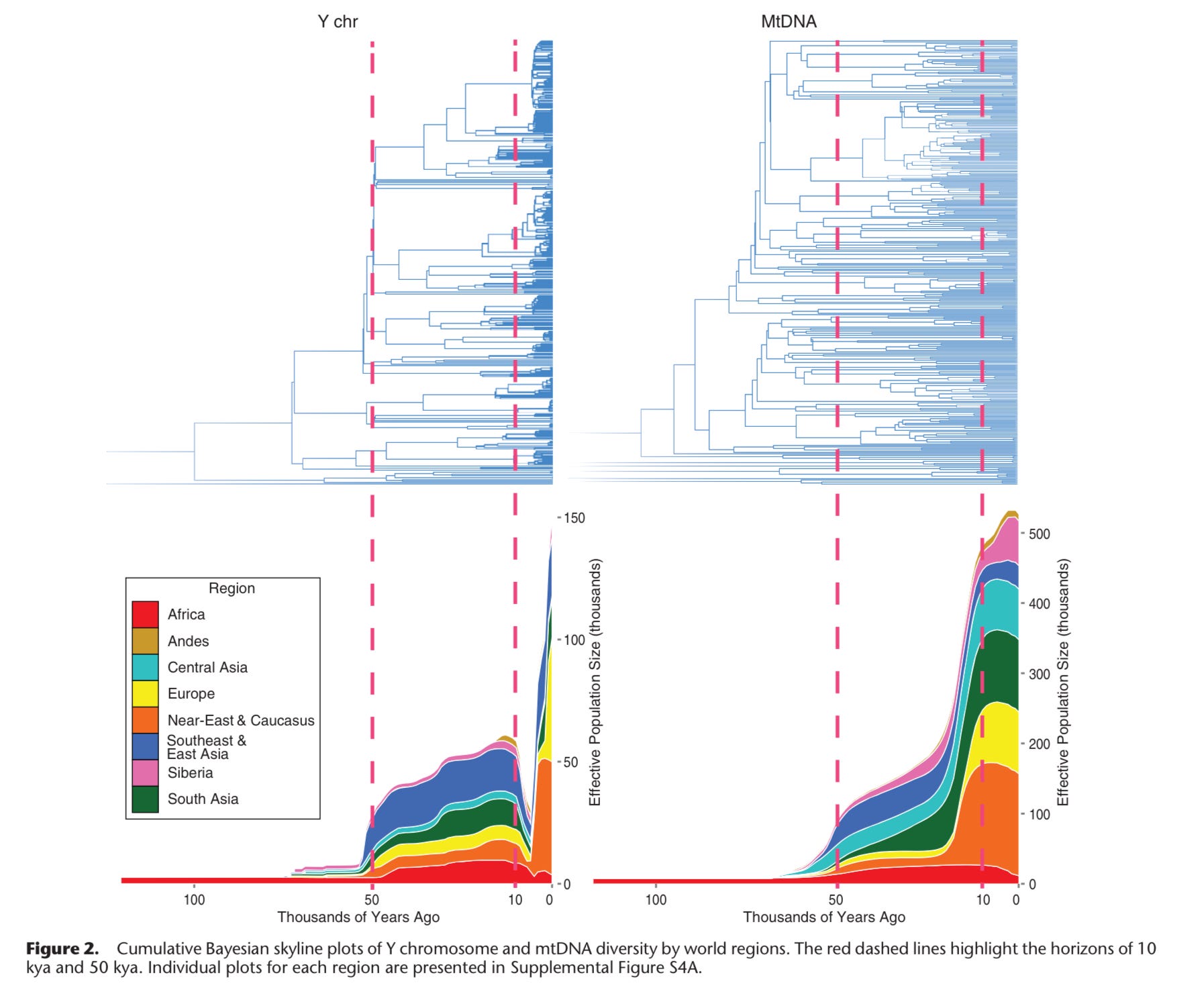
The result was the Neolithic y-chromosome bottleneck, which only about 1-in-17 male lineages survived but did not limit female lineages. Effective male teams killed—or sometimes enslaved—their rivals, took their women and bred with them, intensifying selection among human males for effective teams.
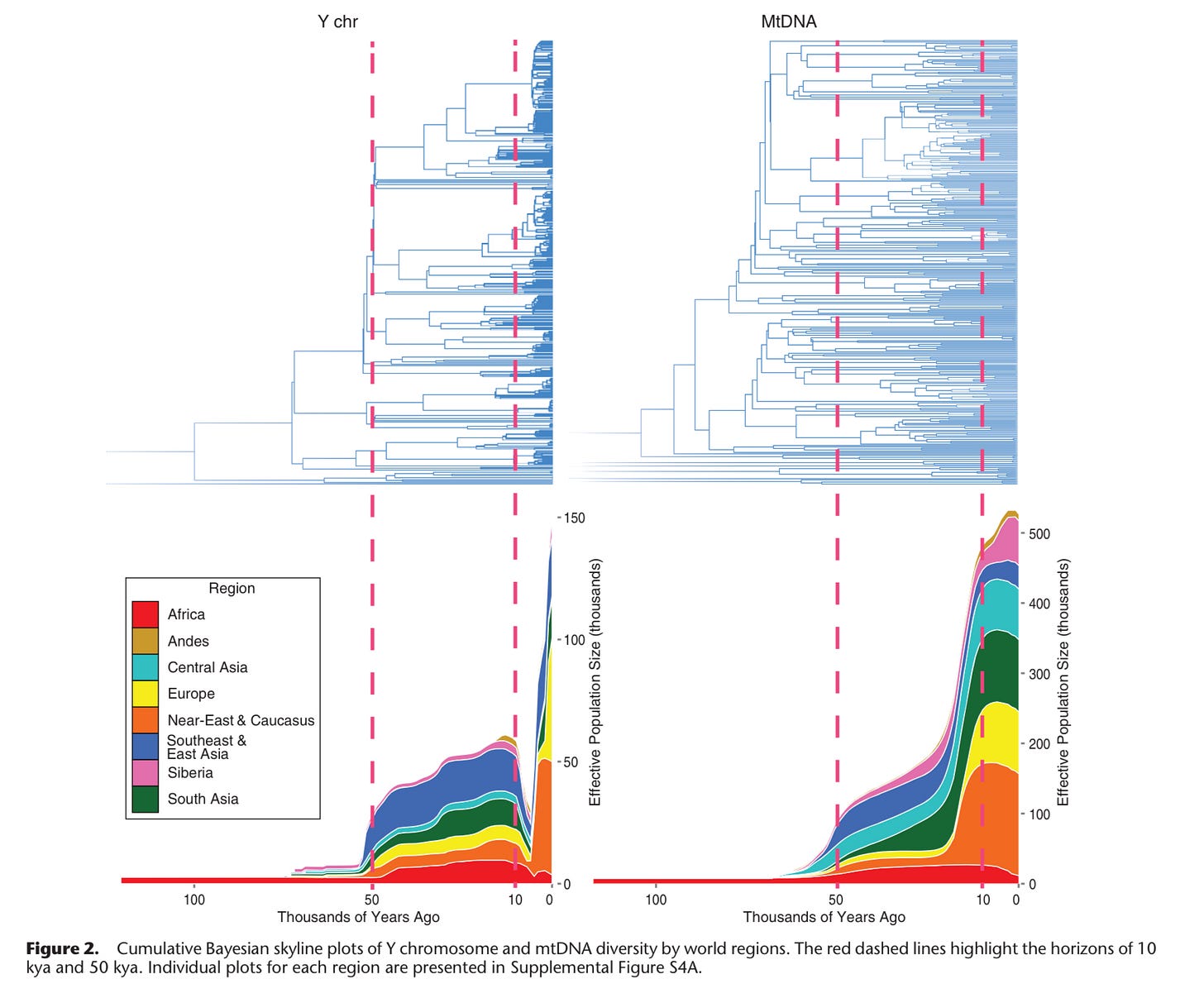
The massive harrowing of male, but not female, lineages after the development of farming and pastoralism. Karmin, et al, 2015. While in any generation, most men reproduced, over time, there was an intense harrowing of male lineages until the social strategy of taxing losing males, which rewarded enabling them to breed new taxpayers, evolved.
It also meant that generations of human females bred with the rapist who had killed their male relatives. This has had lingering effects on patterns of female sexuality—romance novels about the love of a good woman taming a male brute speak to this, as does attraction to “bad boys”.
Social defection has also been much more likely to be a successful strategy for women than men.
The tax-the-losers social strategy of tribute (chiefdoms) and especially taxation (states) required seasonal crops—for stored food was taxable and non-seasonal crops do not structurally generate significant stores of food.
Seasonal crops—requiring the storing of food and the seeds for next year’s crops—also increased the need for protection.
The combination of predation and protection was deeply embedded in the creation and evolution of states. Focusing only one of these features of states is seriously misleading.
Due to the need for taxable seasonal crops, states originated in fewer locations than did farming. Far more of the Earth’s land area has had states first imposed on them from outside than were origin points for states.
Farming does not, in itself, generate significant surplus—food above subsistence—it mainly supports more babies.
Tribute and taxation, by taking food before it was used to support more babies, does generate significant surplus.
As states have dominated the creation, extraction and distribution of surplus, they are a fundamental structuring element in societies—including of their class structures—they are not “reflections” of them.
The socially structuring power of states makes it harder to impose accountability on them.
As no mechanism of accountability is infinitely flexible or scaleable, the larger the state apparatus, the greater the incentive—and potential capacity—to frustrate accountability to the wider society.
Due to states creating surplus through their extraction efforts, state societies are considerably more complex than stateless societies.
As states are built from taxation—coercive extraction of resources, originally in kind—and more taxpayers mean more revenue, as soon as there are states, there are incentives to expand the territory (and subjects) from which one extracts resources.
Empire is the result of there being states with the capacity to be imperial.
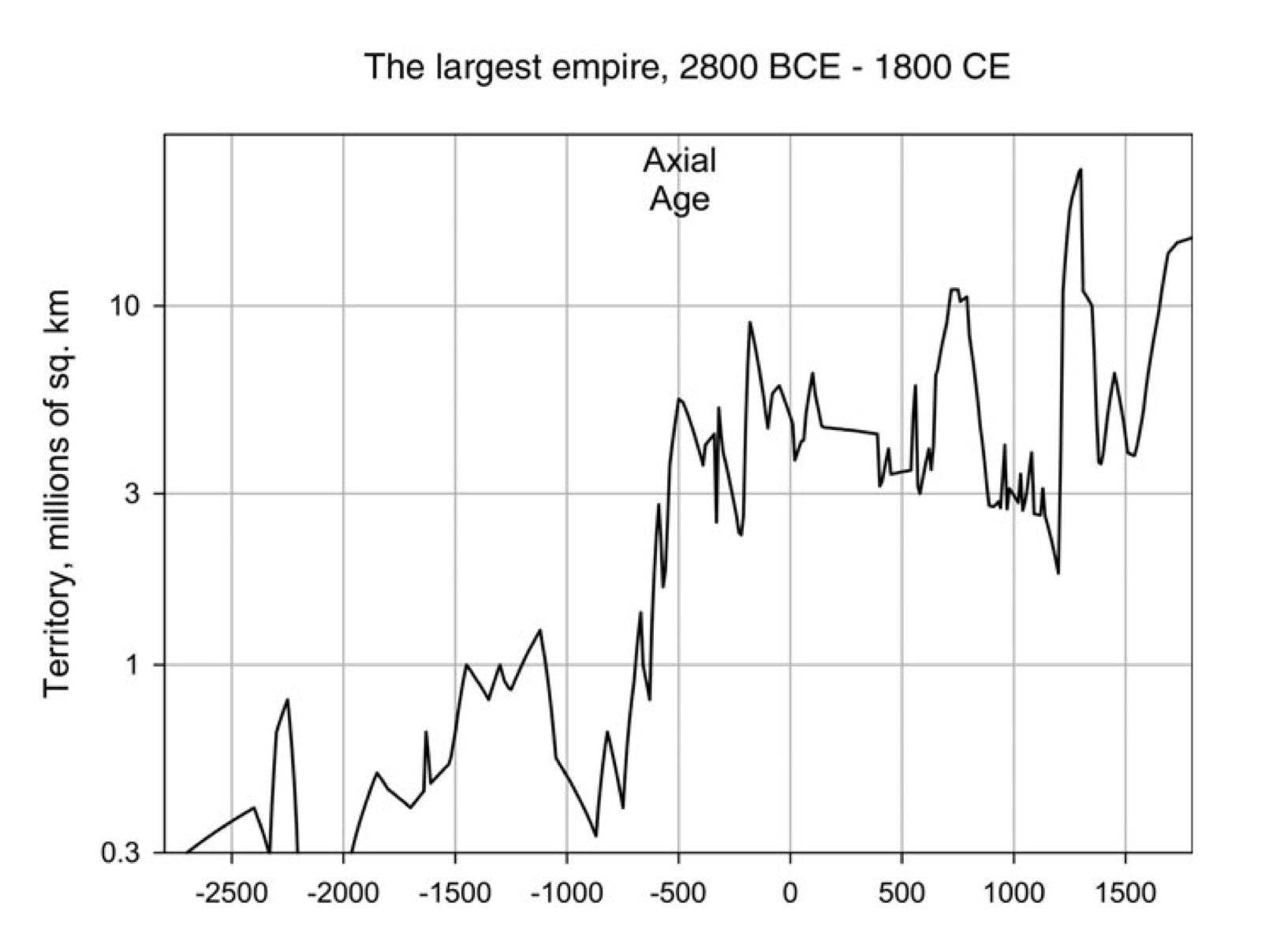
In particular, increases in the level of trade tends to increase the scale of states—including of empires—as trade gives access to resources from outside your territory, enables greater specialisation inside your territory (so Smithian growth in production) and can be fostered by providing protection, other public goods and transport networks.1 For instance, as pastoralists were also traders, the creation of the Scythian tribal confederation—the first substantive steppe polity—led to increases in the size of empires based around the Fertile Crescent, culminating in the first mega-empire—larger than five million square kilometres—the Persian Empire. Similarly, given the need for China to import horses (due to the lack of selenium in it soils) and trading silk to buy them, a unified China generating more trade—and so revenue therefrom—tended to be matched by empires encompassing more of the taxable territory across Eurasia. The Qin-Han (221BC-220) unification coincides with the rise of the Roman, Parthian (247BC-224) and Kushan (c.30-c.375) empires.2 The Sui-Tang (581-902) unification coincides with the rise of the Rashidun and Umayyad Caliphates (632-750).3 The partial—but increasingly commercial—Song unification (960-1127) coincides with the rise of the Seljuk Empire (1037-1194). The Yuan-Ming-Qing (1271-1912) unification coincides with the rise of the Ottoman Empire (1299-1922).
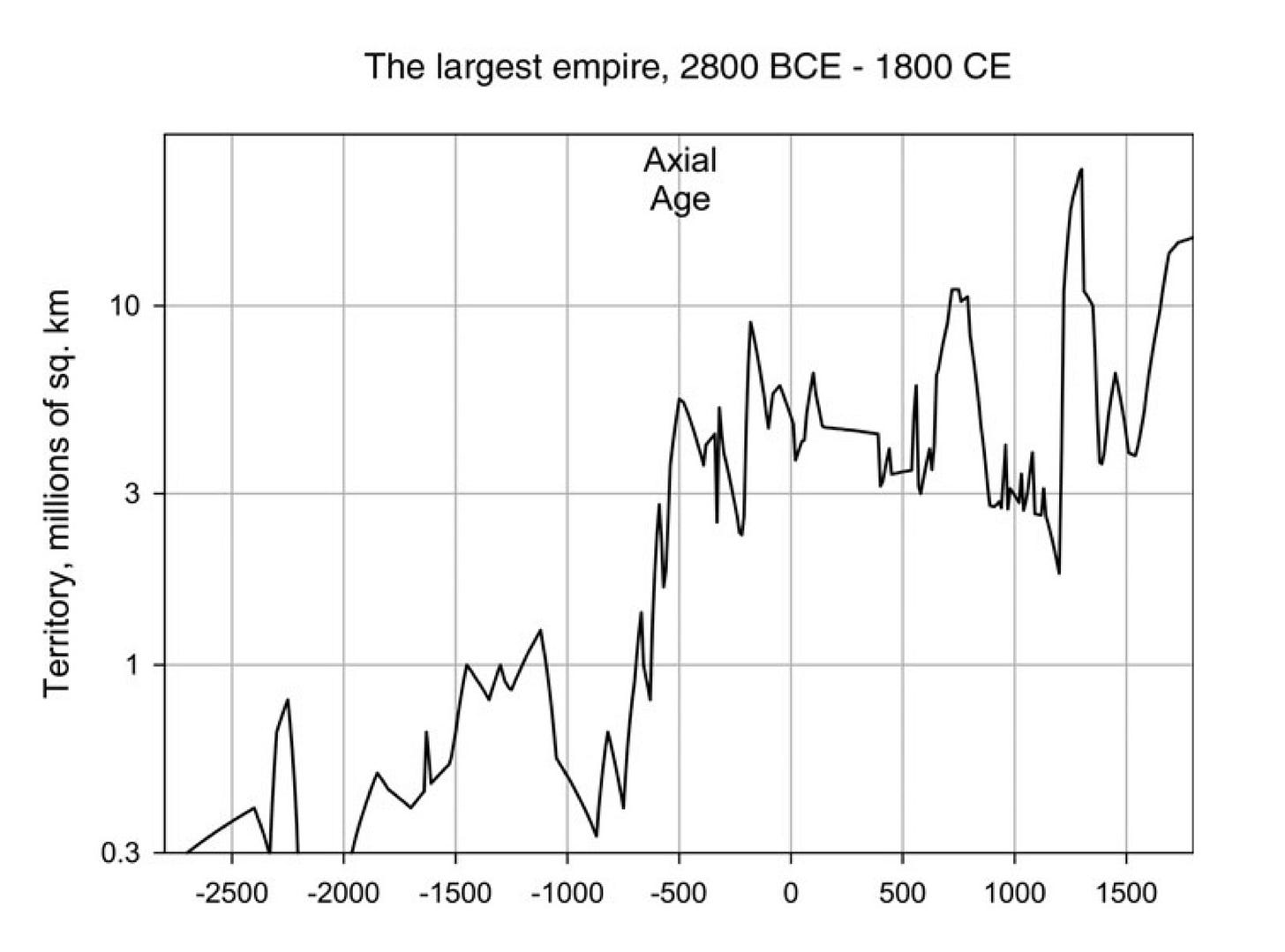
Source, Turchin 2009. Until the C20th, any economic or social arrangements that fostered the capacity and resources for states to operate at scale led to empire. The more such capacity expanded, the larger empires tended to be. For instance, the dramatic fall in transport and communication costs from the 1820s onwards—with the invention of steamships and railways—led to huge increases in trade and to European maritime empires reaching their peak extent outside the Americas.
As empires tend to encourage trade through more extensive provision of protection to increase their revenues, this creates both upward and downward spirals between trade and empire.
States come in two basic forms (1) authoritarian, based on ruler and subjects; and (2) associational, based on deliberative assemblies and citizens. Some states have mixes of these forms.
Until the development of the representative principle, associational states—which occurred in many civilisations (e.g. ancient India, Mesoamerica)—could not successfully scale up, so tended to be overwhelmed by authoritarian states, that could and did scale up. Rome’s willingness to expand who could be a citizen was, at best, a partial exception to this pattern, given the Roman Republic’s collapse into rule by emperors.
We cognitively model not facts but significance to us, so what we can grasp, especially what is vivid.
Culture is the social transmission of norms, skills, connections, symbolic markers and rituals, cognitive framings and life-strategies. Such transmission can be down family lines; by the example of other adults; or by the example of peers or other interaction groups.
Culture is an emergent phenomena, mobilising various evolved mechanisms.
Culture is a “bottom-up”, socially permeable, if persistent and interactive, phenomenon that also involves such things as shared narratives.
Culture is not some all-encompassing, top-down, unitary thing despite the power of shared cognitive framings in generating robust, shared expectations.
Nevertheless, the persistence of culture generates much of its value, by generating robust, shared patterns of expectations.
Myth operates as compressed memory, providing stories helping to
build and sustain shared expectations, references and cognitive framings.
Expressing myths in epic poetry operates as an effective oral transmission mechanism, since poetic metre provides an error correction device: breaking the rhythm and/or the rhyme (depending on how a language works) reveals an error. The Vedas, the Homeric and Vedic epics, could thus be transmitted across centuries orally.
Since institutions are structures of rules and norms, a polity needs to have a strong civic culture to have robust institutional norms and so robust institutions. Normative decay or collapse often precedes regime, or even polity, collapse.
How many people come into a society, at what rate, in what size groups, with what cognitive framings, inevitably affects the social equilibria that institutions are based on, and so how they operate. Thus, mass immigration can fracture a polity to the point of civil war: examples include the Texas Revolution (1835-6), the American Civil War (1861-5), the Jordanian Civil War (1970-1) and the Lebanese Civil War (1975-90).
The definition of nation by Regino of Prum (d.915), based on Classical conceptions—Diversae nationes popularum interse discrepant genere moribus lingua legibus (the peoples of various nations differ by origin [ancestry], customs, languages and laws)—became the standard definition in medieval Europe and expresses why ethnicity, as a multi-dimensional structure for human interactions, has been a persistent factor in human affairs:
Via culture, ethnicity profoundly affects: (1) how extensive, and robust, shared expectations are; so (2) ease of communication and interaction; and (3) patterns of social connection, including marriage and friendship networks. Religion can operate similarly, especially regarding (3).
Modern sub-cultures indicate how much cultural identification can be chosen. The more complex and immersive the culture, the more difficult it can be to adopt. Nevertheless, the permeability of human social groups—including cultural groups—is a major factor in human social selection.
Serious adoption of a new culture usually takes time and operates across modes of social interaction, such as religion, kinship arrangements, dress, epic narratives, songs, etc.
Different cultures generate different patterns of individual and social calculations, different cognitive framings and so different normative social-scapes, social signals and patterns of expectations.
Precisely because we cognitively model significance not fact, people from different cultures, religions, ideologies will behave differently in the same circumstances because the cognitive significance differs, so the operational incentive structures differ.
Precisely because we human cognitively model significance to us, we persistently fail to understand how much other people can have very different perspectives. Even when we are so aware, folk often assume the rival perspective is a reverse of their own, which is just another way of imposing our cognitive framing on others. Thus, folk on the left focused on equality, and liberals focused on liberty/autonomy, regularly misread conservative focus on order.
Recent scholarship has identified culture, along with institutions, as very important factors in long-term economic growth. In particular, formally similar or identical institutions can operate very differently in different cultures due to differences in cognitive framings, norms and expectations.
The way social media has undermined group attention has had a polarising, therefore socially corrosive, effect on modern polities. This is especially as social media is very effective at upscaling relational aggression.
Social media has also greatly complicated peer group interactions, as these can become both more invisible to parents, operate in potentially emotionally intense “slivers” of human interaction—so without all the physical cues we have evolved and learnt to notice—and be highly deceptive, since people can present quite false online personas.
Online interactions are para-social rather than social. Thus, by not transmitting the signs of emotional commitment and affinity that are important to female sexuality, dating apps greatly increase hypergamous choices by their female users. Like all effects with some genetic base, female hypergamy is very much mediated by social and informational interactions.
The dramatic expansion in our access and use of energy (aka the Industrial Revolution aka the Great Enrichment) since the development of steamships and railways in the 1820s has meant falling transport, communication and production costs. It created mass globalisation—that is, markets that extend across polities.
Dwellings created households as consumption and production units. Even government became centred on royal and imperial households.
Vassalage and fiefs represented government by distributed households.
The harnessing of cheaper and cheaper energy for transport and production meant that production moved en masse out of the households, which became consumption units.
Mass production—moving production out of households—coupled with falling communication and transport costs, generated mass politics. Thus, while national feeling goes make centuries, even millennia—Old Kingdom Egypt was the first nation-state, with a very clear sense of who was, and was not, Egyptian while from 928 onward the English kings of the Houses of Wessex, Godwin, Normandy, Blois, and the first two Plantagenets proclaimed themselves King of the English (Rex Anglorum) rather than King of England (Rex Anglie)—nationalism as mass politics is largely a product of the energy breakthrough.
Urban polities with deliberative assemblies generated precursors to modern mass politics, both because of population concentration and because urban centres have forms of factory production—production outside the household—going back millennia.
Mass production made it easier for states to tax economic activity, as factories and firms became tax extraction points. The previous dominance of taxes on land and trade for state revenue became eclipsed by income taxes on labour and capital.
Mass production raised the value of production and exchange—so labour and capital—for state revenue while lessening the importance of territory (i.e., land). That shifted the advantage towards the commercial (increase trade) states of the maritime order over the continental anarchy (grab territory) states.
Mass production and mass communication increased the importance of shared language for both mass political action and for coordination across ever larger ambits of state action, including discouraging exit of labour to different language (and cultural) groups.
The more revenue (and military capacity) relies on labour (including its potential mobilisation), the more creating a sense of shared identity—typically based on shared language and culture—is an advantage to a state, both for internal coordination and for retaining taxpayers.
These shifts undermined empire by raising its costs, lessening its benefits and generating increased capacity and motivation to exit empires. As Henry Kissinger commented: It would have occurred to no one in the eighteenth century that the legitimacy of a state depended on linguistic unity. It was inconceivable to the makers of the Versailles settlement that there might be any other basis for legitimate rule. Whereas the C19th naval hegemon—Great Britain—relied on the largest empire in history to support its naval hegemony, the post-1945 naval hegemon—the US—relies on the largest alliance network in history to do so.
Regarding imperial calculations, administrative elites came to have far better career prospects from internal colonisation of their own societies—via the expanding welfare states—or “vertical” colonisation—via expanding international bodies—than the “horizontal” territorial colonisation of traditional empires. The EU (and its precursors) has been a mechanism for replacing the administrative opportunities of territorial or maritime empire with those of transnational administration. The “ever closer union” of the EU is a transnational colonising enterprise.
As the administrative classes expanded, they become more socially imperial in their own societies, using mass immigration to balkanise the demos and delegitimise local culture and heritage. After the collapse of the Soviet Union decreased fears that the working class might defect to a rival ideology, or that they might be needed to be mobilised to meet an existential threat, a wider pattern of elite contempt within Western countries for the heritage and other attachments of their demos developed. There are few more colonial enterprises than “decolonising the curriculum”, whereby a self-righteous elite condemns the heritage of the “legacy” population and demands it be replaced by its superior offerings.
In a world of low and falling communication and transport costs, the interests of capital increasingly favour movement of factors of production—including labour—across borders. Careful comparison of economic performances by different countries show that the alleged wider economic (and even more social) benefits of such movement of labour, and even of capital, are regularly over-sold.
Cheap energy, interacting with technological change, to generate falling transport, communication and production costs, means increasingly efficient replacement of what was done within households (individually or via local networks) while raising the cost of children—especially for women, who have a much wider range of possibilities the more education and other social possibilities they have—and increasing urbanisation. This combination increasingly eliminates the large family “tail” needed for positive fertility. This is even more so when the improved educational and income opportunities of women have the effect of reducing the pool of marriageable men.
As human niches expand from cheap energy generating mass prosperity, social factors become less constraining, resulting in innate tendencies manifesting more strongly, including cognitive differences between men and women.
As transactions generate both commercial and tax revenue, commerce extending the range and size of markets, and state programs and services being provided on a transactional basis, all favour promoting transactions over connections—such as providing public housing on the basis of need that ignores patterns of local social connections.
Our capacity for self-deception makes it easier for socially-negative incentives to operate, especially when there are networks of people with a shared interest in the appropriate rationalisations and not-noticings.
That much of the welfare state apparat gains increased access to resources if social pathologies increase has a socially corrosive effect. For example, public health gains more resources the more metabolically unhealthy the population becomes; NGOs and government departments paid to service the homeless get more resources the more homeless people there are; those paid to service the disabled get more resources the more people are defined as disabled; those paid to oppose discrimination get more resources the more things are defined as discriminatory; and so on.
Moral project public policy is inherently socially imperial, by actively promoting concept and mission creep while using its proclaimed good (moral) intentions to frustrate critical examination and accountability.
The replacement of connections with transactions increasingly forces younger generations to purchase benefits that were previously provided by connections and more robust social commons. This has an impoverishing effect across the generations in terms of human flourishing, an effect that is masked by treating the exchange value of transactions being measurable as making them more valuable than benefits from social connections and social commons that do not so register. Hence: The young are told they are richer, and in the currency of flat-screen televisions they are. But the goods that constitute a life — house, spouse, children, good school, good neighbors — have inflated so far beyond wages that the ordinary life path of 1965 now requires an extraordinary income. “GDP goes up” is used to deflect attention from more direct considerations of human flourishing and social resilience.
As we humans are adapted to connections first and transactions a distant second, such shifts away from households and connections to transactions increasingly disconnects measurable transactions (e.g. GDP) from human well-being.
Various religious communities reject or limit such seductive efficiencies and so can maintain the inter-generational resilience of positive fertility. Congregations in particular provide potentially robust sets of connections.
The next post in this series examines how the failure to accept the constraint that everything social is emergent from the biological means that much of social “science” is not, in fact, science.
References
Books
Douglas Allen, The Institutional Revolution: Measurement and the Economic Emergence of the Modern World, University of Chicago Press, 2012.
Scott Atran, In Gods We Trust: The Evolutionary Landscape of Religion, Oxford University Press, [2002] 2004.
Roy F. Baumeister, Is There Anything Good About Men?: How Cultures Flourish by Exploiting Men, Oxford University Press, 2010.
Joyce F. Benenson with Henry Markovits, Warriors and Worriers: the Survival of the Sexes, Oxford University Press, 2014.
Stephanie Coontz, Marriage, a History: How Love Conquered Marriage, Penguin, 2005.
Alfred W. Crosby, Throwing Fire: Projectile Technology Through History, Cambridge University Press, 2002.
Martin Daly and Margo Wilson, The Truth about Cinderella: A Darwinian View of Parental Love, Yale University Press, 1998.
Roger Eatwell and Matthew Goodwin, National Populism: The Revolt Against Liberal Democracy, Pelican, 2018.
David Frye, Walls: A History of Civilization in Blood and Brick, Faber & Faber, 2018.
Jean Gimpel, The Medieval Machine: The Industrial Revolution of the Middle Ages, Pimlico, [1976] 1992.
Bryan Hayden, The Power of Ritual in Prehistory: Secret Societies and the Origins of Social Complexity, Cambridge University Press, [2018] 2020.
Heather Heying and Bret Weinstein, A Hunter-Gatherer’s Guide to the 21st Century: Evolution and the Challenges of Modern Life, Swift, 2021.
Philip Jenkins, The Next Christendom: The Coming of Global Christianity, Oxford University Press, [2002] 2003.
Garett Jones, The Culture Transplant: How Migrants Make the Economies They Move To a Lot Like the Ones They Left, Stanford University Press, 2023.
Robert L. Kelly, The Lifeways of Hunter-Gatherers: The Foraging Spectrum, Cambridge University Press, [1995] 2013.
Frank H. Knight, Risk, Uncertainty and Profit, Cosimo, [1921], 2005.
Victor Lieberman, Strange Parallels, Southeast Asia in Global Context, c.800–1830: Volume I, Integration on the Mainland, Cambridge University Press, [2003] 2010.
Victor Lieberman, Strange Parallels, Southeast Asia in Global Context, c.800–1830: Volume 2, Mainland Mirrors: Europe, Japan, China, South Asia and the Islands, Cambridge University Press, [2009] 2013.
Raoul McLaughlin, The Roman Empire and the Indian Ocean: The Ancient World Economy & the Kingdoms of Africa, Arabia & India, Pen & Sword Military, 2014.
Raoul McLaughlin, The Roman Empire and the Silk Routes: The Ancient World Economy & the Empires of Parthia, Central Asia & Han China, Pen & Sword History, 2016.
William H. McNeill, Keeping Together in Time: Dance and Drill in Human History, Harvard University Press, 1996.
Jordan Peterson, Maps of Meaning: The Architecture of Belief, Routledge, 1999.
Kenneth M Pollack, Armies of Sand: The Past, Present, and Future of Arab Military Effectiveness, Oxford University Press, 2019.
Yossef Rapoport, Becoming Arab: The Formation of Arab Identity in the Medieval Middle East, Princeton University Press, 2025.
Christian Rudder, Dataclysm: Who We Are (When We Think No One’s Looking), Fourth Estate, 2014.
Erwin Schrödinger, What Is Life? The Physical Aspect of the Living Cell with Mind And Matter & Autobiographical Sketches, Cambridge University Press, [1944, 1958, 1992] 2013.
James C. Scott, The Art of Not Being Governed: An Anarchist History of Upland Southeast Asia, University of Yale Press, 2009.
Kevin Simler and Robin Hanson, The Elephant in the Brain: Hidden Motives in Everyday Life, Oxford University Press, 2018.
Will Storr, The Status Game: On Social Position And How We Use It, HarperCollins, 2022.
Michael Strevens, The Knowledge Machine: How an Unreasonable Idea Created Modern Science, Penguin, 2022.
Robert Trivers, The Folly of Fools: The Logic of Deceit and Self-Deception in Human Life, Basic Books, [2011], 2013.
Peter Turchin, End Times: Elites, Counter-Elites and the Path of Political Disintegration, Penguin, 2024.
Articles, essays, blogposts, etc
P. W. Anderson, ‘More is Different,’ Science, New Series, Vol. 177, No. 4047. (Aug. 4, 1972), 393-396. https://cse-robotics.engr.tamu.edu/dshell/cs689/papers/anderson72more_is_different.pdf
Menelaos Apostolou, ‘Sexual selection under parental choice: the role of parents in the evolution of human mating,’ Evolution and Human Behavior, 28 (2007) 403–409. https://www.researchgate.net/publication/237929517_Sexual_Selection_Under_Parental_Choice_The_Role_of_Parents_in_the_Evolution_of_Human_Mating
Scott Atran, ‘“Devoted Actor” versus “Rational Actor” Models for Understanding World Conflict,’ Briefing to the National Security Council, White House, Washington, DC, September 14, 2006. https://core.ac.uk/download/pdf/6801978.pdf
Scott Atran, Robert Axelrod, Richard Davis, ‘Sacred Barriers to Conflict Resolution,’ Science, Vol. 317, 24 August 2007, 1039-1040. https://www.researchgate.net/publication/6123217_Sacred_Barriers_to_Conflict_Resolution
Joyce F. Benenson, Henry Markovits, Caitlin Fitzgerald, Diana Geoffroy, Julianne Flemming, Sonya M. Kahlenberg and Richard W. Wrangham, ‘Males’ Greater Tolerance of Same-Sex Peers,’ Psychological Science 2009 20: 184-190. https://www.jstor.org/stable/40065052
Paul M. Bingham, ‘Human Uniqueness: A General Theory,’ The Quarterly Review of Biology, Vol. 74, No. 2 (Jun., 1999), 133-169. https://www.academia.edu/83860282/Human_Uniqueness_A_General_Theory
Paul M. Bingham, ‘Human evolution and human history: A complete theory,’ Evolutionary Anthropology: Issues, News, and Reviews, (2000) 9: 248-257. https://www.academia.edu/83860856/Human_evolution_and_human_history_A_complete_theory
Christopher Boehm, ‘Egalitarian Behavior and Reverse Dominance Hierarchy,’ Current Anthropology, Vol. 34, No.3. (Jun., 1993), 227-254 (with Comments by Harold B. Barclay; Robert Knox Dentan; Marie-Claude Dupre; Jonathan D. Hill; Susan Kent; Bruce M. Knauft; Keith F. Otterbein; Steve Rayner and Reply by Christopher Boehm). https://lust-for-life.org/Lust-For-Life/_Textual/ChristopherBoehm_EgalitarianBehaviorAndReverseDominanceHierarchy_1993_29pp/ChristopherBoehm_EgalitarianBehaviorAndReverseDominanceHierarchy_1993_29pp.pdf
Barry Bogin, Jared Bragg, Christopher Kuzawa, ‘Humans are not cooperative breeders but practice biocultural reproduction,’ Annals of Human Biology, 2014 Jul-Aug; 41(4): 368-80. https://www.researchgate.net/publication/263130566_Humans_are_not_cooperative_breeders_but_practice_biocultural_reproduction
Selina Brace, Yoan Diekmann, Thomas J. Booth, Lucy van Dorp, Zuzana Faltyskova, Nadin Rohland, Swapan Mallick, Iñigo Olalde, Matthew Ferry, Megan Michel, Jonas Oppenheimer, Nasreen Broomandkhoshbacht, Kristin Stewardson, Rui Martiniano, Susan Walsh, Manfred Kayser, Sophy Charlton, Garrett Hellenthal, Ian Armit, Rick Schulting, Oliver E. Craig, Alison Sheridan, Mike Parker Pearson, Chris Stringer, David Reich, Mark G. Thomas, and Ian Barnes, ‘Ancient genomes indicate population replacement in Early Neolithic Britain,’ Nature Ecology & Evolution, 2019 May;3(5):765-771. Epub 2019 Apr 15. Erratum in: Nature Ecology & Evolution 2019 Jun;3(6):986-987. https://pmc.ncbi.nlm.nih.gov/articles/PMC6520225/
Judith K. Brown, ‘A Note on the Division of Labor by Sex,’ American Anthropologist, Vol.72, Issue 5, October 1970, 1073-1078. https://anthrosource.onlinelibrary.wiley.com/doi/10.1525/aa.1970.72.5.02a00070
William Buckner, ‘On secret cults and male dominance,’ Traditions of Conflict blog, January 31, 2018. https://traditionsofconflict.com/blog/2018/1/31/on-secret-cults-and-male-dominance
William Buckner, ‘Where are the matriarchies?’ Traditions of Conflict blog, March 18, 2018. https://traditionsofconflict.com/blog/2018/3/17/where-are-the-matriarchies
Michael L. Burton, Lilyan A. Brudner, and Douglas R. White, ‘A model of the sexual division of labor,’ American Ethnologist, (1977) 4: 227-252. https://www.researchgate.net/publication/227823427_A_Model_of_the_Sexual_Division_of_Labor
R. Calsbeek, ‘Ecological rules for global species distribution also predict performance variation in Ironman triathletes,’ PLoS ONE, 2023, 18(5): e0283282. https://journals.plos.org/plosone/article?id=10.1371/journal.pone.0283282
Satyajit Chatterjee, ‘A theory of asset price booms and busts and the uncertain return to innovation’, Business Review, Federal Reserve Bank of Philadelphia, 2011, issue Q4, pages 1-8. https://www.philadelphiafed.org/-/media/frbp/assets/economy/articles/business-review/2011/q4/brq411_theory-of-asset-price-booms-and-busts.pdf
O¨rjan Falk, Ma¨rta Wallinius, Sebastian Lundstro¨m, Thomas Frisell, Henrik Anckarsa¨ter, No´ra Kerekes, ‘The 1% of the population accountable for 63% of all violent crime convictions,’ Social Psychiatry & Psychiatric Epidemiology, 2014, 49, 559–571. https://link.springer.com/content/pdf/10.1007/s00127-013-0783-y.pdf
Jo Freeman, ‘Trashing: The Dark Side of Sisterhood,’ Ms magazine, April 1976, pp. 49-51, 92-98. https://www.jofreeman.com/joreen/trashing.htm
David Friedman, ‘A Theory of the Size and Shape of Nations,’ Journal of Political Economy, Vol.85, No.1, Feb. 1977, 59-77. https://www.researchgate.net/publication/24107762_A_Theory_of_the_Size_and_Shape_of_Nations
Chris D. Frith, ‘The role of metacognition in human social interactions,’ Philosophical Transactions of the Royal Society B, 2012, 367, 2213–2223. https://pmc.ncbi.nlm.nih.gov/articles/PMC3385688/
Zachary H. Garfield, Kristen L. Syme, Edward H. Hagen, ‘Universal and variable leadership dimensions across human societies,’ Evolution and Human Behavior, Volume 41, Issue 5, 2020, 397-414. https://tinyurl.com/muykzzpb
David C Geary, Jennifer Byrd-Craven, Mary K Hoard, Jacob Vigil, Chattavee Numtee, ‘Evolution and development of boys’ social behavior,’ Developmental Review, Volume 23, Issue 4, 2003, 444-470. https://citeseerx.ist.psu.edu/document?repid=rep1&type=pdf&doi=453100fc9af781a989a5bedb4eb8f1a298435a07
Herbert Gintis, Carel van Schaik, and Christopher Boehm, ‘Zoon Politikon: The Evolutionary Origins of Human Political Systems’, Current Anthropology, Volume 56, Number 3, June 2015, 327-353. https://pubmed.ncbi.nlm.nih.gov/29581024/
Jack A. Goldstone, ‘Efflorescences and Economic Growth in World History: Rethinking the “Rise of the West” and the Industrial Revolution,’ Journal of World History, 2002, Vol. 13, No. 2, 323-389. http://culturahistorica.org/wp-content/uploads/2020/02/goldstone-efflorescences.pdf
Mark Granovetter, ‘The Strength of Weak Ties: A Network Theory Revisited,’ Sociological Theory, Vol.1, 1983, 201-233. https://www.csc2.ncsu.edu/faculty/mpsingh/local/Social/f15/wrap/readings/Granovetter-revisited.pdf
Jonathan Haidt and Jesse Graham, ‘Planet of the Durkheimians, Where Community, Authority, and Sacredness are Foundations of Morality,’ December 11, 2006. https://papers.ssrn.com/sol3/papers.cfm?abstract_id=980844
Kim Hill, Michael Barton, and A. Magdalena Hurtado, ‘The Emergence of Human Uniqueness: Characters Underlying Behavioral Modernity,’ Evolutionary Anthropology, 2009, 18:187–200. https://tinyurl.com/4xp4csdk
Erik P. Hoel, Larissa Albantakis, and Giulio Tononi, ‘Quantifying causal emergence shows that macro can beat micro,’ PNAS, December 3, 2013, vol. 110, no. 49, 19790–19795. https://www.pnas.org/doi/10.1073/pnas.1314922110
Z. Hofmanová, S. Kreutzer, G. Hellenthal, C. Sell, Y. Diekmann, D. Díez-del-Molino, L. van Dorp, S. López, A. Kousathanas, V. Link, K. Kirsanow, L.M. Cassidy, R. Martiniano, M. Strobel, A. Scheu, K. Kotsakis, P. Halstead, S. Triantaphyllou, N. Kyparissi-Apostolika, D. Urem-Kotsou, C. Ziota, F. Adaktylou, S. Gopalan, D.M. Bobo, L. Winkelbach, J. Blöcher, M. Unterländer, C. Leuenberger, Ç. Çilingiroğlu, B. Horejs, F. Gerritsen, S.J. Shennan, D.G. Bradley, M. Currat, K.R. Veeramah, D. Wegmann, M.G. Thomas, C. Papageorgopoulou, & J. Burger, ‘Early farmers from across Europe directly descended from Neolithic Aegeans,’ Proceedings of the National Academy of SciencesU.S.A., 113 (25) 6886-6891. https://www.pnas.org/doi/10.1073/pnas.1523951113
Meng Hu & Emil O. W. Kirkegaard & John Fuerst, ‘Income and Education Disparities Track Genetic Ancestry,’ OpenPsych. (2023) 10.26775/OP.2023.09.11. https://www.researchgate.net/publication/373840894_Income_and_Education_Disparities_Track_Genetic_Ancestry
Emily Hurren, Carleen Thompson, Brian Jenkins, April Chrzanowski, Troy Allard, Anna Stewart, ‘Who are the Perpetrators of Child Maltreatment?,’ Report to the Criminology Research Advisory Council Grant: CRG 18/13-14, May 2018. https://www.aic.gov.au/sites/default/files/2020-05/18-1314-FinalReport.pdf
Henrik Jacobsen, Kleven Claus, Thustrup Kreiner, Emmanuel Saez, ‘Why Can Modern Government’s Tax So Much? An Agency Model Of Firms As Fiscal Intermediaries,’ NBER Working Paper 15218, August 2009. https://www.nber.org/papers/w15218
Ian Janssen, Steven B. Heymsfield, ZiMian Wang, and Robert Ross, ‘Skeletal muscle mass and distribution in 468 men and women aged 18–88 yr,’ Journal of Applied Physiology, 2000 89:1, 81-88. https://www.researchgate.net/publication/12415379_Skeletal_muscle_mass_and_distribution_in_468_men_and_women_aged_18-88_yr
Rachel Jewkes, Emma Fulu, Tim Roselli, Claudia Garcia-Moreno, ‘Prevalence of and factors associated with non-partner rape perpetration: findings from the UN Multi-country Crosssectional Study on Men and Violence in Asia and the Pacific,’ Lancet Global Health, Vol.1, October 2013, e208-e218. https://tinyurl.com/3amv4ds6
Ada Johansson, Pekka Santtila, Nicole Harlaar, Bettina von der Pahlen, Katarina Witting, Monica Algars, Katarina Alanko, Patrick Jern, Markus Varjonen, and N. Kenneth Sandnabba, ‘Genetic Effects on Male Sexual Coercion,’ Aggressive Behavior, 2008 Volume 34, 190–202. https://www.researchgate.net/publication/6011396_Genetic_effects_on_male_sexual_coercion
Tim Kaiser, Marco Del Giudice, Tom Booth, ‘Global sex differences in personality: Replication with an open online dataset,’ Journal of Personality, 2020, 88, 415–429. https://www.researchgate.net/publication/334279951_Global_Sex_Differences_in_Personality_Replication_with_an_Open_Online_Dataset
Hillard Kaplan, Kim Hill, A. Magdalena Hurtado, and Jane Lancaster, ‘The embodied capital theory of human evolution,’ in Peter T. Ellison (ed.) Reproductive ecology and human evolution, De Gruyter, (2001), 293-317. https://www.unm.edu/~jlancas/EmbCapTheoryHumEvo2001.pdf
Hillard Kaplan, Kim Hill, Jane Lancaster, A. Magdalena Hurtado, ‘A theory of human life history evolution: Diet, intelligence, and longevity,’ Evolutionary Anthropology, August 2000, Vol.9, Iss.4, 156-185. https://www.unm.edu/~hkaplan/KaplanHillLancasterHurtado_2000_LHEvolution.pdf
Hillard Kaplan, Jane Lancaster & Arthur Robson, ‘Embodied Capital and the Evolutionary Economics of the Human Life Span’, in Carey, James R. and Shripad Tuljapurkar (eds.), Life Span: Evolutionary, Ecological, and Demographic Perspectives, Supplement to Population and Development Review, vol. 29, 2003. New York: Population Council, 152-182. https://www.unm.edu/~jlancas/EmbCapTheoryHumEvo2001.pdf
Monika Karmin, et al., ‘A recent bottleneck of Y chromosome diversity coincides with a global change in culture,’ Genome Resources, 2015 Apr;25(4):459-66. https://pmc.ncbi.nlm.nih.gov/articles/PMC4381518/
Morgan Kelly, ‘The Dynamics of Smithian Growth,’ The Quarterly Journal of Economics, Vol. 112, No. 3 (Aug., 1997), 939-964. https://www.researchgate.net/publication/24091590_The_Dynamics_of_Smithian_Growth
Henry A. Kissinger, ‘The Congress of Vienna: A Reappraisal, World Politics, Vol. 8, No. 2 (Jan., 1956), 264-280. https://www.jstor.org/stable/2008974
Katherine J. Latham, ‘Human Health and the Neolithic Revolution: an Overview of Impacts of the Agricultural Transition on Oral Health, Epidemiology, and the Human Body,’ Nebraska Anthropologist, 2013, 187, 95-102. https://digitalcommons.unl.edu/nebanthro/187/
David C. Lahtia, Bret S. Weinstein, ‘The better angels of our nature: group stability and the evolution of moral tension,’ Evolution and Human Behavior, 26, 2005, 47–63. https://www.researchgate.net/publication/228350694_The_better_angels_of_our_nature_Group_stability_and_the_evolution_of_moral_tension
Lichter, D.T., Price, J.P. and Swigert, J.M. ‘Mismatches in the Marriage Market,’ Journal of Marriage and Family, (2020), 82: 796-809. https://gwern.net/doc/sociology/2019-lichter.pdf
Michael P. Lombardo, Robert O. Deaner, ‘Born to Throw: The Ecological Causes that Shaped the Evolution of Throwing In Humans,’ The Quarterly Review of Biology, March 2018 Vol. 93, No. 1, 1-16. https://www.researchgate.net/publication/323411478_Born_to_Throw_The_Ecological_Causes_that_Shaped_the_Evolution_of_Throwing_In_Humans
Debin Ma, ‘Rock, scissors, paper: the problem of incentives and information in traditional Chinese state and the origin of Great Divergence,’ Economic History Working Papers 37569, London School of Economics and Political Science, Department of Economic History, 2011. https://www.lse.ac.uk/Economic-History/Assets/Documents/WorkingPapers/Economic-History/2011/WP152.pdf
Debin Ma & Jared Rubin, ‘The Paradox of Power: Principal-agent problems and administrative capacity in Imperial China (and other absolutist regimes),’ Journal of Comparative Economics, (2019), 47(2), 277-294. https://digitalcommons.chapman.edu/esi_working_papers/212/
C.F. Martin, R. Bhui, P. Bossaerts, T. Matsuzawa, & C. Camerer, ‘Chimpanzee choice rates in competitive games match equilibrium game theory predictions,’ Scientific Reports, 2014, 4, 5182. https://www.researchgate.net/publication/262885591_Chimpanzee_choice_rates_in_competitive_games_match_equilibrium_game_theory_predictions
A.E. Miller, J.D. MacDougall, M.A. Tarnopolsky, D.G. Sale, ‘Gender differences in strength and muscle fiber characteristics,’ European Journal of Applied Physiology and Occupational Physiology, 1993; 66(3): 254-62. https://macsphere.mcmaster.ca/bitstream/11375/22586/1/miller_andrea_1990Dec_masters.pdf.pdf
Nathan Nunn, ‘Culture And The Historical Process,’ NBER Working Paper 17869, February 2012. http://www.nber.org/papers/w17869
Olalde, I., Brace, S., Allentoft, M. et al., ‘The Beaker phenomenon and the genomic transformation of northwest Europe.,’ Nature (2018) 555, 190–196. https://www.researchgate.net/publication/323916898_The_Beaker_phenomenon_and_the_genomic_transformation_of_northwest_Europe
C. O’Madagain, M. Tomasello, ‘Shared intentionality, reason-giving and the evolution of human culture,’ Philosophical Transactions of the Royal Society B, 2021, 377: 20200320. https://www.researchgate.net/publication/357000359_Shared_intentionality_reason-giving_and_the_evolution_of_human_culture
V. M. Narasimhan et al., ‘The formation of human populations in South and Central Asia,’ Science, 365, eaat7487 (2019). https://reich.hms.harvard.edu/sites/reich.hms.harvard.edu/files/inline-files/eaat7487.full_.pdf
M.B, Petersen, M. Osmundsen, & J. Tooby, ‘The Evolutionary Psychology of Conflict and the Functions of Falsehood,’ in (David C. Barker and Elizabeth Suhay eds.) The Politics of Truth in Polarized America: Concepts, Causes and Correctives, Oxford University Press, 2020. https://www.cep.ucsb.edu/wp-content/uploads/2023/06/Petersen-et-al-Evolutionary-Psychology-of-Conflict-and-Functions-of-Falsehood-REVISED-20082020-1.pdf
Ian E. Phillips, ‘Big Five Personality Traits and Political Orientation: An Inquiry into Political Beliefs,’ The Downtown Review, Vol. 7, Iss. 2 (2021). https://www.annualreviews.org/content/journals/10.1146/annurev-polisci-051010-111659
Peter J. Richerson, and Robert Boyd, ‘The evolution of human ultra-sociality,’ in Irenäus Eibl-Eibesfeldt and Frank K. Salter (eds.), Indoctrinability, ideology, and warfare: Evolutionary perspectives, Berghahn, 1998, 71-95. https://www.researchgate.net/publication/2314563_The_Evolution_of_Human_Ultra-sociality
Harold Robertson, ‘Complex Systems Won’t Survive the Competence Crisis,’ Palladium: Governance Futurism, June 1, 2023. https://www.palladiummag.com/2023/06/01/complex-systems-wont-survive-the-competence-crisis/
S. Roman, ‘Historical dynamics of the Chinese dynasties,’ Heliyon, 7, e07293. https://www.researchgate.net/publication/352435560_Historical_dynamics_of_the_Chinese_dynasties
Laurie A. Rudman and Stephanie A. Goodwin, ‘Gender differences in automatic in-group bias: why do women like women more than men like men?,’ Jornal of Personality and Social Psychology, 2004 Oct;87(4):494-509. https://rutgerssocialcognitionlab.weebly.com/uploads/1/3/9/7/13979590/rudmangoodwin2004jpsp.pdf
R. Schacht and K.L. Kramer, ‘Are We Monogamous? A Review of the Evolution of Pair-Bonding in Humans and Its Contemporary Variation Cross-Culturally,’ Frontiers in Ecology and Evolution, 2019, 7:230. https://www.researchgate.net/publication/334518077_Are_We_Monogamous_A_Review_of_the_Evolution_of_Pair-Bonding_in_Humans_and_Its_Contemporary_Variation_Cross-Culturally
David P. Schmitt, Martin Voracek, Anu Realo, Ju¨ri Allik, ‘Why Can’t a Man Be More Like a Woman? Sex Differences in Big Five Personality Traits Across 55 Cultures,’ Journal of Personality and Social Psychology, 2008, Vol. 94, No. 1, 168–182. https://www.researchgate.net/publication/5671655_Why_Can’t_a_Man_Be_More_Like_a_Woman_Sex_Differences_in_Big_Five_Personality_Traits_Across_55_Cultures
Daniel Seligson and Anne E. C. McCants, ‘Polygamy, the Commodification of Women, and Underdevelopment,’ Social Science History (2021), 46(1):1-34. https://www.researchgate.net/publication/354584406_Polygamy_the_Commodification_of_Women_and_Underdevelopment
Kevin Simmler, Social Status: Down the Rabbit Hole (13 October 2015); Social Status: Further Thoughts (13 October 2015); and Minimum Viable Superorganism (11 February 2016). https://meltingasphalt.com/social-status-down-the-rabbit-hole/
Tuan-Hwee Sng, ‘Size and dynastic decline: The principal-agent problem in late imperial China, 1700–1850,’ Explorations in Economic History, Volume 54, 2014, 107-127. https://conference.nber.org/confer/2011/CE11/Sng.pdf
Jordan E. Theriault, Liane Young, Lisa Feldman Barrett, ‘The sense of should: A biologically-based framework for modeling social pressure’, Physics of Life Reviews, Volume 36, March 2021, 100-136. https://pmc.ncbi.nlm.nih.gov/articles/PMC8645214/
Jessica C. Thompson, Susana Carvalho, Curtis W. Marean, and Zeresenay Alemseged, ‘Origins of the Human Predatory Pattern: The Transition to Large-Animal Exploitation by Early Hominins,’ Current Anthropology, Volume 60, Number 1, February 2019. https://ora.ox.ac.uk/objects/uuid:da2850f1-f415-4130-9d35-8ed23fdd6b89/files/r2b88qc185
John Tooby and Leda Cosmides, ‘The Psychological Foundations of Culture,’ in The Adapted Mind: Evolutionary psychology and the generation of culture, J. Barkow, L. Cosmides, J. Tooby (eds), Oxford University Press, 1992, 19-136. https://www.researchgate.net/publication/243708265_The_Psychological_Foundations_of_Culture
Michael Tomasello, ‘The ultra-social animal,’ European Journal of Social Psychology, 2014, 44, 187–194. https://www.researchgate.net/publication/261567999_The_ultra-social_animal
Robert Trivers, ‘Parental investment and sexual selection,’ in B. Campbell, Sexual Selection and the Descent of Man, Aldine de Gruyter, 1972, 136–179. https://www.researchgate.net/publication/288653750_Parental_Investment_and_Sexual_Selection
Peter Turchin, ‘A theory for formation of large empires,’ Journal of Global History, (2009) 4, 191–217. https://peterturchin.com/wp-content/uploads/2023/06/Turchin_JGH_2009.pdf
Harvey Whitehouse, Pieter François, Patrick E. Savage, Daniel Hoyer, Kevin C. Feeney, Enrico Cioni, Rosalind Purcell, Jennifer Larson, John Baines, Barend ter Haar, Alan Covey & Peter Turchin, ‘Testing the Big Gods hypothesis with global historical data: a review and “retake,”’ Religion, Brain & Behavior, (2022) 13(2), 124–166. https://www.tandfonline.com/doi/full/10.1080/2153599X.2022.2074085
Polly Wiessner, ‘Hunting, healing, and hxaro exchange: A long-term perspective on !Kung (Ju/’hoansi) large-game hunting,’ Evolution and Human Behavior, 23 (2002) 407–436. https://www.sciencedirect.com/science/article/abs/pii/S109051380200096X
Richard W. Wrangham, James Holland Jones, Greg Laden, David Pilbeam, and NancyLou Conklin-Brittain, ‘The Raw and the Stolen: Cooking and the Ecology of Human Origins,’ Current Anthropology, Volume 40, Number 5, December 1999, 567-594. https://web.stanford.edu/~jhj1/papers/wrangham_etal1999.pdf
Richard W. Wrangham, ‘Two types of aggression in human evolution,’ PNAS January 9, 2018, Vol.115, No.2, 245–253. https://www.pnas.org/doi/abs/10.1073/pnas.1713611115
Richard W. Wrangham, ‘Targeted conspiratorial killing, human self-domestication and the evolution of groupishness,’ Evolutionary Human Sciences, 2021 Apr 6;3:e26. https://pmc.ncbi.nlm.nih.gov/articles/PMC10427284/
In his original article, Friedman argues that wider control of trade routes allows more effective taxation by larger states. Looking at evidence from, for example, Roman tax revenue, it is clear that increased specialisation—increasing tax revenue from land revenue—and the capacity of public goods provision to increase trade, are much more important in trade increasing state revenue faster than administrative costs rise, and so increasing the size of states.
The collapse of Roman silver exports due to massive debasement of its coinage (likely due to collapse in silver mining) hugely weakened the Roman-Indian trading system and coincides with the collapse and/or shrinkage of dynasties, empires and states across Eurasia. The Crisis of the Third Century was not just Roman. Indeed, the continued control of the Mediterranean trade routes gave the Empire greater resilience than other polities. Conversely, the later Vandal conquest of the Maghreb (435) fatally undermined the revenue viability of the Western Roman Empire.

The extremely disruptive An Lushan rebellion (755-763) and its aftermath coincides with the shrinkage of the Abbasid Caliphate, which accelerates after the collapse of the Tang dynasty. The Abbasids even sent cavalry to help the Tang dynasty put the rebellion down.
Lorenzo, are you still planning on writing the essays laid out in Worshipping The Future ? I loved the series and am really keen to read the rest of them.
Especially, the What Is To Be Done part!
Another excellent post, which also precipitated a lively enlightened discussion.