

The first post in this series looked at how the term capitalism is used to romanticise the state. The second post examined how the capitalism and capitalist mislead about the dynamics of commerce. The third post is an interlude looking at the anti-entropic nature of life. The fourth post examines how the research grant system has corrupted academe, based on a quite false “crank the handle” notion of innovation. This post concludes the series.

For another example of what dreadful terms capitalism and capitalist are, consider market-dominant minorities such as overseas Chinese (particularly Hakka), overseas Indians (particularly Gujaratis), overseas Lebanese (particularly Maronites), Jews, Igbos, the Sogdian diaspora ... These are groups with strong internal trust and reputation networks that give them a strong information—and so coordinating, anticipation and risk-management—advantages over people in the wider society. This is especially true in low-trust societies. Such market-dominant minorities have advantages in engaging in commerce and in creating and using capital.
Capital is not magical. It does not spontaneously arise or get used well. It has to be created and applied. Not only that, it is very clear that groups and polities vary greatly in their capacity to create and use capital. It is that—highly variable—creation and use that is crucial.
Capital has to be coordinated; it has to be used in service of sufficiently correct anticipation of commercial and other conditions; there has to be risk management. These things are all information and feedback questions.
Market-dominant minorities are so because of their advantages in information and feedback—including how they use that information and feedback. (If I wanted to summarise problems with contemporary Western democracies in a single phrase, it would be broken feedbacks.)
It turns out, that their human and social capital and their culture—that is, their norms, skills, outlooks and connections—are the real advantages of market-dominant minorities. None of these features are mere products of capital; not even those that count as capital.
Nor is this capital that you can just add from outside. They cannot be readily incorporated into some arithmetic function of labour and capital (such as a Cobb-Douglas production function). Since these features are so much about human agency, and information and normative landscapes, it is a open question whether calling human and social capital forms of capital is, in itself, misleading.
Part of the problem for market-dominant minorities is precisely that their use of information is “invisible” to outsiders. (It is also invisible to Marxist Theory.) It is thus easy to accuse them of “cheating”, of being “social parasites”.
As history shows again and again, convince a group of Homo sapiens that that group over there are parasites—and that you and yours would be better off without them—and one has set the scene for massacre, for mass murder. A principle that the entire history of Revolutionary Marxism, of Communism, displays even more vividly: every single Marxist mass murder was legitimated by the parasites charge. This is why the labour theory of value is a primer for mass murder.
Communism has been so murderous because it labels entire classes as parasites. Nazism was so murderous because it labelled entire races as parasites—indeed, also as toxic, exploitive parasites—and created a realm of destroyed states that stripped people of the protections of citizenship: regions where Nazi race extermination was more deadly to the population than even Stalinism. In both cases, creating the golden future required eliminating the human blocks to the same.
In the case of market-dominant minorities, the very interior clannishness that gives them information, reputation and feedback—so trust—advantages can also lead to genuinely exploitive behaviour towards outsiders. Periodic massacres and expulsions of market-dominant minorities is a pattern going back many centuries, across states and civilisations. (China provides some dramatic examples, while Chinese diasporas have also been victims of such.)
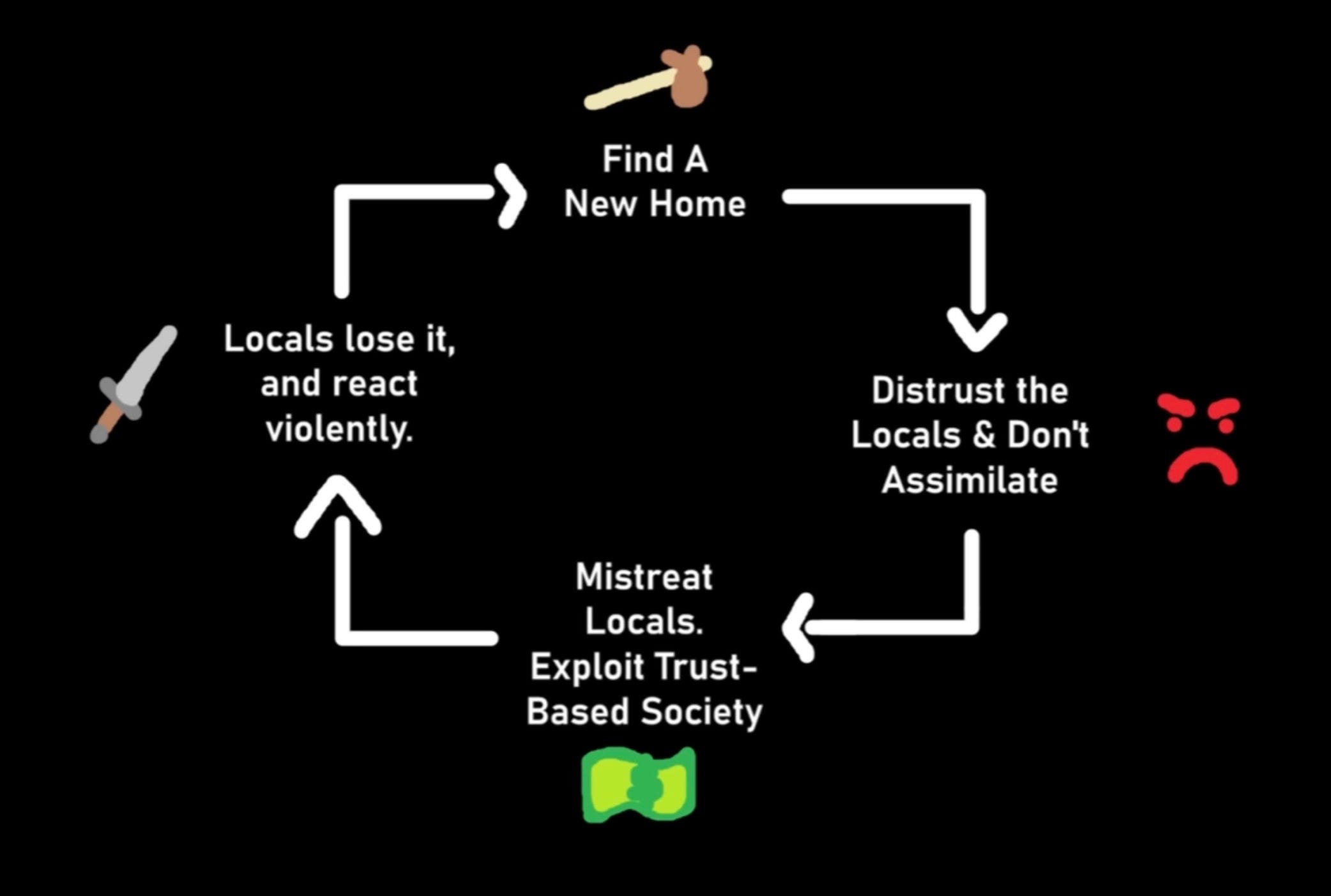
Those strong internal connections within market-dominant minorities can be very much a two-edged sword. Whatever role capital plays in all this, it is very much derivative of the underlying dynamics of human action: especially of information and normative landscapes.
Misleading our focus
The terms capitalism and capitalist direct our attention to capital: a factor of production in mainstream Economics and a form of property in Marxian Theory. That the same terms can be based on such different conceptions of the world should give us pause.
This is especially so given the very different emotional salience of the usages. In her book The Virtue Hoarders, the author talks of efforts against capitalism and its deeply destructive system of exploitation and rent seeking. Deeply destructive compared to what? The level of exploitation and rent-seeking were much worse in societies before the energy take-off; in non-commercial state societies—and especially—in all the ostentatiously post-capitalist Party-state polities. Besides, who are more relentless, and ruthless, virtue-hoarders than the Party elites in Communist societies?
This is mythic capitalism. It is not a judgement based on an accurate grasp of historical patterns. But that is not what such judgements are about. They are about judging existing society—framed in a very particular way—against an imagined future that has never occurred anywhere and which every attempt to create has been various levels of dreadful failure.
Alas, such an imagined future has two huge advantages. It can be as perfect as one wants and gives adherents a sense of moral and cognitive grandeur—indeed, of moral heroism—with minimal effort or sacrifice. This is a deeply flattering conception of the possibilities for rightful human action based on a thorough flattening of the complexities of human social dynamics; especially when it elides the role and dynamics of states in structuring societies (including our own). After all, the entire point of all forms of socialist politics is to get control of the state so as to restructure society.
The sense of moral and cognitive grandeur of the politics of the imagined glorious future can be highly motivating. It thus generates both zealots and fellow-travellers. When it generates effective status games, it motivates folk who may well have no idea how much they are fellow-travellers—or to what—while they provide very useful social cover and insulation for the zealots.
Misleading uses of capitalism and capitalist are very much part of this game. Take over the resources (especially the capital), have good intentions, everything else will follow. The repeated disasters in trying to create post “capitalist” societies and policies flow directly from impoverished analysis of social and economic dynamics. The fundamentally misdirecting nature of the terms capitalism and capitalist do much of the work. Nor can this problem be fixed by insisting on “correct” usages because focusing on capital is never going to be correct analysis of the relevant social dynamics.
Obscuring human agency
But much of mainstream Economics can also be profoundly flattening of human action and dynamics. It is why mainstream Economics is regularly so poor at analysing immigration.
As mainstream Economics does not have a robust understanding of long-term economic growth, it cannot identify the variables relevant to analysing immigration, even just in terms of economic impact, given that importing people affects every aspect of a society. Beirut was “the Paris of the Middle East” until mass Palestinian immigration put an end to that. Now, Paris is becoming the Beirut of Europe as a consequence of multi-generational Muslim immigration. Immigrants make the society they come to more like the society they left, especially when imported in “large lumps”.
The use of the Cobb-Douglas production function as a basis for economic growth models is an analytical flattening of human action. Reliance on such production functions is why mainstream Economics has failed to generate a robust theory of long-term economic growth.
The most common version of Cobb-Douglas production function is:

where Y is the total production output, L is the labour input, K is the capital input, A is total factor productivity,

is the labour elasticity of output

and is the capital elasticity of output.
This production function is pretending to be something like equations from Physics, such as force = mass x acceleration (f=ma) or e=mc2. It is nothing of the kind.
Such production functions attempt to turn people into interchangeable social particles as a basis for a Social Physics. People become interchangeable GDP-producing bio-widgets: the fundamental nonsense at the heart of much mainstream analysis of immigration. (The other nonsense is that immigrants become the only Homo sapiens in human history who cannot make things worse for others: or, if they do, it is because of some other policy failure that has nothing to do with immigrants.)
Yes, production is a result of the use of the factors of production, but it is the result of creation of capital and its coordinated and successful use with labour (and land). Humans vary enormously in their propensity to create and use capital, let alone to coordinate across factors of production and manage risk. The attempt to add entrepreneurship as a factor of production is a nod in that direction without actually covering the normative and information landscape within which human act.
Acknowledging the importance of institutions in understanding patterns of long-term economic growth is a step in the right direction, but it is nowhere near enough. Institutions do not, in themselves, provide even close to a full map of the information and normative landscapes of human action. Institutions depend quite directly on what norms people have and apply for how, and how well, they function.
Economists tend to over-state the importance of formal property rights due to not taking operative conventions—so normative patterns—within societies sufficiently seriously. The People’s Republic of China began its post-1978 commercial take-off well before it legally recognised commercial property rights; legal recognition which was a drawn-out process.
Culture matters deeply: formally similar institutions and organisations will function quite differently in different cultural contexts because the people both inside those institutions, and interacting with them, will behave quite differently depending on their cognitive and normative framings that differ—often dramatically—across cultures. The liberal sensibility, for instance, is very much a cultural artefact.
We are biological beings who use information and resources to maintain ourselves and seek to achieve our purposes. Production at scale is a profoundly cooperative activity. Us having normative capacity enables more robust cooperation, provided we are operating on the basis of sufficiently shared norms. Levels of pro-social cooperation are not remotely evenly spread across, within, or between human populations.
Where are risk profiles in a Cobb-Douglas (or any) production function? Where is the information landscape in any production function? Where are norms and cognitive framings in any production function? Coordination is itself an information and feedback problem that works so much better when people have, not only shared cognitive framing and norms, but cognitive framings and norms that are conducive to commercial vitality and pro-social interactions.
The information landscape—interacting with your goals and physical circumstances—generates the patterns of risk you have to navigate, as what information you do, or do not have is fundamental to risk. The very notion of risk is about being purposeful beings, for without purpose, there is no risk—there is no grading of good and bad outcomes. Only a purposeful being can have preferences.
Risk is quite fundamentally the interaction between purposes and information. Knightian uncertainty is where there is not enough information to calculate risk, while certainty means no new information can change outcomes. Risk is the information range between the two information poles of certainty and Knightian uncertainty. Every one of our actions entails an implicit, or explicit, risk judgement.
Precisely because we are purposeful beings using resources and information, and there is no information from the future, the operation of commerce is profoundly moulded by risk management. But, then, so are the patterns of foragers; of peasant farmers; of … If you abstract away from risk and its management, you abstract away from effective explanation of economic patterns and outcomes.
A production function is a fancier labour theory of value. Instead of a labour theory of value that presumptively assumes successful production, we get a labour+capital theory of value that takes successful direction of labour and capital to production (i.e. value) for granted—it as a function of the level of capital, labour and productivity—and abstracts away from all the information landscape complexities and difficulties that precede and surround such. This includes the coordination difficulties that arise from, for example, not sharing norms or from norms that are not sufficiently prosocial.
The real dynamics of economic growth—and especially long-term economic growth—are about human agency. It is that human agency that creates capital, or does not, and to what degree: that uses it well, or not, and to what degree. Agency that uses information and resources to fulfil purposes and shared norms and cognitive framings to be resiliently productive (or not).
It is human agency that operates in highly variable ways such that people cannot be reduced to interchangeable social particles. Skills, networks, cognitive framings; these all matter deeply precisely—and vary enormously—because it is all about human agency. It is all about biological beings that use resources and information to fulfil their purposes.
A Cobb-Douglas production function does not, in fact, describe a deep structure of social reality. Output per worker has not converged across countries precisely because of human variability, because people are not interchangeable social “particles”; because information landscapes matter; because norms and cognitive framings matter. The so-called Solow residual—the bit after labour and capital accumulation—is not nearly analytically sufficient.
Poorer countries with high saving rates have tended to converge in their living standards with richer one. Saving rates, however, vary greatly between countries and groups because of deeper economic and social structures and judgements about risk.
Such would-be Social Physics production functions are not science. They are Potemkin science, with the surface-maintaining scaffolding, but not the substance. It is not at all surprising that mainstream Economics still does not have a robust understanding of long-term economic growth.
What passes itself off as social “science” is useful when it identifies mechanisms—e.g., gains from trade, comparative advantage, transaction costs, opportunity cost, social networks, stereotype accuracy, IQ, OCEAN/HEXACO, and CBT. Attempting to then create Theory on top typically fails, and can fail toxically, as people use false or inadequate Theory to curate their information flows—to preserve their cognitive “assets”. This regularly includes using Theory to curate what they count as evidence and how evidence is used.
The failed analytical arrogance of such Theory has done much to create historically illiterate Western elites displaying remarkable levels of cognitive/epistemic closure. Hence we end up with institutionalised stupidity in Dietrich Boenhoffer’s sense of stupidity.
The failure of social “science” has been the failure to embrace the consilience with more fundamental structures of reality that is fundamental to science: specifically, that everything social is emergent from the biological. Mainstream Economics has not stopped to consider:
We are dealing with biological beings: what does that imply?
We are dealing with Homo sapiens, what does that imply?
The social is emergent from the biological, what does that imply?
We have normative capacity but wildly variable norms, what does that imply?
We are cultural beings, what does that imply?
Life, and its manifestations, are in a constant struggle against entropy, what does that imply? (That, among other things, we should pay more attention to resilience.)
Production functions are bad modelling of economic activity. Where does mathematical modelling in mainstream Economics go wrong? Largely from ignoring biological constraints:
That perception costs, so is economised on: thus we always have incomplete information.
That cognition costs, so is economised on: thus we do not calculate all possibilities at all times.
That threats and opportunities constantly shift, so (given the preceding constraints) we satisfice, we do not maximise.
That we are genetic beings, so are not interchangeable social “particles” due to differences in distribution of genetic traits between and within human groups.
That we are normative-cultural beings, so have different framings and norms such that the same circumstances can generate different behaviours, because different cognitive framings applied to circumstances change the incentives and norms only coordinate robustly when they are shared.
In other words, this analytical flattening works by assuming away so much of what makes us human, rather than mathematically convenient abstractions.
At best, production functions map the patterns of success, they do not explain it.
In conclusion
The dynamics of capital are both emergent and variable; commerce is about a great deal more than capital and its use; states are not mere reflections of the economic or social system but fundamental structuring elements thereof. Those societies we can reasonably describe as mercantile are so for much wider reasons than “capital”.
We should stop using the terms capitalism and capitalist. They greatly mislead. They badly distort our thinking; our understanding of social dynamics; of human dynamics; of human agency; of what it is to be biological beings using information and resources to fulfil our purposes and shared norms to cooperate (or not).
References
Peter L. Bernstein, Against the Gods: The Remarkable Story of Risk, John Wiley & Sons, [1996] 1998.
Cristina Bicchieri, The Grammar of Society: The Nature and Dynamics of Social Norms, Cambridge University Press, 2006.
Cristina Bicchieri, Norms in the Wild: How to Diagnose, Measure and Change Social Norms, Oxford University Press, 2017.
Liam Brunt & Edmund Cannon, ‘A grain of truth in medieval interest rates? Re-examining the McCloskey-Nash hypothesis,’ (1999). https://www.researchgate.net/publication/228434881_A_grain_of_truth_in_medieval_interest_rates_Re-examining_the_McCloskey-Nash_hypothesis
Satyajit Chatterjee, ‘A theory of asset price booms and busts and the uncertain return to innovation’, Business Review, Federal Reserve Bank of Philadelphia, 2011, issue Q4, 1-8. https://www.philadelphiafed.org/-/media/frbp/assets/economy/articles/business-review/2011/q4/brq411_theory-of-asset-price-booms-and-busts.pdf
Ronald Coase & Ning Wang, How China Became Capitalist, Palgrave Macmillan, 2013.
Gregory Cochran and Henry Harpending, The 10,000 year explosion : how civilization accelerated human evolution, Basic Books, [2009] 2010.
Herbert Gintis, Carel van Schaik, and Christopher Boehm, ‘Zoon Politikon: The Evolutionary Origins of Human Political Systems’, Current Anthropology, Volume 56, Number 3, June 2015, 327-353. https://pubmed.ncbi.nlm.nih.gov/29581024/
Mark Granovetter, ‘The Strength of Weak Ties: A Network Theory Revisited,’ Sociological Theory, Vol.1, 1983, 201-233. https://www.csc2.ncsu.edu/faculty/mpsingh/local/Social/f15/wrap/readings/Granovetter-revisited.pdf
F. A. Hayek, ‘The Use of Knowledge in Society,’ American Economic Review, Sep. 1945, XXXV, No. 4, 519-30. https://statisticaleconomics.org/wp-content/uploads/2013/03/the_use_of_knowledge_in_society_-_hayek.pdf
Garett Jones, The Culture Transplant: How Migrants Make the Economies They Move To a Lot Like the Ones They Left, Stanford University Press, 2023.
Arnold Kling and Nick Schulz, Invisible Wealth: The Hidden Story of How Markets Work, Encounter Books, [2009] 2011.
Frank H. Knight, Risk, Uncertainty and Profit, Cosimo, [1921] 2005.
Meir Kohn, ‘An Alternative Theoretical Framework for Economics,’ Cato Journal, Vol. 41, No. 3 (Fall 2021). https://www.cato.org/cato-journal/fall-2021/alternative-theoretical-framework-economics
Arthur Lewis, ‘Economic Development with Unlimited Supplies of Labour,’ The Manchester School, May 1954. https://la.utexas.edu/users/hcleaver/368/368lewistable.pdf
Michael Lynch, ‘Mutation and Human Exceptionalism: Our Future Genetic Load,’ Genetics, March 2016, Vol. 202, 869–875. https://academic.oup.com/genetics/article/202/3/869/5930150
D. N. McCloskey and John Nash, ‘Corn at Interest: The Extent and Cost of Grain Storage in Medieval England‘, The American Economic Review, Vol. 74, No. 1 (Mar., 1984), 174-187. https://www.jstor.org/stable/1803317
D. N. McCloskey, ‘The Open Fields of England: rent, risk, and the rate of interest, 1300-1815,’ in David W. Galenson (ed.), Markets in history: Economic studies of the past, Cambridge University Press, 1989.
Xavier Marquez, ‘A Model of Cults of Personality,’ APSA 2013 Annual Meeting Paper, Last revised: 26 Aug 2013. https://www.academia.edu/4205457/A_Model_of_Cults_of_Personality
Xavier Marquez, ‘Two Models of Political Leader Cults: Propaganda and Ritual,’ Politics, Religion, & Ideology, Volume 19, Issue 3, 2018, 265-285. https://papers.ssrn.com/sol3/papers.cfm?abstract_id=3208495
Joram Mayshar, Omer Moav, Zvika Neeman, ‘Geography, Transparency, and Institutions,’ American Political Science Review, June 2017, 111, 3. 622-636. https://warwick.ac.uk/fac/soc/economics/research/workingpapers/2016/twerp_1129_moav.pdf
Joram Mayshar, Omer Moav, Luigi Pascali, ‘The Origin of the State: Land Productivity or Appropriability?,’Journal of Political Economy, April 2022, 130, 1091-1144.
Nathan Nunn, ‘Culture And The Historical Process,’ NBER Working Paper 17869, February 2012. http://www.nber.org/papers/w17869
Mancur Olson, The Logic of Collective Action: Public Goods and the Theory of Groups, Harvard University Press, [1965] 1982.
Mancur Olson, The Rise and Decline of Nations: Economic Growth, Stagflation and Social Rigidities, Yale University Press, 1982.
Mancur Olson, Power and Prosperity: Outgrowing Communist and Capitalist Dictatorships, Basic Books, 2000.
Yingyi Qian, ‘How Reform Worked in China,’ William Davidson Working Paper, Number 473, June 2002. https://papers.ssrn.com/sol3/papers.cfm?abstract_id=317460
James C. Scott, Seeing Like a State: How Certain Schemes to Improve the Human Condition Have Failed, Yale University Press, 1998.
James C. Scott, Against the Grain: A Deep History of the Earliest States, Yale University Press, 2017.
Chenggang Xu, ‘The Fundamental Institutions of China’s Reforms and Development’, Journal of Economic Literature, 2011, 49:4, 1076–1151. https://www.researchgate.net/publication/227363166_The_Fundamental_Institutions_of_China’s_Reforms_and_Development
The Brazilian election offers up an interesting contrast. The system vast in size (over half a million voting machines used and over four million public servants drafted to work on a Sunday) is entirely centralized, entirely digitalized, leaves no physical ballots to audit, and was built for speed. It is a masterwork of automation. Yet, it is exactly this degree of technical complexity - of which the public has very little if no access to - that is invoked as evidence of its invulnerability to fraud. But all that´s needed, on account of its automation and technical perfection, is a handful of technicians at the very top, to generate whatever result is desired from the people responsible for running it. Now, from the very beginning (1992) the INSTITUTIONAL ASSUMPTION behind this whole monstrosity was that the people responsible for running it would never, ever, have some overriding interest in assuring that one election result prevails over another, much less could they count on the collaboration of the technicians who actually make it run. But this assumption HAS IMPLODED. So many of the judges who run it have been implicated in some of the most absurd corruption allegations imaginable. Certainly many of the career technicians involved, if not actually willing participants, know the risks of telling the truth nowadays. So it is even plausible that the election was fixed WITHOUT ANY PRIOR KNOWLEDGE ON THE PART OF THE SO-CALLED WINNER, Presidente Lula. This would probably be a first in human history.
During my career in aerospace manufacturing and IT I came to recognize that "manufacturing" was essentially the application of informtion to the manipulation of materials to make the goods used directly or in support of providing services. This applied equally to the design parameters and to the process factors and criteria used on the factory floor.
Initially I was biased to believe that the "engineers" were the core source of valid and valuable information [i.e., the real value adders]. As I learned more about business and corporate behavior, I learned that many administrative functions were also needed to bring that engineering wonderfulness to full profitable fruition. Functions as as security, facilities, procurement, HR, legal, Health Dept., sales and marketing, etc., also played a role in rolling out a product to our market.
I gather from this essay you are suggesting the information contribution from those various functions, along with the those from the wider society (norms, laws), should have been factored into my thinking in this area. And that we should not forget those "mercantile" activities that do not involve much in the way of material manipulation, but still require substantial information management as part of their value in the marketplace: such as investment advice and services, legal services, insurance, much of medical services, real estate and other brokerage services, etc.
I will add I presume your discussion of strategy and risk assessment (as elements of information and knowledge - and wisdom?) also falls into the role of "management", the bug a boo of the Occupy Wallstreeters and many others, but a critical function that "someone" has to do (even if they are overpaid for doing so, as suitable analytical talent probably can be found in a much wider group of people than just those who make it to the top). Then again, actual pricing for those services suggests supply is limited compared to the demand.
I guess I would summarize your set of essays as a need for us to refocus "economics" as the older version previously called "political economy". [See also Jon Guze's comment. :-) ]