

The first post in this series on using evolutionary reasoning discussed pitfalls of evolutionary reasoning and advanced 42 propositions about human tool use, cooperation and mating patterns. The second post advanced another 78 propositions on norms, language, prestige, propriety, social aggression, diet, religion, and murdering our way to niceness. The third post was an interlude post on the role of niches in human societies, including the pattern of imperial demographic booms and social order busts. The fourth post advanced a further 90 propositions on the rise of states, culture, cognitive dimorphism, and mass production. The fifth post examined how the failure to accept the constraint that everything social is emergent from the biological means that much of social “science” is not, in fact, science.
In this sixth and concluding post, I draw some implications from propositions in the previous posts.
When men and women started working together far more in offices and professional capacities, we had to have a public conversation about bad male behaviour. No, you cannot pinch female bottoms, nor leer at female colleagues. Yes, you do have to keep your dick in your pants.
Laws were changed, some men were charged, some men went to gaol. We now need to have more such public conversations, but this time about bad or dysfunctional female behaviour. Doing so runs up against the apparently endless war on noticing that left-progressives have been waging for decades; a war that has been incorporated into various elite status games disseminated from our deeply dysfunctional universities.
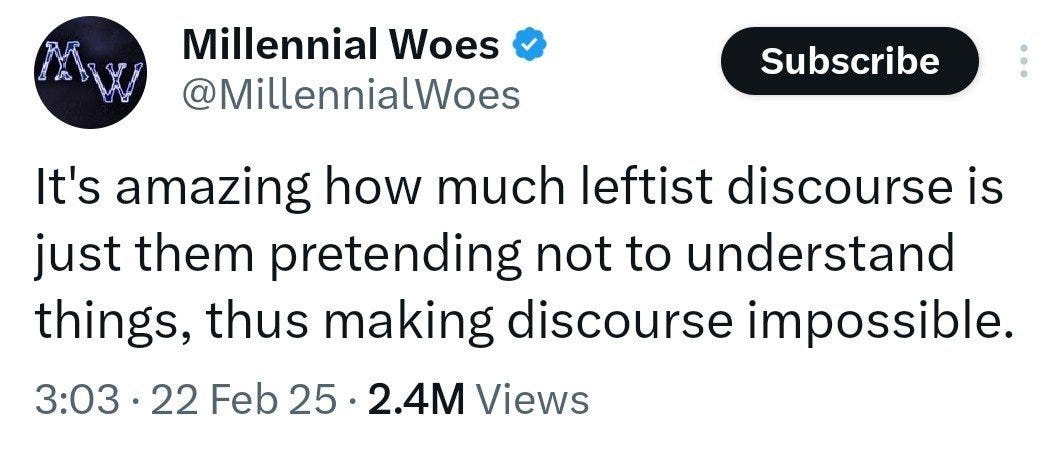
The core claim that so much of the war-on-noticing exists to protect is that either (1) there are no differences in the distribution of genetic and other traits between human groups or (2) any such differences have no causal role in differences in social outcomes. This includes the claim that there are no innate differences, or different tendencies, between men and women that might generate significant differences in social outcomes. In fact, people’s stereotypes about differences between men and women tend to be highly accurate: unsurprising, in that we have a lot of experience with each other. In the words of a recent review study:
By an overwhelming margin (85% of 673 comparisons), judges across the studies providing direct comparisons were correct about the direction of gender differences. Furthermore, three distinct kinds of sensitivity correlations, which correlated estimates with criteria, were positive, indicating an impressive degree of accuracy.
This core claim of no difference in the distribution of genetic and other traits between human groups then allows the not-noticers to morally judge differences in social outcomes between human groups as reliable indicators of intentional or structural maleficent disadvantage if groups do better and advantage if groups do well. This is the always-looking-for-kulaks principle.
The factual claim is false and so, therefore, is the moral conclusion inferred from it. But it is a very simple moral system to operate and—even better—to use to make claims to moral authority and on resources to “fix” the problem. The alleged goal can never be achieved—as it is a false picture of human and social reality—but that very falsity is an advantage, for its impossibility of achievement means that its claims on resources can go on indefinitely.
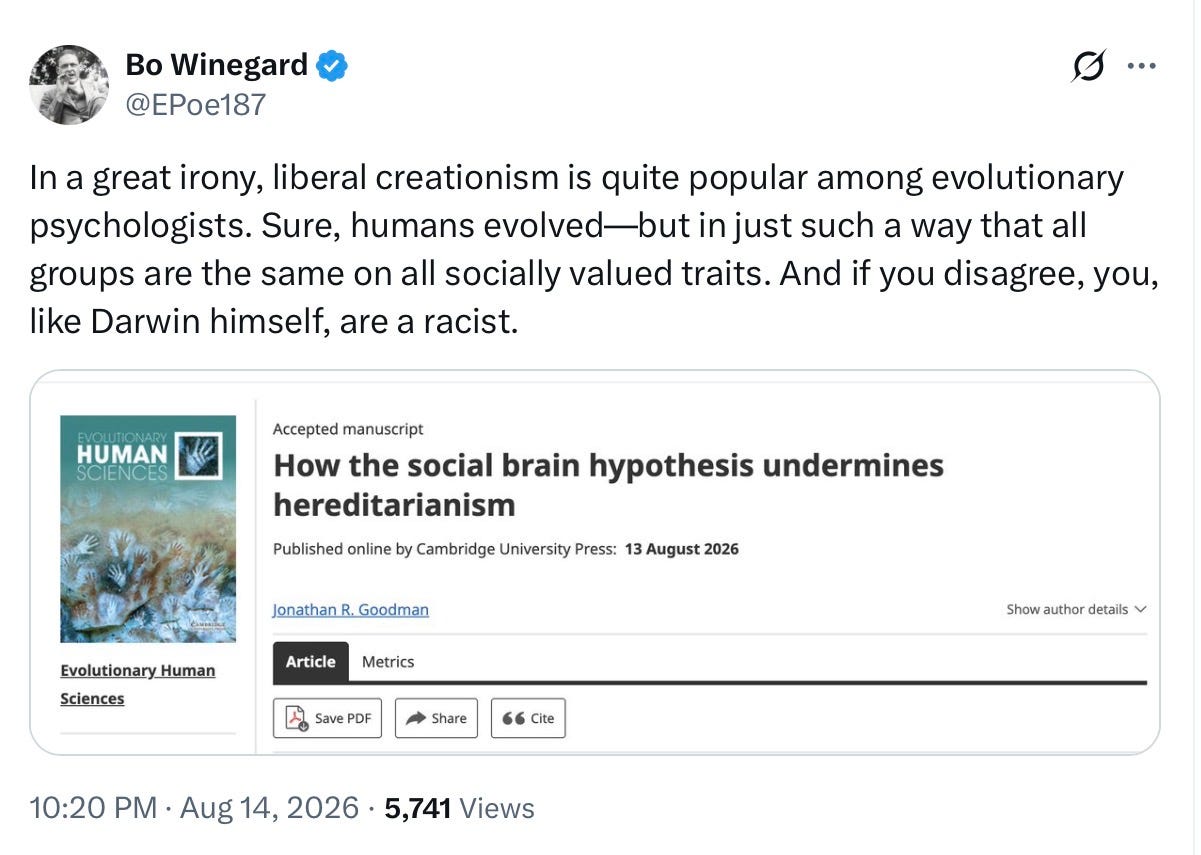
This structure of not-noticing requires systematic processes of moral intimidation to be successfully spread through institutions. Such social imperialism is made so much more effective by shunning and shaming tactics being mobilised to enforce the required moral intimidation.
The status games involved use network effects—there is more benefit to belonging, the larger the network playing correct-belief-makes-you-a-sound-person status games and the larger the network, the cheaper it is to add an extra person. The more people committed to believing X makes you a good person, the more people are committed to believing not-X makes you a bad one. You then get shunning and shaming behaviour in order to signal commitment to the shared status game and to protect the sense of being a good person by believing X. This is a key social dynamic of the “long march through the institutions”.
Social media provides the technology to strongly increase the social signalling and the shunning and shaming that moralises disagreement in service of shared status games. To put it another way, social media upscales social/relational aggression that attacks people’s social standing on the basis of ostentatious moral or social concern.
Because believing X is such performative way of grading people, believing-X makes you a good person creates purity-spirals as people up-the-ante to make their signal—their moral piety display—more salient and reduce competition for positions. It also attracts and empowers the personality disordered—specifically Cluster B’s—as believing-X makes you a good person requires so little to join the status game and advantages those who are manipulatively unrestrained. In other words, it acts as a negative character test, that selects for people of bad moral character.
The inability to admit ever being wrong goes with the moralising of disagreement and identity-through-belief.
Social media does not enable the up-scaling of physical aggression, although it does enable the transmission of threats of such. By contrast, social media—with its electronic mobbing—is a very effective medium for emotional or relational aggression. As women, the physically weaker sex, are particularly inclined to be quite protectively self-deceptive about their own aggression—it is “just” moral or social concern—that leads to both intense aggression and denial of its existence: “there is no such thing as cancel culture”/“it is just a shift in moral, in social, concern”.
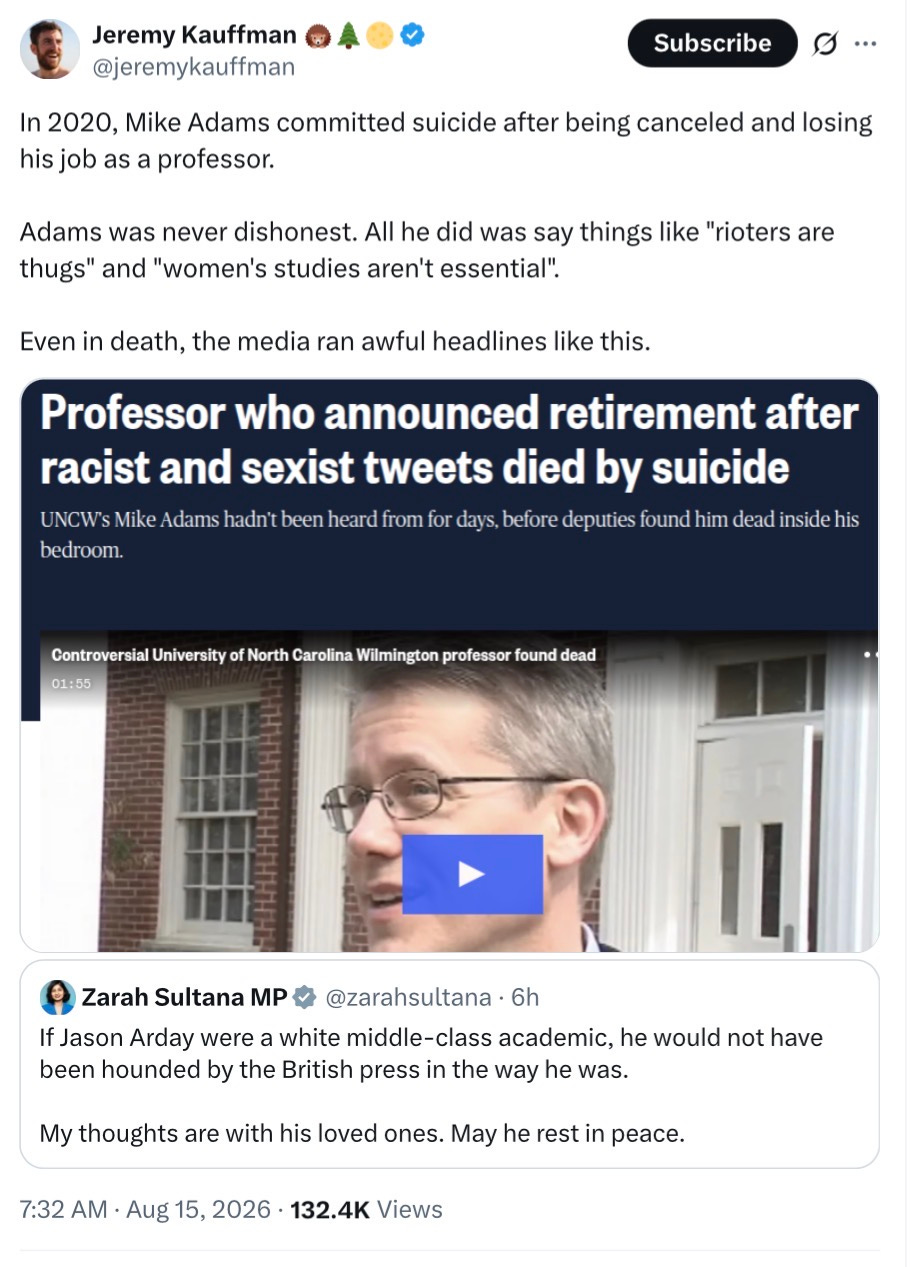
Social media can be particularly toxic for adolescent girls. Adolescents often lack a settled or robust sense of self, tend to be very wrapped up in how other people see them, and have a weak sense of their effect on others. All this is even more so for people-focused adolescent girls, who are both particularly prone to engage in—and be vulnerable to—emotional or relational aggression and to seek socially-protective identities. It is plausible that growing up with the excesses of social media increases support for control of speech, including making hate speech a live issue.
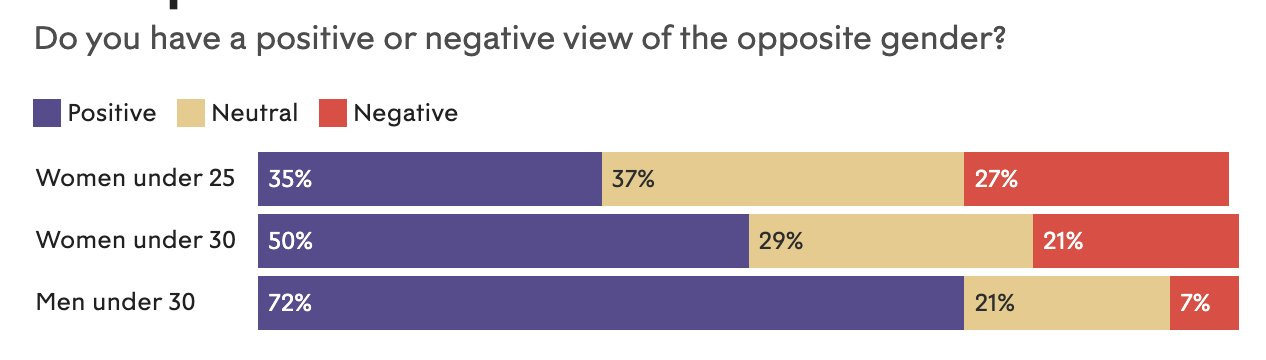
More things-focused boys are much more likely to retreat into playing games (both online or physical games) or some other physical activity. The greater female focus on people makes adolescent girls more vulnerable to social media-generated aggression, identity confusion and comforting cognitive refuges and conformism; the greater male focus on things creates a divergence between young male and female perspectives, aggravated by the strong female social preference for other females.
Due to strong, even at times intense, sex-differentiated selection pressures, in human evolution, human males are systematically better at forming and operating teams than women. Among women, it is the most masculinised personalities—lesbians and tomboys—who tend to be better at teams and teamwork, though they are still generally not as good at it as men.
The operating principle is that men are more likely to suppress their emotions to perform their designated role (in a team, in an organisation). Women are more likely to subordinate their designated role (in a team, in an organisation) to their emotions. Hence, for example, women and girls are more likely to be aggressive towards fellow team members during a game than are men and boys. Hence also—as we will see—male-dominated institutions have been better at catering for women and girls than female-dominated institutions have been at catering for men and boys.
It is not strength difference that leads schoolboy teams to regularly beat women’s national sporting teams. From adolescence on, boys and men are systematically stronger than girls and women of the same age: but even a fit 14 year old boy is not likely to be stronger than a fit, athletic 21 year old sportswoman. It is difference in male and female cognitive and behaviour patterns that leads to teenage boys sporting teams beating national women’s teams.
Institutions—to be functional—generally have to been scaled-up teams. That women are systematically worse at teams than men means that the feminisation of institutions and organisations tends to degrade their functionality. For example, female “emotions-as-threat” tone-policing makes it harder to generate trust, as people curate their interactions. Men and boys make outrageous jokes and rib and insult each other to test whether the others will fold under pressure. The social flattening of tone policing generates much more uncertainty, because it produces far less revealing information, so less trust.
The more differences of opinion are seen as threat, insult or moral failure, the more destructively conformist the institution or organisation is likely to be. This both acts to block feedback and enable the entrenchment of structures of conformist not-noticing.
One way out of this is to have strong standards in favour of truth and robust use of evidence. This, in turn, requires willingness to enforce such standards, which many women find emotionally confronting to do, as they are far more primed to read emotions as threat. Retreating from enforcing standards and boundaries on the grounds of being “inclusive” gives emotional—and so moral—cowardice a warm inner glow via a patina of self-righteousness. An emotionally-comforting retreat from enforcing standards then aids the entrenchment of emotionally-comforting opinion conformities.
That women tend to be self-deceptive about their own aggression—passing it off as moral or social concern—can be highly corrosive to the internal operation of an organisation or institution. In particular, it can be an effective way to block inconvenient information or concerns. All of this makes an information-restricting conformity likely to develop, and become entrenched, within an organisation as it becomes more female-dominated while making it less functional in enforcing standards, so delivering services.
Women are much less likely than men to have friends of lower socio-economic standing—as those of lower social standing are generally not a good social return on the emotional investment that female friendships are based on. Given the biological expense of human children, focusing on getting a good social return for one’s emotional investment was a successful reproductive advantage. For more team-oriented men, one never knows when someone of lower socio-economic status might be useful on your team.
Feminisation—that is, the increasing pervasiveness of more female-typical behaviour patterns—thus raises issues of weakening social solidarity. One of the striking things about contemporary Western societies is how little active concern that female university graduates show for people, including other women, of lower socio-economic status within their own societies. They have very little sense of how very different the experience of women in very different social milieus can be, and they do not socialise with such women to find out.
Britain provides an extreme example of this lack of social solidarity, in how little public outrage or concern the systematic rape and sexual exploitation of mainly working class girls by Muslim (mainly Pakistani) gangs has generated among female university graduates, who otherwise can go from zero to outrage in 280 characters. The willingness of such women to allow men who declare themselves to be women into women’s prisons, shelters and other spaces, is another example of women not being the social solidarity sex.
As men are far less likely to find women threatening than women are to find men threatening, and men focus more on things and performance of roles, women show far higher rates of social preference for other women than men do other men. It also means that, because women are typically more alert to other people’s emotions and see relationships in terms of emotional investment, that women tend to be systematically better at networking than men. This aids the feminisation of organisations, especially if male-only spaces are eliminated.
Men thus tend to be more socially inclusive, both across the sexes and across social levels, than do women. Conversely, an ostentatious commitment to “inclusivity” can be an excellent mechanism for not enforcing standards while insisting on opinion conformity. In other words, to greatly reduce actual social inclusiveness.
As previously noted in this series, this has led female-dominated organisations to be much worse at catering to what interests and engages men than male-dominated organisations have been a catering to what interests and engages women. We can see this in how female-dominating publishing has largely lost male readers of fiction; female-dominated Hollywood writers’ rooms have regularly lost male watchers of cinema and television; and female-dominated schooling and education has been catering worse and worse for male students.
Similarly, increasing domination of discourse (including media) and management by female university graduates—people who can now go from zero to outrage in 280 characters—coincided with the British state’s effective abandonment of working class boys in education and working class girls to so-called “grooming” gangs. The contrast with the public horror of Victorian Britain over the forced prostitution of poor girls is stark.
Conformist propriety enforced by patterns of stigmatisation lead to a situation where only approved empathy sends the correct social signals. Preserving the capacity to stigmatise inconvenient speech via moral abuse (racist! Islamophobe! transphobe!) is, by clear revealed preference, more a public concern for university-graduate career women as a group in Britain than mass rape and sexual exploitation of working class girls and women in their own society. Given this social and sexual exclusiveness, it is perhaps not so surprising that a 2015 survey found that only nine per cent of British women identified as feminist.
It is important not to romanticise either sex. The Mongols under Genghis Khan and the Waffen SS were excellent at creating effective teams. Bad male behaviour is often criminal and men overwhelmingly dominate violent crime (except against children) and male sexuality can get very dark. But both sexes are capable of toxic behaviour. With women, there are much more likely to be toxic cliques and networking, as we see in contemporary publishing. With men, you are much more likely to get toxic teams, as when police go bad and in criminal gangs.
Shifting constraints
Feminism is prone to misrepresenting history. What do all the legal advances women have achieved since the mid C19th have in common? Men voted for them. What do all the arguments about such advances have in common? There were men and women on both sides of each argument. The legislative and other efforts to restrain bad male behaviour as women moved into organisations occurred when Parliaments, legislatures and those organisations were still male-dominated.
The feminist claim or implication that this was somehow a men-versus-women story—that men were the oppressor class and women the oppressed class—is brain-rot pseudo-history. British Tommies going “over the top” into German machine-gun fire in the trench warfare on the 1914-1918 Western Front were being what young men have been across human history—the disposable sex. Human societies are complex interactions of cooperation and conflict and that very much includes relations and interactions between men and women.
The key element in the shifting cultural and legal status of women was that social constraints and opportunities massively shifted due to technological and organisational change. This absolutely led to a shift in bargaining power, but it also led to a shift in what social/life strategies made sense and both law and culture changed to reflect that. The fundamental pattern of human societies—the transfer of risks away from child-rearing and of resources to child-rearing—did not go away, it became expressed differently precisely because the constraints and opportunities changed so dramatically.
As economic historian Joel Mokyr points out, changes in constraints and opportunities lead to changes in culture through processes of social selection:
These three characteristics—variation, inheritability, and superfecundity—as Darwin showed, are sufficient to ensure that selection is adaptive: when there is a change in the environment, cultural traits tend to change through the retention of some and the elimination of other elements.
Joel Mokyr, A Culture of Growth: The Origins of the Modern Economy, Princeton University Press, 2017, p.25.
Cultural and legal change are interactive processes.
The gap in years between full adult male suffrage and female suffrage was remarkably short. In the case of the UK, the Act that finally brought in universal adult male suffrage was the same Act that introduced female suffrage.
The peeling away of legal and cultural limitations on women was very much part of the Emancipation Sequence where—in the Anglosphere—free people voted to liberate slaves, Christians voted to get rid of exclusions on Jews, Protestants voted to get rid of exclusions on Catholics, whites voted to get rid of exclusions on blacks, men voted to get rid of exclusions on women, straights voted to get rid of exclusions on gays and lesbians. This was the politics of bargaining and persuasion creating an ever-more expansive and egalitarian notion of citizenship.
While the “men oppressing women” caricature of history is feminist brain-rot, it is very useful feminist brain-rot. Everything can be blamed on “patriarchy”, according to the contemporary conception of “oppression” as “any constraint I don’t like”, so that women can never be responsible for anything bad. On the contrary, they must be endlessly “empowered” because, patriarchy.
This is a bullshit characterisation of contemporary Western societies, but that is irrelevant to the core uses of the concept. Acceptance of the demiurgic power of this mythical patriarchy that socially imprisons women both signals one’s soundness—that you are player of the shared status game in good standing—and justifies endless DEI income and authority, “empowering women” benefits, plus control of legitimacy in discourse, while shielding such moral paragons from responsibility for any failures or dysfunctions.
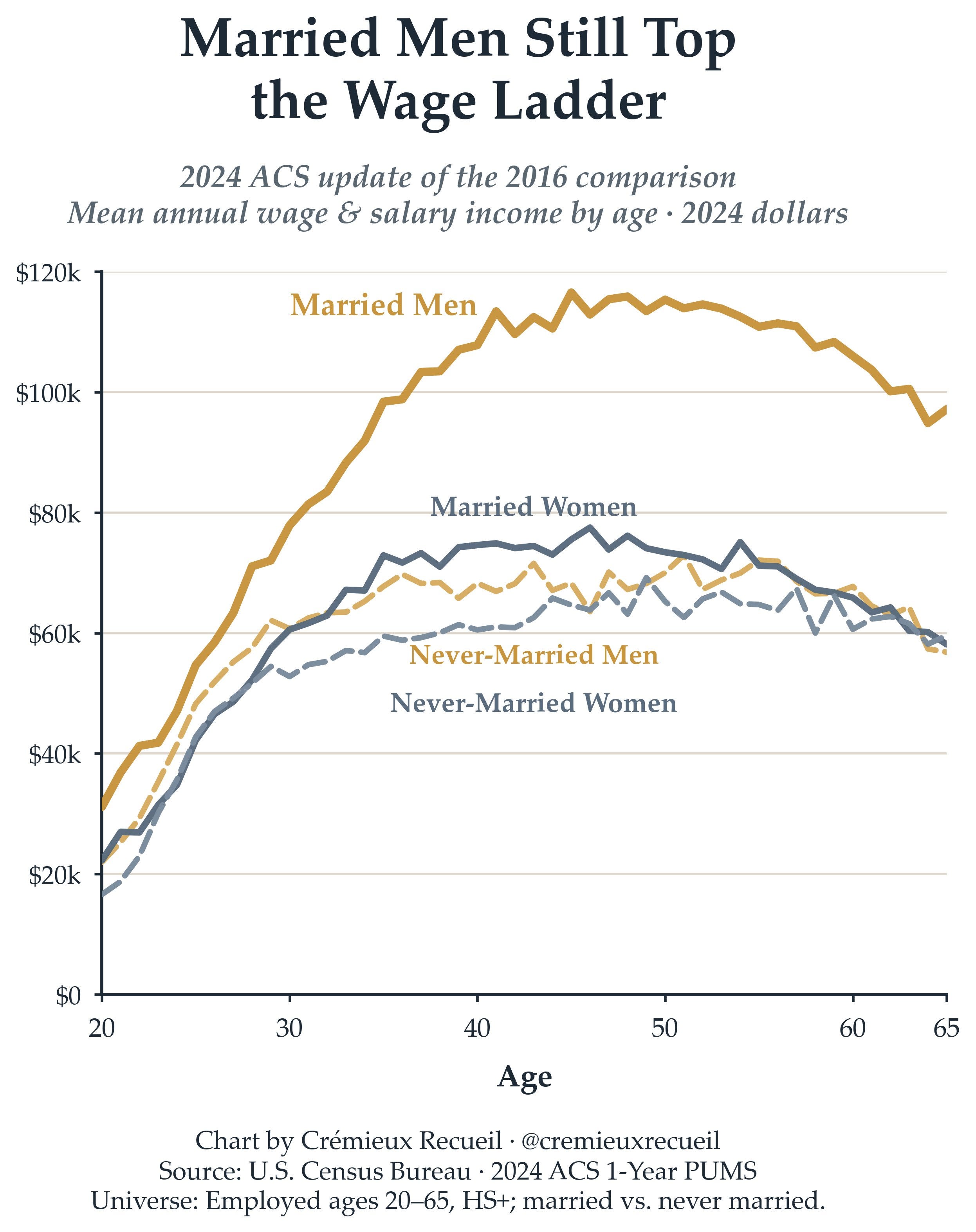
One feature of the way welfare states colonise their societies, is that the pattern of transferring resources to childrearing is now significantly parsed through the state: hence observations about welfare enabling women to “marry” the (welfare) state. As women are more likely to be employed in the public sector or on welfare than men, there are considerable transfers from tax-paying men to tax-paid women. This is done, however, without men gaining any acknowledgment or status from this.
What Substacker Anuradha Pandey nicely refers to as managerial class feminism is not at all keen on motherhood as an identity but tends to be very keen on undermining the status of fatherhood while working against men being able to signal fitness to be a father plus elevating female requirements for such fitness.
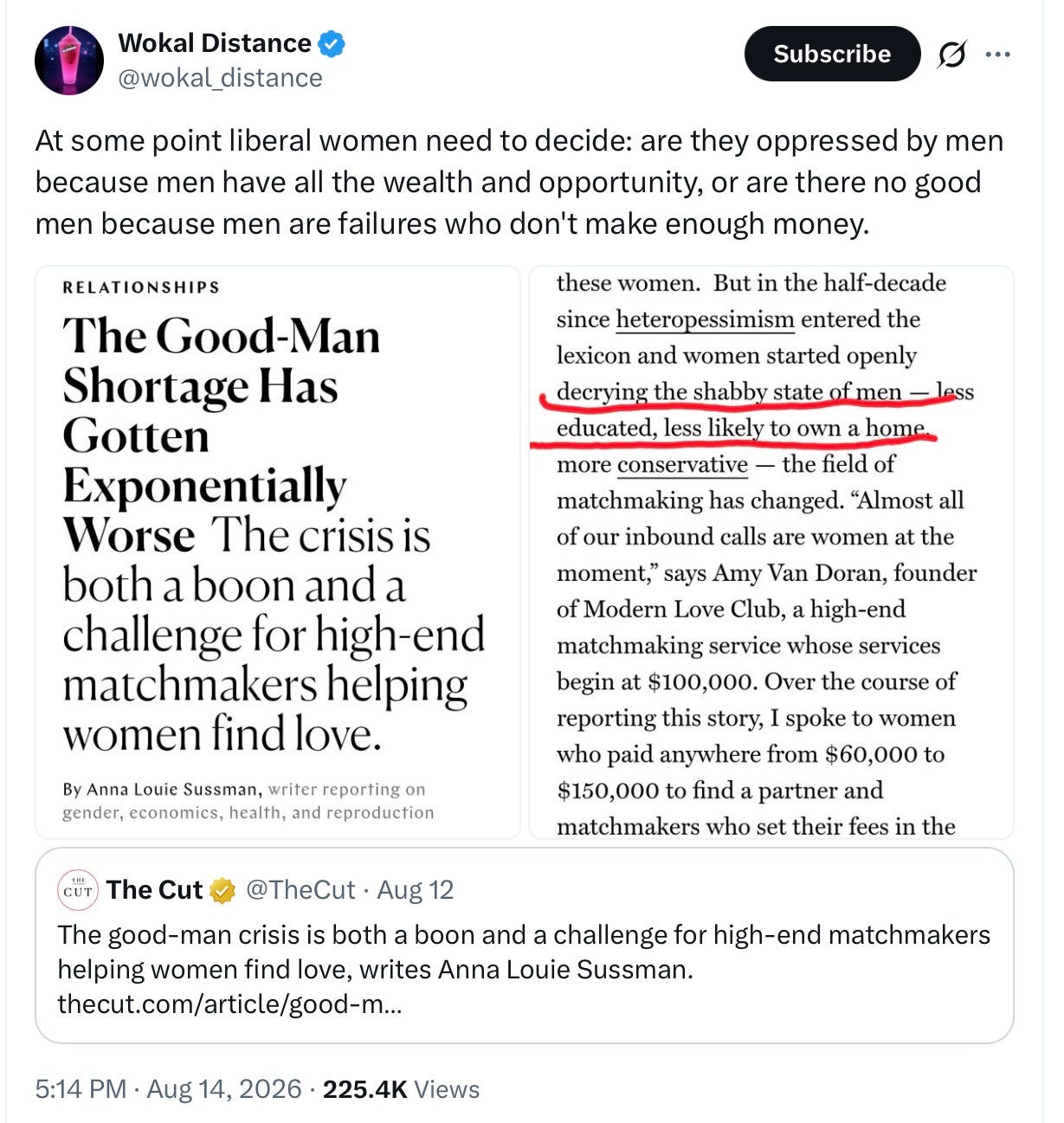
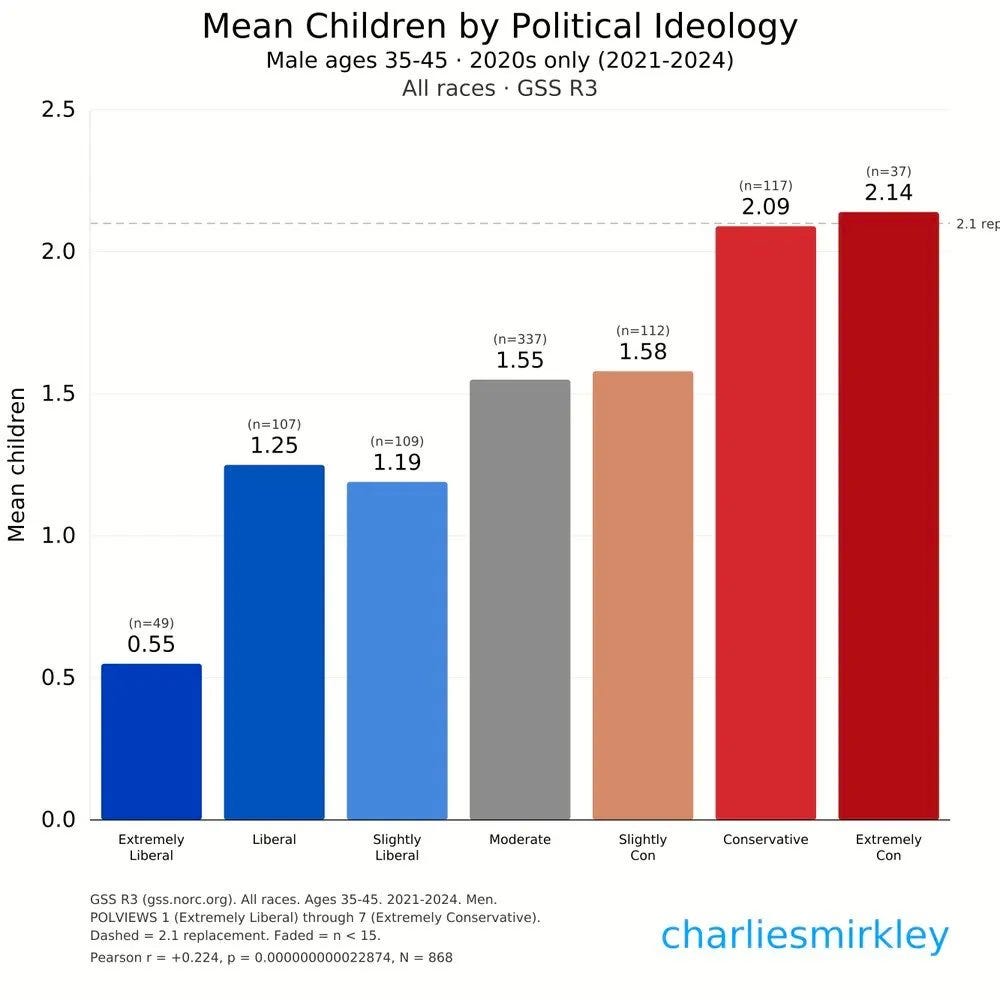
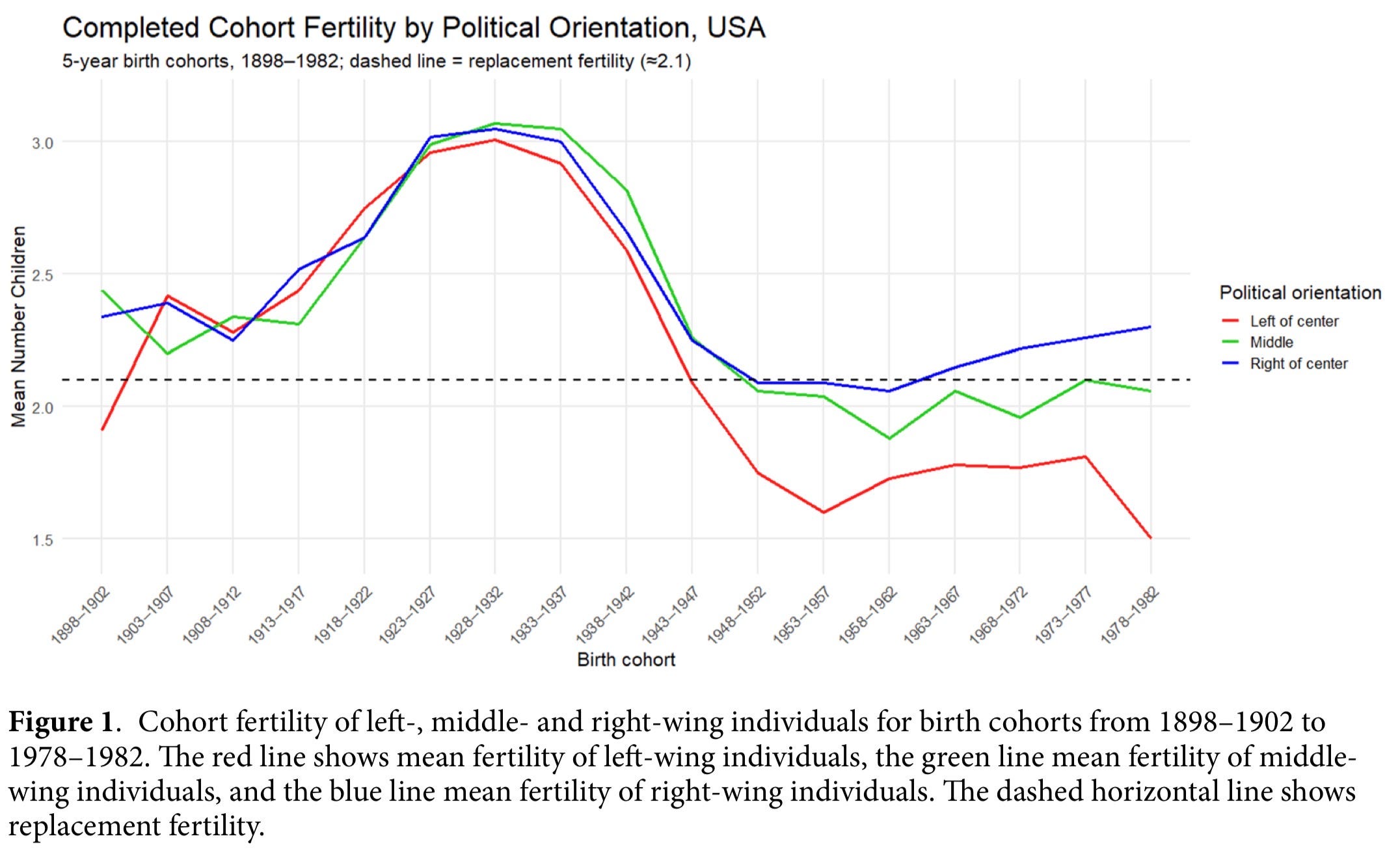
Left-progressive attacks on both the status of fatherhood and on the ability of men to signal fitness for fatherhood likely helps explain why fertility rates in the US are remarkably differentiated by politics.
A sexually dimorphic species
The big difference between the shifting status of women and the other stages in the Emancipation Sequence is that there are profound biological differences between men and women that had no equivalent across the other categories of legal and political exclusion. Along with men and women’s dramatic differences in reproductive roles, we are a size, shape, strength and cognitively dimorphic species. Of these four, size is the dimension on which we are least dimorphic.
The more maximalist feminist claims and aspirations became, the more committed to denying or belittling those differences between the sexes many feminists became. Hence the famous statement by Simone de Beauvoir:
One is not born, but rather becomes, a woman. (On ne naît pas femme: on le devient.)
Feminist biological denialism led directly to the profoundly biological-denialist politics of Transactivism.
Ironically, it was precisely the feminists most likely to draw profound moral distinctions between men and women—the radical feminists—who reacted most strongly against having men invade female spaces and identities via Trans “gender identity” turning being a woman into a purely cognitive identity, to which any biological markers were utterly subordinated. Visible biological markers were so subordinated to alleged cognitive identity that those markers were literally sacrificed by hormonal and surgical mutilation and sterilisation: including, in an utterly appalling evil, having children be so mutilated and sterilised.
It was also striking how many self-declared feminists were happy, even eager, to shame, to shun, to destroy the careers of, those—including women, including feminists—who stood up for biological realism. Alas, such vitriolic shaming and shunning was not in itself new, as it replicated patterns within the women’s movement going back decades.
Feminism—which largely operates as a coordinating mechanism for university-graduate career women—is prone to some revealing patterns. These include: writing violence against children out of the category of domestic violence; treating difficulties for women and girls, and for men and boys, as both being the fault of men and boys; assuming women are accurate about men but men are not accurate about women; being adverse to the notion of male wisdom; focusing on control of the legitimacy of discourse rather than problems affecting folk—even women and girls—further down the social scale; treating female-domination of areas of life (e.g. publishing) as unproblematic but male-domination areas (e.g. STEM) as deeply so; treating motherhood as subordinate to career and being hostile to female choices that do not prioritise career, thereby downgrading the archetypal female social role and functionally setting what men do as the benchmark for women; underestimating the significance of broad social dynamics (e.g. shifts in social bargaining power due to technological change); over-moralising social patterns and changes (e.g. blaming men for unequal bargaining power while refusing to acknowledge that all legal advances for women were voted for by men and that there women and men on both sides of each argument); and taking media effects theory way more seriously than evidence supports.
Feminist intolerance of inconvenient choices by other women could be very bluntly stated.
No woman should be authorized to stay at home to raise her children. Society should be totally different. Women should not have that choice, precisely because if there is such a choice, too many women will make that one. It is a way of forcing women in a certain direction.
‘A Dialogue with Simone de Beauvoir,’ in Betty Friedan, It Changed My Life: Writings on the Women’s Movement, Random House, 1976, p.397.
This intolerance also showed up in the intensely patronising and condescending take on why many women do not identify as feminist: “they do not understand their own interests”. Given the performance of so many British self-proclaimed feminists, perhaps the vast majority of British women who do not identify as feminist are making sound moral and social judgements.
Operationally, careerist or managerial feminism is clearly all about giving highly credentialed career women trumping moral and cognitive authority, and the claim on social niches and resources that flowed from such: to turn educational credentials into moral and cognitive credentials via a melding of doctrine and identity. It is a specific manifestation of the wider curse of managerialism.
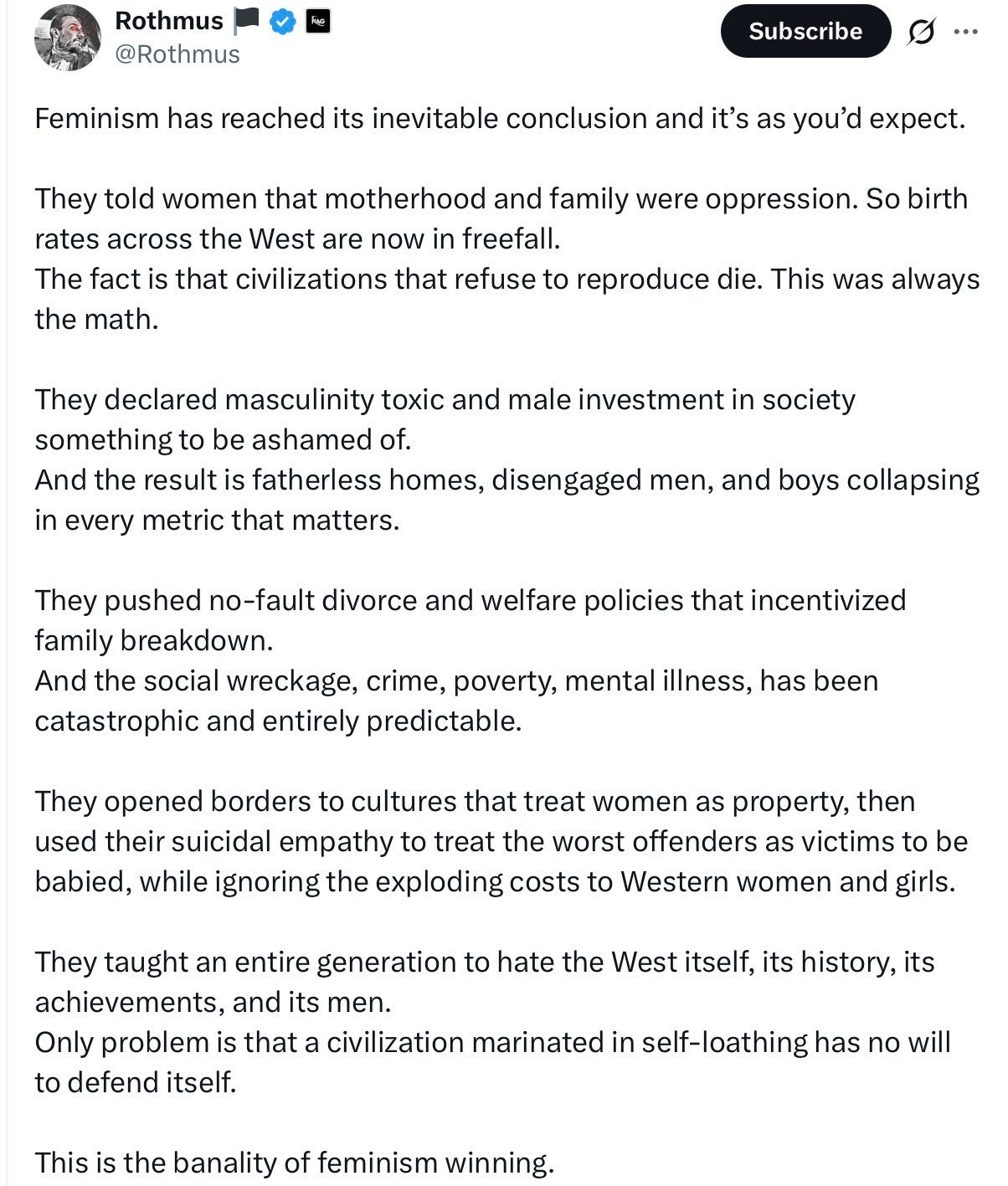
Folk are noticing. A particularly brutal comment is:
Feminism is the belief that women should have authority without accountability while men should have accountability without authority.
Evolutionary biologist Heather Heying notes demands to take, yet not give, among women.
In a similar vein:
While journalist and commentator Helen Andrews made quite a splash with her NatCon 5 presentation and Compact article, various folk are noticing and analysing the effect of feminisation on Western institutions. For example, here. The analytical metaphor of the longhouse has been around for quite some time.
The Karen memes (upper middle class women being entitled scolds); acronyms such as AWFLs (Affluent White Female Liberals); and critical commentary on progressive white women is, at least in part, this lack of social solidarity—yet willingness to publicly scold others—being noted and rebounding.
By seeking to retrospectively hijack the Emancipation Sequence of inclusion-through-persuasion by profoundly mis-characterising it as an oppressor/oppression, Conflict Theory narrative, left-progressivism does what it has a long history of doing: replace an encompassing citizenship with a moral caste system—so female is better than male; coloured is better than “white”; queer is better than straight; disabled is better than able-bodied; migrant is better than native; trans is better than cis. A moral caste system where left-progressives get to decide who does, and does not, have moral authority.
This very much goes with replacing the politics of bargaining and persuasion with the politics of error-has-no-rights and they can determine error.
The combination of replacing emotionally confronting-to-enforce standards and boundaries with emotionally-easy “inclusion” (what consumer psychologist Gad Saad calls suicidal empathy) and emotionally-confronting dissent with emotionally-comforting conformities—all enforced by networked social aggression passed off as moral and social concern—clearly disproportionately appeals to women. It gains strength through the feminisation of organisations, institutions and public discourse and the technology of social media.
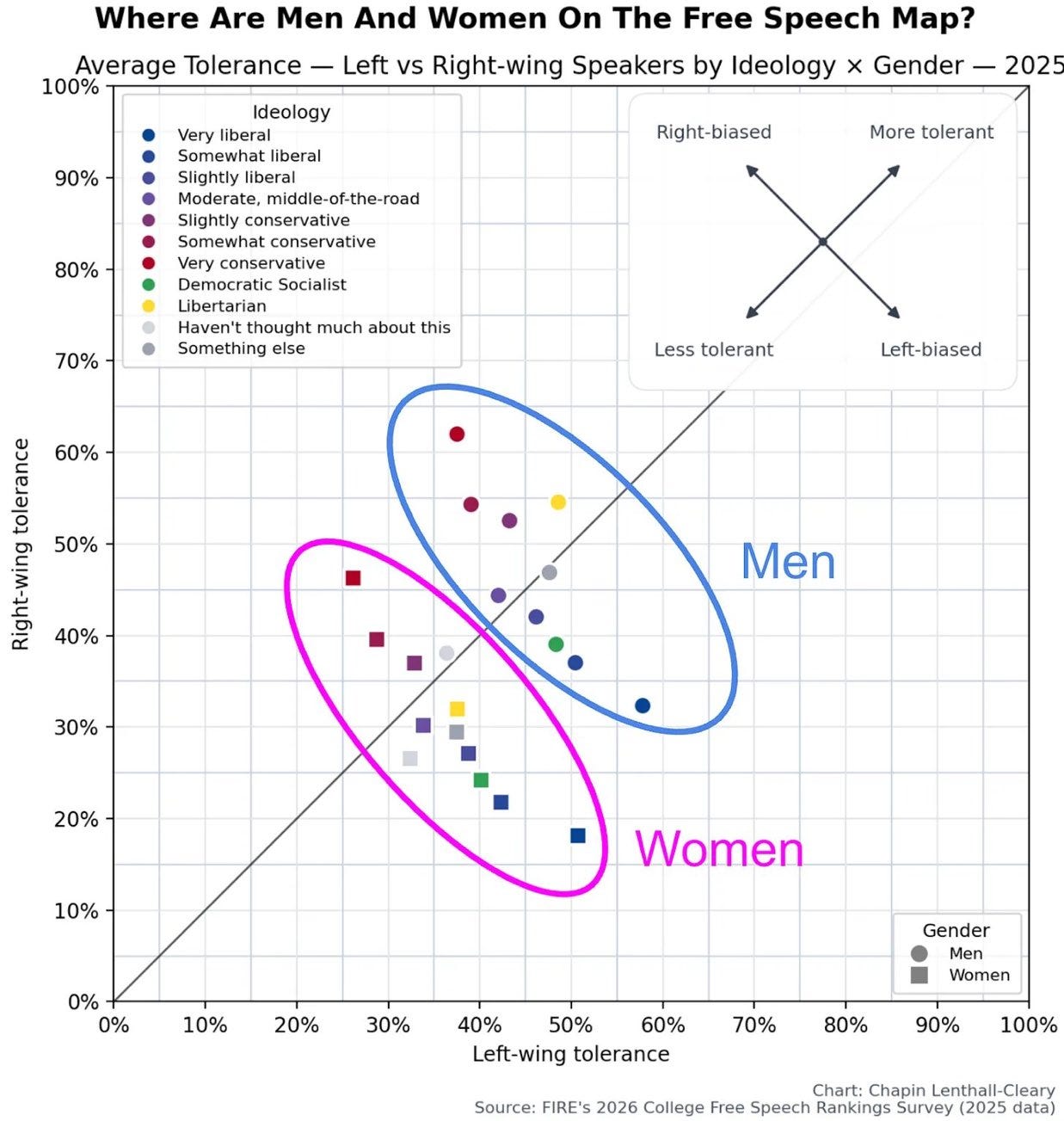
Emotions and roles
The best way to summarise all this is via two strong general tendencies: among women, emotion trumps role; among men, role trumps emotion. These patterns apply neither to all women nor all men, but it is very much the way to bet. Hence men are systematically better at teams; systematically better at running institutions; systematically better at social solidarity; at enforcing boundaries and standards; at coping with dissent and disagreement; at managing feedback.
When men ran Western institutions we got all the standard downsides of state societies: exploitation, oppression, imperialism, etc. But we also got Parliamentarianism, the Scientific Revolution, mass prosperity, and a steadily more egalitarian and expansive view of citizenship, including Parliamentarianism morphing into democracy. In our increasingly feminised institutional present, we can see all those achievements being corroded away in decaying standards and toxic conformities.
The systematic tendency of women and girls having emotion trump roles and men and boys having roles trump emotions turns up again and again. For instance, girls put themselves into Lego; they create domestic spaces where they focus on the interiors to express and explore their own emotions. Girls play inward. Boys play outward. Boys use Lego to build such things as castles for exterior-directed exploring of roles.
We can see the shift from roles trumping emotions to emotions trumping roles operating in contemporary Hollywood. The girl-boss character—who is naturally good at everything as great-because-girl—is emotions-dominating-role. This systematically replaced the hero’s journey of role-tempering-emotions.

Thus did Hollywood embark on the politics of cultural contempt, because that was the status play. For the corollary of great-because-girl was bad-because-boy.
Apart from feminism, and feminisation, you also have hormonally-challenged male feminists—aka soy boys—pandering to such self-righteous feminist narcissism in the hopes of getting laid.
The status play is to critique everything, to strike a pose of “subverting”. That means treating all previous human striving—including the past works one is allegedly adapting in various films and TV series—with implicit or explicit contempt because that inheritance has not achieved the moral splendour worthy of such grand intellects. For example, because there are too many prominent males and not enough women in past histories and stories. What it does not mean is seeing the human past—especially not one’s own society and civilisation—as a rich and complex record of achievement to be built upon.
There is no more colonial exercise than decolonising the curriculum: a self-righteous elite tells the resident majority that their cultural heritage is appalling and they need to abandon it and replace with what their moral and cognitive betters have decided. The Iron Law of “Woke” Projection in operation.
This contempt for heritage, for past strivings, is why feminised progressivism creates such literary and cultural slop. Feminist progressivism kills the wellsprings of creativity—of engaged communication with audiences and a shared culture and heritage—and replace it with the self-serving posturings of wilfully intellectually and culturally impoverished intellects.
Male striving is a very important driver of cultural change and development. Cultural commentator Camille Paglia notoriously commented that if progress had been up to women, we would still be living in grass huts. The evolutionary pressures of males producing the small and motile (i.e. “cheap”) gametes operating within a species that has the most biologically expensive children in the biosphere predictably leads to male striving, including signalling the capacity to protect and provide. A poetic way to put this is that, as human males do not create life, so they externalise the search for meaning.
The toxic pattern of censorious status games moralising disagreement went along with the standard DEI moral caste system and its mix-and-match, tick-the-box, diversity displays. Such markers of “success” fit in well with HR managerialism while leaching out creativity and audience appeal. They manifested the elite status games that had emerged with ever greater strength since the 1990s and the collapse of the Soviet Union eliminated the concerned that the working classes might need to be mobilised against an existential threat.
Such status games grade people by their beliefs, so that wrongthink has to be “confronted” and replaced (especially, working class wrongthink). Hence blaming audiences for not appreciating what their moral and cognitive betters were serving up to them. Grandstanding conformities thus trump competence and creativity. It turns out that expecting audiences to applaud your preachy, emotionally-comforting, sense of your own moral greatness is not good box office.
As the author of the above YouTube video says:
10:57 Every single one of these ran the identical play. Step one, take something people already love. Step two, decide the audience is a problem to be corrected instead of a customer to be served. Step three, put the message ahead of the movie, the lecture ahead of the laughs, the sermon ahead of the story. Step four, when the audience politely declines, don’t look in the mirror. Call them bigots, idiots, misogynists, chuds. And step five, do it all again next year with more money.
11:35 Why do they keep doing it when the graveyard is this full? Because for a certain kind of Hollywood, the applause they’re chasing isn’t yours. It’s each other’s. The box office is almost secondary to being seen making the brave choice at the party. They would genuinely rather lose $300 million and be praised by the right people than make a movie you’d actually love and be called simple for it. That’s not a business strategy. That’s a religion.
And a toxic elite status game. Feminisation is not the only thing going on, but it is a big part of it. As Anuradha Pandey puts it:
Women’s resistance to sharpening our ideas through debate is a root cause of our political malaise. Longtime readers know that theories from women’s studies departments are the foundation of what we call ‘wokeness’ today, and women are the primary enforcers of the identitarian leftist ideologies that have replaced classical liberalism among the educated class. And these irrational beliefs about sacred victims and the holiness of identity are born in exactly the social context I describe: spaces unable to tolerate debate and rational exchange, ruled by status games and emotional vulnerability theater.
A sense of identity—and shared status games—based on affirmed beliefs that moralise disagreement, that are organised through cognitive framings that curate one’s receipt and use of information, create powerfully motivating blocks to admitting getting anything wrong. Updating one’s priors, in a Bayesian or any other sense, is very much not a thing.
From the grotesque refusal to enforce standards; the ostentatious DEI moral conformism; and the utter failure to admit wrongness or take responsibility, the tragic Jason Arday debacle at the University of Cambridge is a horrible distillation of all these trends in institutional dysfunction. Institutions that used to be very capable of running themselves clearly no longer are.
Yes, we are biological beings
Societies can change and develop in all sorts of ways. Nevertheless, everything social emerges from the biological and we remain biological beings, hence the various ways we are a dimorphic species, including being a cognitively dimorphic species. Everything social is mediated by the genetic, just as everything genetic in humans is mediated by the social.
Fashions in indignation change: the facts stay the same.
Robin Fox, Kinship & Marriage: An Anthropological Perspective, Cambridge University Press [1967] 1983, p.5.
Having increasingly female-dominated public organisations and institutions is an unparalleled social experiment. There is no reason to think that it will proceed smoothly and without any problems. On the contrary, the presumption should be the other way. As psychologist Roy Baumeister puts it:
If our society does succeed in eliminating both the privileges and the obligations of manhood, it will be embarking on a remarkable social experiment. Possibly it will work out fine. But don’t bet anything you can’t afford to lose.
Roy F. Baumeister, Is There Anything Good About Men? How Cultures Flourish By Exploiting Men, Oxford University Press, 2010, loc 3300.
In a situation where female tone-policing and moralised aggression sufficiently dominates discourse that, if you criticise men it is feminism, and if you criticise women it is misogyny—so that bad or dysfunctional female-typical behaviour cannot be identified, called out, and discouraged—then such institutionally dysfunctional behaviour will continue, or even multiply. That is a recipe for various forms of institutional decline, even collapse.
As such collapses are like bankruptcy—they happen slowly, then all of a sudden, especially as a general pattern of increasing dysfunction across institutions can have a cascading effect—this could all end very badly.
Perhaps we should—just perhaps—talk about it? Like we have about bad male behaviour in the workplace.
References
Books
Roy F. Baumeister, Is There Anything Good About Men?: How Cultures Flourish by Exploiting Men, Oxford University Press, 2010.
Joyce F. Benenson with Henry Markovits, Warriors and Worriers: the Survival of the Sexes, Oxford University Press, 2014.
Alfred W. Crosby, Throwing Fire: Projectile Technology Through History, Cambridge University Press, 2002.
Martin Daly and Margo Wilson, The Truth about Cinderella: A Darwinian View of Parental Love, Yale University Press, 1998.
Bryan Hayden, The Power of Ritual in Prehistory: Secret Societies and the Origins of Social Complexity, Cambridge University Press, [2018] 2020.
Heather Heying and Bret Weinstein, A Hunter-Gatherer’s Guide to the 21st Century: Evolution and the Challenges of Modern Life, Swift, 2021.
Philip Jenkins, The Next Christendom: The Coming of Global Christianity, Oxford University Press, [2002] 2003.
Garett Jones, The Culture Transplant: How Migrants Make the Economies They Move To a Lot Like the Ones They Left, Stanford University Press, 2023.
Robert L. Kelly, The Lifeways of Hunter-Gatherers: The Foraging Spectrum, Cambridge University Press, [1995] 2013.
William H. McNeill, Keeping Together in Time: Dance and Drill in Human History, Harvard University Press, 1996.
Jordan Peterson, Maps of Meaning: The Architecture of Belief, Routledge, 1999.
Kenneth M Pollack, Armies of Sand: The Past, Present, and Future of Arab Military Effectiveness, Oxford University Press, 2019.
Yossef Rapoport, Becoming Arab: The Formation of Arab Identity in the Medieval Middle East, Princeton University Press, 2025.
Christian Rudder, Dataclysm: Who We Are (When We Think No One’s Looking), Fourth Estate, 2014.
Erwin Schrödinger, What Is Life? The Physical Aspect of the Living Cell with Mind And Matter & Autobiographical Sketches, Cambridge University Press, [1944, 1958, 1992] 2013.
James C. Scott, The Art of Not Being Governed: An Anarchist History of Upland Southeast Asia, University of Yale Press, 2009.
Kevin Simler and Robin Hanson, The Elephant in the Brain: Hidden Motives in Everyday Life, Oxford University Press, 2018.
Will Storr, The Status Game: On Social Position And How We Use It, HarperCollins, 2022.
Robert Trivers, The Folly of Fools: The Logic of Deceit and Self-Deception in Human Life, Basic Books, [2011], 2013.
Articles, essays, blogposts, etc
P. W. Anderson, ‘More is Different,’ Science, New Series, Vol. 177, No. 4047. (Aug. 4, 1972), 393-396. https://cse-robotics.engr.tamu.edu/dshell/cs689/papers/anderson72more_is_different.pdf
Menelaos Apostolou, ‘Sexual selection under parental choice: the role of parents in the evolution of human mating,’ Evolution and Human Behavior, 28 (2007) 403–409. https://www.researchgate.net/publication/237929517_Sexual_Selection_Under_Parental_Choice_The_Role_of_Parents_in_the_Evolution_of_Human_Mating
Joyce F. Benenson, Henry Markovits, Caitlin Fitzgerald, Diana Geoffroy, Julianne Flemming, Sonya M. Kahlenberg and Richard W. Wrangham, ‘Males’ Greater Tolerance of Same-Sex Peers,’ Psychological Science 2009 20: 184-190. https://www.jstor.org/stable/40065052
Paul M. Bingham, ‘Human Uniqueness: A General Theory,’ The Quarterly Review of Biology, Vol. 74, No. 2 (Jun., 1999), 133-169. https://www.academia.edu/83860282/Human_Uniqueness_A_General_Theory
Paul M. Bingham, ‘Human evolution and human history: A complete theory,’ Evolutionary Anthropology: Issues, News, and Reviews, (2000) 9: 248-257. https://www.academia.edu/83860856/Human_evolution_and_human_history_A_complete_theory
Christopher Boehm, ‘Egalitarian Behavior and Reverse Dominance Hierarchy,’ Current Anthropology, Vol. 34, No.3. (Jun., 1993), 227-254 (with Comments by Harold B. Barclay; Robert Knox Dentan; Marie-Claude Dupre; Jonathan D. Hill; Susan Kent; Bruce M. Knauft; Keith F. Otterbein; Steve Rayner and Reply by Christopher Boehm). https://lust-for-life.org/Lust-For-Life/_Textual/ChristopherBoehm_EgalitarianBehaviorAndReverseDominanceHierarchy_1993_29pp/ChristopherBoehm_EgalitarianBehaviorAndReverseDominanceHierarchy_1993_29pp.pdf
Barry Bogin, Jared Bragg, Christopher Kuzawa, ‘Humans are not cooperative breeders but practice biocultural reproduction,’ Annals of Human Biology, 2014 Jul-Aug; 41(4): 368-80. https://www.researchgate.net/publication/263130566_Humans_are_not_cooperative_breeders_but_practice_biocultural_reproduction
Judith K. Brown, ‘A Note on the Division of Labor by Sex,’ American Anthropologist, Vol.72, Issue 5, October 1970, 1073-1078. https://anthrosource.onlinelibrary.wiley.com/doi/10.1525/aa.1970.72.5.02a00070
William Buckner, ‘On secret cults and male dominance,’ Traditions of Conflict blog, January 31, 2018. https://traditionsofconflict.com/blog/2018/1/31/on-secret-cults-and-male-dominance
William Buckner, ‘Where are the matriarchies?’ Traditions of Conflict blog, March 18, 2018. https://traditionsofconflict.com/blog/2018/3/17/where-are-the-matriarchies
Michael L. Burton, Lilyan A. Brudner, and Douglas R. White, ‘A model of the sexual division of labor,’ American Ethnologist, (1977) 4: 227-252. https://www.researchgate.net/publication/227823427_A_Model_of_the_Sexual_Division_of_Labor
R. Calsbeek, ‘Ecological rules for global species distribution also predict performance variation in Ironman triathletes,’ PLoS ONE, 2023, 18(5): e0283282. https://journals.plos.org/plosone/article?id=10.1371/journal.pone.0283282
Alice H. Eagly, Judith A. Hall, ‘The kernel of truth in gender stereotypes: Consider the avocado, not the apple,’ Journal of Experimental Social Psychology, Volume 118, 2025, 104713. https://www.sciencedirect.com/science/article/abs/pii/S0022103124001264
O¨rjan Falk, Ma¨rta Wallinius, Sebastian Lundstro¨m, Thomas Frisell, Henrik Anckarsa¨ter, No´ra Kerekes, ‘The 1% of the population accountable for 63% of all violent crime convictions,’ Social Psychiatry & Psychiatric Epidemiology, 2014, 49, 559–571. https://link.springer.com/content/pdf/10.1007/s00127-013-0783-y.pdf
Martin Fieder & Suzanne Huber, ‘Falling fertility on the left as key driver of US birth decline,’ Scientific Reports, 16, 24003 (2026). https://www.nature.com/articles/s41598-026-57582-3
Harry Frankfurt, ‘On Bullshit,’ Raritan Quarterly Review, Fall 1986, Vol.6, No.2. https://raritanquarterly.rutgers.edu/issue-index/all-volumes-issues/volume-06/volume-06-number-2
Jo Freeman, ‘Trashing: The Dark Side of Sisterhood,’ Ms magazine, April 1976, pp. 49-51, 92-98. https://www.jofreeman.com/joreen/trashing.htm
Chris D. Frith, ‘The role of metacognition in human social interactions,’ Philosophical Transactions of the Royal Society B, 2012, 367, 2213–2223. https://pmc.ncbi.nlm.nih.gov/articles/PMC3385688/
Zachary H. Garfield, Kristen L. Syme, Edward H. Hagen, ‘Universal and variable leadership dimensions across human societies,’ Evolution and Human Behavior, Volume 41, Issue 5, 2020, 397-414. https://tinyurl.com/muykzzpb
David C Geary, Jennifer Byrd-Craven, Mary K Hoard, Jacob Vigil, Chattavee Numtee, ‘Evolution and development of boys’ social behavior,’ Developmental Review, Volume 23, Issue 4, 2003, 444-470. https://citeseerx.ist.psu.edu/document?repid=rep1&type=pdf&doi=453100fc9af781a989a5bedb4eb8f1a298435a07
Herbert Gintis, Carel van Schaik, and Christopher Boehm, ‘Zoon Politikon: The Evolutionary Origins of Human Political Systems’, Current Anthropology, Volume 56, Number 3, June 2015, 327-353. https://pubmed.ncbi.nlm.nih.gov/29581024/
Mark Granovetter, ‘The Strength of Weak Ties: A Network Theory Revisited,’ Sociological Theory, Vol.1, 1983, 201-233. https://www.csc2.ncsu.edu/faculty/mpsingh/local/Social/f15/wrap/readings/Granovetter-revisited.pdf
Kim Hill, Michael Barton, and A. Magdalena Hurtado, ‘The Emergence of Human Uniqueness: Characters Underlying Behavioral Modernity,’ Evolutionary Anthropology, 2009, 18:187–200. https://tinyurl.com/4xp4csdk
Erik P. Hoel, Larissa Albantakis, and Giulio Tononi, ‘Quantifying causal emergence shows that macro can beat micro,’ PNAS, December 3, 2013, vol. 110, no. 49, 19790–19795. https://www.pnas.org/doi/10.1073/pnas.1314922110
Meng Hu & Emil O. W. Kirkegaard & John Fuerst, ‘Income and Education Disparities Track Genetic Ancestry,’ OpenPsych. (2023) 10.26775/OP.2023.09.11. https://www.researchgate.net/publication/373840894_Income_and_Education_Disparities_Track_Genetic_Ancestry
Emily Hurren, Carleen Thompson, Brian Jenkins, April Chrzanowski, Troy Allard, Anna Stewart, ‘Who are the Perpetrators of Child Maltreatment?,’ Report to the Criminology Research Advisory Council Grant: CRG 18/13-14, May 2018. https://www.aic.gov.au/sites/default/files/2020-05/18-1314-FinalReport.pdf
Ian Janssen, Steven B. Heymsfield, ZiMian Wang, and Robert Ross, ‘Skeletal muscle mass and distribution in 468 men and women aged 18–88 yr,’ Journal of Applied Physiology, 2000 89:1, 81-88. https://www.researchgate.net/publication/12415379_Skeletal_muscle_mass_and_distribution_in_468_men_and_women_aged_18-88_yr
Rachel Jewkes, Emma Fulu, Tim Roselli, Claudia Garcia-Moreno, ‘Prevalence of and factors associated with non-partner rape perpetration: findings from the UN Multi-country Crosssectional Study on Men and Violence in Asia and the Pacific,’ Lancet Global Health, Vol.1, October 2013, e208-e218. https://tinyurl.com/3amv4ds6
Ada Johansson, Pekka Santtila, Nicole Harlaar, Bettina von der Pahlen, Katarina Witting, Monica Algars, Katarina Alanko, Patrick Jern, Markus Varjonen, and N. Kenneth Sandnabba, ‘Genetic Effects on Male Sexual Coercion,’ Aggressive Behavior, 2008 Volume 34, 190–202. https://www.researchgate.net/publication/6011396_Genetic_effects_on_male_sexual_coercion
Tim Kaiser, Marco Del Giudice, Tom Booth, ‘Global sex differences in personality: Replication with an open online dataset,’ Journal of Personality, 2020, 88, 415–429. https://www.researchgate.net/publication/334279951_Global_Sex_Differences_in_Personality_Replication_with_an_Open_Online_Dataset
Hillard Kaplan, Kim Hill, A. Magdalena Hurtado, and Jane Lancaster, ‘The embodied capital theory of human evolution,’ in Peter T. Ellison (ed.) Reproductive ecology and human evolution, De Gruyter, (2001), 293-317. https://www.unm.edu/~jlancas/EmbCapTheoryHumEvo2001.pdf
Hillard Kaplan, Kim Hill, Jane Lancaster, A. Magdalena Hurtado, ‘A theory of human life history evolution: Diet, intelligence, and longevity,’ Evolutionary Anthropology, August 2000, Vol.9, Iss.4, 156-185. https://www.unm.edu/~hkaplan/KaplanHillLancasterHurtado_2000_LHEvolution.pdf
Hillard Kaplan, Jane Lancaster & Arthur Robson, ‘Embodied Capital and the Evolutionary Economics of the Human Life Span’, in Carey, James R. and Shripad Tuljapurkar (eds.), Life Span: Evolutionary, Ecological, and Demographic Perspectives, Supplement to Population and Development Review, vol. 29, 2003. New York: Population Council, 152-182. https://www.unm.edu/~jlancas/EmbCapTheoryHumEvo2001.pdf
Monika Karmin, et al., ‘A recent bottleneck of Y chromosome diversity coincides with a global change in culture,’ Genome Resources, 2015 Apr;25(4):459-66. https://pmc.ncbi.nlm.nih.gov/articles/PMC4381518/
Ann Krispenz, Alex Bertrams, ‘Understanding left-wing authoritarianism: Relations to the dark personality traits, altruism, and social justice commitment,’ Current Psychology, 20 March 2023. https://papers.ssrn.com/sol3/papers.cfm?abstract_id=4204827
Michael P. Lombardo, Robert O. Deaner, ‘Born to Throw: The Ecological Causes that Shaped the Evolution of Throwing In Humans,’ The Quarterly Review of Biology, March 2018 Vol. 93, No. 1, 1-16. https://www.researchgate.net/publication/323411478_Born_to_Throw_The_Ecological_Causes_that_Shaped_the_Evolution_of_Throwing_In_Humans
C.F. Martin, R. Bhui, P. Bossaerts, T. Matsuzawa, & C. Camerer, ‘Chimpanzee choice rates in competitive games match equilibrium game theory predictions,’ Scientific Reports, 2014, 4, 5182. https://www.researchgate.net/publication/262885591_Chimpanzee_choice_rates_in_competitive_games_match_equilibrium_game_theory_predictions
A.E. Miller, J.D. MacDougall, M.A. Tarnopolsky, D.G. Sale, ‘Gender differences in strength and muscle fiber characteristics,’ European Journal of Applied Physiology and Occupational Physiology, 1993; 66(3): 254-62. https://macsphere.mcmaster.ca/bitstream/11375/22586/1/miller_andrea_1990Dec_masters.pdf.pdf
Nathan Nunn, ‘Culture And The Historical Process,’ NBER Working Paper 17869, February 2012. http://www.nber.org/papers/w17869
C. O’Madagain, M. Tomasello, ‘Shared intentionality, reason-giving and the evolution of human culture,’ Philosophical Transactions of the Royal Society B, 2021, 377: 20200320. https://www.researchgate.net/publication/357000359_Shared_intentionality_reason-giving_and_the_evolution_of_human_culture
M.B, Petersen, M. Osmundsen, & J. Tooby, ‘The Evolutionary Psychology of Conflict and the Functions of Falsehood,’ in (David C. Barker and Elizabeth Suhay eds.) The Politics of Truth in Polarized America: Concepts, Causes and Correctives, Oxford University Press, 2020. https://www.cep.ucsb.edu/wp-content/uploads/2023/06/Petersen-et-al-Evolutionary-Psychology-of-Conflict-and-Functions-of-Falsehood-REVISED-20082020-1.pdf
Ian E. Phillips, ‘Big Five Personality Traits and Political Orientation: An Inquiry into Political Beliefs,’ The Downtown Review, Vol. 7, Iss. 2 (2021). https://www.annualreviews.org/content/journals/10.1146/annurev-polisci-051010-111659
Peter J. Richerson, and Robert Boyd, ‘The evolution of human ultra-sociality,’ in Irenäus Eibl-Eibesfeldt and Frank K. Salter (eds.), Indoctrinability, ideology, and warfare: Evolutionary perspectives, Berghahn, 1998, 71-95. https://www.researchgate.net/publication/2314563_The_Evolution_of_Human_Ultra-sociality
Harold Robertson, ‘Complex Systems Won’t Survive the Competence Crisis,’ Palladium: Governance Futurism, June 1, 2023. https://www.palladiummag.com/2023/06/01/complex-systems-wont-survive-the-competence-crisis/
Laurie A. Rudman and Stephanie A. Goodwin, ‘Gender differences in automatic in-group bias: why do women like women more than men like men?,’ Jornal of Personality and Social Psychology, 2004 Oct;87(4):494-509. https://rutgerssocialcognitionlab.weebly.com/uploads/1/3/9/7/13979590/rudmangoodwin2004jpsp.pdf
R. Schacht and K.L. Kramer, ‘Are We Monogamous? A Review of the Evolution of Pair-Bonding in Humans and Its Contemporary Variation Cross-Culturally,’ Frontiers in Ecology and Evolution, 2019, 7:230. https://www.researchgate.net/publication/334518077_Are_We_Monogamous_A_Review_of_the_Evolution_of_Pair-Bonding_in_Humans_and_Its_Contemporary_Variation_Cross-Culturally
David P. Schmitt, Martin Voracek, Anu Realo, Ju¨ri Allik, ‘Why Can’t a Man Be More Like a Woman? Sex Differences in Big Five Personality Traits Across 55 Cultures,’ Journal of Personality and Social Psychology, 2008, Vol. 94, No. 1, 168–182. https://www.researchgate.net/publication/5671655_Why_Can’t_a_Man_Be_More_Like_a_Woman_Sex_Differences_in_Big_Five_Personality_Traits_Across_55_Cultures
Daniel Seligson and Anne E. C. McCants, ‘Polygamy, the Commodification of Women, and Underdevelopment,’ Social Science History (2021), 46(1):1-34. https://www.researchgate.net/publication/354584406_Polygamy_the_Commodification_of_Women_and_Underdevelopment
Kevin Simmler, Social Status: Down the Rabbit Hole (13 October 2015); Social Status: Further Thoughts (13 October 2015); and Minimum Viable Superorganism (11 February 2016). https://meltingasphalt.com/social-status-down-the-rabbit-hole/
Jordan E. Theriault, Liane Young, Lisa Feldman Barrett, ‘The sense of should: A biologically-based framework for modeling social pressure’, Physics of Life Reviews, Volume 36, March 2021, 100-136. https://www.researchgate.net/publication/323197652_The_Gender-Equality_Paradox_in_Science_Technology_Engineering_and_Mathematics_Education
Jessica C. Thompson, Susana Carvalho, Curtis W. Marean, and Zeresenay Alemseged, ‘Origins of the Human Predatory Pattern: The Transition to Large-Animal Exploitation by Early Hominins,’ Current Anthropology, Volume 60, Number 1, February 2019. https://ora.ox.ac.uk/objects/uuid:da2850f1-f415-4130-9d35-8ed23fdd6b89/files/r2b88qc185
John Tooby and Leda Cosmides, ‘The Psychological Foundations of Culture,’ in The Adapted Mind: Evolutionary psychology and the generation of culture, J. Barkow, L. Cosmides, J. Tooby (eds), Oxford University Press, 1992, 19-136. https://www.researchgate.net/publication/243708265_The_Psychological_Foundations_of_Culture
Michael Tomasello, ‘The ultra-social animal,’ European Journal of Social Psychology, 2014, 44, 187–194. https://www.researchgate.net/publication/261567999_The_ultra-social_animal
Robert Trivers, ‘Parental investment and sexual selection,’ in B. Campbell, Sexual Selection and the Descent of Man, Aldine de Gruyter, 1972, 136–179. https://www.researchgate.net/publication/288653750_Parental_Investment_and_Sexual_Selection
Harvey Whitehouse, Pieter François, Patrick E. Savage, Daniel Hoyer, Kevin C. Feeney, Enrico Cioni, Rosalind Purcell, Jennifer Larson, John Baines, Barend ter Haar, Alan Covey & Peter Turchin, ‘Testing the Big Gods hypothesis with global historical data: a review and “retake,”’ Religion, Brain & Behavior, (2022) 13(2), 124–166. https://www.tandfonline.com/doi/full/10.1080/2153599X.2022.2074085
Polly Wiessner, ‘Hunting, healing, and hxaro exchange: A long-term perspective on !Kung (Ju/’hoansi) large-game hunting,’ Evolution and Human Behavior, 23 (2002) 407–436. https://www.sciencedirect.com/science/article/abs/pii/S109051380200096X
Richard W. Wrangham, ‘Two types of aggression in human evolution,’ PNAS January 9, 2018, Vol.115, No.2, 245–253. https://www.pnas.org/doi/abs/10.1073/pnas.1713611115
Richard W. Wrangham, ‘Targeted conspiratorial killing, human self-domestication and the evolution of groupishness,’ Evolutionary Human Sciences, 2021 Apr 6;3:e26. https://pmc.ncbi.nlm.nih.gov/articles/PMC10427284/
“brain-rot pseudo-history.” A very useful phrase! This seems to me (admittedly from way outside academia) to precisely characterize what is being and has been taught in schools for decades in what passes for objective American History. I can see it in some of my own schooling from back in the 60s, but a lot more in that of my children and now, my grandchildren.
The females in the WNBA earn most of their revenues on the backs of the males in the NBA. It’s interesting to see how much society can influence social behavior.
If you are located outside of the U.S., then you are forgiven for never having heard of the WNBA. Most people here have never watched a single game, ever.